
AI coding companies are bleeding money. Windsurf and Cursor reportedly have negative gross margins, and The Information reports that Replit, StackBlitz (Bolt), and Lovable are all struggling with poor unit economics, even with some creative accounting to improve their numbers.
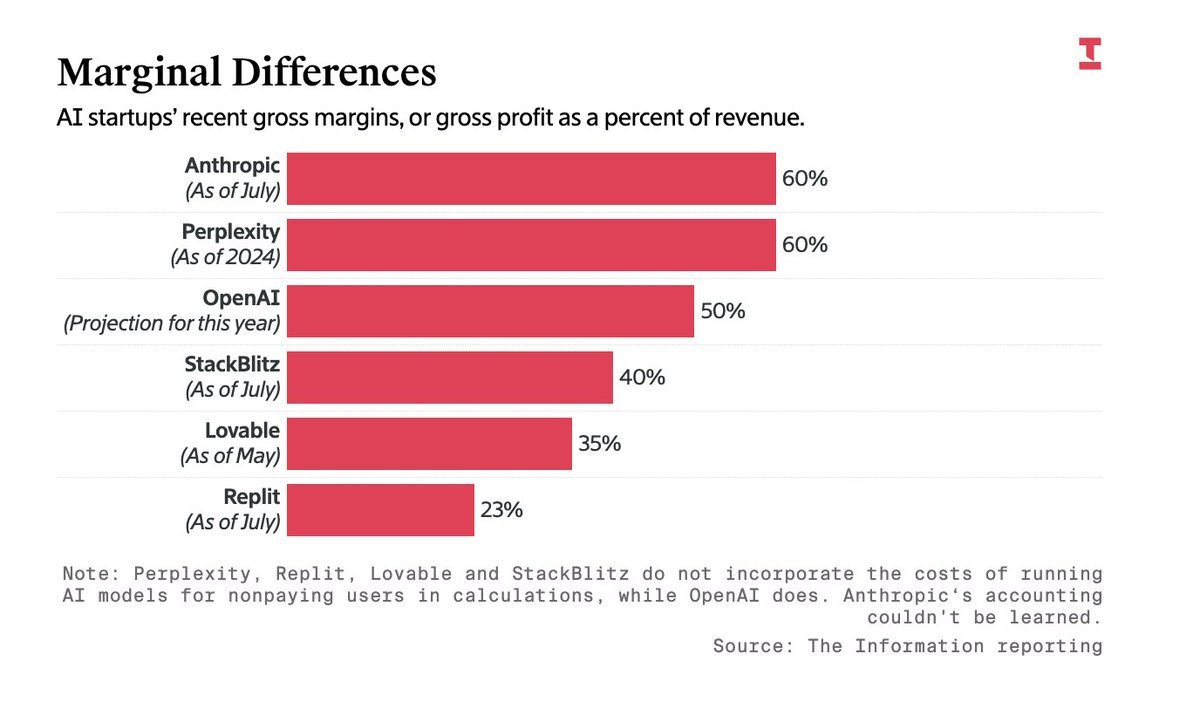
This is particularly surprising to many, as these are essentially software companies. Public software companies have gross margins of 78% and operating margins of ~20%. Why don’t these businesses have high margins, too?
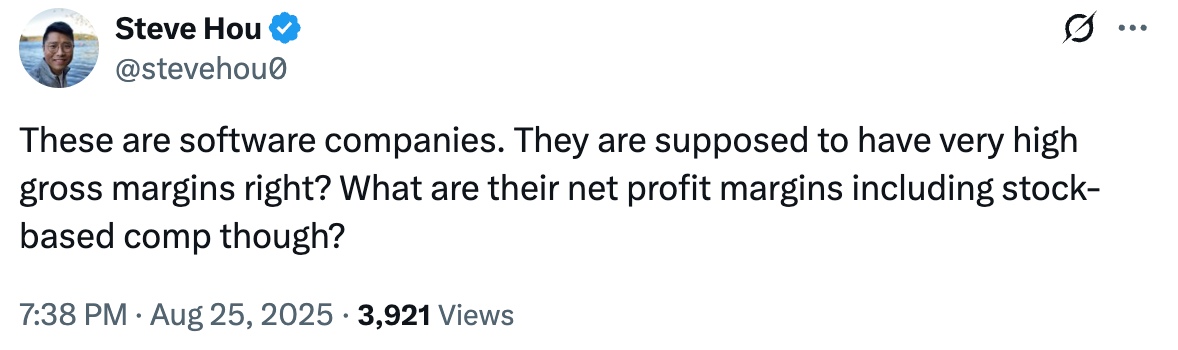
The instinct is to blame higher compute costs. And it’s true that COGS are structurally higher for AI apps because inference compute costs way more than your average SaaS product’s hosting costs. Simply servicing your free users is expensive.
But compute costs only explain why costs are higher, not necessarily why margins are lower. If a bar sells a cocktail with premium liquor, it costs them more to make it. But they also will charge their customers more, and customers will pay more because they get more value from it (these are usually higher margin products!). Why aren’t AI companies charging more for their products to cover their compute costs?
I think the answer is pretty simple: too much competition! In the case of coding, Cursor, Cognition, and Replit have collectively raised billions of dollars, while model builder competitors like OpenAI and Anthropic have raised tens of billions of dollars as well. No one is interested in raising prices if your competitors aren’t and you have money to burn.1
It’s hard, therefore, to take too much away from these companies’ negative margins today. Any “good” business can have its margins ruined in the short term by intense competition.2
The real question is whether these businesses will be successful when prices inevitably rise. One useful framing comes from investor Chris Paik: are the customers for these companies there for the “subsidy” or the “product”? Plenty of examples come to mind where customers were really there for the subsidy, whether it was MoviePass, Bird, 15-minute grocery delivery, WeWork, or fintechs lending at artificially low rates compared to incumbents.
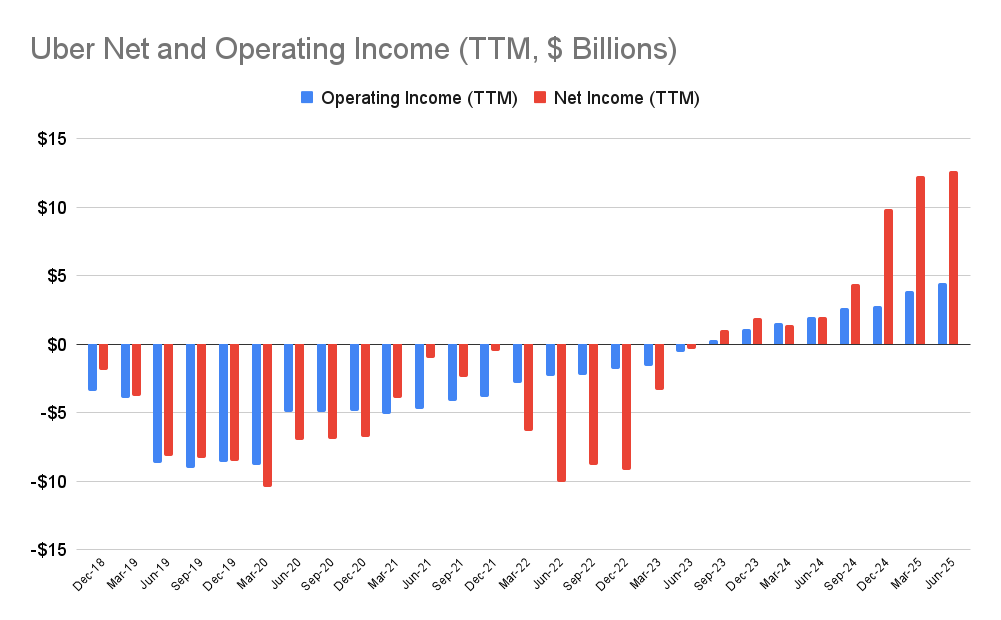
But in other cases, the product is valuable, but the sector as a whole is seeing poor margins due to intense competition. The canonical example of this is the rideshare market in the 2010s. Rideshare marketplaces, like most marketplaces, are great businesses! You take a cut of a transaction and benefit from strong network effects.
However, every single rideshare company had bad margins in the mid-2010s due to increased competition. Once the competition lessened and prices rose, ridesharing became a profitable business, with Uber generating billions of dollars in profit over the last year. This didn’t mean that every rideshare company was a good investment, but investors were generally proven right. Customer demand has remained high, even with higher prices, and it has become a winner-take-all/most market, so subsidies along the way were a good strategy.
I think AI coding companies are squarely in the latter category, where customers are mostly there for the “product”, not the “subsidy.”
Why? Consider Cursor. Its poor margins are reportedly being driven by a small portion of individual developers who are using excessive compute on fixed-priced plans (e.g., $20 per month). That is a pretty straightforward problem to solve: you force customers to consumption-based pricing if they reach certain usage limits. Cursor is already doing this for their enterprise pricing (with reportedly better margins as expected), and there’s no reason this can’t be implemented across the board. They could also follow Anthropic’s lead, which announced rate limits for Claude Code and auto switching from Opus to Sonnet (a worse model) at certain usage thresholds over the summer. We are still so early in the pricing models for these companies, and I’m not worried about their ability to figure this out.
The obvious follow-up: will demand tank with higher prices? I doubt it, even if prices had to rise for everyone, which doesn’t seem necessary given the power user issue. AI is perceived as a massive productivity enhancer for coding.3 Coinbase CEO Brian Armstrong is literally firing engineers on the spot if they haven’t been using Cursor or GitHub Copilot. If Cursor Pro goes from $20 to $40 a month, do we really think software engineers are going to cut their usage all that much? I just don’t see it.
Importantly, there are also no higher-priced alternatives that software engineers can use if AI coding companies raise prices. When MoviePass raised prices, its value proposition disappeared compared to incumbent competitors like AMC. But when the rideshare companies raised prices, there wasn’t some incumbent company that suddenly made more sense to use.4 AI coding companies are in the latter camp, and I expect most users to largely shrug off higher prices whenever they come.5
So the AI coding sector isn’t going anywhere. Even if token costs don’t drop at all, there is more than enough value being driven by these models to justify the higher prices we will inevitably see. This isn’t MoviePass or WeWork 2.0.
However, whether these companies ultimately become “great” businesses with SaaS-like margins or merely “good” businesses with average margins is a separate question. The answer can’t be found by analyzing current (artificially low) margins. Instead, it comes from evaluating whether these companies can develop long-term moats.
As Yoni Rechtman writes, high margins come from pricing power. The challenge for AI coding companies is that many of the characteristics that gave SaaS companies pricing power are less clear for them. Switching costs are low (at least for now), and no one has a significant technological advantage. Companies like Cursor do have a data advantage, as evidenced by model companies trying to buy their data, but it’s not clear how important this is long-term. And unlike rideshare, where network effects were strong enough to make investing billions to get to scale quickly worthwhile, the benefits from scale here are not as strong.
The other challenge that can eat into AI coding margins is that the COGS suppliers for many of these companies (OpenAI, Anthropic) are also their competitors. OpenAI and Anthropic can sell their tokens at cost in their products (Codex, Claude Code), whereas any company that uses them for their models will need to charge a premium to fund their business. Companies like Cursor and Cognition need to add sufficient value over the base models to justify the premium they charge. They also need to ensure that the base model layer remains somewhat commoditized. As Paik has noted, wrapper strategies don’t work if you are wrapping around a monopoly.
I’m a bit torn on this. I could see AI coding companies eventually having more SaaS-like margins if they can build out similar switching costs or workflow depth to traditional SaaS, or by leveraging data advantages to build better products. I could also see them being challenged by the model builders or never seeing the types of moats they need to justify recent valuations.
But either way, people are clearly overreacting to the short-term margin pressures these companies are facing. Short-term margins alone are not a reliable predictor of long-term business viability, especially when the entire sector is characterized by depressed margins due to intense competition. If anything, they are a much better indicator of positive investor sentiment. And today, investors are seemingly optimistic that moats will develop eventually, and the AI coding market is a big enough prize that it’s worth burning a few billion dollars along the way to win it.
We also see margins compressing for traditional SaaS companies due to compute costs. Notion has reportedly seen its gross margin decline from ~90% to ~80% due to costs associated with AI. I think competition is partly to blame here, but we are also in testing mode for many of these tools, so SaaS companies are willing to bundle them in existing products and wait for impact before starting to charge more.
Howard Marks has a famous line: “We think no asset is so bad that there's not a price at which it's attractive for purchase, and no asset is so good that it can't be overpriced.” I think you can say something similar, where no business model is so good that it can’t be made bad in the short term due to competition.
I say “perceived” because the evidence is more mixed than you’d think for coding. That said, I don’t think the market is wrong here, and the hundreds of millions of revenue Cursor has generated is not the result of tricking developers into thinking they are more productive than they actually are.
Other modes of transportation became somewhat more attractive, like taking public transit or driving yourself. However, the value from ridesharing is so significant that any substitution we’ve seen hasn’t been enough to shrink the market, which continues to grow in dollar terms.
I think you can generally argue the same for AI companies in other categories, such as AI search (Perplexity), but the argument that higher prices won’t have a significant impact is definitely strongest for coding.
Comments
Nothing yet. Say the first thing.
Sign in to join the conversation.