
During the recent centennial commemoration of the birth of Fidel, many Cuban analysts recalled Fidel’s historic October 12, 1979, address at the General Assembly of the United Nations, where Fidel spoke in his capacity as President of the Non-Aligned Movement. I focus in today’s commentary on highlights of the address, which was a report on the principles, analysis, objectives, and proposals of the Non-Aligned Movement.
The Non-Aligned Movement (NAM) is an international organization constituted by heads of state or government, dedicated to the defense of the sovereignty of the formerly colonized nations. It holds summits every three years, chaired by countries elected to serve as president of the Movement for three-year terms on a rotating basis. NAM was established in Belgrade, Yugoslavia in 1961 by twenty-three governments, including twenty-one from Africa and Asia plus Yugoslavia and Cuba; it today has 120 member states. Cuba served as President from 1979 to 1982, during which time Fidel denounced the turn of the world powers to neoliberalism; and from 2006 to 2009, when Cuba played an important role in renewing the Movement’s classic anti-colonial Third World project of the period 1961 to 1979, which remains its perspective today.
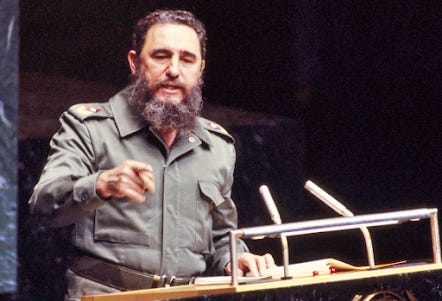
Fidel made clear at the outset of his 1979 address that he arrives to the UN not to speak in defense of Cuba but in defense of the ninety-five countries of the Non-Aligned Movement, which recently had held its Sixth Summit in Havana. The ninety-five countries, he stressed, are from every continent, representing the immense majority of humankind. Fidel declared:
We are united by the determination to defend collaboration among our countries, free national and social development, sovereignty, security, equality and free determination. We are associated in the endeavor to change the current system of international relations which are based on injustice, inequality and oppression. We act in international politics as an independent global factor.
Having met in Havana, the Non-Aligned Movement has just reaffirmed its principles and confirmed its objectives.
We the countries of the Non-Aligned Movement insist that it is necessary to eliminate the abysmal inequality that separates the developed countries from the developing countries. We are fighting for that in order to abolish the poverty, hunger, disease and illiteracy that still plague hundreds of millions of human beings. We strive for a new world order, based on justice, equity and peace, that replaces the unjust and unequal system reigning today, in which, as proclaimed in the Declaration of Havana, “wealth continues to be concentrated in the hands of a few powers whose economies, founded on pillaging, are maintained thanks to the exploitation of the workers and the transfer and pillage of natural and other resources of the peoples of Africa, Latin America, Asia and other regions throughout the world.”
…..
It is important to underline that we are coming from an independent position, one that is not connected to policies that could derive from the contradictions between great powers.
The Non-Aligned Movement, Fidel stressed, sees the elimination of imperialism, colonialism, neocolonialism, apartheid, racism, aggression, occupation, domination, and interference in the internal affairs of nations by the great powers as the necessary foundation for world peace.
With respect to the Middle East, Fidel declared that NAM analyzes the region from the perspective of the right of Palestine to establish an independent State, as already has been affirmed by the UN General Assembly. Fidel asserted:
There is no doubt that the problem of the Middle East has become one of the most worrying in contemporary times. The Sixth Summit [of the Non-Aligned Movement] examined this problem in two dimensions.
On the one hand, the Summit reaffirmed that the determination of Israel to continue its policy of aggression, expansionism and colonial settlement of the occupied territories, with the backing of the United States, constitutes a serious threat to world peace and security.
At the same time, the Summit examined the problem from the angle of the rights of the Arab countries and of the issue of Palestine. For NAM, the issue of Palestine lies at the core of the Middle Eastern problem. Both make up a comprehensive whole and cannot be solved separately.
The basis of just peace in the region commences with the total and unconditional withdrawal of Israel from all occupied Arab territories and it presupposes, for the Palestinian people, the return of all their occupied territories and the recovery of their inalienable national rights, including the right of returning to their homeland, to free determination and the establishing of an independent State in Palestine, in accordance with Resolution 3236 of the General Assembly. That implies the illegality and nullity of measures adopted by Israel in the occupied Palestinian and Arab territories, as well as their establishing colonies or settlements on Palestinian land and on the lands of other Arab territories, the immediate dismantling of which is a requirement for the solution to the problem.
As I stated in my speech at the Sixth Summit: “…we are not fanatics. The revolutionary movement has been brought up in the hatred of racial discrimination and pogroms of any kind, and from the depths of our souls, we repudiate with all our strength the ruthless persecution and genocide which, in its time, Nazism unleashed against the Jewish people. But I can find nothing more similar to that in our contemporary history than the eviction, persecution and genocide that is being carried out today against the Palestinian people by imperialism and Zionism. Stripped of their lands, driven out of their own homeland, dispersed throughout the world, they are an impressive example of abnegation and heroism, and they are the living symbol of the greatest crime of our times.” (APPLAUSE)
Can anyone be surprised then that the Non-Aligned Movement should be obliged to point out, for reasons not arising from any political prejudice but from the objective analysis of the facts, that United States policy plays a fundamental part in preventing the establishment of just and complete peace in the region, by allying itself with and backing Israel and by working to obtain partial solutions favoring Zionist aims and ensuring the fruits of Israeli aggression at the cost of the Arab peoples of Palestine and of the entire Arab nation? The facts, and only the facts, led the Movement to condemn US policies and maneuvers in the region.
In addition, Fidel maintained that the Non-Aligned Movement sees the importance of true sovereignty and political independence as the foundation to the resolution of economic problems. He declared:
At the very beginning of their analysis of world economic problems, the Heads of State or Government [of the Non-Aligned Movement] on the one hand “once again solemnly underlined the supreme importance of consolidating political independence via economic emancipation … and they reiterated that the existing international economic system went against the basic interests of developing countries, that it was profoundly unfair and incompatible with the development of non-aligned countries and other developing countries and did not contribute to the elimination of the economic and social ills afflicting those countries…”
And on the other hand, they emphasized “the historic mission that the Non-Aligned Movement ought to be undertaking: the struggle for achieving the economic and political independence of all developing countries and their peoples; to exercise full and permanent sovereignty and control over their natural resources and of every kind over their economic activities; and to promote deep-rooted restructuring by the establishment of the New Economic Order.”
They concluded with these words: “The struggle to eliminate the injustice of the existing international economic system and to establish the New International Economic Order is an integral part of the struggle of the people for political, economic, cultural and social liberation.”
However, Fidel emphasized, the modest economic goals of the developing countries are not being attained, and indeed, global inequality has increased in recent years, as a consequence of the structures of the world economy, which establish an unequal exchange between the prices of manufactured goods exported by the developed countries and the primary products exported by the developing countries. Therefore, “the first fundamental objective in our struggle lies in reducing, to the point of elimination, the unequal exchange prevailing today, which converts international trade into a profitable vehicle for the additional pillaging of our resources.”
In addition, Fidel discussed the problem of the debt of the developing countries, and he stressed that the developing countries need resources to pay their debts and at the same time undertake new investments to make the leap to development. He called upon all nations to join together to organize resources for development, under the direction and management of the United Nations. Such a project would be of benefit to all nations, and it would establish the foundation for world peace.
Fidel concluded:
The din of weapons, threatening language, and arrogance on the international scene must cease. Enough already with the illusion that the world’s problems can be solved with nuclear weapons. Bombs can kill the starving, the diseased and the ignorant but they cannot kill hunger, disease or ignorance. Nor can they kill the fair sense of rebellion of the people; and in the holocaust the rich will also die, and the rich are the ones who have the most to lose in this world. (APPLAUSE)
Let’s bid farewell to weapons and let us devote ourselves in a civilized fashion to the most exhausting problems of our era. That is the most sacred responsibility and duty of every statesman in the world. Besides, that is the indispensable premise for human survival.
§
Further considerations
During his presidency of the Non-Aligned Movement from 1979 to 1983, Fidel continued to address the conditions of the world-economy and the need for structural transformations. He met regularly with Cuban economists to analyze the theme. These efforts culminated in a book, The Economic and Social Crisis of the World: Its repercussions for the underdeveloped countries, its dismal prospects, and the need to struggle if we are to survive, which was Fidel’s report to the Seventh Summit of the Non-Aligned Movement in New Delhi in 1983. I review the book in my August 14, 2026, commentary, “Fidel speaks in the name of the colonized.”
No posts
Comments
Nothing yet. Say the first thing.
Sign in to join the conversation.