
Playback speed
×
Share post
Share post at current time
Share from 0:00
0:00
/
So guess what happens to us "unique" individuals: we're basically interchangeable, too, and therefore disposable.

I narrate key points in my post “In Our “Everything is Disposable” Economy, We’re Disposable, Too.”
When a product fails (as planned) or is rendered obsolete (as planned), it ends up in the landfill, or on rare occasions, in a legitimate recycling process. When we're rendered obsolete (as planned), there's no centralized putrid landfill where we're dumped; we're just abandoned in private cubbyholes, like the junked car under the tarp in the garage.
Or in some cases, we're "recycled" into a lower paying job or a lower-price tier. Sure, you can still "afford" healthcare "insurance" (smirk), but there's now a $5,000 deductible which you have to pay up front in cash before your "insurance" kicks in (oops, your claim was denied by our AI claims process, better luck next time), and since cash is tight you forego medical care and suffer the predictably dire consequences. Welcome to a lower-tier of "service" that you can "afford."
You lost your full-time job with benefits, no problem, there's an entire gig / delivery / rideshare economy of completely interchangeable, commoditized workers and consumers that will absorb you (The Borg will see you now.) And when you burn out, you just disappear from the digital screen, and what happens to you is your business. Welcome to a lower-tier of "employment."
In Our "Everything is Disposable" Economy, We're Disposable, Too
·
Aug 17
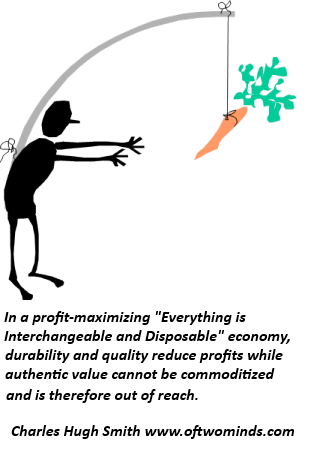
Here’s the problem in a profit-maximizing economy: durability is intrinsically less profitable than obsolescence, so to maximize profits, Everything Is Disposable, either by design (planned obsolescence, accelerated product cycles, product no longer supported, software upgrades, etc.)
Comments
Nothing yet. Say the first thing.
Sign in to join the conversation.