
The evolution of new species is built on separation. Nearly every new life form begins when some event splits one population off from the rest of its species, giving that separated population room to evolve in new and different ways. Typically, this splitting off is subtle — a river slowly changes course, a mountain range rises over the course of eons, some members of the species swim off to a new island.
But sometimes, that split is anything but subtle.
Around 5.3 million years ago, the Mediterranean basin was cut off from the Atlantic Ocean. This period is known as the Messinian Salinity Crisis — over the course of between 400,000 and 600,000 years, nearly the entire basin dried up, and what water remained was as salty as the Dead Sea is today. Animals like mice, deer, goats, salamanders, and even elephants could wander the seabed with ease.
Then, one day, the Strait of Gibraltar opened.
Researchers disagree about exactly how fast it happened, but it was fast. And violent. As geologists Daniel García-Castellanos and Paul Carling describe in a piece in The Conversation, trillions of gallons of ocean water rushed through the newly formed gap at over 70 miles per hour and 1,000 times the volume of the Amazon River. It traveled down a kilometer-high hillside and hit with such force that it carved a skyscraper-deep trough into the ground. It was a natural disaster comparable to a supervolcano erupting.
Within a little as a few months, the basin was full.
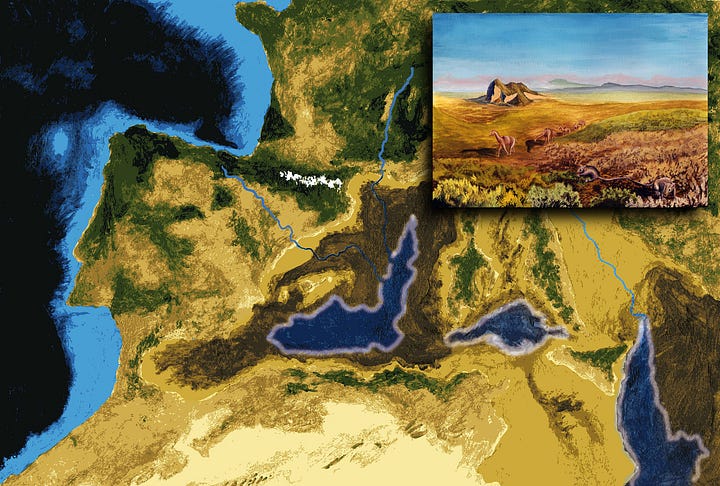
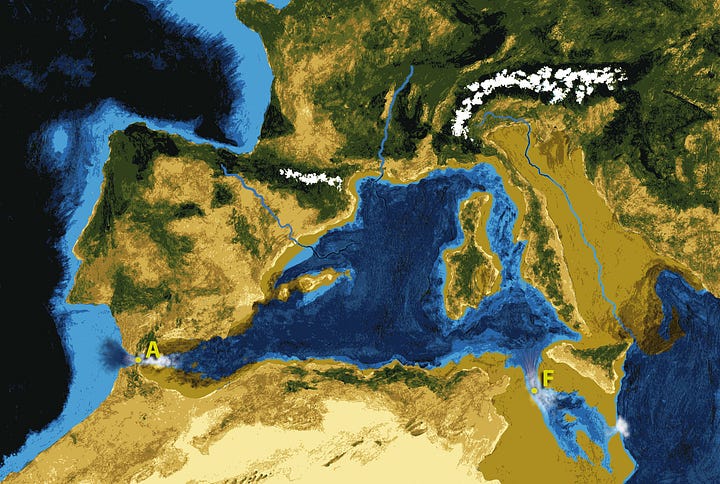
For the animals that lived in the hypersaline water, this flood was a catastrophe —around 90% of native fish species died in the flood. Surely similar disasters happened for land animals as burrows flooded, herds were swept away, and entire ecosystems were wiped off the map. But as the water levels rose, the mountains within the basin turned into islands: Sicily, Ibiza, Crete, Cyprus. On these islands, a few land animals managed to avoid the floods. Separated so dramatically from the rest of their species, these animals were free to evolve in surprising ways.
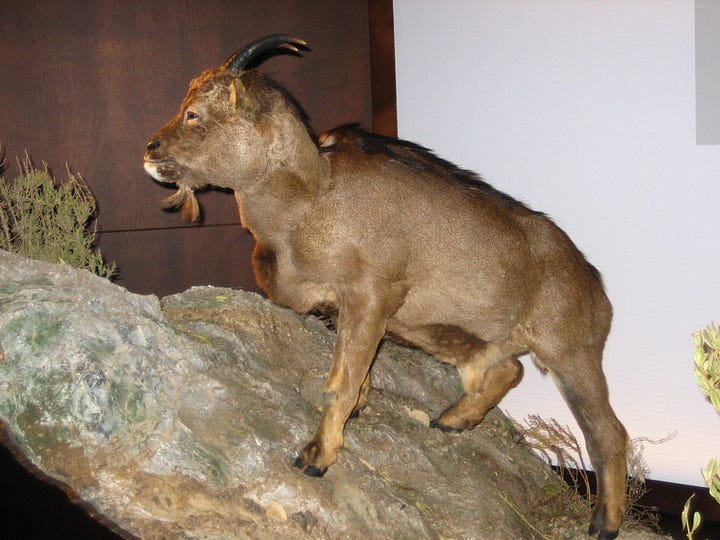
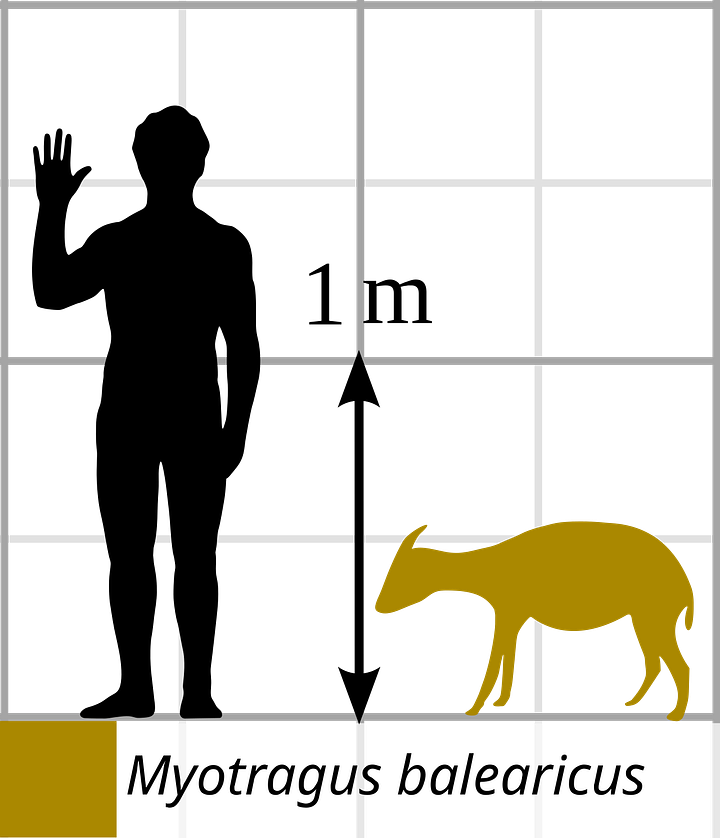
Take Myotragus balearicus, a foot-and-a-half-tall “goat-antelope” native to the Balearic Islands in the western Mediterranean. It had forward-facing eyes like a predator, poorly-developed ankles that likely gave it a wobbly gait, a diet mostly consisting of toxic Balearic boxwood, and constantly-growing teeth like a rodent.
These adaptations are all a response to the lack of predators on these islands. Without anything hunting them, there was no need for a sturdy build, sideways-facing eyes, or quick locomotion, and with food in relatively short supply on the islands, Myotragus benefited by shrinking its body, brain, and muscles to save energy.
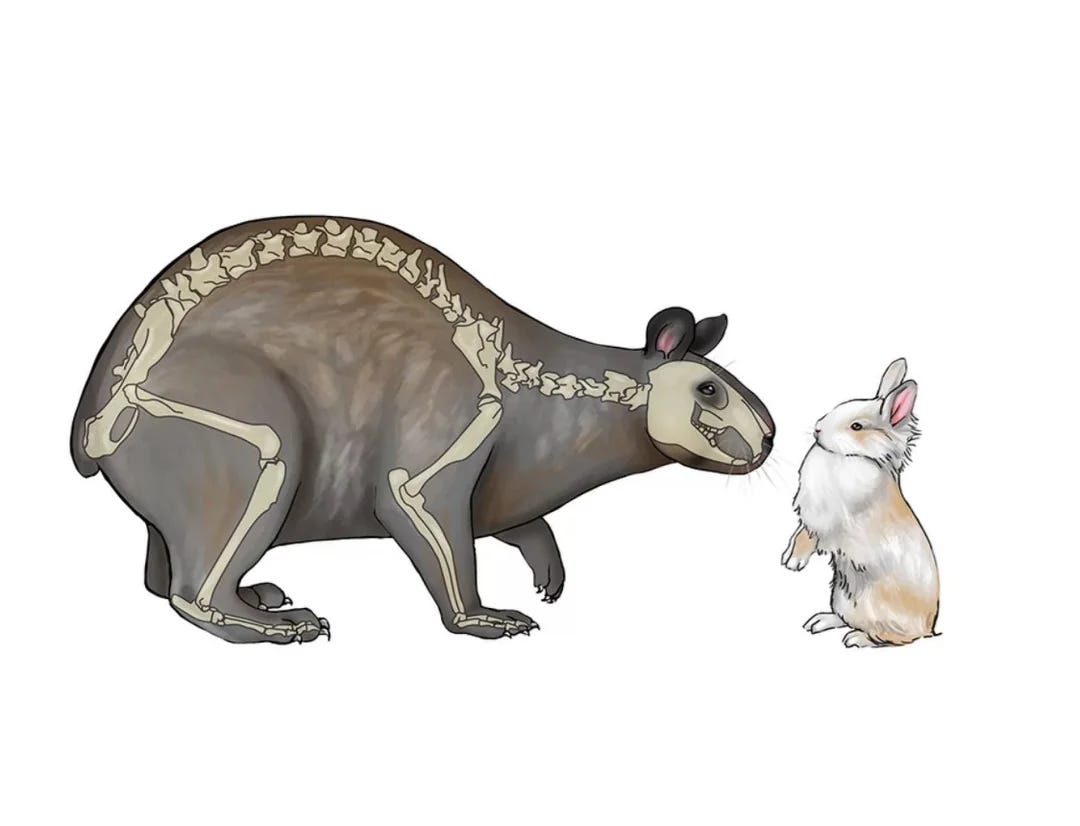
While Myotragus shrunk, other animals grew. The Balearics were also home to a group of giant dormice called Hypnomys (around double the size of mainland dormice), a giant shrew called Nesiotites (around triple the size of mainland shrews), and my personal favorite, a giant rabbit known as Nuralagus rex. Coming in at a whopping 18 pounds, N. rex was the largest rabbit to have ever lived, more than ten times larger than a wild European rabbit. Even Flemish giants, the largest rabbits that breeders have managed to create, are merely half the size of these island giants. N. rex was so big it couldn’t even hop.
These two phenomena — large animals shrinking and small animals growing — are the two hallmarks of a phenomenon known as the “Island Rule”. On islands, predation is limited, so large herbivores shrink to save energy rather than protect themselves and small herbivores grow to compete with each other rather than hide.
And if the Galapagos are the poster child for adaptive radiation, then the Mediterranean islands should be the poster child for the island rule.
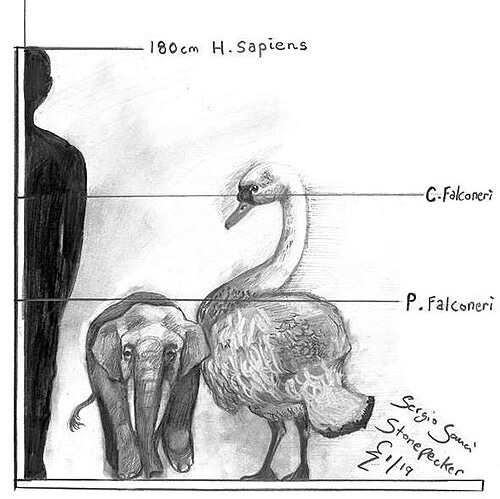
We see this same phenomenon repeated again and again. There was a dormouse on Malta that was fourteen times the size of its mainland relative and a dwarf hippopotamus on Cyprus that was a mere 4% of the size of its ancestor. Crete had a mouse that septupled in size and a 16 inch tall deer with antlers as long as its body. Most striking of all, Sicily was home to both a two-foot-long giant tortoise and a 3-foot-tall dwarf elephant.
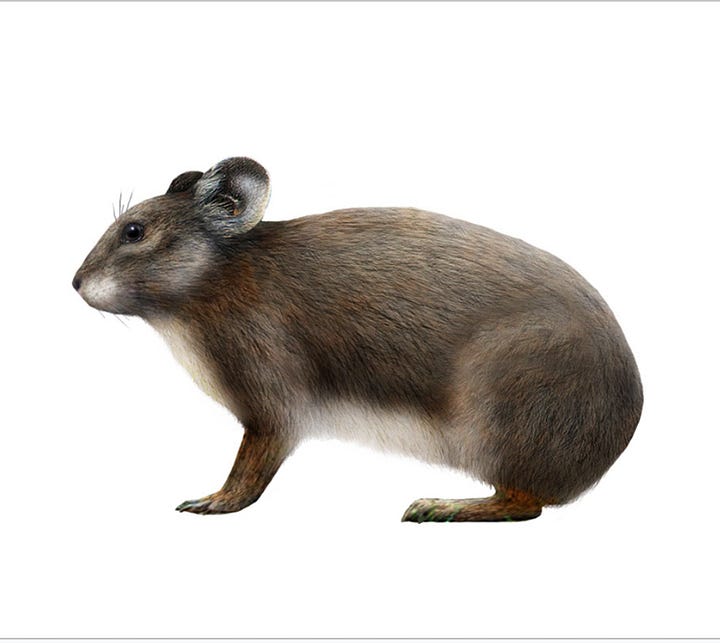
Later, subsequent waves of animal migration changed the diversity of these islands again. Tilos in modern-day Greece gained a dwarf elephant of its own, while Sicily gained an endemic wolf subspecies and a flightless swan that towered over its dwarf elephants. Sardinia and Corsica in particular developed a diverse collection of endemic animals, many of whom speed-ran the island rule — a dwarf mammoth and a dwarf deer, a large pika that was hunted by a tiny dog called the Sardinian dhole, both a giant otter and a dwarf otter, and a giant weasel-like animal related to modern-day polecats.
What happened to all of these animals?
Some of them went extinct due to climate change or the arrival of new competitors — the giant rabbit Nuralagus rex, for instance, likely went extinct when Myotragus reached its island and outcompeted it for resources. Many more went extinct when the first human settlers reached these islands. This, I would argue, isn’t really the early humans’ fault, but rather a natural consequence of a new apex predator reaching a previously untouched environment.
But a few animals held on a little longer until another wave of extinctions arrived. The tiny Mus minotaurus, or “Minotaur mouse,” of Crete and a dwarf elephant on Tilos may have gone extinct during the Bronze age, and Sardinia lost its native vole, mole, and pika when Roman forces took over the island. We don’t think of the Roman Empire as a biologically destructive force in the same way the British or American Empires have been, but something about centralized states seems to spell doom for the animals on their frontiers. More recently, the Sicilian wolf held on well into the modern age until it was finally killed by farmers in the 20th century.
I’ve been thinking about these animals a lot lately because they stand in stark contrast to an assumption that, I think, a lot of us hold: that Europe is biologically boring.
On some level, it’s true. Europe has less biodiversity than any continent besides Antarctica, and certainly has the fewest large intact natural areas — no Amazon, no Outback, no Congo Rainforest. Nearly every cool animal found in it is also found in Africa or Asia.
But this perceived “boringness” is partially due to how much humans have changed the continent’s animal life. There was an initial wave of extinctions when humans arrived, just like everywhere else, but this was followed by many more extinctions tied to imperial expansion and societal changes. There were leopards in Ancient Greece, pelicans in Roman Britain, a massive cow that went extinct in Poland in the 1600s. All of these animals were driven to extinction by humans, and with each extinction, the ecological baseline shifted further and further.
Thanks to this shifted baseline, though, one might assume the continent has little left to care about, ecologically speaking. But there is still plenty special in Europe. Nowhere is that clearer than with the Mediterranean islands’ reptiles and amphibians.
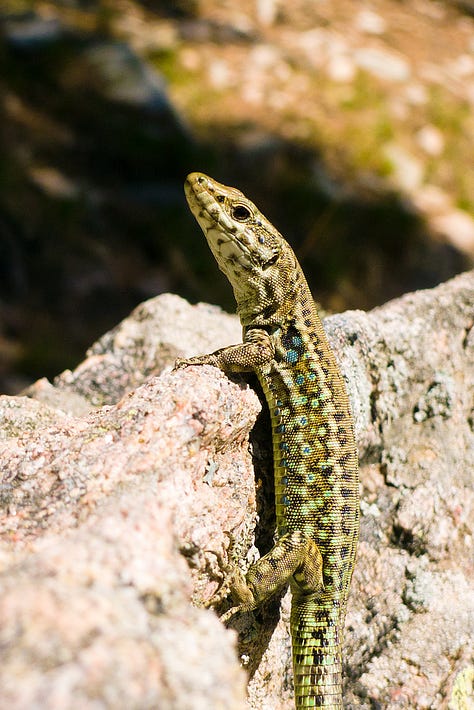
You could spend a lifetime hopping from island to island and still struggle to see all these reptiles and amphibians. Sardinia alone has six species of endemic salamanders, representing around 10% of Europe’s total salamander diversity. Crete, Cyprus, Rhodes, and Majorca are each home to a frog found nowhere else. There are a plethora of endemic lizards, including the Aeolian Wall Lizard, which is only found on three tiny volcanos off the Italian coast. Milos wall lizards, endemic to the Cyclades archipelago, are hunted by the Cyclades blunt-nosed viper, which is also endemic to that archipelago. This viper is a third the length of is mainland relatives —like the hippos of Cyprus and Myotragus of the Balaerics, it is an island dwarf.
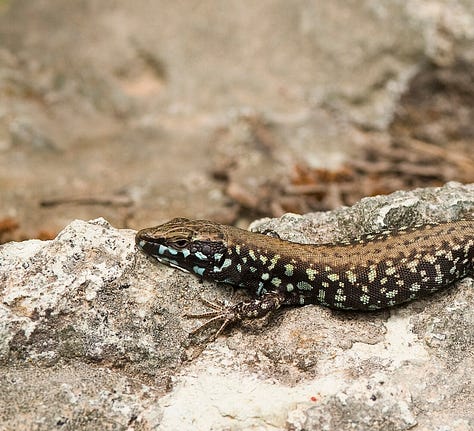
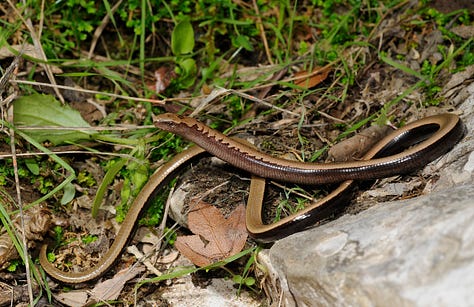
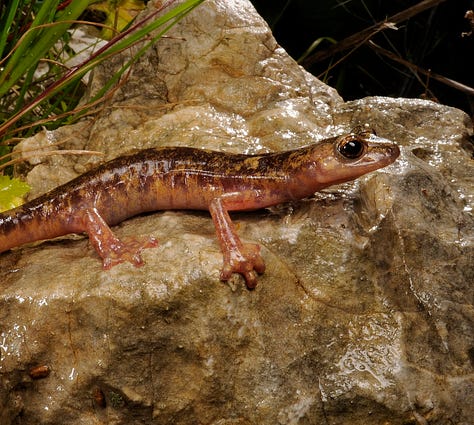
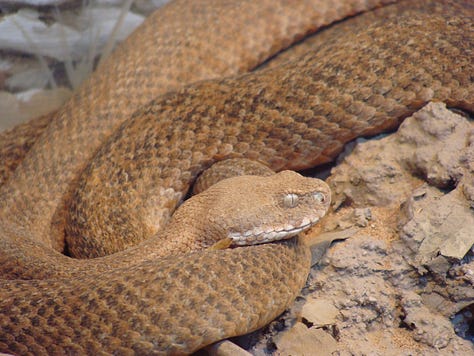
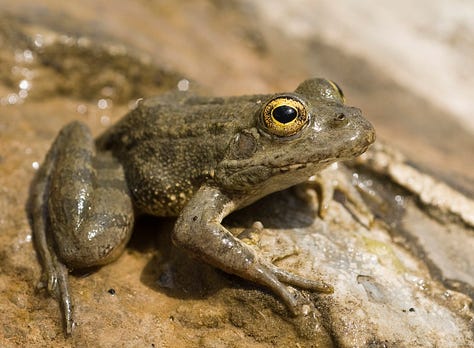
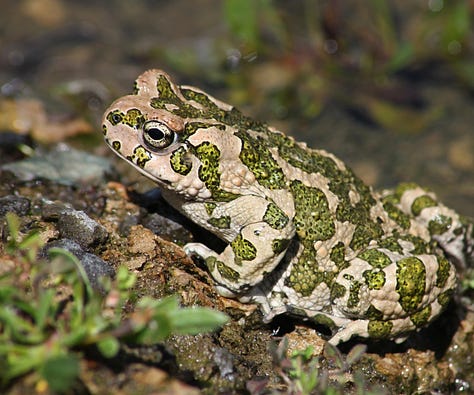
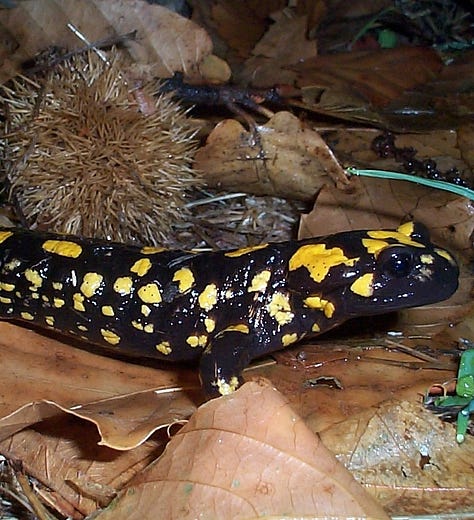
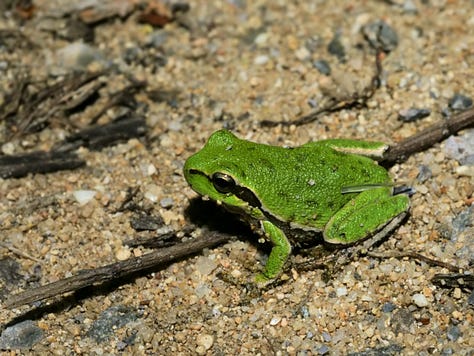
These animals are no less extraordinary than the extinct animals they shared their islands with. They survived a biblical flood that created a land of giants and dwarves, then eked out a living as invasion after invasion of outsiders struck down their compatriots. They are a reminder of what once was and is, of the former and present diversity of this strange sea. They may not be dwarf elephants or giant rabbits, but they are no less worthy of awe.
Nearly all of these animals are under threat from some combination of climate change, development, introduced species, and hunting, not unlike the animals of the past. But we know what’s happening to them this time. More importantly, we know how to prevent them from meeting the same fate.
No posts
Comments
Nothing yet. Say the first thing.
Sign in to join the conversation.