
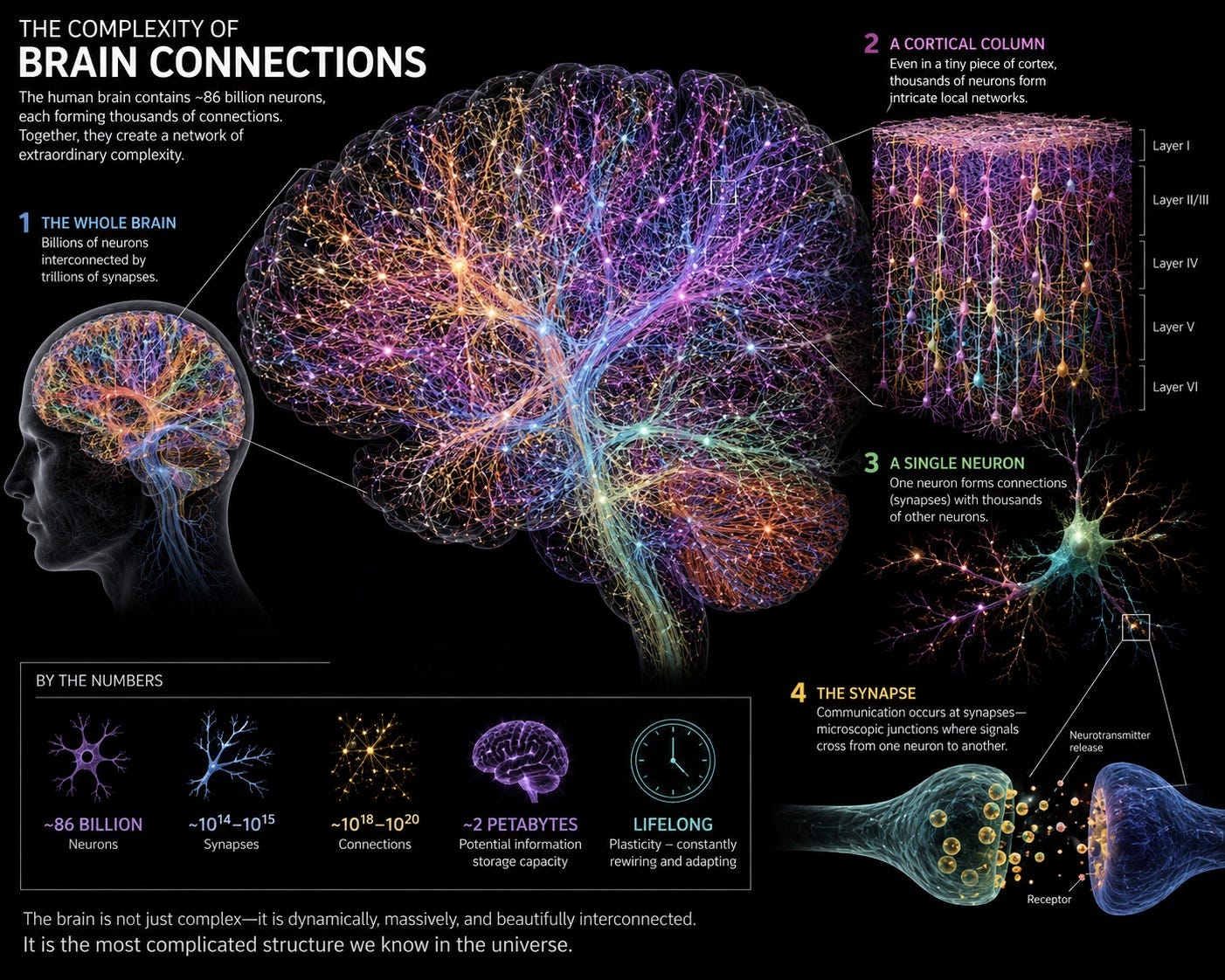
Illustration courtesy of ChatGPT
We are in the midst of a spasm of angst (a lot of sequential consonants in those words) concerning whether there is a long term future for the human brain in its competition with A.I. Are there things the brain can do that the machine cannot, or is artificial general intelligence the end of a 2 million year run of human intellectual supremacy on this planet?
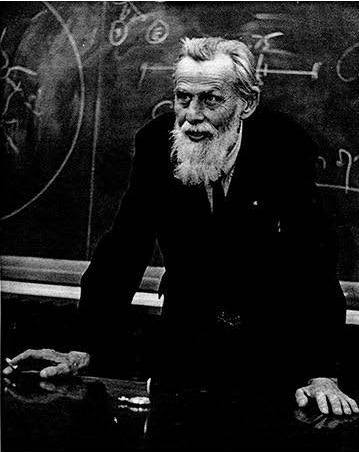
Warren McCulloch
The age of neural networks started in 1943 when Warren McCulloch and Walter Pitts published their paper “A Logical Calculus of the Ideas Immanent in Nervous Activity.” McCulloch and Pitts were characters almost as complicated and certainly more interesting than that title. McCulloch studied philosophy at Haverford, a tiny liberal arts college outside Philadelphia, before finishing his degree at Yale. From there he went to medical school at Columbia and started a life-long study of the brain’s physiology, finishing his career at MIT’s Research Laboratory of Electronics. Pitts was as different from McCulloch as it was possible to be. He taught himself Greek, Latin, and calculus as a young child. He ran away from a dysfunctional home at age fifteen and settled in Chicago where he studied philosophy but never earned a degree. Pitts had read Bertram Russell and Alfred North Whitehead’s insanely complicated Philosophia Mathematica when he was only twelve and, when he pointed out several of the book’s logical errors to Russell, he was invited to study at Cambridge.
Pitts met McCulloch in 1942, and the two developed a mathematical theory of neural networks that led to their seminal paper. It was published when Pitts was only eighteen. Pitts eventually moved to MIT where Norbert Weiner became his mentor. When the two had a falling out in the mid 1950’s Pitts became a reclusive alcoholic. He continued to write but stopped publishing and, before he died at age 46, he destroyed his entire collection of articles. McCulloch died the same year.
Johnny von Neumann encountered McCulloch and probably Pitts as well at the Macy Conferences on Cybernetics in the late 1940s. He was fascinated with their description of neurons that integrated multiple inputs into single outputs and acted with computer-like logic. McCulloch and Pitts’ neural networks could potentially perform ‘and’, ‘or’, and ‘nor’ functions just like Claude Shannon’s relays. Von Neumann recognized that parallel neural networks had the potential to be vastly more powerful than the sequential serial programming of his computer model, but he also recognized that his hardware was neither fast enough nor well enough synchronized to mimic the brain. Besides, their memory was far too small.
McCulloch and Pitts did not deal with it, but the brain has another important level of complexity. Von Neumann’s computers were binary. Everything was coded into either a 1 or a 0. The brain is analog. A neuron can receive thousands of inputs with variable—even adjustable—strengths. Some make the neuron more likely to fire and some make it less likely to do so. The brain cell integrates all the inputs and either fires or it does not. The likelihood of firing is weighted depending on the sum of the inputs. Computers are serial and binary. Brains are parallel and analog and vastly more complicated.
Von Neumann gave up on neural networks and went back to his digital machines, although he came back to them years later when technology started to catch up. Unfortunately by that time he was dying, and his manuscript for The Computer and the Brain was only published posthumously. Von Neumann did not live long enough to see what technology could accomplish. Processors that could take billions of inputs simultaneously and adjust their weights in a way analogous to the way neurons integrate variable effects resulted in machines that could amass and correlate amounts of data many orders of magnitude greater than a human brain can and do it 10,000 times as fast. Because the machines can adjust those weights as they are trained, A.I. can learn. People who really understand A.I. predict that artificial general intelligence—a machine superior to the human brain—is only a matter of time, and maybe not very much time, but before we declare our brains obsolete, it is worth a few comparisons.
In the first place, data centers striving to achieve AGI take up acres, consume billions of watts of energy, and are cooled with millions of gallons of water. Your brain weighs three pounds, moves around on your shoulders, and runs on 20 watts. Modern neural networks have millions of processors and billions of connections. The brain has almost 100 billion neurons and a million billion connections. Imaging every cell and every connection in the human brain would require two zettabytes of data, more than there currently is in the entire world wide web. And brains are awesomely efficient. A large language model has to be trained on 1,000 times as many words as a human infant before it can converse at a similar level.
But it is not just a difference in brute compute. It is hard for a human brain to compete with A.I.’s ability to deploy semantic knowledge. The machine is a whiz with data, but does that define intelligence? One could argue that a better definition of intelligence is the ability to explain what is observed, predict what will come next, and ultimately control outcomes. Much of the way we do that is based on intuition and experience.
A very simple example is the fact that major league batters contact a pitched ball between 75 and 80 percent of the time.[1] A 95 mph fastball takes about 400 msec to get from the pitcher’s hand to the plate. To get the visual image of the pitcher from the retina to the brain and back to the muscles making the swing takes between 200 and 250 msec and the swing itself takes another 150 msec. If you do the arithmetic you can see that the decision to swing has to be made before the ball is half way to the plate. The batter is able to do that for two reasons. First, he has practiced tens of thousands of times. Second—and just as importantly—he has years of situational experience. He knows what kind of pitch is most likely given the pitcher, the catcher, and the situation.
Machines learn by using vast amounts of data to make predictions. Humans use data as well, but they augment that with a mental picture of what has happened in the past. That experience comes from a combination of memory and input from the five senses. At least for now, machines are anchored in place and their only version of experience is second hand from their training data. In addition, for A.I. every problem is new and every solution starts from zero.
Experience is not the brain’s only advantage. We have talked about the fact that connections between neurons are adjustable. A.I. does that solely by varying the weights of inputs based on the statistical likelihood of an outcome. Humans do that as well, but they have another way to change weights—emotion. The strength of a neural connection varies with how much of specific neurotransmitters is released at each synapse, but neurotransmitters also change with the mental state of the brain’s owner. Dopamine increases in pleasurable situations. Norepinephrine increases with threats. Nursing babies cause a gush of oxytocin in their mothers., and those are only a few of the chemicals the nervous system uses. Variations in mental state—particularly states involving interaction between humans—change how the brain processes information.[1] There are mental states (pain is a good example) that profoundly alter the way brains deal with the world even though they are hard or even impossible to put into words. It is hard to imagine A.I. competing in that world. Foundational models can imitate emotions but they cannot have them.
At least since Gutenberg’s press allowed most of humanity to read, we have measured intelligence as a combination of memory, literacy, and numeracy. A.I. is better at all of those than we are. However, the machines have no accumulated experience, and their ability to evaluate and predict is purely statistical. In a constantly changing world occupied by constantly changing humans, the machines are at a disadvantage.
Perhaps going forward, we should change our definition of intelligence and change the skills we train for. When we learned to write, our left brains took command and visions generated by our right brains receded. When we learned to mass produce written material, we gave up the ability to memorize and devoted our brains to creating new knowledge. For the past century or so, we have increasingly spent our time and mental energy interacting with an explosion of data and information. Now A.I. can do that for us. Perhaps we need to train for intuition and empathy.
[1] However only 5-8 percent of the hit pitches result in a safe base hit.
[1] It is also true that many of those same chemicals directly impact how the body functions. They make pupils constrict, raise the heart rate, and redirect blood flow to the muscles for example. Emotion changes the body as well as the brain.
No posts
Comments
Nothing yet. Say the first thing.
Sign in to join the conversation.