
There seems to be little question that the new version of artificial intelligence and large language models like Chat GPT will change how we interact with our information sources, and that got me thinking about another time when the way information was transmitted changed.
We have already looked at the evolution of the alphabet. Pictograms were graphic representations that bore no relation to a language’s sounds. Logograms, which have persisted in Asian languages, were more abstract but still not phonetic, and the brain handles logograms differently than it does a phonetic alphabet. Japanese still has two separate writing systems—kanji which is logographic and kana which is phonetic and syllabary. Brain injured Japanese patients brought up with both systems have been carefully studied; kana uses the left brain exclusively while kanji needs both the right and left sides.
The earliest Semitic alphabets did represent sounds but came without vowels and initially represented the way syllables sounded. Sumerian and Egyptian writing, besides lacking vowels, were an uninterrupted string of characters, some of which were read right to left, some left to right, some top to bottom, and some first in one direction and then the opposite one—boustrophedon from the Greek for oxen that plowed a field back and forth. The text had to be read aloud to make sense, and it was best if the reader already knew what he was reading since the code left many gaps. The ancient syllabary texts were better as reminders of what one already knew than as sources of new information.
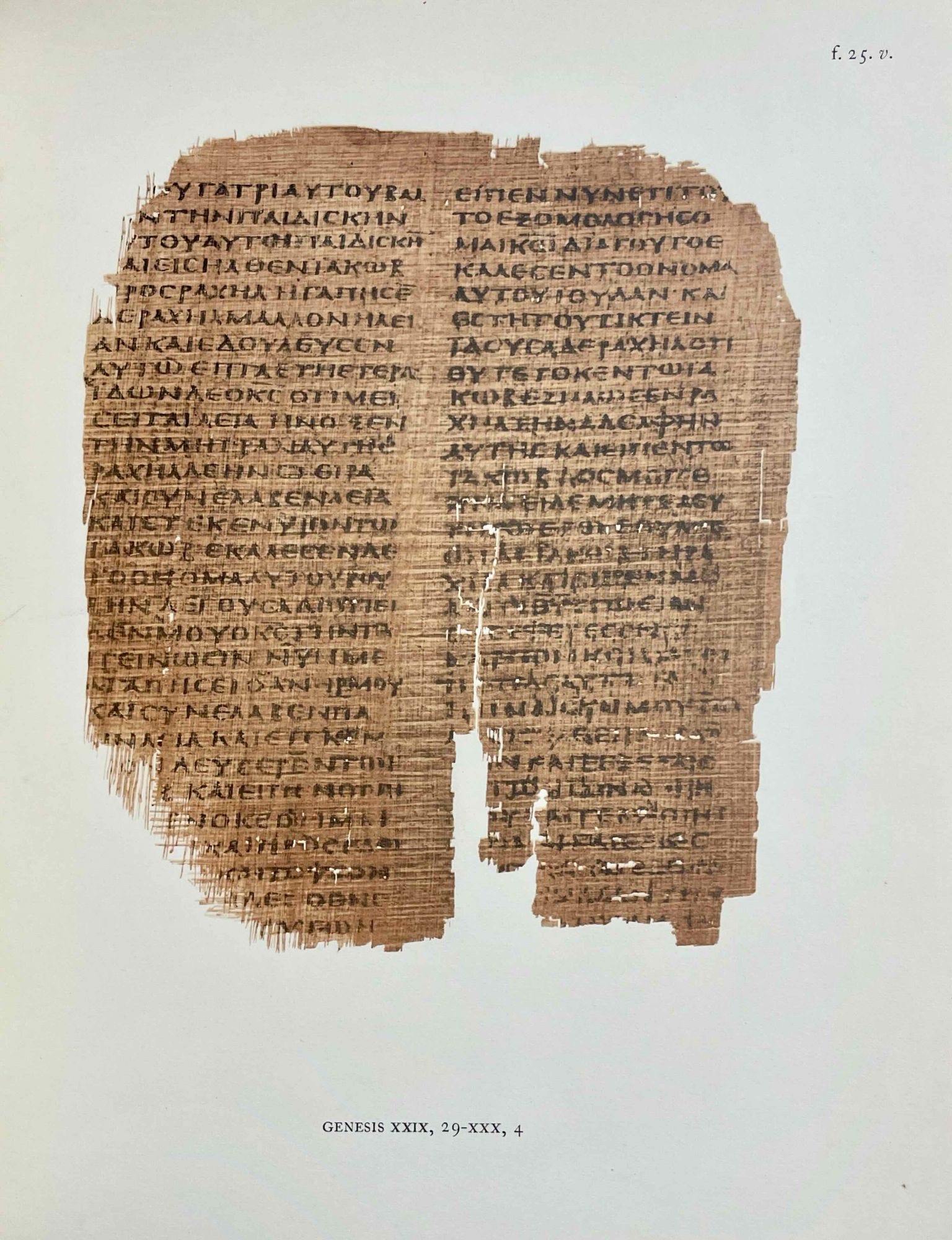
In an effort to make the code easier to decipher, the symbols were divided, usually with periods or spaces, but the division went away when the Greeks added vowels. Greek was written in scripta continua, a constant string of letters with no separation between paragraphs, sentences, or words. If one is reading left to right across the page (as the Greeks did) the eye’s ability to focus extends about fifteen characters out. It does not take much imagination to see how difficult it might be to decipher what is meant by an uninterrupted river of characters, only fifteen of which you can concentrate on at a time.
Why the Greeks chose to do that—and why Latin writers eventually adopted scripta continua as well—is unclear. One suggestion is that continuous script simply packed more words onto an expensive parchment. Perhaps the Greeks just liked how it looked on the page. Maybe reading was intentionally made difficult. As we noted earlier, the twenty-two Greek characters were much easier to learn than cuneiform or hieroglyphics, and perhaps those who made a living reading and writing made literacy harder to maintain their corner on the market. All of those are guesses, but the end result is not. Scripta continua profoundly affected how manuscripts were reproduced and read.
The scriptoria where manuscripts were reproduced were a constant undercurrent of sound. The representations we have of the copyists show them sitting with pen in hand and manuscript balanced on a knee. There was no space for a source from which to copy. The scribes were being read to by a lector while the writer got the words on a page in block-like, perfectly regular script. The reader was a performer, but the scribe was somewhere between a technician and an artist, and scribes were valuable. In medieval Ireland, the penalty for killing one of them was the same as that for murdering a bishop.
The important thing here is that reading scripta continua almost had to be done out loud; silent reading was an anomaly. When St. Augustine went to study with Bishop Ambrose of Milan in the late 4th century, he was amazed to find his teacher alone in his cell with a book. “When he read his eyes scanned the page and his heart sought out meaning, but his voice was silent and his tongue was still. Anyone could approach him freely and guests were not commonly announced, so that often, when we came to visit him, we found him reading like this in silence, for he never read aloud.”[1] There had been scattered references to others silently reading—Euripides, Demosthenes, and Julius Caesar—but it was uncommon enough to always be remarkable. In fact, in Hebrew and Aramaic a single word is used for both speaking and reading.
Things changed in the early 7th century beginning with monks in Ireland who probably wanted to make the Bible more comprehensible. They reintroduced the separation of Latin into individual words. From Ireland, individual written words spread to France and Italy in the early Renaissance, to Slavic Cyrillic in the 17th century, and to Sanskrit only recently.

Once words were separated the look of the page changed drastically. A stream of characters was broken with spaces, capitalization, and decoration. Most importantly, it was no longer necessary to read text aloud to decipher it and reading fundamentally changed. Silent reading made it possible to digest the complex ideas of Albertus Magnus and William of Ockham. Clerics and educated laymen could study alone and even put their thoughts in glosses and margin notes. (The thoughts were not entirely religious. There was a small explosion of both homosexually and heterosexually explicit marginal illustrations in religious literature.) Text read and contemplated silently broke the Church monopoly on the written word and gave rise to heretical ideas that were anathema to Rome, and some of those ideas made it into tracts that were publicly circulated. Christian heresy had been around as long as there had been a church, but since written thoughts had to be read out loud, it was risky and never too great a threat. Silent reading made it dangerous, and the first heretic was burned at the stake in Orleans in 1022.
Separating text into individual words fundamentally changed how reading was done and how information was transferred. That small change shook the status quo. Imagine what a large language model might do.
References:
Manguel, Alberto, A History of Reading. New York: Viking, 1996. Very readable and a wealth of arcane and interesting information.
Saenger, Paul, Space Between Words: The Origins of Silent Reading. Stanford, CA, Stanford University Press, 1997. Scholarly impressive research, but a bit dense for casual reading.
[1] From Confessions, vi, 3.
No posts
Comments
Nothing yet. Say the first thing.
Sign in to join the conversation.