

Welcome new subscribers!
In this series of upcoming newsletters, we will share some helpful ideas for all of us looking for new opportunities, taking time off from a full-time job (involuntarily or otherwise), or starting new things!
And... jobs! At least for this series, you’ll find that we’ve collected interesting recent job postings for Product, UX, Strategy, Research, and adjacent roles that we’ve encountered lately. Please note we have no special connection to these roles so please follow whatever instructions are on the organization’s page and let us know how it goes!
Also in the spirit of giving, I am offering a couple of slots to grab on my calendar if you’d like to chat. Are you building something good for the world? Technology, programs, or services in the nonprofit or people-first realm? I am offering these free catalyst calls - 45 minutes where I will help you solve a problem or work through a strategic aspect of your business. Topics might include: go-to-market, setting up research or discovery, issues with adoption or retention, team or leadership issues, ethical challenges, or just “something isn’t working.” You will be surprised at what we can do in a session.
You’re out of work, so how do you keep your skills sharp?
First, consider taking the time to get right with yourself. Do you need rest? Community? A reflection practice? Some gratitude? Try scheduling your worry so it doesn’t become consuming. There’s no point in spending your time in catastrophe mode, even if it feels like everything is collapsing.
Here are three things that can help you stay engaged and learning.
Be an advisor
Volunteer on a team
Develop a for-the-common-good side project
Reach out to nonprofit organizations, startup incubators, schools, or job training programs and offer your time
Sign up to volunteer through a mentoring service like ADP List or join a mentoring program through local or online product communities
Keeping your skills sharp isn’t just about technical or strategic skills. It’s also important to grow as a leader and contributor.
Look for volunteer opportunities through Idealist or Taproot
Join a cross-functional team training program like Tech Fleet
Most startups fail. And these days, there’s more failure than ever given how easy it is to start something. Trying to do some kind of YC hustle co probably won’t make you happy, so why not use this time to find something really meaningful to build?
Look for a buddy you can work on this with. You are far more likely to benefit from this project if you don’t go it alone. Join communities of product, design, or technical folks if you are not connected to anyone else in your area.
Look for the biggest challenges faced by people in your community. By this I mean people you actually know, but not necessarily are close to. If you’re not contributing to your community in some way, make that be step 2 and call this step 3
Talk to at least one or two people each day.
Don’t ask them to tell you what their challenges are, instead ask them about their past week. What has been notable? What are the humdrum things they never talk about with people because they think it would be boring? Be curious and a real listener.
Take notes after your conversations about things you noticed. Don’t just focus on what problems you heard, note when you picked up on emotion (frustration, joy, or any other feelings).
Once you notice patterns, start writing some hypotheses. These are NOT solutions to problems you’ve heard about. Instead, they should be in roughly the form: “[People with x characteristics] seem to find [y] difficult/benficial when [z]”
Now begin to focus on people with those characteristics for your conversations. They can be some of the same people, it’s fine. Avoid is telling them your hypothesis. Instead, ask them to tell you more about the “when” part of your hypotheses. For example, ‘People with more than one dog’ seem to find ‘getting help with walking’ difficult ‘when they have to work late.’ In this case, you’d be talking to people who have more than one dog about times they work late. Crucially, you’re not asking about the difficulty of getting help with walking their dogs! Your hypothesis will be born out only if they mention the problem without prompting.
Try to capture common details about the timing and context of the problem or desire as well as characteristics of people who most seem to experience the problem or have the goal
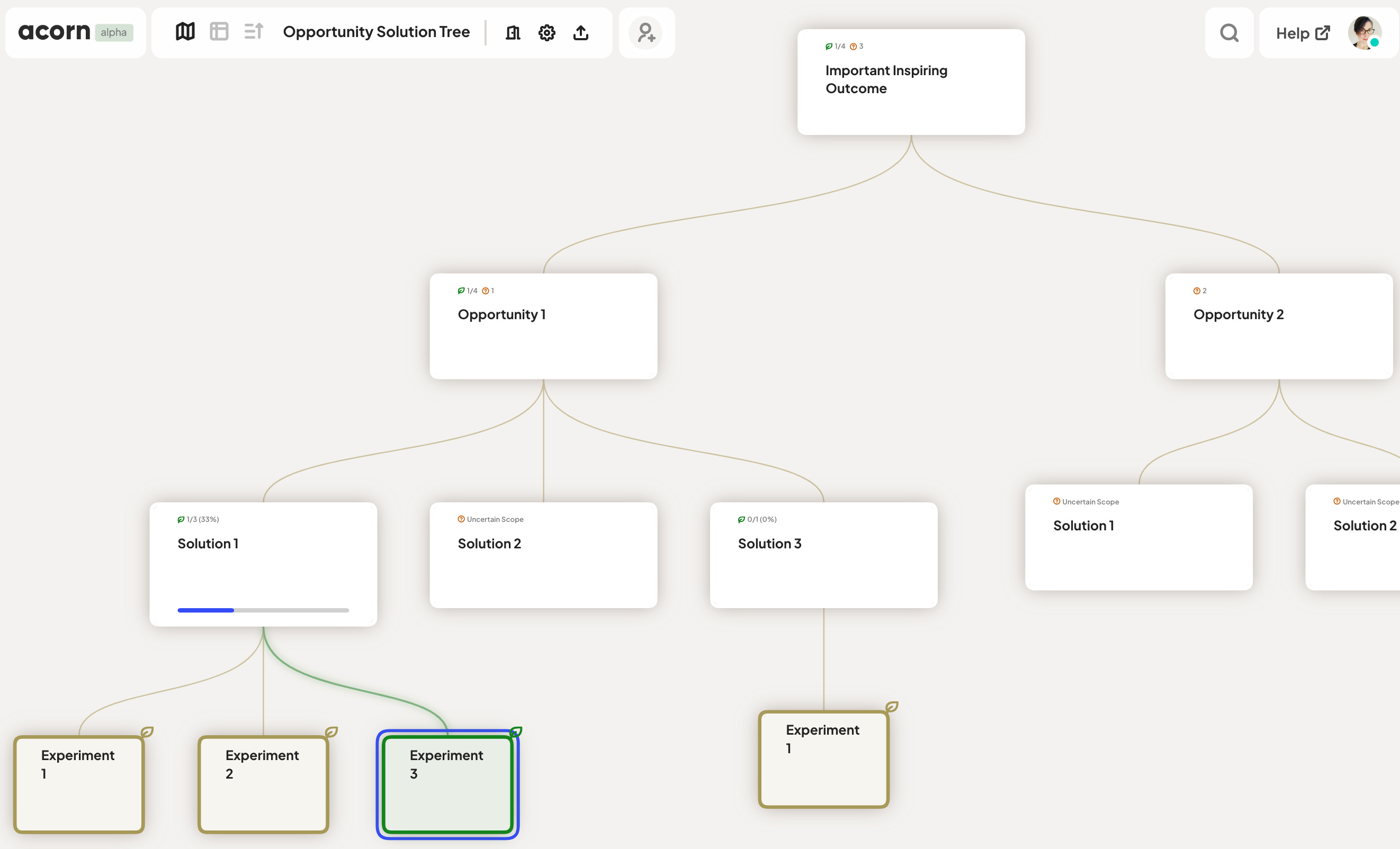
Create an opportunity-solution tree.
Since this is not a plan to make a zillion dollars, you can have business outcomes like “We only have to spend 3-4 hours a week on this,” “We want to make a difference in a specific area such as housing or LGBTQAI+ rights,” or “I will get to hang out with people I really like.”
Now put the key opportunities you’ve identified in your chart. (these are the pain points, desires, goals you’ve discovered in your conversations, along with key motives)
Under that, come up with solutions that could solve the problem. Have fun with this, think of anything that comes to mind
Now evaluate each solution on how well it maps to YOUR GOAL and the motives and challenges cited by the people you talked to
Before you go all out vibe coding, think about what the most minimal way to learn about whether your solution could help. Maybe the answer isn’t technology at all.
Look around at the resources that already exist to solve the problem. Try testing these with people who you met who had the issue. Why isn’t this solution good enough?
Once you have a pretty strong idea of how to solve the problem in a way that also meets your goals, make a paper prototype. This can even just be a storyboard showing the stages a person has as they encounter the moment of the challenge or goal, how they decide what to do, and how your solution would meet that moment.
Review the storyboard with a couple of the people you spoke to.
Consider any tradeoffs for your audience, or any downsides for them in the approach you are taking. Do not gloss over these or hide them from view.
If you are going to vibe code something, first work with your AI collaborator to map out a product spec and a data architecture.
Make sure to tell the AI to ask you lots of questions. If you don’t know the answers, you might consider more research
At the same time, look for more people who fit the characteristics of your identified audience. Now is a good time to go back to your wider communities to put the word out to find those folks
Consider working with existing organizations who serve the same people you want to reach
Don’t be a perfectionist. If what you offer can give your audience value, put it in their hands
Don’t worry if you don’t reach a lot of people. If you can make just a few people’s lives better with your project, it will be worth it!
Keep making small improvements as you see how people use what you made
Write up what you learned and share it widely!
For this series, we are opening up the comments - at least as long as they stay on-topic and focused on helping each other.
Share Changemaker Product Management
Senior PM & SR. Product Designer at Candid
Prize Design Consultant at XPrize
Executive Operations Manager at The Trevor Project
Product Manager, Technology at ACLU
Director of Education Content Strategy and Design at Team4Tech
Associate Director, Digital Product Design at Planned Parenthood
Product Marketing Manager at One Project
Visual Designer, Temporary at ProPublica (Apply by 11/26!)
No posts
Comments
Nothing yet. Say the first thing.
Sign in to join the conversation.