
When I first moved back to Utah in 2017, I was invited to join a book club.
Of course I joined it. I love book clubs.
I love everything about them: reading books, buying new books, discussing books with my friends, eating food with my friends, discussing movies and TV shows, getting good book recommendations, getting good movie and TV show recommendations, having friends, sharing my life with my friends, learning about other people’s lives, having a place to talk with other women about things that women care about like faith and sex and menopause and politics and everything under the sun, talking about our husbands, talking about our kids, talking about not having either and what makes it hard, finding support…basically, being in a good book club is amazing, and the only way to find a good book club is to accept invitations to join them.
So I joined.
And it was a revelation.
Because here is the difficulty with book clubs. Sometimes they read books I don’t like. When I was in a book club in Indiana (which was a good one for a long time), we had a few months in a row where we read sad, long, historical fiction novels. It was hard on me. At the time (when I am honest, this is probably still true), I didn’t like reading sad books. I wanted to read optimistic literature that left me feeling hopeful. I wanted to escape, and I wanted to think deeply about interesting questions. And I found the historical fiction we were reading to be profoundly sad and intellectually shallow. I was (probably still am) a bit of a snob in my own ways, and those books weren’t meeting my snobbish, book-loving needs.
But this new book club was different. In this book club, everybody read whatever they wanted to read. We didn’t have assigned books. We just brought all of the books we had read in the last month and showed them off and gave them reviews.
Sometimes a friend would bring a pile of ten or more books to share. Others may not bring a single book, but would talk about the audiobook they were in the middle of and hadn’t yet finished. Women were swapping novels so that every month a different person would read the same book and we would get to hear, over the course of a season, three or four different reviews.
We still enjoyed all of the benefits of the book club, but without the downside of having to read books we didn’t like to read a few times a year.
I am going to get to the chapbook soon, I promise.
Because in one of those meetings, one of my friends said something wise.
We were talking about Homestar Runner, the late 90s flash animation sensation we had all enjoyed, and she reminded us of this Strongbad gem:
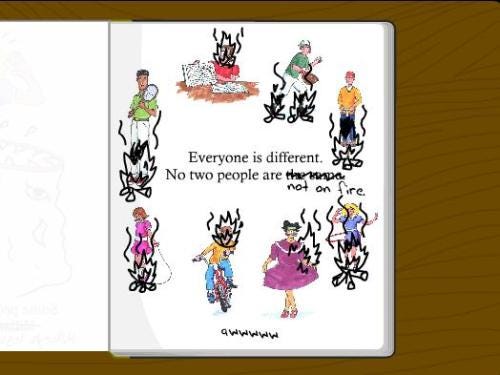
I remember laughing at the way Strongbad ended his children’s book. I laughed at the funny grammatical construction and the comical drawings of flames where they obviously did’t belong, but I hadn’t done what my friend had and really thought about what the line could mean.
I don’t think that Mike Chapman and Craig Zobel (the creators of Homestar Runner) had intended for my friend to get so much wisdom from the statement, but she explained, in book club (probably while eating a cream puff or having a cup of tea), that this was her mantra. Anytime she was interacting with anybody—at home, at church, or work, or at the grocery store—she tried to remember that the person in front of her was probably on fire. They were probably struggling, suffering or otherwise troubled.
Her goal was to be a person who would relieve the suffering of others instead of contributing to it. I would argue that just by recognizing the pain in others, she was beginning to achieve that goal.
Her comments were the inspiration for a short story that was later published at Wayfare Magazine, a very short piece about the fires that people hide. I’m not going to talk more about that story here because you can read it, just click on the link.
And now we can get to the chapbook!
I have been publishing short fiction online and in print magazines for over 20 years. I have published a diverse smattering of flash fictions, and I have been wanting to bring the best of them together into a small volume that could be read in a single sitting, something that I can give to friends and family when they ask me what kind of a writer I am.
I have finally decided to bring this chapbook to reality, and as I assembled it, “No Two People Are Not on Fire” emerged as a good title story. It starts the collection, but the chapbook also includes a dozen other stories that I have published over the years. There are stories about faith, motherhood, and nature. They are narrated often by women, but sometimes by men, often by adults, but sometimes by youth—but always by someone with a fire of some kind, a worry, problem, or idea that has swept through their life.
On Thursday (July 16th, 2026 for those of you who may find this late), I will be launching a kickstarter to raise the money to publish this chapbook.
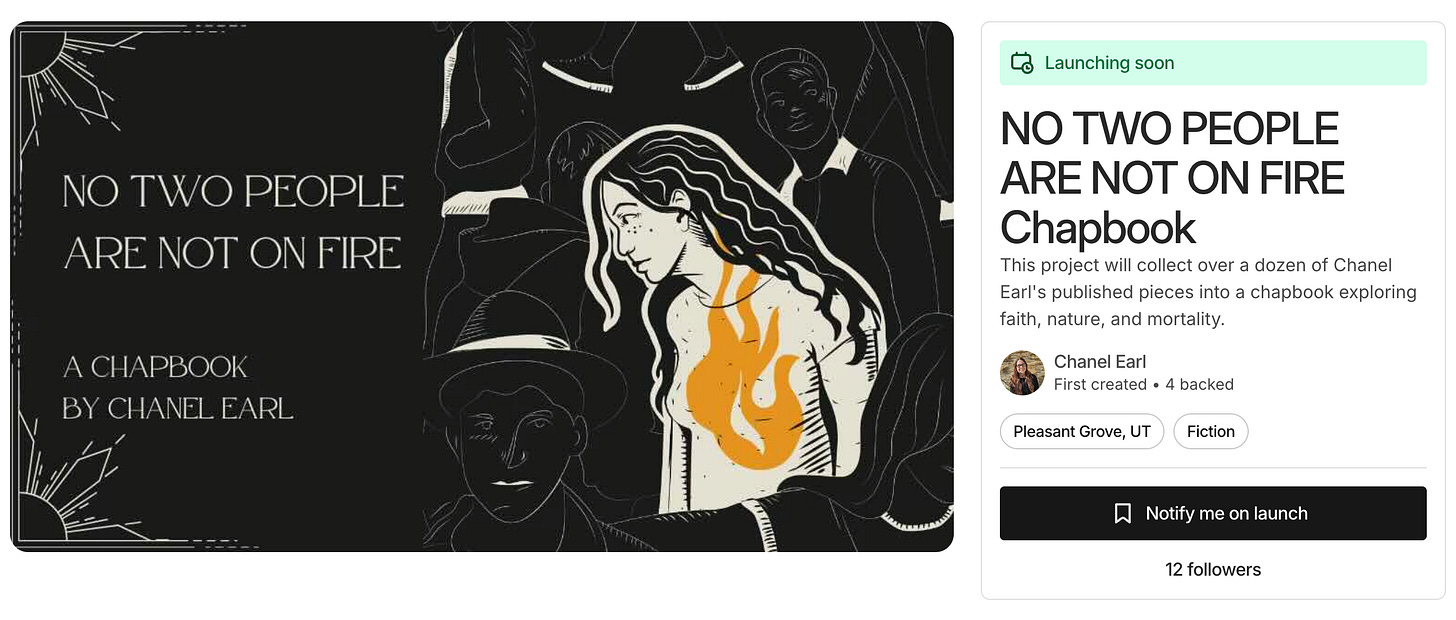
I just checked, and it looks like I have eleven friends and family members following the project already, but I wanted to write a post about this project to encourage more people to follow the kickstarter and support it when it launches. You can click on the image above to visit the page.
If you enjoy this story, I think you will love the collection, and my secret hope is that these pieces—often inspired by statements made by my friends in book clubs over the years—will make their way to new book clubs. It would take the story full-circle if you ordered a copy of this collection through the kickstarter, and then shared it with your book club over grapes, tortilla chips and salsa, or—my book club’s current favorites—a loaf of homemade sourdough bread and a tray of 50 chicken nuggets from Wendy’s!
Thank you!
No posts
Comments
Nothing yet. Say the first thing.
Sign in to join the conversation.