
Before anything else — if you haven’t read my previous post, start there: I put together an in-depth breakdown of the top 10 digital product trends of 2026 and exactly how to find them before everyone else. It includes 450+ digital product ideas you can steal (ethically, of course) to generate passive income this year. Consider it the companion piece to everything you’re about to read.
There is a kind of frustration that lives inside the digital product space — and if you’ve been here long enough, you’ve felt it. You spend weeks building a product, getting the design just right, setting up the listing, writing the description. You launch… and then nothing happens. Not because the product was bad. Not because the design was wrong. But because someone else already got there first, and the market moved on while you were still in Canva.
The difference between a digital product that sells quickly and one that collects digital dust rarely comes down to quality. It almost always comes down to timing. The sellers who consistently generate passive income aren’t necessarily the most talented designers in the room — they’re the ones who figured out how to read the room before everyone else arrived.
I’ve spent years studying this. Six years as an independent brand strategist and designer, working with 60 to 80 brand clients before ever opening a template shop. What I learned from that work — from watching trends translate from mood board to market, from seeing what buyers respond to before the algorithm catches up — is that trendspotting is a skill. It’s learnable, repeatable, and once you build the habit, it becomes the single most valuable thing you do for your digital product business.
This mini guide gives you the full toolkit: where to look, what to look for, and how to translate what you find into products that sell. These aren’t abstract suggestions — these are the specific platforms, tools, and community spaces that give you a real window into what buyers are actively searching for right now. Work through this systematically, build it into your research rhythm, and you’ll rarely be late to a trend again.
Because the goal isn’t to chase trends. The goal is to spot them early enough that you’re the one setting the pace.
Etsy’s search bar is one of the most underused research tools in the digital product world, mostly because people treat it like a listing tool instead of what it actually is: a live window into buyer intent.
When you type a keyword into Etsy’s search bar, the autosuggest feature is doing something important — it’s showing you the exact phrases real buyers are using to find products, ranked by search volume. These aren’t curated suggestions. They’re pulled from actual search behavior. Pay close attention to the long-tail variations that appear (the phrases with three or four words) because these reveal buyers who know exactly what they want, which typically means higher purchase intent.
From there, refine by category and sort by “bestsellers” to see what’s already converting. Don’t just look at what’s selling — look at how many reviews a listing has accumulated recently, what the listing photos look like, and what keywords appear in the titles. The bestseller section in any niche is essentially a validated trend report, updated in real time.
Quick fix: Search your core niche keyword, screenshot the autosuggest results, and check back monthly. The suggestions that are new tell you what’s gaining traction.
Your existing customers — and your competitors’ customers — are leaving you detailed product briefs in the reviews section, and most sellers aren’t reading them carefully enough.
On Etsy, reviews frequently mention what the buyer loved, what they wished was included, how they’re using the product, and occasionally what they couldn’t find elsewhere. That last piece is gold. A review that says “I wish this also came with a weekly version” or “would love a version for two-person households” is a direct product development note from someone already in your market.
If you don’t have your own sales yet, go directly to bestselling competitors in your niche and read their reviews. Look for patterns across multiple listings — the same want or frustration appearing repeatedly is a signal worth acting on. The buyers who leave detailed reviews are telling you exactly what to build next.
Watching competitors isn’t copying. It’s market research, and it’s one of the fastest ways to identify where a niche is heading.
Keep a short list of three to five successful sellers in your niche and check their shops regularly — not to replicate their work, but to notice what they’re launching and when. If a competitor releases a new product in a category they haven’t touched before, that’s often a signal they’ve spotted something moving. If multiple competitors launch similar products within a short window, the trend is already here and you’re in the early-majority window rather than the early-adopter window.
Go deeper by reading the reviews on competitor products with a specific lens: what are buyers wishing the product did that it doesn’t currently do? Where are the gaps? The most useful product ideas often live in the space between what a bestseller already delivers and what its buyers still want.
Amazon’s bestseller lists in physical product categories are one of the most overlooked research tools for digital product creators, because the instinct is to dismiss physical products as irrelevant. That’s the wrong read.
Physical product trends almost always precede their digital equivalents by three to six months. When a particular planner format, journal category, or organizational system starts climbing Amazon’s bestseller list in print, the digital version of that same format is the natural next move — and the market is often still wide open.
Browse categories like books, calendars, planners, organizational tools, and educational materials. Look for themes, aesthetic trends, format innovations, and specific features that keep appearing in top-selling products. Then ask: what would the Canva template, the printable PDF, or the digital download version of this look like?
Browse Amazon Bestsellers here.
Answer the Public visualizes the questions people are typing into search engines around any keyword — and for product research, it’s one of the clearest signals of unmet need you’ll find anywhere.
When someone types a question into a search engine, they’re expressing a gap. They need something they don’t have yet. When hundreds of people are asking the same question, that gap is a product opportunity. Enter your niche keyword and pay particular attention to the “what,” “how,” and “which” questions — these tend to surface practical needs that translate well into templates, guides, and organizational tools.
A quick, free version of this research: do a Google search for your core niche keyword and scroll down to the “People Also Ask” and “Related Searches” sections. These sections update based on real search behavior and give you a fast read on what your potential buyers are wondering about right now.
Instagram functions as a real-time visual trend report, especially for design aesthetics, color palettes, and styling directions. Follow the accounts in your niche that consistently produce high-quality content, and pay attention to what gets reshared and saved more than what gets liked — saves indicate that people found something genuinely useful or aspirational, which is a stronger buying signal than a like.
Search niche-specific hashtags like #coachworkbook, #brandkits, #digitalplanner, or whatever applies to your product category. Look for patterns in what’s appearing repeatedly: specific color stories, recurring design elements, particular formats or layouts. When the same aesthetic keeps showing up across multiple unrelated accounts in the same week, that’s a trend moving through the visual culture of your niche.
Reels are especially useful for spotting organizational and lifestyle trends early, because creators tend to show the use of a product rather than just the product itself — which tells you exactly what problem it’s solving and how buyers are integrating it into their lives.
The most underrated source on this list. Most sellers focus entirely on platform data and miss the editorial layer — the industry observers, niche bloggers, and newsletter writers who are actively synthesizing trends and translating them into forecasts.
Search “[your niche] trends 2026” or “[your target audience] blogs” to find the publications that serve your specific category. Look for posts labeled “trend report,” “what’s selling now,” or “what’s coming this season.” These pieces are often written by people who spend significant time in the market and are connected to early signals the algorithm hasn’t surfaced yet.
Sign up for newsletters in adjacent markets too. A parenting newsletter might surface an education trend two months before it appears on Teachers Pay Teachers. A wellness publication might flag an organizational trend that hasn’t hit the planner market yet. Cross-niche reading is one of the fastest ways to get ahead.
Pinterest Trends is a dedicated tool that shows what users are actively searching for on the platform, broken down by time period, audience demographics, and category. Unlike general search tools, Pinterest Trends surfaces visual intent — people come to Pinterest specifically looking for things to make, buy, or organize around, which maps closely to digital product demand.
Use it to validate ideas before you build them. If a keyword you’re considering has rising search volume on Pinterest Trends, you have evidence that buyer attention is moving in that direction. If it’s flat or declining, that’s equally useful information. The tool also surfaces related keywords and categories, which can open up adjacent product ideas you hadn’t considered.
Once a year, Pinterest publishes its Pinterest Predicts report — a data-backed forecast of the trends expected to grow in the coming year, across dozens of categories. This isn’t editorial speculation; it’s based on actual search patterns from hundreds of millions of users globally.
The report covers everything from home decor to fashion to food to lifestyle, and it consistently surfaces trends six to twelve months before they peak on other platforms. If you can identify a trend in Pinterest Predicts that maps to your niche, you have a meaningful window to build and launch before the market gets crowded.
Google Trends is best used not for confirming what’s already popular, but for discovering what’s becoming popular and where related interest lives. The “Related Queries” and “Related Topics” sections are where the real research happens.
Enter your core niche keyword and scroll to those sections. The “Rising” filter specifically shows terms that have seen significant growth in search volume recently — these are the early signals. A term labeled “Breakout” has grown more than 5000% in search interest, which usually means a trend is moving fast and the window is short.
Use Google Trends alongside Pinterest Trends and Etsy search data for the clearest picture: when multiple platforms show the same keyword rising simultaneously, you’re looking at a trend with genuine momentum rather than a platform-specific spike.
For planners specifically, Etsy is your primary research ground. Browse bestsellers within specific planner subcategories — daily, weekly, financial, habit tracking, meal planning — and pay close attention to the combination of features that appear in top sellers. The most successful planner products right now aren’t single-format tools; they’re integrated systems that bundle multiple organizational functions into one cohesive download.
On Pinterest, search for specific planner types and filter by most saved. The layouts and aesthetic directions that appear repeatedly in high-save content are what buyers are actively aspiring toward. Pay attention to whether the aesthetic is leaning minimal, maximalist, color-coded, or neutral — the visual direction of a planner trend matters as much as the functional format.
Planner communities on Facebook are one of the best places to do direct market research in this category. Join groups dedicated to specific planner systems — Hobonichi users, Happy Planner communities, digital planner groups — and read the questions and requests being posted. Buyers in these communities are often highly specific about what they want and remarkably articulate about what’s missing from current options.
Seasonal digital products live and die on timing, which means your research calendar needs to run three to four months ahead of the actual holiday. What you’re building in August is what will sell in November.
On Etsy, search “[holiday] printables” or “[season] classroom decor” and sort by bestsellers to see what’s already proven in the market. Note the color palettes that keep appearing — holiday color trends shift year to year, and what was everywhere last season may feel dated this year. Look at whether products are leaning into a realistic, traditional aesthetic or something more graphic and modern, because that shift often signals a broader design movement.
On Pinterest, search for curated seasonal boards and look specifically at pins that are gaining saves right now, even if the holiday is still months away. Pinterest users plan far in advance, which makes the platform especially useful for catching seasonal trends early. Holiday-focused blogs and lifestyle publications often publish trend roundups in the months before each major holiday — these editorial pieces are doing research on your behalf.
This category moves quickly because it maps closely to the tools and platforms businesses are actually using. The most successful business template products solve specific, current workflow problems — which means your research needs to stay close to what’s happening in the tools and platforms your buyers are working in.
On Etsy, filter for digital business templates, marketing resources, and spreadsheets, and pay attention to which specific platforms or workflows the bestsellers are designed around. A Notion template that solves a specific problem, a social media planning spreadsheet built around a current content format, a pitch deck structure that reflects how buyers are actually presenting right now — these products succeed because they’re mapped to real, present-day workflows.
Creative Market’s Templates section is excellent for tracking design direction in business templates — the styles, layouts, and aesthetic choices that are getting purchased there tend to show up as Etsy demand a few months later. Trend-focused business blogs and newsletters, particularly those covering productivity tools, AI workflows, and content creation, are where you’ll find the signals earliest.
Teachers Pay Teachers is the clearest demand signal in this niche — the homepage featured resources and the bestseller filters give you a direct read on what educators are purchasing right now, organized by grade level, subject, and activity type.
Pinterest is especially strong for this category because parents and teachers both use it heavily for educational content discovery. Search specific grade levels, subjects, or activity types and filter by most saved. Montessori-style activities, STEM projects, and sensory play content have had sustained growth and continue to surface new sub-niches worth exploring.
Niche-specific educational blogs and parenting publications often publish roundups of popular learning activities by season or theme — these editorial pieces surface what’s being searched for and shared, which translates directly to download demand.
Getting the trend right at the product level is only half the equation. The visual execution has to match where the design conversation is moving — because buyers in the digital product space are design-literate. They notice when something looks dated, even if they can’t articulate exactly why.
Adobe Color (color.adobe.com) lets you explore trending color palettes and build your own based on what’s rising in the broader design community. The “Explore” section surfaces publicly shared palettes organized by recency and popularity, which gives you a real-time read on where color direction is moving across industries.
The Pantone Color Institute publishes color trend forecasting throughout the year, culminating in the Color of the Year announcement that tends to ripple through consumer products, fashion, and design for the following twelve to eighteen months. The Color of the Year isn’t just a PR moment — it signals a broader cultural shift in aesthetic preference that shows up in what buyers respond to. Follow their releases here.
For typography: Google Fonts’ Trending section (fonts.google.com) shows what type choices are gaining traction across the design community, and everything there is free for commercial use. Font Squirrel (fontsquirrel.com) curates free commercial-use fonts and publishes a “Hottest Fonts Today” section that’s worth checking regularly. Typography trends move slower than color trends but shift meaningfully from year to year — and a product that uses a typeface that’s already peaked reads as behind before the buyer can name why.
Branding style guides from established companies in your niche — particularly any that have done recent rebrands — are rich research material. Study the font combinations, color stories, and layout choices they’re moving toward. Where major brands are going visually is often where consumer taste in that space is heading.
Free design resource platforms like Freepik and Pixabay curate trending graphics and illustrations, and their “trending” sections update with what’s being searched for and downloaded most. Search terms like “modern,” “2026 aesthetic,” or your specific niche alongside these to find visual directions gaining traction.
Design communities on Reddit, particularly r/graphic_design and niche-specific subreddits, as well as design-focused Instagram accounts and Behance, give you access to the actual working conversation among designers — which tends to surface aesthetic movements before they hit mainstream product markets.
If you’ve worked through this guide and you’re ready to move from research to actual product development, my previous post has you covered. I compiled over 450 digital product ideas, organized by niche and trend category, drawn directly from the research methods outlined above.
You can read it for free today: 10 Digital Product Trends That Can Make You Money in 2026 (+ 450 Ideas You Can Steal). It’s usually available in the shop as a standalone resource, but the full breakdown is in that post — no opt-in required. Consider it the head start on everything you’ve just learned to research.
There is a particular kind of friction that happens when a seller has done everything right — found the trend early, built the product well, priced it correctly — and still can’t convert browsers into buyers. Nine times out of ten, it’s a brand cohesion problem. The product is good. The brand isn’t carrying it.
Which is exactly what the Overnight Dream Brand Bundle aims to fix.
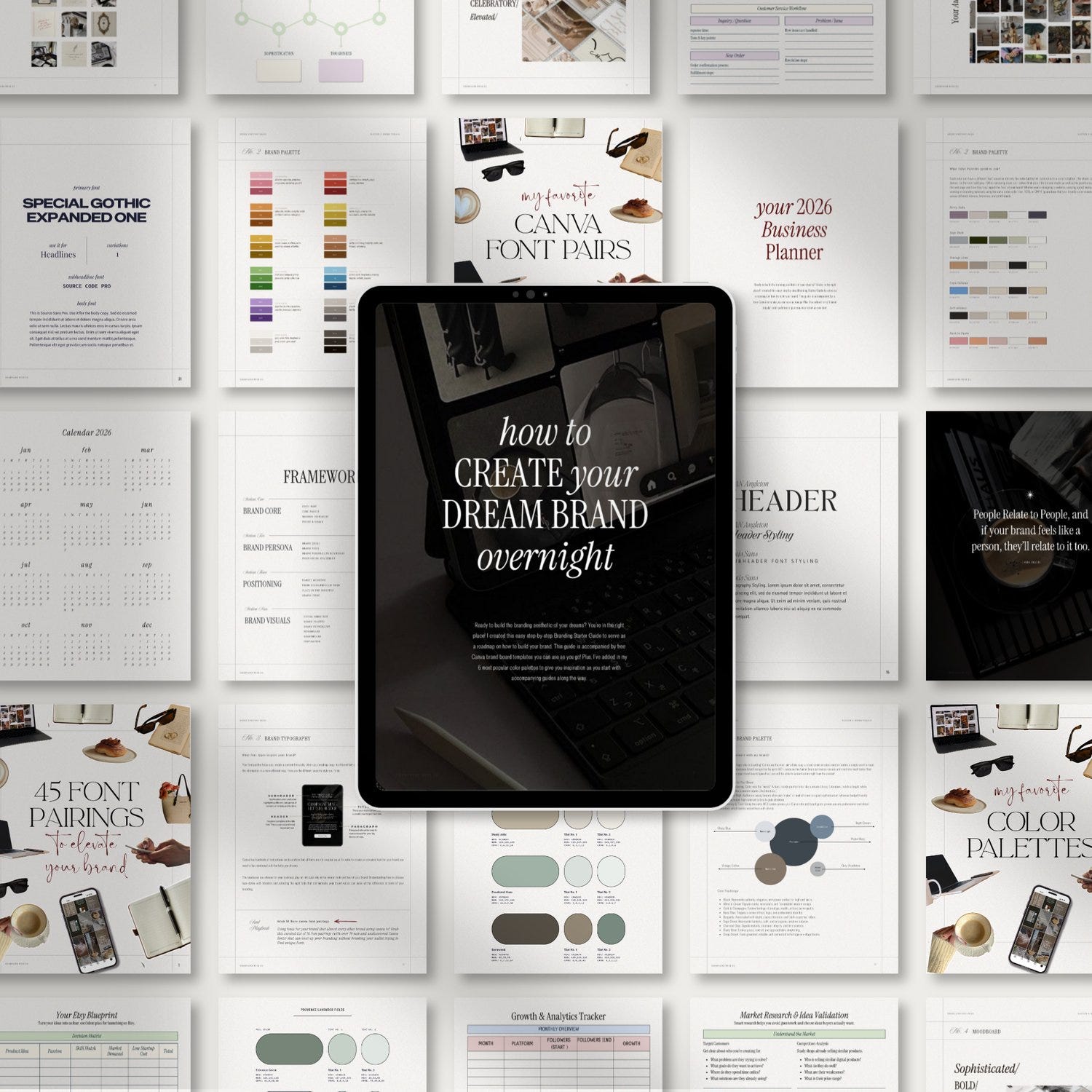
This is not a font pack with a few colors thrown in. It’s a complete visual identity system designed to take you from scattered to cohesive in a single working session. Inside, you’ll find 95 curated font pairs on Canva — organized so you’re not guessing about which weights and styles work together — alongside 100+ color palettes organized by brand emotion, because the palette that communicates trust doesn’t look the same as the one that communicates luxury, and the difference matters more than most sellers realize.
The bundle also includes the ultimate 2026 Business, Branding & Content Planner, which maps out your brand strategy, content calendar, and product launch planning in one cohesive document. Alongside it, an 80+ page extensive branding workbook that walks you through the excavation work: clarifying your positioning, identifying your visual direction, and building the strategic foundation before any design decisions are made. And finally, 90 brand boards to use as visual inspiration — not mood boards in the abstract sense, but specific brand direction references organized by aesthetic category, so you can identify where your brand belongs and what it should look like when it gets there.
The sellers whose listings stop traffic have one thing in common: their brand does the work before the buyer even reads the product description. That’s what cohesive brand identity actually does. It creates recognition, trust, and desire at a glance.
The Overnight Dream Brand Bundle is here. If you’re building products worth buying, make sure the brand carrying them is worth trusting.
If any of this has been useful to you, consider becoming a Champagne Muse affiliate. You’d earn 30% commission on every product sold through your link — which translates to up to $30 per sale, depending on the product. It’s a straightforward program: share what you’d genuinely recommend, earn when someone buys.
Click link above to get started— We manually approve affiliates to make sure that they are best aligned with our business. If you're approved, you'll hear back within 24 hours! *If you've purchased a template from us in the past, your application will automatically get approved.
You’ll get your own custom links to share for each product that gives customers 15% off their order. We recommend putting the link at the footer credit for “Champagne Muse” if you're using one of our websites, or you can share links on your blog, Pinterest, Instagram, etc!
For each sale made, you’ll get a 30% commission! Payments will be sent directly through Paypal and there’s no cap on commissions— So you can earn as much as you’d like!
Apply to become an affiliate here.
When you find a design that catches your attention across any of these platforms, don’t just save it. Identify the specific elements at play — the color pairing, the typeface combination, the layout structure, the pattern or texture. Then ask whether those elements solve a visual problem for your buyer or simply look beautiful. Beautiful and functional is the standard; beautiful alone is decoration.
This toolkit works best as a living practice, not a one-time read. Set a recurring research session into your calendar — weekly if you’re building actively, monthly at minimum — and work through these platforms with intention. What you’re looking for isn’t confirmation that your current ideas are valid. You’re looking for signals that tell you where the market is moving before it gets there.
The sellers who build sustainable passive income from digital products aren’t doing something fundamentally different from everyone else. They’re just doing their research consistently, acting on what they find quickly, and letting their brand do the work of converting once a buyer arrives.
Each issue goes a layer deeper into the strategy behind what’s selling and why. The research never really stops; it just gets more interesting the longer you do it. Stay around for next weeks post on finding your brand aesthetic.
Cheers 🥂

Comments
Nothing yet. Say the first thing.
Sign in to join the conversation.