
A friend of mine called me a few weeks back, mid-spiral, trying to start a Substack. "I think I want to write about... wellness?" she said. Not a question, exactly, but not not a question either. I asked, gently, wellness for who. She said, dead serious, "wellness... in general." I have never heard three words carry so little information while sounding so confident. I said that's not really a for-who, that's a category on a grocery store shelf. She got a little defensive. "Wellness is universal, everyone needs it, that's the whole point." I said sure, but "everyone" isn't an audience, "everyone" is who nobody actually writes to. She pushed back harder. "So what, I have to pick one tiny group and ignore everybody else?" And I said, kind of, yes, actually, that's the whole trick.
I asked what she actually knew that other people didn't. She thought about it for a solid ten seconds and said, "I guess I know a lot about how to not have a breakdown while also running a business." She'd been arguing with me for ten minutes to defend "wellness in general" while the actual, sharp, funny, specific thing was sitting right there the whole time. She'd just never said it out loud with a straight face before.
Most Substacks that stall out didn’t fail because the writing was bad. They failed because the niche was too wide to hold anything up. “Wellness” isn’t a promise to a reader. Neither is “Design,” or “writing,” or “finance.” They’re filing cabinets, not newsletters, and a filing cabinet has never made anyone hit subscribe.
Just the other day I opened the Business category on Substack, scrolled for maybe four minutes, and had the realization that I’d read this exact newsletter before. Different name, same seven-figure launch story, same “I quit my corporate job” intro paragraph. It’s a text-only medium and it still somehow has stock photo energy.
So this is a long one, and I mean that as less of a warning and more of a promise. We’re going to go through why broad niches quietly sink good writers, what actually makes a niche profitable on this platform specifically, every broad category worth considering, the sub-niches hiding inside each one, which of those are crowded versus wide open, who each niche actually suits, and how to pick yours without a six-week identity crisis.
Substack in 2026 does not reward volume. It rewards a strong, specific point of view attached to a specific person the reader can picture. That’s the whole shift — trust, authority, and community now outperform generic content produced at scale, largely because generic content produced at scale is what the rest of the internet is drowning in already. Readers aren’t short on information. They’re short on someone worth trusting inside a topic they actually care about.
The categories that consistently perform, especially the paid ones, share one trait: they help someone make money, save time, reduce risk, or improve their status or identity. That’s not a coincidence, and it’s not cynical either — it’s just what people have historically paid for, in every medium, forever. Finance, tech, B2B, and professional career advice keep showing up at the top of “best paid categories” lists for exactly this reason. They solve problems people already have a wallet open for.
Here’s the part that trips people up. A profitable niche isn’t the broad category. It’s the sentence hiding just underneath it. I’ve noticed the strongest sub-niches almost always follow one of six formulas, and once you see them you start recognizing them everywhere:
Audience + problem — “Writing for founders.”
Audience + life stage — “Parenting toddlers as a working mom.”
Audience + profession — “AI for lawyers.”
Audience + outcome — “Sleep management for athletes.”
Audience + region — “Real estate in Dubai.”
Audience + product category — “Fashion for petite models.”
None of the above formulas mention the broad category on its own. “Real estate” doesn’t convert. “Real estate in Dubai for first-time investors” does, because it names a person and a stake. The broad niche is useful exactly once - as the shelf you put the actual newsletter on. The business itself always lives in the narrower promise. Here’s what each formula is actually doing, and how to tell which one fits what you already have.
Audience + problem works when you can name a specific pain point better than the person experiencing it can.
“Writing for founders” isn’t about writing in general — it’s about the exact moment a founder stares at a blank LinkedIn post and can’t figure out why their genuinely good idea sounds flat on the page. If you’ve solved a problem for people over and over, in client work, in DMs, in the same conversation at every dinner party, this is your formula.
The tell: you can finish other people’s sentences about the problem before they do.
Audience + life stage works because life stages come with a built-in expiration date and an equally built-in urgency.
“Parenting toddlers as a working mom” only applies to a reader for a few years, which sounds like a limitation and is actually the opposite — during those years, that reader is desperate, searching, and has almost nowhere else that speaks to her exact overlapping pressures.
Use this formula if your expertise is tied to a season of life rather than a permanent skill: new parenthood, a divorce, a big move, the first year of a business, menopause, retirement.
Audience + profession works because professionals have money, they have a narrow window of attention, and they resent being spoken to like a general reader.
“AI for lawyers” beats “AI tips” because a lawyer doesn’t want to translate general advice into their world themselves — they want someone who already did the translating. This formula is the natural fit if you’ve worked inside an industry and know its specific vocabulary, tools, and unspoken rules.
Audience + outcome works when the outcome is specific enough to be a promise rather than a vibe.
“Sleep management for athletes” is not “better sleep,” it’s a named result for a named kind of person, and that person can picture exactly what they’re buying before they subscribe. Use this formula when your content is genuinely built to produce a measurable change — more energy, better margins, less anxiety — not just information to browse.
Audience + region works because local knowledge doesn’t scale the way generic advice does, which makes it valuable precisely because nobody else can copy-paste it.
“Real estate in Dubai” beats “real estate” because regulations, buyer behavior, and market timing are different in every region, and a reader making a six-figure decision wants someone who actually knows their specific market, not a global overview. This formula fits if you have deep, current knowledge of one place.
Audience + product category works when style or taste needs a body, a budget, or a life context attached to make sense.
“Fashion for petite professionals” beats generic styling content because it removes the guesswork of “will this actually work for me” before the reader even opens the post. Use this formula whenever the broad version of your topic (fashion, food, travel, design) is really a matter of taste that only makes sense once you’ve named who it’s for.
The quickest way to find yours: look at which formula you were already using in real conversations, before you ever thought about Substack. The niche that fits fastest is usually the one you’ve been running for free, for years, without noticing it had a name.
Before we get into sub-niches, here’s the full list of broad categories worth knowing, because they’re the raw material everything else gets built from: AI, business, tech, finance, health, wellness, parenting, hobbies, law, architecture, fashion, writing, real estate, hospitality, design, food, education, travel, sports, and media/culture.
Some of these are obviously monetizable at the broad level (finance, tech). Some only work once they’re narrowed (wellness, media/culture). A few are sitting almost entirely untouched at any level, broad or narrow, which is its own kind of opportunity if you’ve got real experience in them. We’ll get to which is which in Section 4. First, the sub-niches.
Everyone’s AI opinion sounds the same by the third newsletter, which is genuinely an accomplishment given how new the topic is. Skip the “AI is changing everything” essay and go specific: AI for lawyers, AI workflows for consultants, AI prompts for educators, AI for architects. I’d also add AI for real estate agents and AI for wedding planners — anyone drowning in repetitive client admin is starving for this.
The word “business” has been drained of meaning. Solo founder ops. Bootstrapped business breakdowns. Pricing strategy. Customer research. Offer design. Add operations for one-person agencies and the actual math behind raising your prices to the pile. People don’t pay for vibes. They pay to be told what to charge.
Tech readers will pay real money to avoid reading vendor marketing themselves, which is the whole business model hiding in plain sight. SaaS teardowns, cybersecurity for small businesses, developer tools, product strategy for startups. Also underused: tech buying guides for non-technical founders and the tools nobody tells you to cancel.
“Personal finance” as a category is mostly the same iced-coffee-and-index-funds post wearing different sunglasses. It gets interesting fast once you attach a person to it: personal finance by life stage, local investing, behavioral finance, tax basics, retirement planning. Add finance for freelancers with irregular income — an enormous, underserved, slightly panicked audience — and money conversations for couples who avoid them.
Broad, a little exhausting as a category, sharpens the moment you name who it’s for. Health for busy professionals, metabolic health, women’s health, sleep, health tech. I’d add health for people who travel constantly and health for shift workers, because both groups are being written for approximately… never.
Wellness only works with an actual problem attached, otherwise it’s just a Notes app screenshot. Stress recovery, burnout recovery, mindfulness for workers, longevity routines, wellness for founders. New additions: wellness for people who hate wellness content (there is a real audience here, trust me 😂) and recovery for people who over-function.
Massive free audience, weirdly thin paid one, unless you get specific. New parents, homeschooling, teen money, parenting in multilingual families, parenting for working moms. “Parenting” isn’t a newsletter — “parenting a toddler while running a business and lying about being fine” is. Add parenting through a divorce and parenting kids with big personalities you didn’t sign up for.
Chronically underrated as a business category and I will die on this hill. Photography, birdwatching, knitting, board games, watches, wine, gardening. People will pay for community around the thing other people find slightly baffling that they love this much. Add fountain pens and home bartending — both have rabid, well-funded little corners of the internet.
Legal content converts the moment it stops sounding like legal content. Legal tech, law for creators, small business legal basics, contract education, compliance for startups. Add the one contract clause that keeps ruining people’s month — narrower than it sounds, works better than it sounds.
Niche, strong when it’s tied to real projects, and yes, I am biased, I contain multitudes. Residential design, small-space living, sustainable interior design strategies, architecture for developers. Underused: architecture for regulation-heavy regions (Dubai, for one, has a lot of very specific rules nobody’s writing about clearly) and architecture school survival guides.
Already proven on Substack, so the room isn’t empty, it’s just better with an actual point of view. Personal styling, sustainable wardrobe, workwear, luxury fashion, fashion for specific body types. “Outfit inspo” is not a sub-niche. Fashion for climate-specific wardrobes and fashion resale strategy are.
Broad to the point of being meaningless until you attach a monetizable path. Writing for founders, ghostwriting, freelance essays, book proposals, AI-assisted writing, editing systems. “I love writing” isn’t a newsletter. “I help founders sound like themselves in writing” is. Add writing for people who hate writing and newsletter writing for other newsletter writers, which is admittedly a bit meta.
Works best when it’s local, investor-focused, or decision-driven — real estate readers are trying to make an actual choice, not kill time. Local market analysis, first-time buyers, investing, luxury property, short-term rental strategy. Add real estate for relocating expats and off-plan investing explained for people who are terrified of it.
Genuinely under-served compared to general business content, which is rare air in 2026. Restaurant ops, hotel management, F&B trends, service design, hospitality branding. If you’ve worked a single shift in this industry, this is closer to an empty hallway than a crowded room. Add hospitality hiring and retention — an industry-wide headache nobody’s writing about well.
Converts because it helps people make or sell something better, not just look at something pretty. Brand strategy, UX/UI for small businesses, packaging, visual identity, AI design workflows. Add design for non-designers who got stuck running their own rebrand (yes, hello, that’s me!) — a bigger audience than it sounds.
Crowded at the very top. There is no shortage of banana bread content in this world. But the sub-niches stay sticky: meal planning for diabetics, specialty baking without breaking the bank, home cooking by culture, budget gourmet, restaurant business. Add cooking for one and food for people who hate meal prep but still want to eat well — a much bigger, much hungrier audience than the algorithm suggests.
Works with a clear goal and a repeat need — people come back because they’re still solving the same problem next month. Homeschooling, adult learning, study systems, edtech, learning design. Add education for career-changers and learning design for people with ADHD, both wildly underwritten.
Gets far more monetizable the moment it stops being “look at this beach” and starts being specific and high-intent. Business travel, solo female travel, luxury family travel, regional guides, points and miles. Add travel for chronic illness or accessibility needs and slow travel for people trying to actually rest.
Community and identity carry this one in a way pure information never does. Sports business, athlete media, fan analysis, youth sports parenting, niche leagues. Add sports for people who only care about the business side, not the game itself — a real, specific, slightly niche-within-a-niche audience.
The hardest category to monetize unless your point of view is genuinely distinct, so “distinct point of view” isn’t optional here, it’s the entire business. Local culture, book coverage, niche criticism, creator economy, audience trends. Add culture criticism specifically for a diaspora audience — underused, and there’s real hunger for it.
Some straight talk on where the actual competition is, because “pick a sub-niche” only helps if you know which rooms are already full.
Crowded, proceed with a very sharp angle: Business, wellness, personal finance for millennials, generic AI commentary, food, and fashion. Not impossible, just popular. You need a genuinely specific point of view to be heard in any of these, not just a nice substack name.
Moderately open, room to build authority fast: Tech (broad tech commentary is crowded, but narrow tech sub-niches like SaaS teardowns are wide open), law, education, travel, sports.
Quietly wide open right now: Hospitality, architecture, real estate at the regional level, health for specific working populations (shift workers, frequent travelers), and media/culture with a diaspora or highly specific cultural lens. These are the hallways nobody’s standing in. If you have real professional experience in any of them, this is close to a running head start.
For creators (people building a personal platform, voice-first): fashion, food, travel, hobbies, media/culture. These reward personality and taste as much as expertise, and they’re where a distinct point of view does most of the heavy lifting.
For professionals (people with a career or credential behind them): law, finance, tech, real estate, architecture, hospitality, design. These reward specificity and lived experience over charisma. Readers are here to borrow your judgment, not your personality.
For hobbyists (people going deep on something they love, not their day job): the hobbies category itself, plus niche corners of food, travel, and wellness. These are slower-growing but often stickier — the audience is smaller and far more loyal, and they’ll pay for community as readily as information.
Most people fit more than one of these at once, which is fine. The categories aren’t mutually exclusive. They’re just a filter for where your specific mix of experience and voice will land hardest.
Run every sub-niche idea you’re considering through three filters before you commit to anything.
Authority — do you actually know this, or are you performing knowing it. Readers can tell the difference within two posts.
Audience access — can you reach the specific person this is for, right now, with the platform and relationships you already have. Not hypothetically. Right now.
A monetizable problem — is there an actual expensive, time-consuming, or risky problem this audience has, that you can solve better than the general version of this content already does.
If a sub-niche clears all three, it’s yours to build. If it only clears one or two, it’s probably still a good newsletter — just maybe not yet a business.
Broad niches are containers, not businesses. The money lives in the sentence underneath — audience plus problem, life stage, profession, outcome, region, or product category. Some categories are loud right now (business, wellness, generic AI, food, fashion) and some are sitting almost empty (hospitality, architecture, regional real estate, health for specific working populations). Your job isn’t to avoid the crowded ones, it’s to find the specific angle inside them.
Here’s the short version, if you want to actually do something with this today:
Write down the broad category you keep coming back to.
Pick the formula that matches how you already talk about it — problem, life stage, profession, outcome, region, or product category.
Say the sub-niche out loud to a friend and watch whether their face changes. If they immediately know someone who needs it, that’s your signal.
Check it against authority, audience access, and a monetizable problem. All three, you’re building. One or two, you’re still just writing, which is fine, but know the difference.
Once it’s named, stop touching the wording and go write the first ten posts. The niche gets sharper with use, not with more thinking about it.
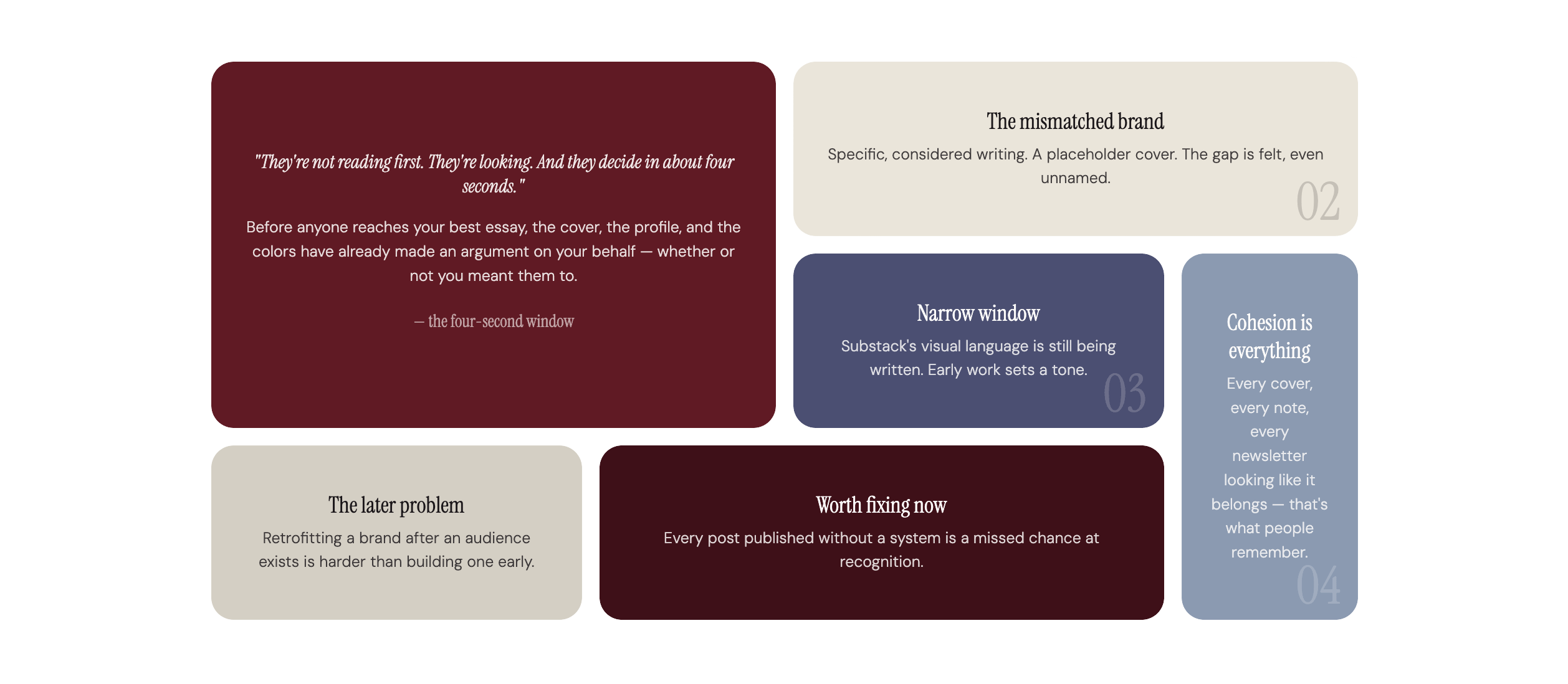
Naming it is genuinely the easy half, though — five steps, an afternoon, done. The harder half is what happens after, when you have to actually look like the person who owns that space, not just sound like it in your bio. A sharp sub-niche wrapped in a generic template still reads as a generic newsletter. I’ve watched people nail the positioning and still lose the reader, because the page itself gave nothing away before a single word was read.
That four-second window is real, by the way, and it’s not a marketing exaggeration. Someone forms a first impression of your publication before they’ve read your best essay — the cover, the colors, the type, the whole visual argument you’re making whether or not you meant to make one. 38% of visitors disengage the second a page feels unconsidered, and readers don’t separate your writing from the container it lives in. They just quietly close the tab and never tell you why.
Which makes sense — you’re a writer, not a designer. The writing takes everything you have. The visuals are the later problem. Until they become the reason someone doesn’t stay.
This is exactly the gap the Champagne Muse Substack Brand Identity beta (I know its a mouthful) was built to close. It’s a complete, considered visual identity system built specifically for Substack — logos, palette, type, covers, newsletters, everything in between — designed around what your publication actually is, not a template stretched to fit it. Six years of brand and design freelancing, 70-plus clients served before this, a five-year architecture design background shaping how the whole system thinks about structure and composition, and only three beta spots open right now.
There are four ways in, depending on how much you want built:
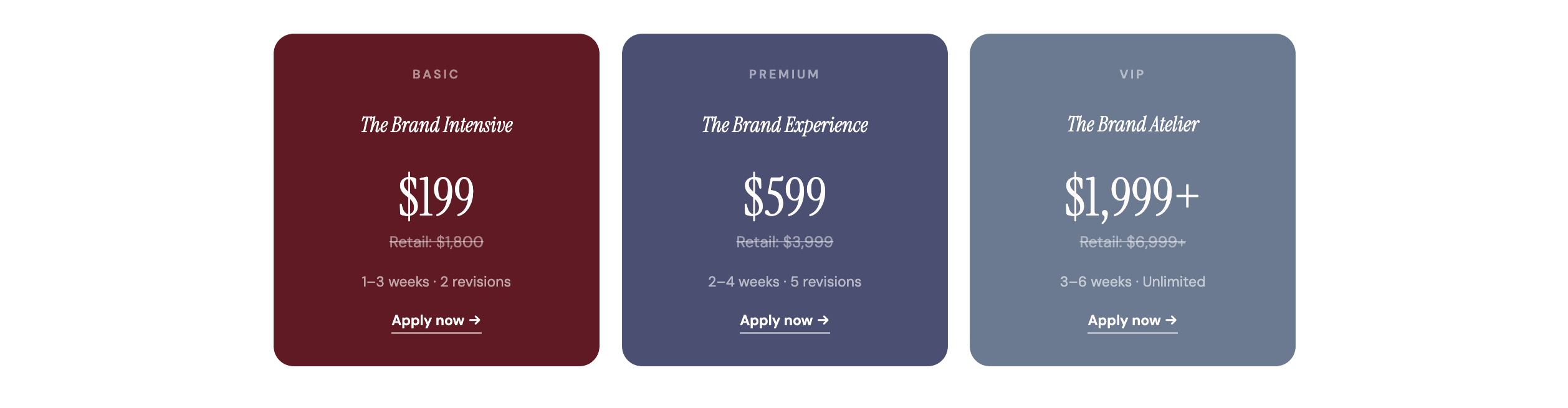
The Brand Intensive ($199, retail $1,800) — the clean, complete foundation. Three logo variations, a full color and typography system, your Substack cover, five article cover templates, an article graphics kit, newsletter graphics plus one layout, and the Brand Guidelines and Brand Board every package includes. Two revisions, delivered in one to three weeks.
The Brand Experience ($599, retail $3,999) — the most popular tier, and the full system. Everything in Basic, six logos including a favicon, twenty article cover templates, thirty Notes graphics, seven lead magnets, a full social media kit, and a brand strategy and voice layer built in. Five revisions, two to four weeks.
The Brand Atelier ($1,999+, retail $6,999+) — everything, including the editable source files, for a brand built to keep growing with you. Nine logos in every format, thirty-four pre-written posts, a DIY Rebrand Bundle, a fifty-piece social mega kit, and a full strategy document. Unlimited revisions, three to six weeks.
The Brand, Tailored — scoped and priced around exactly what you need, mixing deliverables across tiers. Good if you’re starting fresh or just filling specific gaps. Price confirmed before any work begins.
This is the first time this service has been offered for Substack specifically. Three spots are open at significantly reduced pricing in exchange for a detailed testimonial and case study consent. The work is identical — the price reflects the newness of the format, not the experience behind it.
Three spots, beta pricing, in exchange for a detailed testimonial and case study consent once it’s done. After the beta closes, everything moves to retail, and beta clients keep a permanent 20% discount on any future rebrand.
Not to sound too dramatic, but I’ve researched and complied a list of over 240 Substack ideas categorized by every niche listed in this post. These arent full fledged ideas you can base your entire substack on, but starting points (or even a push) towards finding something your passionate about creating/writing here on Substack thats both profitable and fun. Grab the masterlist below:
I know this is my first post in a while, I’ve had a totally unpredicted (read: chaotic) 2 and a half months. Juggling between university, restarting my store, rebranding Champagne Muse and a new internship (At Apple, if I may.) I’m way behind schedule on my newsletters, posts and any collaborations I’ve had planned... But i know I’ll be back on track soon. So here is the first post after my unplanned hiatus, and next week I’ll be bringing to you a slightly more exciting one ;)

Comments
Nothing yet. Say the first thing.
Sign in to join the conversation.