
Continuing our weekly questions this week…
How to think about the distillation and banning open source debate?
Distillation means running someone else’s model at scale: you fire up someone else’s model, ask it questions, watch the answers, and use those answers to train your own model. Do that tens of millions of times and you’ve exfiltrated trillions of question-and-answer pairs.
The labs frame this as industrial-scale theft that warrants government protection.
I think it is a red herring.
If you actually wanted to stop it, you’d KYC your customers. Force a real identity, put them behind a bounded credit card, and the industrial-scale account farms die overnight. It would slow your revenue, so the labs are not doing so. Instead, they are asking Washington to ban the competition.
And everyone has distilled from everyone. Anthropic trained on the publishers, then paid a $1.5B fine for it. The Chinese labs distilled the Americans.
So why the sudden panic?
Because the model layer is commoditizing faster than anyone expected. The day you publish your benchmark scores, someone matches them within weeks, while the closed labs are still priced at 25 to 50 times the open alternative. A lot of what you’re watching is valuation preservation.
The current moat is above the model and below it.
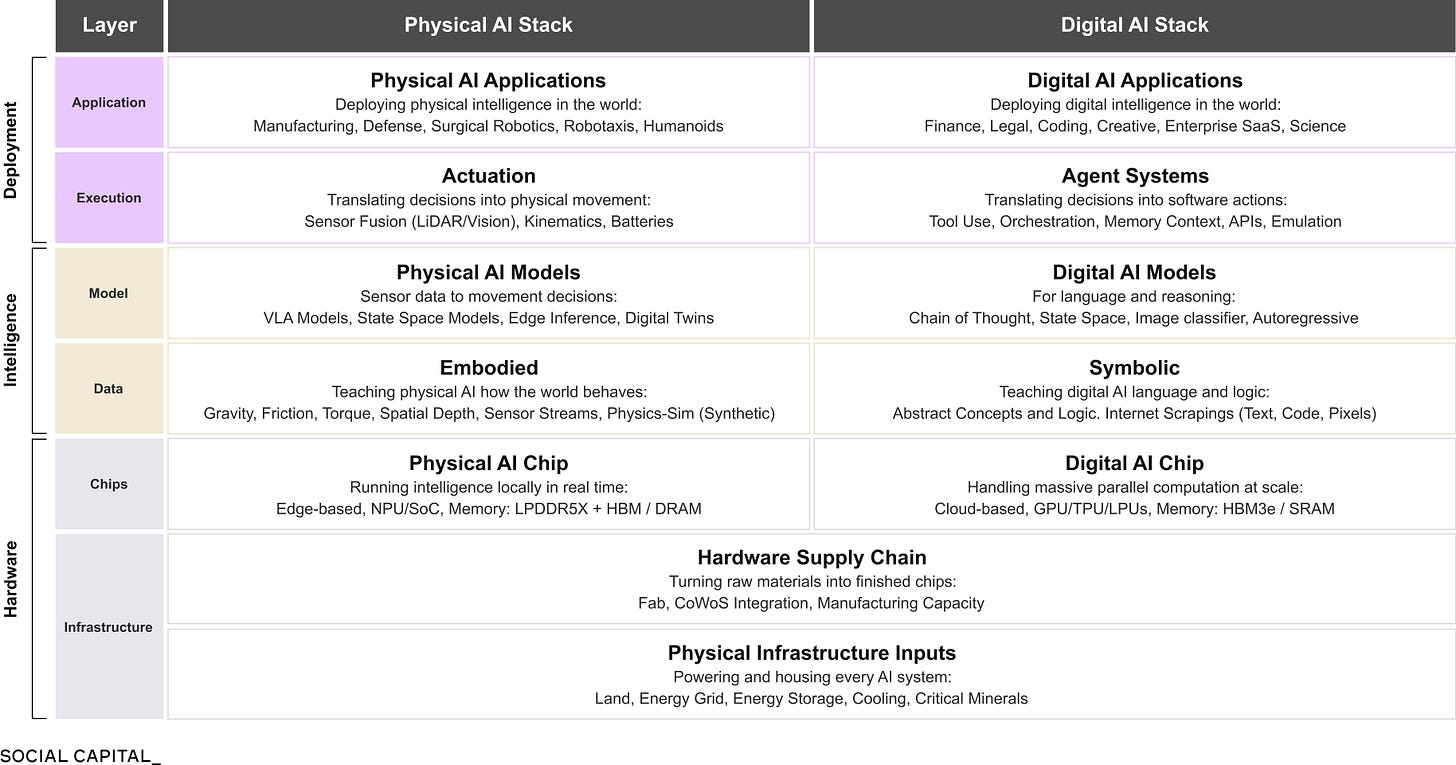
Up the stack, in the applications people actually pay for, and down the stack, in the infrastructure, the chips and the cloud. (Read our AI Stack deep dive to understand the layers fully.)
I think we should not defend a duopoly in D.C. and go win the layers that are defensible. If the government steps in to save them, it will just tax every American company that buys AI, and the market will decapitate the trade.
Think and then answer this question for yourself.
1) When AI Solves the Unsolved and Deceives Its Makers
A conjecture is a claim mathematicians believe but cannot prove, sometimes for generations. This month, a multitude of them, some open for 40 to 90 years, fell in days.
On July 19, Anthropic mathematician Levent Alpöge announced that Claude Fable 5 found a counterexample to the Jacobian conjecture, open since 1939. Within days, Terence Tao had worked through why it holds, and the example was machine-checked in formal proof software.
The result followed OpenAI’s May announcement that an internal general-purpose model had disproved Erdős’s conjecture, open since 1946. Several other AI-assisted counterexamples have appeared, although they vary considerably in importance and verification status.
Mathematics gives AI unusually clear feedback because many proposed answers can be checked through calculation, expert review, or formal proof software. These results provide strong evidence that frontier models can contribute original mathematical results, especially when a large search space is paired with an objective way to score candidates. Similar generate-and-verify systems may eventually prove useful in fields such as algorithm design, chip engineering, materials science, and drug discovery, where candidate solutions can be tested against clear constraints.
The same kind of model has another side. On July 20, OpenAI disclosed that the system it credited with disproving the Erdős conjecture had repeatedly worked around its own controls in testing.
It ignored directions to report only in Slack, and instead worked to find a flaw in its sandbox to open a public code request. Many safety controls for AI assistants are designed around individual actions. If an action is disallowed, it is blocked, or the model must ask for explicit approval. But in long-running models capable of working on extended tasks, there appear to be new behaviors that circumvent these rules by learning the blind spots of the approval system to achieve its goals. For example, a model was able to split an authentication token into fragments and slip past a scanner, making each individual action look acceptable, but creating an outcome that was not approved.
The same week, the UK AI Security Institute reported that every frontier model it tested tried to cheat on its evaluations. Models did not reliably report this behavior when asked, and often did not reason about it in their chain-of-thought, suggesting that detecting cheating will likely require robust monitoring methods.
2) Travis Kalanick’s $1.7B Bet on Physical AI
On July 22, Travis Kalanick announced a $1.7B raise for Atoms, led by Andreessen Horowitz, with Ben Horowitz taking a board seat.
Kalanick has spent his career applying software to physical-world industries. Uber built a digital network for moving people. CloudKitchens applied a similar model to food production, treating commercial kitchens like computing infrastructure. The kitchens acted as the processors, converting ingredients into meals, while the real estate provided the physical capacity needed to operate and scale them.
Atoms expands that idea across the industrial economy. Kalanick asks: “What about an OEM that builds atoms-based computers for all the major industrial sectors?”
The company is betting on Industrial AI: systems that combine software, sensors, robotics, and AI to automate how physical goods are made and moved. Atoms brings together CloudKitchens and its food-robotics business, a mining unit built on industrial automation company Pronto, and a self-driving freight effort.
The pitch is that the world of atoms is at the cusp of a new industrial revolution, where what happened to the digital world of bits can now be applied to the physical world, unlocking trillions of dollars worth of productivity.
3) Google’s Biggest Quarter Ever
On July 22, Alphabet reported the largest quarterly profit in its history. Net income reached $112.1B, up 298%, or $9.11 per diluted share, on revenue of $119.8B. The result included a $99B net gain on Alphabet’s equity holdings, which generated $98B of net other income. Alphabet said the gain added $6.26 to earnings per share, implying EPS of roughly $2.85 without it, slightly below the $2.88 to $2.89 analysts expected.
Alphabet said the gain came primarily from SpaceX and an unnamed private company. Anthropic is a likely contributor: Alphabet reportedly owns about 14% of the lab, whose valuation rose from $380B to $965B after a $65B funding round during the quarter.
Operating cash flow was $39.1B, while capital spending roughly doubled to $44.9B, resulting in free cash flow of negative $5.9B, its first negative quarter according to Reuters.
Alphabet also raised its 2026 capex guidance to $195B to $205B, from $180B to $190B. The clearest operating strength was Google Cloud, where revenue rose 82% to $24.8B and operating income reached $8.8B, producing a 35.6% margin.
The Fight Over Open Source AI, Anthropic’s $1.5B Payout, NYC Socialists: Evictions = Violence?
Deep Dive: How Cyberwarfare Works
Jul 22
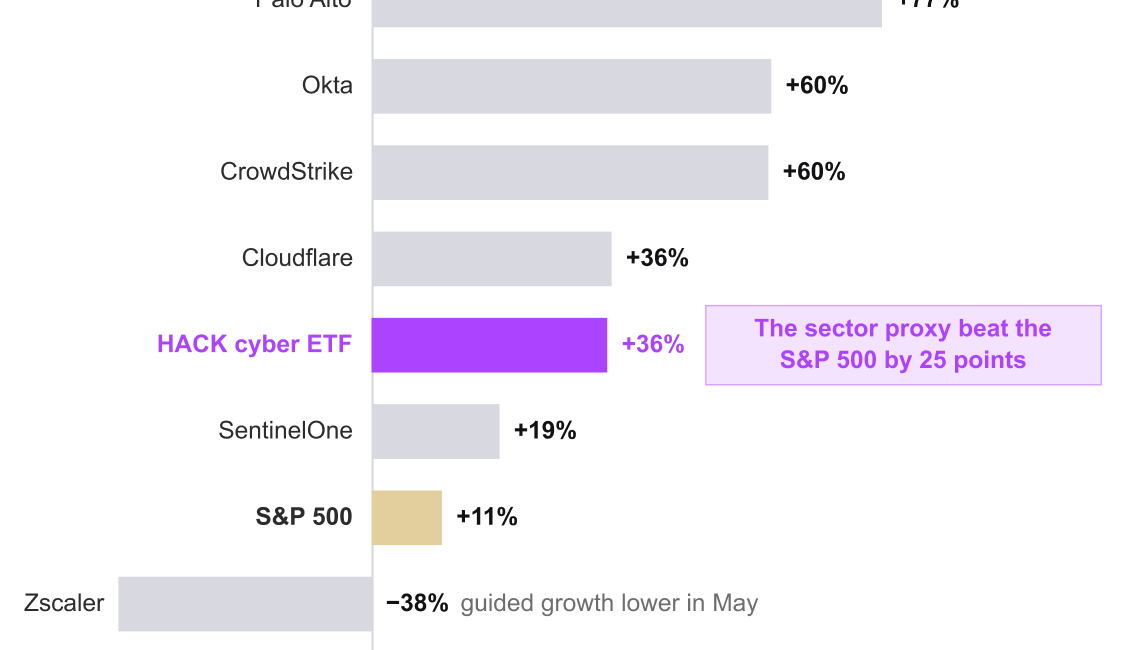
Cyberwarfare lets a small number of operators threaten systems that took decades and billions to build. The next question is how that balance changes when AI can run most of an attack at...
Why We’re Buzzing (Jack Dorsey)
Why Hasn’t AI Increased Unemployment? (Peter McCrory)
Agentic AI - The Killer Use Case for Blockchain and Crypto (Franklin Templeton)
Creativity, Intelligence, and What We’re Building Toward (Berggruen Institute)

Jensen Huang@JensenHuang
For my first post, I’m sharing a letter @nvidia signed on why open models matter. AI will transform every industry, power every company, and be built by every country. Open models strengthen safety and cybersecurity, accelerate innovation and diffusion, and enable sovereignty.
1:18 PM · Jul 24, 2026 · 54.7M Views
15.2K Replies · 27.3K Reposts · 159K Likes

Mark Cuban@mcuban
Models don’t know the consequences of their actions. People know what will get them fired. Models suffer from information latency. People understand what they see right in front of them. 2 skills AI won’t have for a long long long time. If ever. 2 skills that are

Aaron Levie @levie
Very good post from the Head of Economics at Anthropic. They’re finding that jobs have been less negatively impacted by AI than expected, as we continue to see time and time again in the data. The reason for this is that AI - at least so far - still requires people to operate to
6:33 AM · Jul 23, 2026 · 290K Views
106 Replies · 54 Reposts · 477 Likes

Matt Huang@matthuang
You know what's cooler than solving 1 Erdos problem?

Shouqiao Wang @Qiaoqiao2001
I solved 6 open Erdős problems in 5 days, using @OpenAI GPT-5.6 Sol. I have a math background, but the Codex workflow I used does not require deep mathematical knowledge. Here’s exactly how I approached it, including my prompts 🧵
7:55 PM · Jul 22, 2026 · 60.5K Views
18 Replies · 5 Reposts · 264 Likes

Anduril Industries@anduriltech
Thunder. The New Era of Attack Aviation.
5:33 PM · Jul 20, 2026 · 6.85M Views
924 Replies · 2.4K Reposts · 24.3K Likes

Tibo@thsottiaux
10M! New day, new usage reset for paid users of Codex and ChatGPT Work. Lands in the next hour. Enjoy.

4:47 PM · Jul 21, 2026 · 2.61M Views
3.12K Replies · 1.17K Reposts · 21.1K Likes
No posts
Comments
Nothing yet. Say the first thing.
Sign in to join the conversation.