
War is evil. Few statements sound more humane. Fewer yet, more evasive.
Too many crimes against humanity, too many innocent victims: children, women, the elderly. Each war, each enemy, each century.
If these words resonate with you as ultimately true, and you are not unsettled by the war being recursively attributed to itself rather than the aggressor, you are the problem.
In peacetime, in the world of academic abstractions, even when two belligerents of comparable strength and competing claims clash on the battlefield, condemning war itself is defensible. But not today. Not when this is the lens through which Moscow’s war on Ukraine is presented or seen.
When peace advocacy gets detached from the duty to act, appeasement follows. The aggressor interprets it as permission.
If the stated objective is less war but the result is more of it, what distinguishes such righteous posturing from warmongering?
Not “each enemy.” Russia. The invader.
All horrors flow from the Kremlin’s decision to commit a crime of aggression, clearly defined in the UN Charter and one of only four crimes the International Criminal Court is sanctioned to prosecute.
By any consequentialist measure, policies rooted in faux-pacifism have stimulated Russia’s appetite for war: from the brazen violation of Georgia’s borders in 2008, to the illegal annexation of Crimea in 2014, to the flooding of Donetsk and Luhansk with Russian troops and weapons, the downing of a civilian airliner, and ultimately the largest war in Europe since 1945.
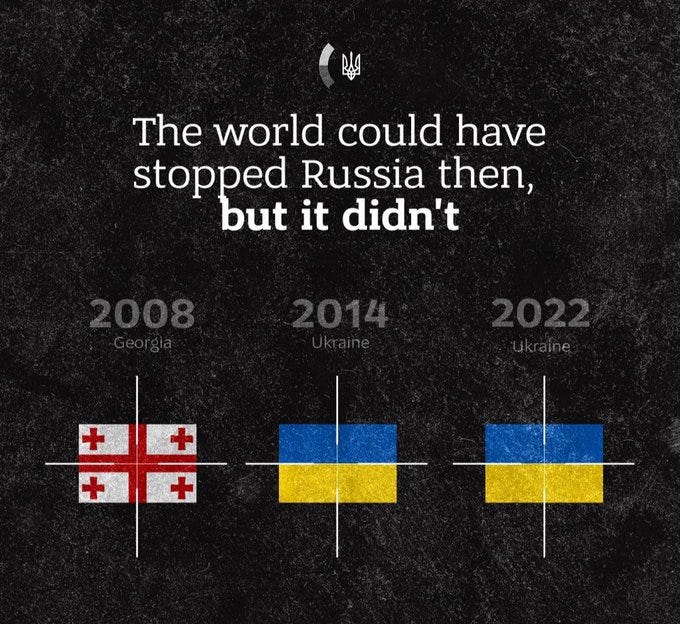
The same script, on repeat: Moscow manufactures a grievance, attacks a neighbor, and European leaders proclaim restraint as the path back to peace. More death and destruction follow. Europe’s refusal to confront reality, which in practice means confronting the threat decisively, taught Moscow that aggression pays.
Four dangerous misconceptions sustain Europe’s self-defeating reflex.
The first is that war is waged between two belligerents while good people suffer on both sides. A truism that, taken to its logical conclusion, erases the distinction between invading and being invaded. Russia and Ukraine are not the same. Russia deliberately targets and murders civilians. Ukraine, categorically, does not. The UN has found that in 2025, for every three Russian civilians killed, ninety-seven Ukrainians were.
The second is that non-violent resistance is universally applicable. When it comes to colonial conquest, forced assimilation, and ultimately the disappearance of a nation, it is not.
Postwar Europe has long wrestled with a genuine philosophical question: is defending one’s homeland a duty or a trap? When young men are called upon to kill and die for their nations, are they doing so for illusions? When these questions, valid as they are, are transposed onto Russia’s criminal war, they become a sleight of hand.
Ukrainians are not fighting for an abstraction. They are fighting because Russian soldiers crossed the border to rape and torture, to massacre Ukrainians for daring to exist. The alternative to armed resistance is not a change of flag. It is kidnapped children, filtration camps, and mass graves. Bucha, Mariupol, and Izium remove all doubt.
The third false premise is that the end of war brings betterment. History suggests otherwise. Some wars end with the aggressor defeated; some with the victims enslaved. Still others end in intermissions. The guns fall silent while injustice entrenches. Should Europe fail to help Ukraine drive out the invaders, Moscow’s present target will be left to a peace in the cemetery. And the continent – of which Ukraine is an integral part – will have to relearn history’s grim lesson: unpunished evil spreads.
The fourth is the threat of nuclear war. It is pseudo-pacifism’s strongest and weakest argument: strongest because the moral imperative of preventing human annihilation is indisputable; weakest because it fails to grapple with the very danger it invokes. Russia did not use its doomsday weapons when its army collapsed outside Kyiv, when Ukraine liberated Kherson, or when Crimea came under attack. The claim that nuclear risk rises if the West helps Ukraine defend itself mistakes intuition for evidence.
As Timothy Snyder put it: “By taking nuclear blackmail seriously, we have actually increased the overall chances of nuclear war.” Beijing, Russia’s most consequential backer, has taken a nuclear first strike off the table for the Kremlin.

While pacifists in Europe debate ethics from the safety of their armchairs, Ukrainians speak with the clarity of people who have lived under Russian fire for twelve years.
In a 2024 essay aptly titled Why pacifism kills, Ukrainian intellectuals wrote from experience rather than theory. Their argument was simple: an adversary committed to violence reads restraint as an invitation. The high-minded principles of inclusivity and open society do not survive contact with a regime that sees them as proof of decadence.
This is not an abstract debate. Russia has attacked over 1,000 healthcare facilities in Ukraine. It has destroyed 358 educational institutions through aerial bombardment. Bombed 675 churches, abducted, tortured, and murdered priests. Of the nearly 53,000 verified civilian casualties since the start of the full-scale invasion, more than 3,000 have been children.
Europe has agency and power; it should exercise both. Taurus missiles remain undelivered, frozen Russian assets untransferred, and each vacillation is dressed in the language of caution. Meanwhile, Moscow exploits Europe’s disunity. The fractures between north and south, the retreat by some states into narrow national interest at the expense of solidarity and collective defense, become a force multiplier for the Kremlin.
The willful blindness has a long pedigree. A century ago, Moscow starved millions of Ukrainians to death, and the world largely accepted the framing Moscow pushed: a famine, a terrible tragedy, an act of God. It took decades for Holodomor to be recognized for what it was -- a genocide. Decades of complacency among the academics, policy-makers, and opinion leaders morphed into complicity.
Centuries of forced russification under tsars and commissars followed the same logic: deny the crime, play the victim, wait for the world to forget. The Russian Orthodox Church, long fused with the KGB and now the FSB, has played its part in the same colonial project. What Moscow is doing today has a name, a history, and a pattern.
Russian aggression must fail, and be seen to fail. Expecting Ukraine to carry the burden for all of Europe while others retreat into half-measures is neither wisdom nor restraint. It is the surest path to the wider war pseudo-pacifists claim to fear.
A version of this article first appeared in Neue Zürcher Zeitung (NZZ), on March 27, 2026
Comments
Nothing yet. Say the first thing.
Sign in to join the conversation.