

Investor Pool: Venture capital (VC) financing gathers a group of investors aiming for high, quick returns.
Prospectus Invitation: Fund managers send prospectuses to potential investors, inviting them to participate in the investment.
Portfolio Diversification: Venture capital firms invest in numerous projects to reduce risk, avoiding putting all their capital into one project.
High Risk, High Reward: Early-stage investments can yield higher returns but also carry more risk.
Startups and Roadmaps: Startups seek funding from VCs by presenting roadmaps to showcase their product and market potential, aiming to attract investors.
Crypto Startups: Fundraising works differently for crypto startups compared to traditional ones.
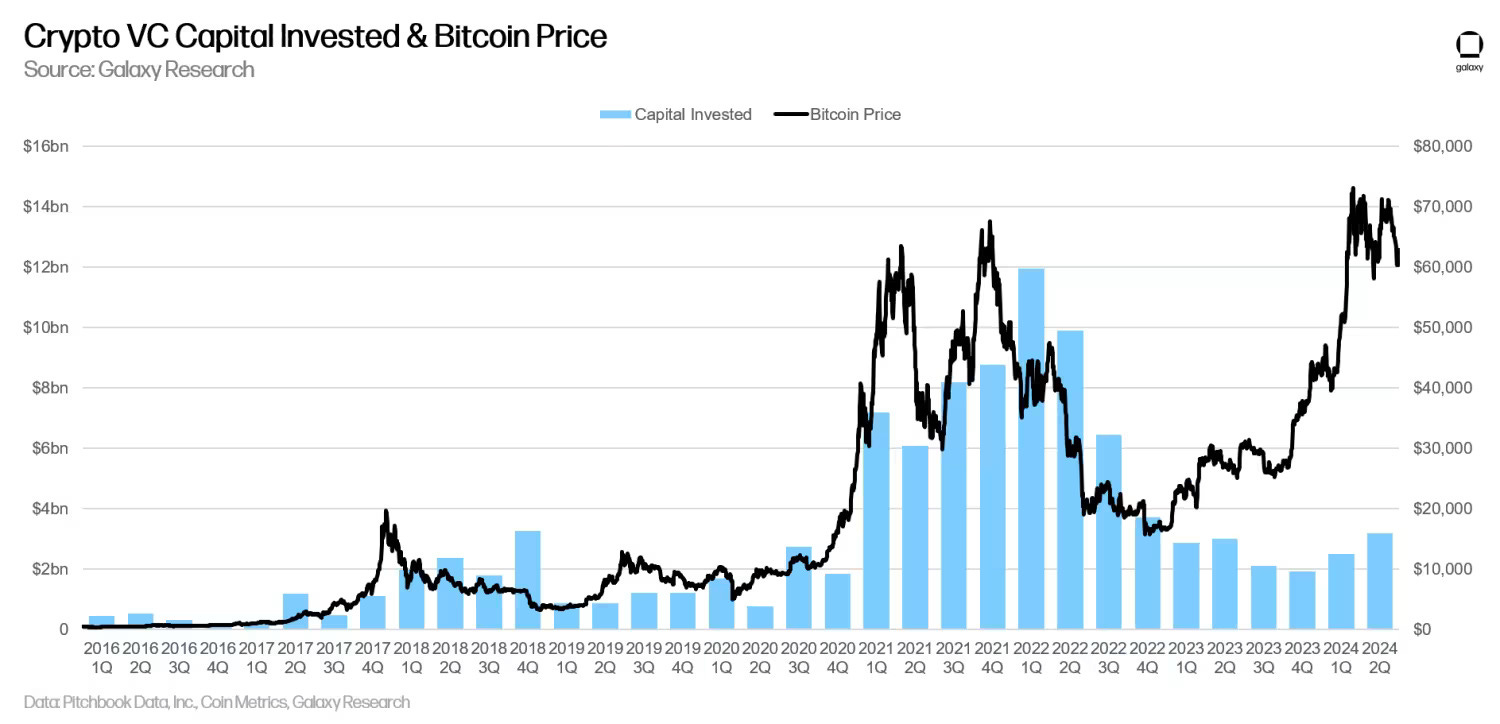
Venture capital deal count peaked in early 2022 with significant liquidity deployed into upcoming startups.
Deal counts and capital invested by venture capitals have significantly declined since early 2022.
The drop in capital invested is sharper than the decline in deal count, showing that venture capitals are investing less money in each crypto startup.
Venture capital investment in crypto startups peaked around the same time as Bitcoin’s price surge in early 2022.
Despite Bitcoin reaching all-time highs, crypto venture capital investments did not match early 2022 levels, indicating decreased interest or trust in new crypto startups.
Pre-seed: Ideation phase where funding comes from family, friends, or angel investors without equity involvement.
Seed Capital: Early fundraising for market viability testing, product development, and business growth.
Series A: Startup capital for validated products with steady cash flow, used for expansion and further development.
Series B: Early growth stage focused on scaling operations and expanding market reach with a large user base.
Series C: Expansion stage aimed at product diversification and market entry, often through acquisitions, preparing for an IPO.
Pre-Seed Stage: Focus on concept development, tokenomics, team building, and drafting the whitepaper; early funding from angel investors or blockchain ecosystem grants.
Seed Round: Capital raised from early investors to develop the project, finalize the MVP, and build traction; token pre-sales to institutional investors at a discount.
Private Sale: Tokens sold to selected investors, typically institutional investors or crypto funds, often with better terms for early backers.
Public Token Sale: Involves retail investors raising significant capital through ICOs, IDOs, or STOs, offering tokens to a wider audience.
Post-Fundraising Operations: Focus on product development, token exchange listings, and ensuring token utility while achieving roadmap milestones and engaging the community.
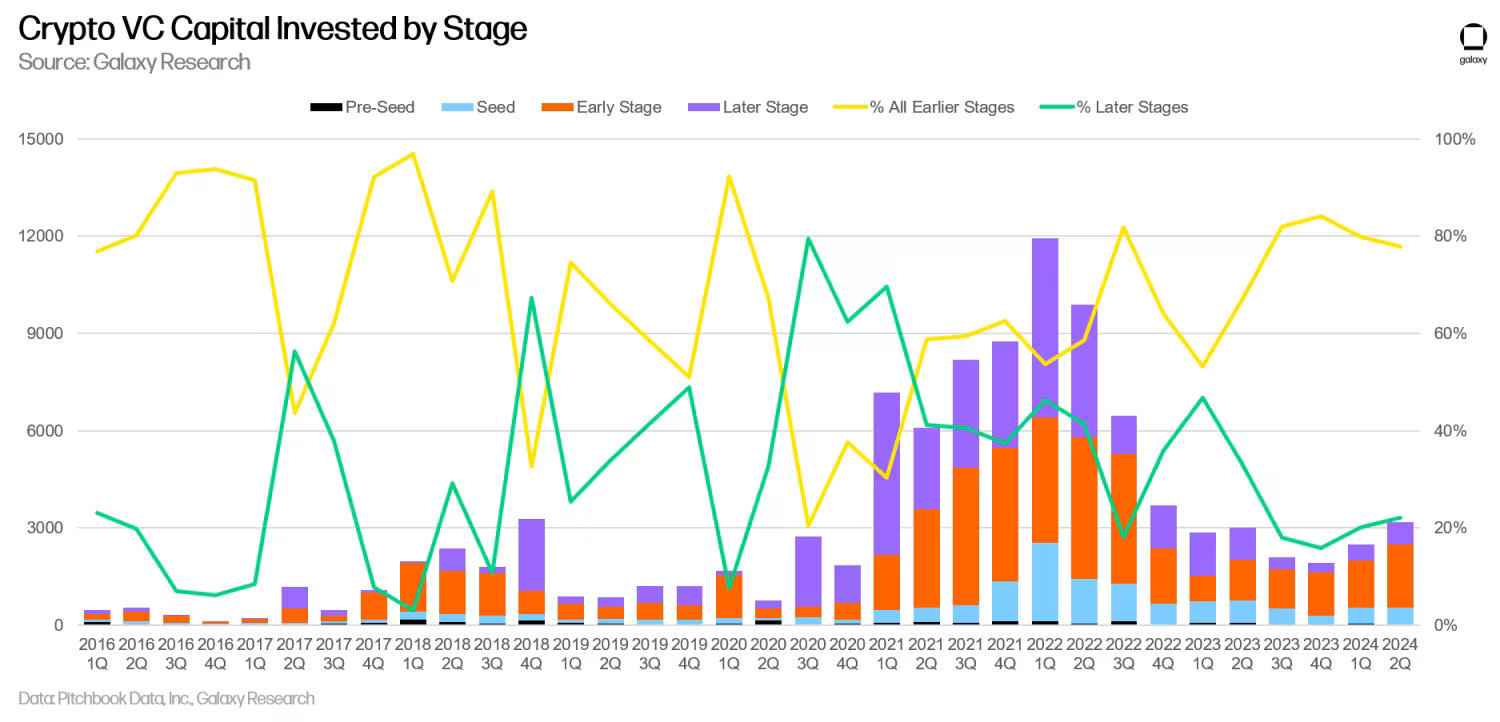
After mid-2022, crypto venture capitals invested significantly less capital into later-stage startups.
VCs view crypto as a high-risk, high-reward investment, preferring early-stage investments for cheaper equity and more potential gains.
The risk-to-reward ratio in later-stage investments has become less attractive to VCs.
Common VC strategies include selling shares to other investors for an exit and capital gain.
Selling shares at a high price in later-stage companies can be more challenging in some cases.
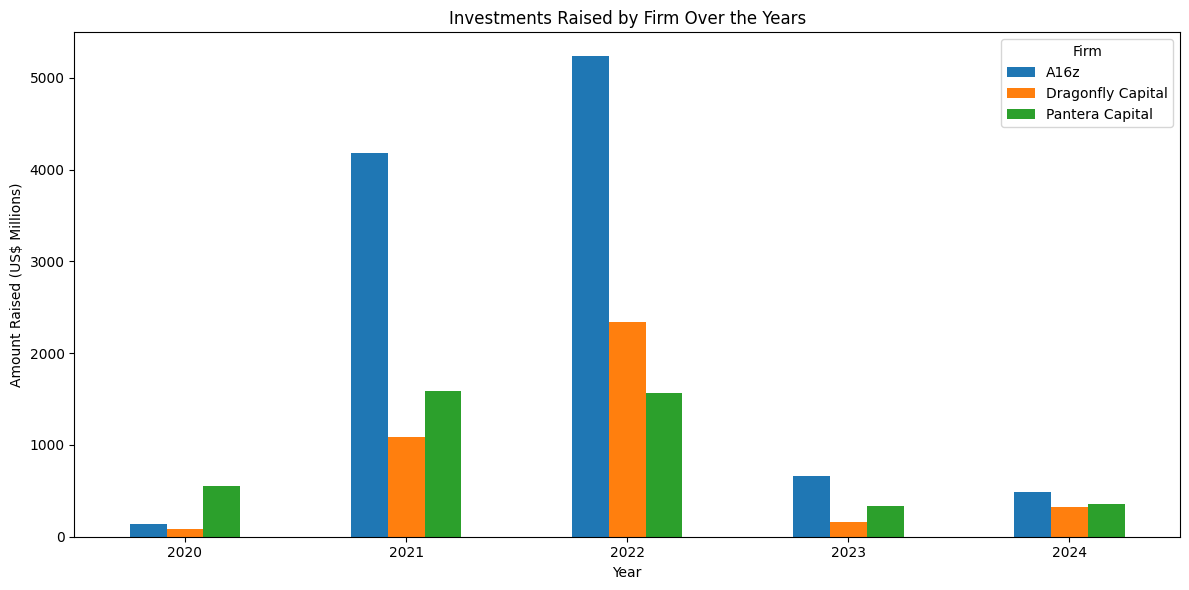
Notable venture capital firms like A16z, Dragonfly Capital, and Pantera Capital have invested in major crypto projects.
Demand for crypto investments peaked in 2022 and has declined since then, as seen from the investments raised by these firms over the years.
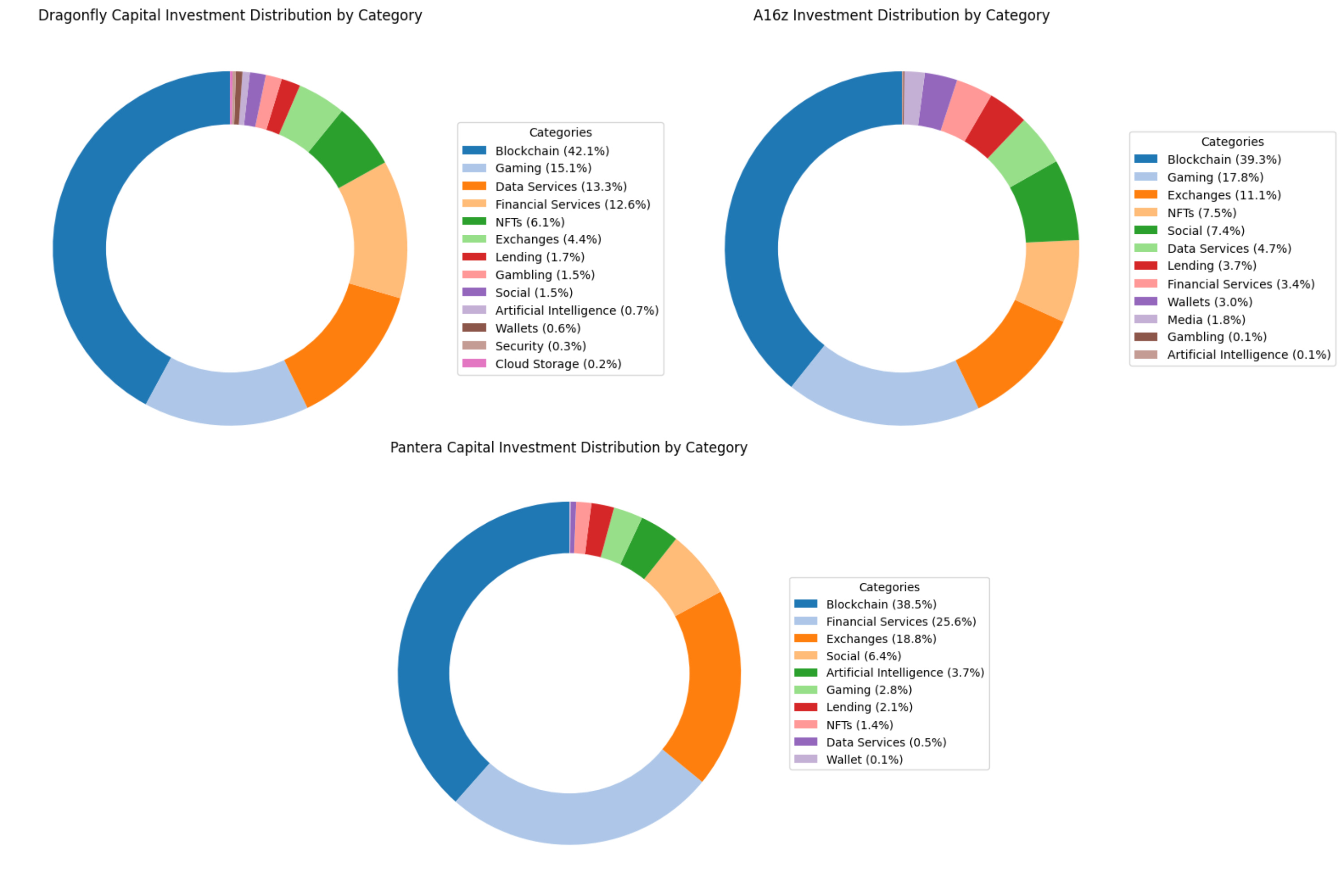
Popular investment categories for venture capitals include Blockchain, Financial Services, Exchanges, and Data Services.
The key question is why venture capitals are no longer investing as heavily in these sectors.
Venture capitals are still investing in crypto projects but with less exposure than before.
Market Volatility: The crashes of 2022 and 2023 increased caution among VCs, especially for early-stage crypto projects seen as high-risk.
Shift to Safer Assets: Many VCs are focusing on more stable investments like Bitcoin and Ethereum, which offer returns with less risk than early-stage startups.
Shift in Focus: VCs are now selective, targeting sectors with long-term growth potential, such as AI-related crypto projects and infrastructure, while speculative projects like NFTs and meme coins have lost funding.
Regulatory Uncertainty: The unclear regulatory landscape, particularly in the U.S. and Europe, has led VCs to hold back on significant investments until regulations become clearer.
Despite current challenges, the future of the crypto industry is promising, with emerging projects harnessing blockchain technology to solve real-world problems.
Key sectors leveraging blockchain include:
Artificial Intelligence (AI)
Decentralized Physical Infrastructure Networks (DePIN)
Tokenization of Real-World Assets (RWAs)
Decentralized Identifier (DID)
Web3 Gaming
Blockchain improves security and scalability for these technologies.
Tokenization of assets via blockchain enhances liquidity for traditional assets, making them more liquid and easily tradable.
Crypto AI projects like Bittensor and Render integrate AI with blockchain for decentralized computing and data management, gaining traction in the space.
Decentralized AI addresses issues in centralized models, such as data control, lack of transparency, privacy concerns, and bias, by distributing data across nodes and promoting data democratization.
Decentralized AI models incentivize participants to contribute computing power, improving efficiency, scalability, and transparency through blockchain's public ledger.
Decentralized Physical Infrastructure Networks (DePIN) use blockchain to decentralize infrastructure like data storage and energy grids, enhancing transparency and accessibility.
Traditional infrastructures are centralized, leading to inefficiencies and monopolies, while DePIN allows communities to manage infrastructure democratically.
DePIN incentivizes users to contribute resources, enabling peer-to-peer transactions such as securely trading excess solar power with neighbors.
Tokenization of assets like real estate or commodities increases liquidity, accessibility, and transparency by representing them as blockchain tokens.
Blockchain enables fractional ownership, allowing smaller investors to participate in high-value assets like real estate, simplifying trading.
Blockchain’s immutability ensures secure record-keeping and reduces fraud in asset trading, making transactions safer and more efficient.
Traditional identification systems are centralized, putting personal data at risk and limiting individuals' control over their digital identities.
Decentralized Identifiers (DIDs) allow individuals to create and manage their digital identities independently, stored securely on a blockchain.
DIDs enhance privacy and security by allowing users to selectively share identity information, reducing reliance on centralized authorities.
Traditional gaming platforms are centralized, with developers owning all in-game assets, limiting players' ability to trade or retain ownership of their digital assets.
Blockchain enables the creation of NFTs representing in-game assets, allowing players to trade, sell, or transfer their assets outside the game and retain ownership even if the game shuts down.
Decentralized platforms like Solana offer scalable, low-cost infrastructure for blockchain-based games, giving players more control over their digital assets and creating new in-game economies.
No posts
Comments
Nothing yet. Say the first thing.
Sign in to join the conversation.