
Writers have conflicting advice when it comes to the use of the speech tag “said.” A number of folks, particularly on Instagram lately, have argued that writers should vary up their speech tags, in much the same way you’d vary your adjectives, verbs, and nouns.
The argument against “said” goes: Why use “said” over and over when you could be mixing things up and using “declared,” “replied,” “announced,” or other verbs?
That said, most of the books on novel writing I’ve read have been pro-“said.” The one that immediately comes to mind is Good Writing by Neal Allen and Anne Lamott. It shares 36 ways to improve sentences and rule #4 is “Stick with ‘Said.’” While not technically a ranked list, the earliest rules do seem more fundamental, so it being #4 is saying something.
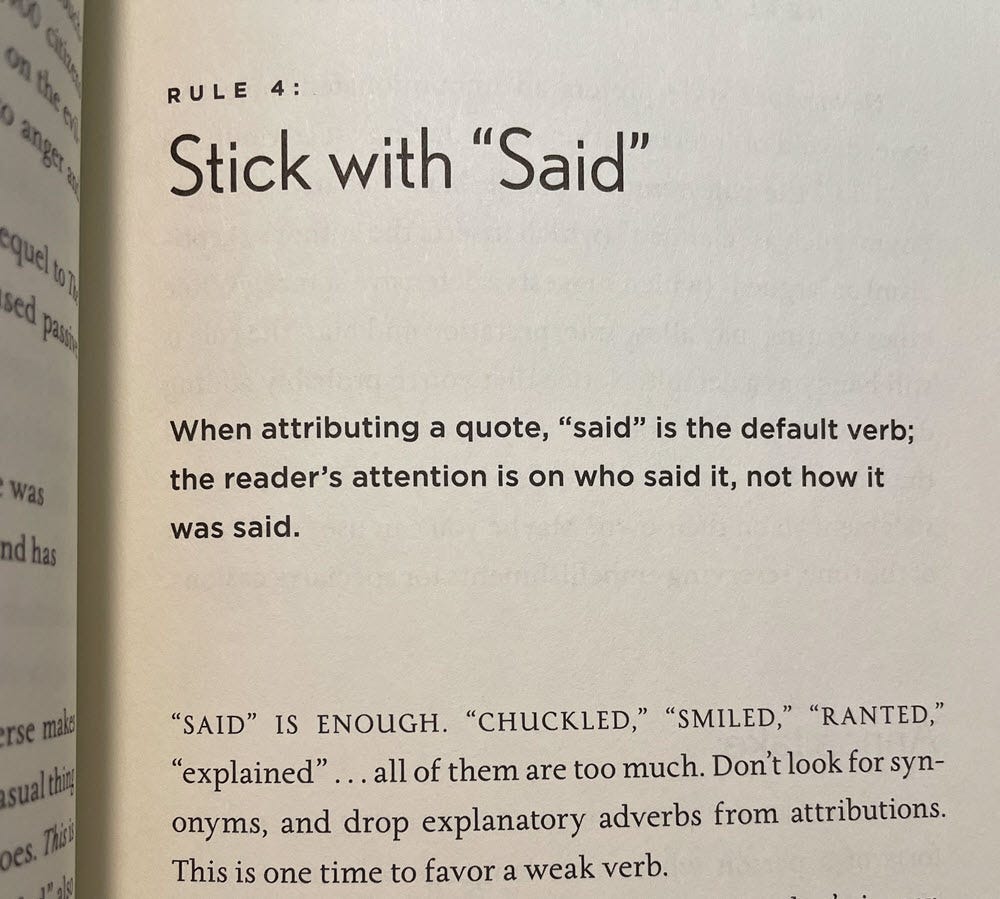
Others have argued that “said” is so common and so expected that it’s functionally invisible—like an article or conjunction.
Like myself, Allen is a former journalist, so this rule makes a lot of sense to me. “Said” is neutral and unbiased, which is important in journalism. Embellish the speech tags on quotes and you’re editorializing.
That said, novels aren’t journalism. And as with most of Neal’s rules, Lamott delivers some counterpoints, arguing in favor of some “said” alternatives like “mumbled” and “whispered,” for example. I agree with Lamott that speech tags like those that tell how a statement was physically delivered are useful.
But here’s the part in Neal’s argument that really resonates with me. He says, “Why not let the reader interpret the character’s statement all on their own?”
That feels like the general rule about choosing strong verbs so you don’t have to use adverbs. For instance, if you have to say, “he quipped,” then perhaps it’s not a good quip.
To bring in the adverb angle, that’s in the same vein as “he said snidely.” The character’s words, body language, and context should convey his snideness without you having to say so.
So, where do I come down on this issue in practice? I did a quick search for speech tags in the manuscript for the first book in my dystopian sci-fi trilogy (Project: T.A.G.), which has been seen by a developmental editor and copy editor. Here’s a partial breakdown:
says: 657 instances
asks: 31
whispers: 20
replies: 16
announces: 8
barks: 7
declares: 6
mumbles: 4
coos: 2
responds: 1
remarks: 0
You can see I’m solidly in the present tense of the “said” camp, but not an absolutist. “Asks” feels similarly invisible to me. “Whispers,” “announces,” “mumbles,” and “declares” bring a little color to the physical manner in which things were said. The “barks” are mainly associated with one character, and the “coos” with another, so those are part of characterization.
I also did a quick check of the very first draft of my manuscript and found that my latest version has 10% fewer speech tags overall. In most cases, I was able to replace speech tags with action beats that established which character is currently acting, rendering the speech tag unnecessary. While “said” is quite invisible, being able to eliminate a speech tag altogether is even better.
Do you prefer “said” or do you like to aggressively vary your speech tags or do you fall something in between?
Related posts:
Good Writing: An Evening with Anne Lamott & Neal Allen
‘Write what you know’ is too limiting
For more, visit ChadSWhite.com. To receive future posts for free or to become a Patron and support my dystopian sci-fi novel and get special thank-you goodies upon its publication…
No posts
Comments
Nothing yet. Say the first thing.
Sign in to join the conversation.