
WARNING: This little paen to my two favorite bird dog breeds — which was originally published elsewhere long ago — is above all a humor piece, but it does contain opinions: some actual, most firmly tongue-in-cheek. If you read it and disagree with a chuckle, that was the intent. If you read it and then wish to track me down and whip my ass as your insulted dogs look on approvingly, well, you may need to work on your sense of humor. And by work, I mean find one…
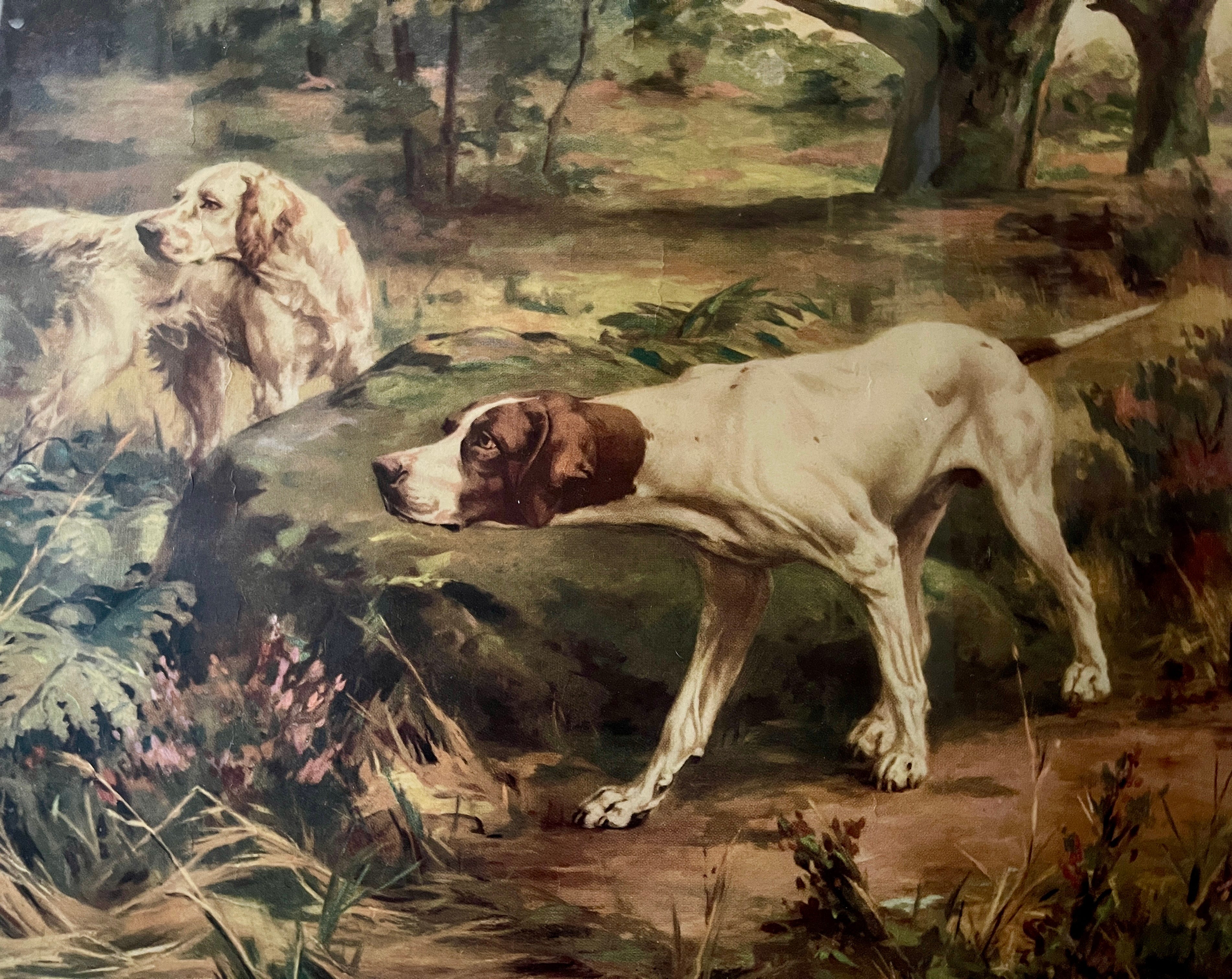
Above my desk hangs an old print. I have no idea as to its actual age, but the paper exhibits the dull, yellowed patina of many years now passed, and the scene depicted upon its surface is faded and washed out.
Neither the art itself nor the subject matter it depicts is new, crisp, vibrant, or trendy. But it represents something dear to me, and something which I think more upland hunters should be holding dear to them, too, not only for its historical significance, but the fact that it represents what I believe are the two best canine tools for pure upland bird hunting ever produced.
And what are these paragons of pointing breeds of which I wax so loquaciously? What scene is depicted on my wall? It’s a vintage scene of two dogs in tandem; the OG bird dog breeds that came before all others, and in my mind — and the minds of many others — still stand head and shoulders above the pack when it comes to being just flat-out, balls-to-the-wall bird-finding superstars: The English setter, and the pointer (no “English” please, just “pointer”).
Now, I am not here to disparage any other breed. Unless of course you’re into dogs that grow beards, in which case let’s face the ugly truth (so to speak): you asked for it...
I kid! I kid! In truth, there are no wrong choices. Your choice of dog is yours alone, and there are a host of variables, needs, and circumstances unique to each of us that go into that decision.
But there are better choices. And what I’m saying is that all other things being equal, you will not find a pointing breed that outperforms a setter or pointer in the singular task of finding and pointing birds. And while you may find their equal as pets and household companions, you won’t find their better in that regard, either.
The modern pointer and English setter are the ultimate bird-finding canine athlete. That’s what they’ve been bred to do for hundreds of years. Nothing else. No fur, no blood tracking, no detours to track and kill racoons, opossums, coyotes, rabbits, or the occasional housecat. Having a “great prey drive” is meaningless if that prey drive includes not just birds, but literally any multi-cellular lifeform.
When you own a pointer or setter there are no worries of unprovoked ancillary bloodshed. In the field there is no distraction from the singularity of the task. Pointers and setters are superlative in the purpose for which they were bred, and they are pure poetry in motion either gliding across the prairie or floating through the trees. All they do is eat up ground, find birds, and look damn good doing it.
But being a great bird dog is not enough: They must be good companions, too. And this is where setters — but especially pointers — have been the victim of some of the most ridiculous bullshit spouted by social media “experts” who may have seen a pointer, once, in their lives and decided to repeat the same tired garbage they heard from the last no-nothing upland “influencer” in that vast, shallow, cacophonous confirmation of the Dunning-Kruger effect called social media.
The fact is, pointers and setters are as personable, goofy, outgoing, and loving as any other dog breed, and more so than many of the breeds that are currently trending with the Instagram Cool Kids crowd. I’ve got two sleeping pointers at my feet as I type this to prove it.
I’ve also heard the arguments about setters and pointers, but especially pointers — and ESPECIALLY dogs with field trial lineage, as many pointers and setters do — as being “too much dog” for the average person.
I simply don’t know what the hell that’s supposed to mean. You mean they find birds too well? They like to hunt too much? It’s nonsense and gibberish spouted by people who have zero experience with the breeds. Personally, I’ll take “too much dog” over too little dog any day of the week.
Here’s another one you hear ad nauseam from the social media experts, especially about pointers: “Field trials have nothing to do with hunting, and those field trial dogs don’t have any personality and can’t find birds in real hunting situations. They’re just bred to run.”
An entire feature story could be written about the inanity of that statement. I don’t have the word count to do it here, but suffice it to say if you hear that statement come from the mouth of someone you’re getting advice from, get better advice, and quickly.
There are any number of excellent reasons why for decades — centuries, even — when you said “bird dog” what you meant was a setter or a pointer. In recent years, however, setters, and especially pointers, have been supplanted in popularity by other, lesser breeds. There are a variety of reasons — all spurious — for this trend, with the emphasis on “trend.”
You see, bird hunting is a world of trends. What we gravitate toward as individuals simply tends to reflect the larger societal patterns of groupthink. The viral herd thunders ever-forward toward the next Big Thing: The hottest new vest, the coolest new gun, the hip new location or bird to hunt, but especially the super-cool, trendy dog breed to own.
And in recent years there have been a number of breeds that have become more popular than either the traditional pointers or setters. But after hunting over, watching in the field, or just being around many of these allegedly wunderkind breeds, I am utterly gobsmacked as to why.
Why, for crying out loud, would you choose a breed based not on performance and potential, but on the trendiness of popularity, social media peer pressure, and the advice of internet experts?
The fact is — and I’ll argue this all day long — is that you are far more likely to get a great-performing bird dog out of a setter or a pointer (and if I’m honest I’d include the GSP and Brittany in that group as well) than you are from some obscure breed that was originally used to hunt, I don’t know, Icelandic hoary hens, or was originally bred to sniff out truffles, or fight Roman gladiators, or serve as the King of Prussia’s personal canine bodyguard, but is now being touted as the be-all, end-all by people who are trying desperately to adapt these dogs to the American uplands.
There is something of a youth movement afoot in the upland world these days. There are a ton of younger, new, newish, or new-adjacent bird hunters out there. And that is a wonderful thing to behold. Some are still on their first dog, or perhaps their second. Many of them are still searching for their first dog. My point is, there are a lot of bird hunters out there who, quite frankly, have not seen a ton of different dogs work or play.
And if the Wire-Bearded Schnutzen Hound is truly the right choice for you, then by all means, get one.
But I cannot state this any more plainly: If you want the best chance of getting a dog that will find you birds, regardless of where or what you hunt and where or how you hunt, and if you want a dog that will also make a fantastic family companion, dispense with the It Dog of the Moment and go find yourself a pointer or an English setter.
You won’t be sorry. You’ll just find birds.
Comments
Nothing yet. Say the first thing.
Sign in to join the conversation.