

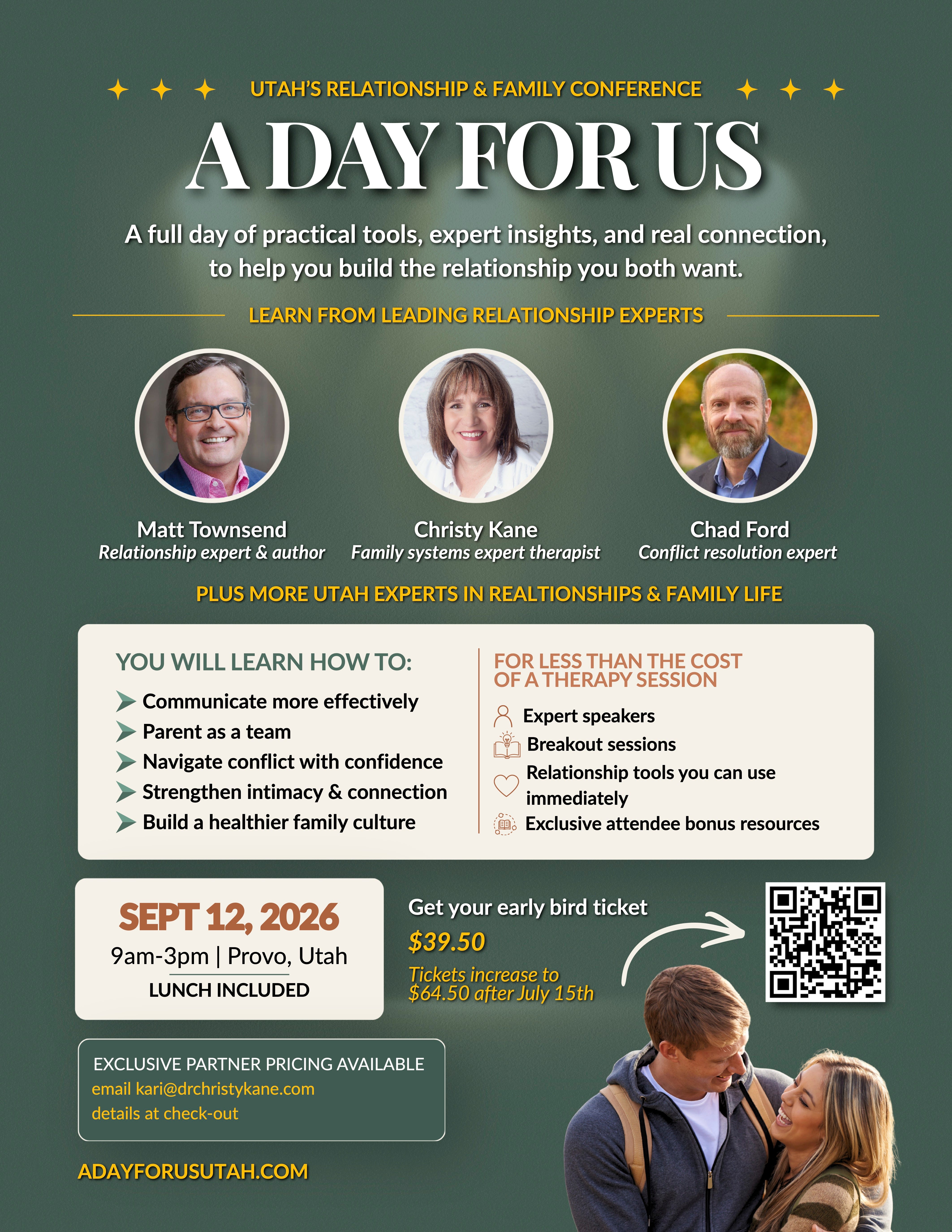
On September 12, I’ll be delivering a cool workshop at A Day For Us, a one-day relationship and family conference at Rocky Mountain University in Provo, Utah.
The conference runs from 9:00 a.m.–3:00 p.m. and is designed for couples, parents, and individuals interested in practical approaches to strengthening relationships, communication, and family life.
The title of my keynote starting at 10:15 am will be “Peace Talks for People Who Share the Bedroom,” and I’m going to turn a keynote into a practical workshop to address something that often causes the most pain for the people I work with — conflict in their marriage or with their partners.
Over the years, I’ve spent time as a conflict mediator, trainer, and coach who has worked with everyone from government officials in the Middle East to CEOs in the boardroom. However, wherever I go, inevitably, things get personal. It turns out that as important as geopolitical conflict and corporate conflict are, nothing causes pain quite like the pain people experience when they are in destructive conflict with someone they love.
And the truth is, relationship conflicts are the one type of conflict that we actually have so much control over. Politics and large corporations are like trying to turn large aircraft carriers. Relationships? It may feel impossible; however, there are effective tools that can start transforming a relationship in days.
This reminds me of a story (edited here for length) that I told in my book Dangerous Love: Transforming Fear and Conflict at Home and in the World:
A number of years ago I was invited to do a conflict transformation workshop in Ramallah in the West Bank. The audience comprised a number of Palestinian government officials.
Everything I had prepared seemed insignificant compared to the challenges they were facing.
“What was the point of conflict transformation workshop for a conflict that has no chance of ever being transformed?” a Palestinian official asked.
His comments weren’t new to me. I encounter them wherever I go in conflicts big and small.
“Can I ask you a question?” I said to the government official. “How has the conflict between Israelis and Palestinians affected your people? What sorts of challenges does it create?”
There was no shortage of answers. Fear, poverty, restriction of movement, resentment, and revenge were all popular responses from the officials in the room.
“I don’t know what you were expecting today, but I wonder, how many of you thought that in ninety minutes, we were going to solve the Palestinian-Israeli conflict?” I said with a grin.
The room erupted in laughter. Of course no one thought that.
“How about this then,” I said. “Can you tell me how the split between Palestinians—the split between Fatah and Hamas—how that has affected your life?”
Fatah and Hamas were the two dueling political parties in Palestine. They hated each other as much or more than they hated Israelis.
Again, the room was filled with depressing stories—stories of villages and families torn apart, hatred of their own kind, the inability to project a united strong front to Israelis. The civil war happening underneath the bigger war—the war in the community—had pushed them even further away from peace.
“Do you think, in the next ninety or so minutes, we can solve the Fatah-Hamas rift?”
Again, there was laughter. One man commented that between the two, peace between Muslims and Jews was easier than between Fatah and Hamas.
“Tell me about Ramallah,” I continued. “You are all living here in this city. How has the conflict affected everyday life in Ramallah?”
The situation, believe it or not, became direr as they recounted the day-to-day struggles of living. Poverty was widespread. Educational institutions were poor. More and more people were turning to radical philosophies to make some sort of meaning out of the madness. Their children, especially, were bearing the brunt of the conflict.
“You know what I’m going to ask next,” I said with a chuckle. They laughed harder and didn’t even wait for me to ask.
“No, we aren’t solving the problems in Ramallah today.”
“I think you are right,” I said, relieved. “What about your families? Your families specifically? How has all of this—the problems with Israelis, with Fatah-Hamas, and in Ramallah—affected you as fathers and husbands?”
There was a long pause. The men’s eyes were focused on the ground. One by one these men talked about difficult marriages, problems with kids, long nights where they wondered how they were going to provide a bright future for their family.
There was so much pain in the room. I’m always struck by how much pain there is in the room.
“We may not be able to fix the Israel-Palestine conflict today. Nor will we be able to make a dent in the Fatah-Hamas one. Even the problems in Ramallah seem foreboding right now. But our homes, do you think there’s something we could do, today, to influence peace in our homes?”
Now, on most days, I could expect that the answer to this would be something along the lines of “Not until my wife changes!” or “Not until my kids start respecting me!”
But that wasn’t the case this day. These men were desperate to do something—anything—to make the world they lived in a little better for their families. They wanted to do something. They wanted to turn first.
And in that moment of deep reflection, so did I. Some relationships in my life weren’t right either. How could I ask for changes from others that I wasn’t willing to make myself?
We spent the next hour talking about: our fear of conflict, the difference between seeing people as people and seeing them as objects and what that looked like at home. We talked about collusion and conflict escalation. We talked about the type of reconnection and reconciliation that happens when we let go of our justifications and reach out, with dangerous love, to those we are in conflict with.
We told stories of wayward children and how we had messed them up. We waxed on about our mistakes. We refused to cede responsibility for them to the circumstances or people who invited us to make those mistakes. We spoke of dangerous love.
An hour later, all of us had resolved to turn first, to love more dangerously. As the workshop ended, we exchanged hugs.
For the first time, in a long time, people left the room with hope.
On September 12th, I’m going to be sharing with you the same thing I shared with them. If you are struggling in a marriage or romantic relationship and are running out of hope, I hope you’ll consider attending. I believe most relationships, with the right conflict tools, can turn from our source of greatest pain to our source of greatest joy.
My workshop won’t be the only one. There are a number of amazing speakers and workshops to help with all sorts of relationship challenges.
The day includes two other keynote sessions:
Dr. Matt Townsend — “Feeding the Seven Basic Needs of Healthy Relationships”
Dr. Christy Kane — “The Work of Becoming Safe for Each Other”
Participants can also choose from breakout sessions addressing several common challenges in relationships:
The Moment I Lost You (And How We Find Our Way Back)
From Triggers to Intimacy: How Safety, Shame, and Trauma Shape Connection
After the Rupture: Healing Betrayal and Rebuilding Trust
Money and Attachment: Why Couples Cope So Differently with Financial Stress
Building a Home: The Psychology of Pornography and Lasting Intimacy
When Nervous Systems Collide
Better tools for navigating conflict.
Clearer communication skills.
A deeper understanding of relationship patterns.
Practical ways to stay connected during busy seasons of life.
Fresh perspectives on intimacy and desire.
New approaches to difficult conversations.
A greater understanding of how financial stress is directly tied to our ways of connecting.
A personalized plan for strengthening your relationship.
Access to an exclusive couple’s check-in.
The conference is hosted by Kane Counseling Services in partnership with Rocky Mountain University. Registration is currently $39.50 and includes the sessions, resources and handouts, recordings, and lunch.
And use code: Chadford26 to get $5 off per ticket!
If you can’t make the A Day for Us conference, I’ve got several other cools things I’m involved with that you might like, including:
Waymakers Peacemakers Needed Conference in Washington D.C. Sept 19
Waymakers workshops at Faith Matters Restore:Connect on Sept 25-26
A Transformative Mediation Certification training on November 12-14.
Here are all the details:
September 19: Peacemakers Needed Event
Washington D.C.
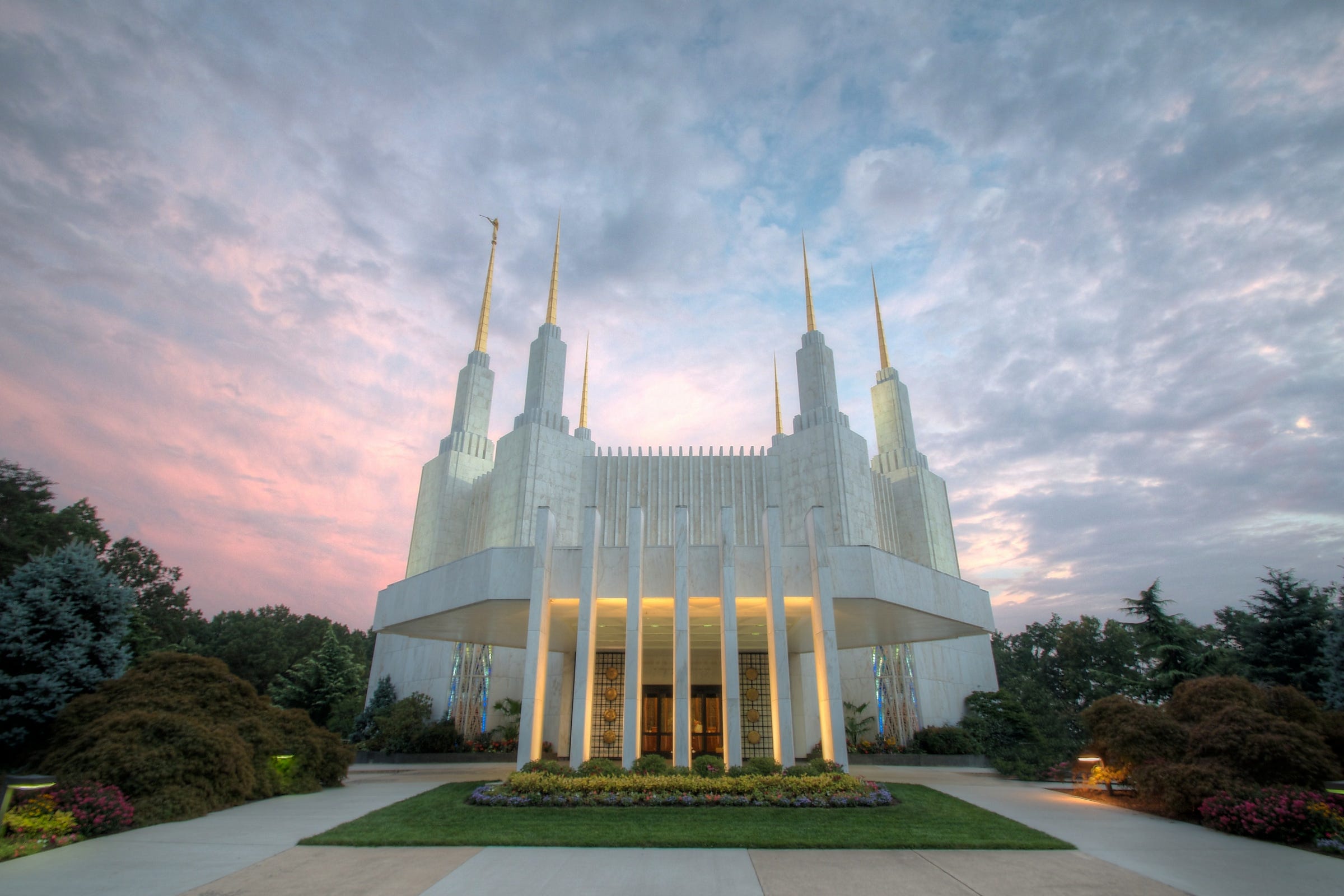
On September 19, 2026, Waymakers is excited to be co-hosting a peacemaking gathering at the Visitors’ Center of the Washington, DC Temple of the Church of Jesus Christ of Latter-day Saints. If anyone has ever driven at night around the 495 beltway, you’ve seen the majestic temple lighting up the dark horizon. This will be a perfect setting for each of us to deepen our commitment to the vocation of peacemaking. As Martin Luther King Jr. famously said, “Darkness cannot drive out darkness; only light can do that. Hate cannot drive out hate; only love can do that.” Peacemaking is all about bringing greater light and love into a world of conflict.
Co-sponsored by the Visitors’ Center and the Heravi Peace Institute at Utah State University, “Peacemakers Needed” will be a half-day workshop featuring multiple keynote addresses and interactive workshops. You’ll learn practical, skills-based strategies from experienced teachers that can help you navigate interpersonal, interfaith, and political conflict with greater understanding and confidence. In addition to me and Chad, the gathering will feature these expert practitioners:
Judge Thomas Griffith, retired U.S. judge, United States Court of Appeals for the District of Columbia Circuit
Jim Ferrell, bestselling author of You and We: A Relational Rethinking of Work, Life, and Leadership
Ravi Gupta, Charles Redd Professor of Religious Studies at Utah State University
Maybree Spilsbury, Director of Peacemaking at Mormon Women for Ethical Government
This event is free and open to the public (ages 16+), but registration is required. Space is limited especially in the afternoon workshops, so be sure to register now…then invite your friends to do the same!
Saturday, September 19, 2026 1:00 PM – 5:30 PM Washington D.C. Temple Visitors’ Center 9900 Stoneybrook Drive Kensington, MD 20895
Sept 24-26: Restore: Connect Conference
Orem, UT
Faith Matters has a brand-new format for Restore this year—designed to make your experience more interactive, more embodied, and more communal than ever before and Waymakers and our REPAIR workshops will be a big part of it.
This year Restore will be September 24-26 at the Noorda Center at UVU, where we’ll make full use of the space by having an opening social on Thursday, followed by two days of smaller, more intimate sessions that will bring you closer to the presenters and closer to each other.
Each day, you will be able to choose multiple sessions to attend, with class sizes ranging from 150 to 700. This means sessions will have the flexibility to be more interactive and participatory—giving you more opportunities to connect with other attendees, ask presenters your questions, integrate what you’re learning, and dive deeper into important topics.
Waymakers will be there in full force running a REPAIR series of workshops both Friday and Saturday that include:
“Dangerous Discipleship: Following Jesus Beyond Political and Cultural Identities” - Chad Ford and Pastor Jamie White
In every generation, followers of Jesus have claimed their political ideologies, religious cultures, and media to reflect the “true” beliefs of Jesus. Our politics, religious communities, and even broader popular culture can gradually, and even dramatically, reshape our understanding of Jesus and His Kingdom. This interactive workshop invites us to re-examine our identities and rediscover practices that cultivate deeper discipleship to Jesus. Drawing from scripture, history, social psychology, conflict transformation theory, and the Christian contemplative tradition, participants will learn how to stay rooted in Jesus while faithfully engaging a polarized world.
“Holding Sacred Conflict: Leading Through Political Division, Faith Transition, and Relationship Conflict” by Chad Ford
Congregations are facing serious turbulence—from political polarization and cultural change to faith transitions. Many faith leaders fill ill-equipped to help their congregants navigate these difficult challenges. Too often we either end up avoiding these conversations or trying to resolve them too quickly. This workshop aims to give Bishops, Relief Society and Elders Quorum presidencies, and Young Women and Young Men leaders practical tools to step into these conflicts to create belonging, deepen understanding, and help people navigate difficult conversations while remaining rooted in Christlike love and discipleship.
“Peacemaking 101: Where to Start” - Patrick Mason
In his April 2026 General Conference talk, President Oaks urged all Latter-day Saints to learn and implement “the language and methods of peacemakers.” Perhaps you have felt the desire to make peacemaking a central part of your discipleship, but you don’t quite know what it means or where to start. In this session, Patrick Mason will teach some basic concepts and skills for how you can take the next step on your journey of being a peacemaker.
“Out of the Rubble: Rebuilding a Resilient Faith after Deconstruction” - Pastor Jamie White
Faith deconstruction often feels like a pretty major demolition in our lives, as if everything we once counted on to stand firm has somehow collapsed like piles of rubble all around us. It can be easy to get stuck there—in the pain, disorientation, and doubt—with no clear path for how to rebuild something better. Yet beyond our faith crisis, church hurt, or dismantling of certainty, there is hope for a deeper, more resilient faith in Christ. This workshop will explore how to rebuild, offering participants a safe space to explore what comes next without rushing the healing process, while identifying spiritual truths worth keeping, developing practices rooted in love, and embracing new rhythms of grace, mystery, and authentic community. Standing among the rubble doesn’t have to mean you’ve lost your faith. In fact, it can be the beginning of something stronger, deeper, and more faithful than before.
“Holy Attention: An Experiential Workshop on Presence, Wonder, and Communion” by Melissa Mason and Amanda Ford
What does it look like to pursue God when faith feels inconsistent, attention drifts, or certainty fades? In this workshop, therapists and educators Melissa Mason and Amanda Ford invite us to explore how permission to rest can become an invitation to deeper communion with God. Through experiential practices that broaden our imagination of faithful discipleship, we’ll discover how attention, silence, breath, movement, creativity, beauty, and relationships can become pathways to deeper connection with God, ourselves, and each other.
“Kirtan Immersion: Peacemaking through Music and Mantra” by Ravi Gupta
Kirtan is an ancient Hindu practice from India that aligns our body and mind through music and mantra. Participants in this workshop will explore the power of devotional music to create pathways of peace within ourselves and in community with others. We will learn techniques of mantra meditation as we immerse ourselves in sacred sound. No prior experience with kirtan is needed.
I’m excited to invite you to join the fourth cohort of the Transformative Mediation Certification Program a 40-hour training for a select group of Utah’s leading mediators, attorneys, social workers, educators, and change agents:
Fourth Cohort
Law & Justice Center, SLC, UT November 12-14, 2026 (30 hours in-person) Tuition: $1500
I’d be honored to have you join me in this next select cohort, helping set the standard for transformative mediation across Utah and beyond.
Participants who complete the program will receive a Professional Certificate in Transformative Mediation jointly awarded by Utah State’s Heravi Peace Institute, Utah Dispute Resolution, and Disagree Better as well as up to 40 hours of CLE credit or Social Work Continuing Education Credit.
There are only a few spots left, so if you’re interested, now’s the time.
Comments
Nothing yet. Say the first thing.
Sign in to join the conversation.