
There are some things that I love. The Reds, obviously. Movies. History. Reading. Reading about movies, history, the Reds. And Reds history.
I still like my guide to building the essential Reds bookshelf. If you can only have one Reds book on your shelf, it obviously needs to be The Big 50. I mean, c’mon, if we’re talking about Reds books that are currently in print, it’s obviously the best. A 5-star rating on Amazon! (Also, please go give it five stars on Amazon, my friends.)
But if we’re talking about every Reds book ever published, the essential one is Redleg Journal. Here’s what I had to say about it:
Redleg Journal: Year by Year and Day by Day with the Cincinnati Reds since 1866 by Greg Rhodes and John Snyder. Published in 2000 and long out of print, this is actually probably my favorite Reds book of all time. If you can find a copy, you need to have it. Long due for an update, but if you’re a Reds fan, you’ll have plenty of fun just flipping through this every so often.
One of the things that keeps creeping across my mind is that I need to start working on an updated edition. Maybe someday.
Until then, however, one of the things I like to do is pull out my copy of RJ and look at the index. It has entries listed by calendar dates, and I’ll flip back and forth to see what happened on this day in Reds history. Every time, it occurs to me how Reds history has intersected with Cincinnati history…and with United States history.
But don’t trust me on this. Let’s look at what has happened on April 14 over the years. (I especially love the 1905 entry; I especially hate the 1935 entry, which represents one of the worst-ever decisions by Reds management.)
Three months after Thomas Edison receives a patent for the first long-lasting electric light bulb, the Reds open their new ball park on the north side of Bank Street, south of Western Avenue and just west of McLean Avenue. The Reds celebrated the opening with a 6–5 win in ten innings in an exhibition game against a team from Washington.
The new facility was named Bank Street Grounds. The Reds played at the site, which also hosted circuses and Wild West shows, through the 1883 season. The move was made because the Bank Street site was much closer to the center of the city than Avenue Grounds. One of the innovations on the scoreboard at Bank Street Grounds was the posting of the name of each player as he came to bat, in addition to up-to-date scores of out-of-town games, via telegraph. The identification of players by uniform number didn’t take place until 1932. Worcester, Massachusetts replaced Syracuse in the National League line-up. The Reds old field, Avenue Grounds, and the nearby area continued to be used for amateur baseball until the turn of the century. Called the Cincinnati Baseball Grounds, the fields were centered around Alabama Street, west of the railroad tracks.
N.B.: I’m working on another piece about Reds stadiums, so I went to the Cincinnati Enquirer archives to see what they said about the new ballpark in the paper the next day. To my surprise, they didn’t even mention it. Here’s the box score from the game, an exhibition against Washington, if you’re interested.
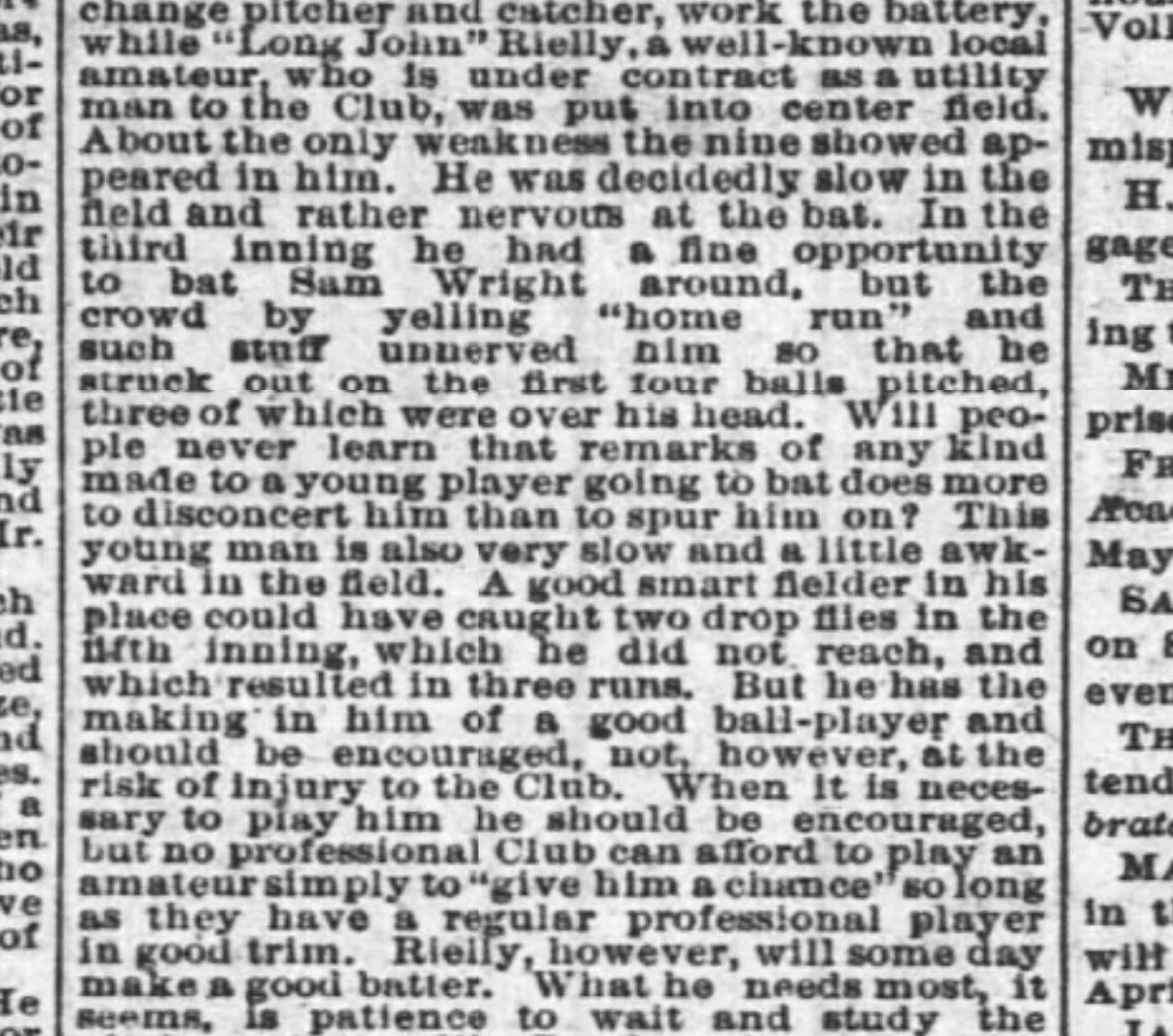
What they did mention was the debut of “Long” John Reilly, who would eventually be inducted into the Reds Hall of Fame. He struggled mightily: “[H]e struck out on the first four balls pitched, three of which were over his head.” As you might expect from the media, it was blamed on the fans!
The Reds beat the Cubs, 3–2, with a run in the ninth inning before 13,000 on Opening Day at the Palace of the Fans. Jack Sutthoff allowed two runs in the first, but pitched shutout ball the rest of the way. The winning run resulted from Joe Kelley’s double and Tommy Corcoran’s single.
The Reds lose, 9–4, to the Pirates on Opening Day at the Palace of the Fans.
Creating funerals for fictitious deceased relatives in order to escape work to attend Opening Day is a long-standing Cincinnati tradition. On the morning of the 1905 opener, Jack Ryder of The Cincinnati Enquirer wrote: “It is really wonderful, the frightful mortality among grandmothers, aunts and cousins, which makes it imperative, in all decency, that office boys and other such steady toilers should be absent from their scenes of labor this afternoon. How sad it is!”
N.B.: During my senior year of high school, my late grandmother — a big Reds fan — called my school and told them I had a dentist appointment so I could leave to watch the game. She was a legend. I need to write about her sometime.
The Reds lose, 6–5, to the 1908 world champion Cubs before 19,256 on Opening Day at the Palace of the Fans. The Reds scored five runs in the first inning off Orval Overall, but Chicago battled back and won with a run in the ninth inning. The Cubs went on to win the 1908 pennant, their third in a row.
The Cincinnati Enquirer reported that “more automobiles were seen at the park yesterday than ever before. The sheds were crowded with machines of various sizes and power.” The “sheds” were originally built for the horse-drawn carriages of Cincinnati’s wealthiest citizens. Before the end of the year, Henry Ford sold his first Model T and General Motors was formed, revolutionizing the burgeoning auto industry.
Six weeks after the inauguration of Cincinnatian William Howard Taft as President of the United States, the Reds lose the season opener, 3–0, to the 1909 World Champion Pirates at Palace of the Fans.
For the first time in club history, the parking area inside the ballpark under the grandstand was insufficient to hold all of the carriages and automobiles which conveyed fans to the game. Findlay Street was lined with autos parked bumper-to-bumper between Western Avenue and the railroad yards. The new Reds manager was Clark Griffith. A future Hall of Famer, Griffith posted a 237-146 lifetime record as a pitcher. In 1901, he helped establish the American League, and as manager of the Chicago White Sox, won the new circuit’s first pennant. Griffith managed the Reds to a 222-238 record over three seasons.
Reds pitcher Fred Beebe pitches a three-hit shutout on Opening Day to defeat the 1910 National League champion Cubs, 1–0, in ten innings before 21,221 at the Palace of the Fans. Tom Downey drove in the winning run.
In Washington, D.C., Cincinnati native and President William Howard Taft began a tradition by throwing out the first pitch on Opening Day for the Senators game.
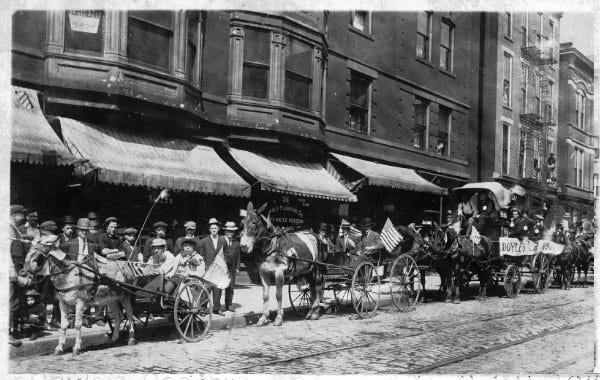
Three months after the start of Prohibition, the Reds begin their defense of the world championship with a 7–3 win over the Grover Cleveland Alexander and the Cubs before 24,822 at Redland Field. Edd Roush homered, the first Red to hit one on Opening Day since 1894.
Among those in attendance was John D. Rockefeller, then the richest man in the world. The Reds added a squad of detectives in 1920 to roam the Redland Field grandstand and root out and arrest gamblers.
Pete Donohue pitches a six-hit shutout on Opening Day to defeat the Cardinals before 31,888 at Redland Field in a game that lasted just one hour and 20 minutes.
An item in the Reds 1925 game program read, “There will be a game played on these grounds on every scheduled day, despite rain storms. Rain cannot penetrate the cover we use for the diamond. It sheds water like a duck’s back.”
The Reds lose the season opener, 7–3, to the defending National League champion, and 1931 world champion, Cardinals before 29,848 at Redland Field. Joe Stripp homered for Cincinnati. The Reds lost 17 of their first 19 games and were 9–32 on June 2. From August 1, 1930 through June 2, 1931, the Reds had a record of 24–75.
In 1931, the Reds offered free parking to the first 400 autos arriving each day the club played at home. Construction of nearby Union Terminal and its railroad yards reduced the size of the parking lot at Redland Field from 1,000 spaces to 400.
After a spring-training trial, the Reds return Johnny Mize to the Cardinals.
The Reds acquired Mize on a conditional basis from the Cardinals for $50,000 on December 13, 1934. He played well enough for the Reds during spring training to win the starting first base job, but doctors determined that a groin injury would require surgery and put him out of action for months. Leery of investing in “damaged goods”, the Reds returned his contract to St. Louis. Mize had the operation and began playing in mid-season with the Cardinals Rochester farm club. He reached the majors in 1936, the start of a Hall of Fame career in which he would compile a .312 batting average and clout 359 homers despite missing three full seasons during World War II.
In the first wartime opener since 1918, the Reds lose, 4–2, to the Pittsburgh Pirates before 34,104 fans at Crosley Field. The game was played five days after the fall of Bataan, one of many shocking military defeats suffered by the United States at the hands of Japan early in 1942.
Signs painted on the left field wall near the foul line read: “Remember Pearl Harbor,” “Keep Fit,” “Avoid Waste,” and “For Victory, Buy Defense Bonds and Stamps.” The Reds announced that balls hit into the stands would be returned and donated to the recreation departments of the Armed Forces. The policy remained in effect throughout the war, temporarily ending the mad scramble in the grandstand and bleachers for possession of foul balls and home runs. The wartime shortage of players didn’t really hit until 1943. The only member of the 1941 Reds, who missed the 1942 season because of military commitments was 22-year-old infield prospect Benny Zientara. In 1946, Zientara married a member of the WACs he met during the war.
Wally Post’s tape-measure homer highlights a 7–3 win against the Cardinals at old Busch Stadium in St. Louis. The ball struck the Budweiser sign atop the scoreboard some 90 feet above the playing field 410 feet from home plate. Jay Hook, who held an engineering degree from Northwestern University, estimated the ball would have traveled 569 feet if it hadn’t hit the sign. Post also added a double and a triple, as the Reds scored five runs for a ninth-inning victory.
The Reds started the season with a 5-2 record, then lost eight games in a row. After a 12-17 spring training and a 5-10 beginning to the regular season, another sixth-place finish looked likely. Entering the 1961 season, every National League club except the Reds had appeared in at least one World Series since 1945. Cincinnati’s last pennant was in 1940.
N.B.: They would go on to win the pennant in 1961, losing to the Yankees in the World Series.
Two days after the launch of Columbia, the first space shuttle, Bruce Berenyi pitches a two-hitter to beat the Padres, 4–0, in San Diego. The only Padres hits were singles by Terry Kennedy in the third inning and Luis Salazar in the seventh.
A nephew of former major league pitcher Ned Garver, Berenyi was 9–6 in the strike-shortened 1981 season and posted a 3.50 ERA.
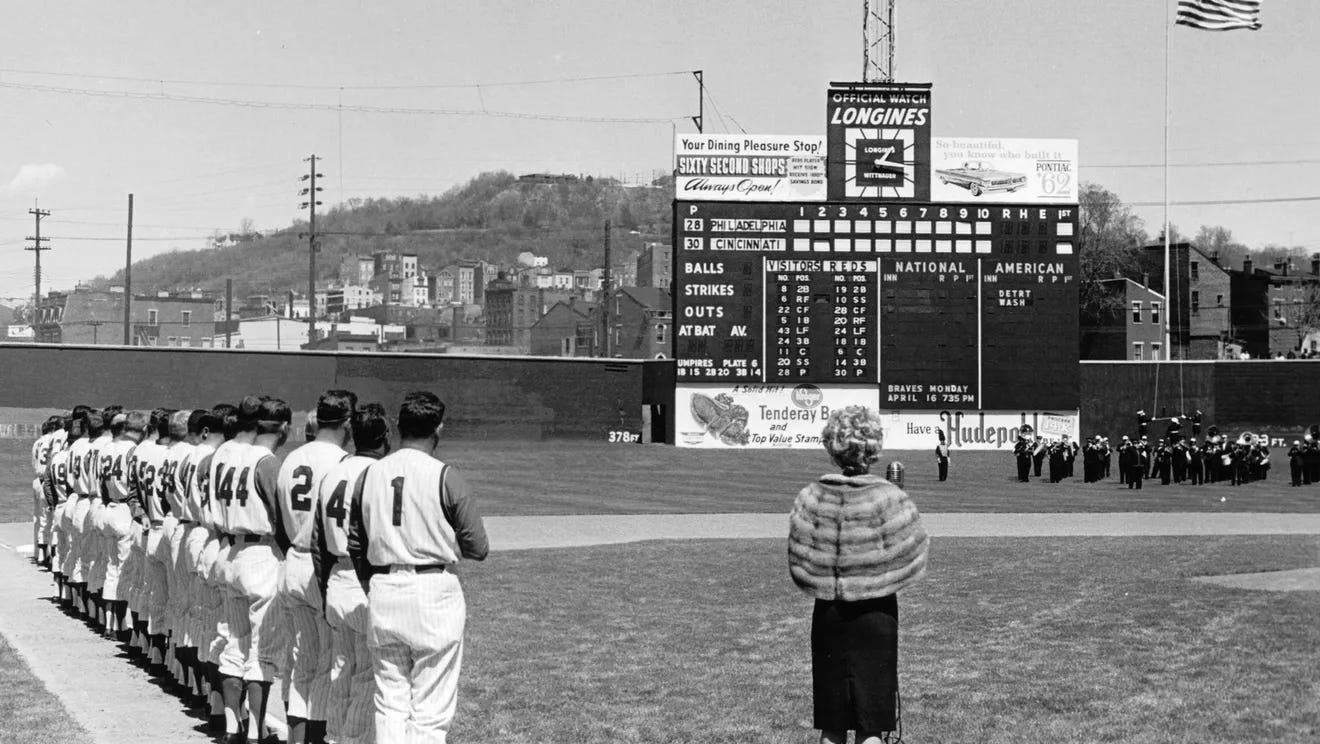
Paul O’Neill homers in the ninth inning to beat the 1992 National League champion Braves, 5-4, at Riverfront Stadium. O’Neill entered the game in the fourth inning after Glenn Braggs was ejected for arguing a third-strike call.
The Reds play at Turner Field in Atlanta for the first time, and lose, 15–5, to the Braves. Despite the loss, Deion Sanders tied a club record with four stolen bases.
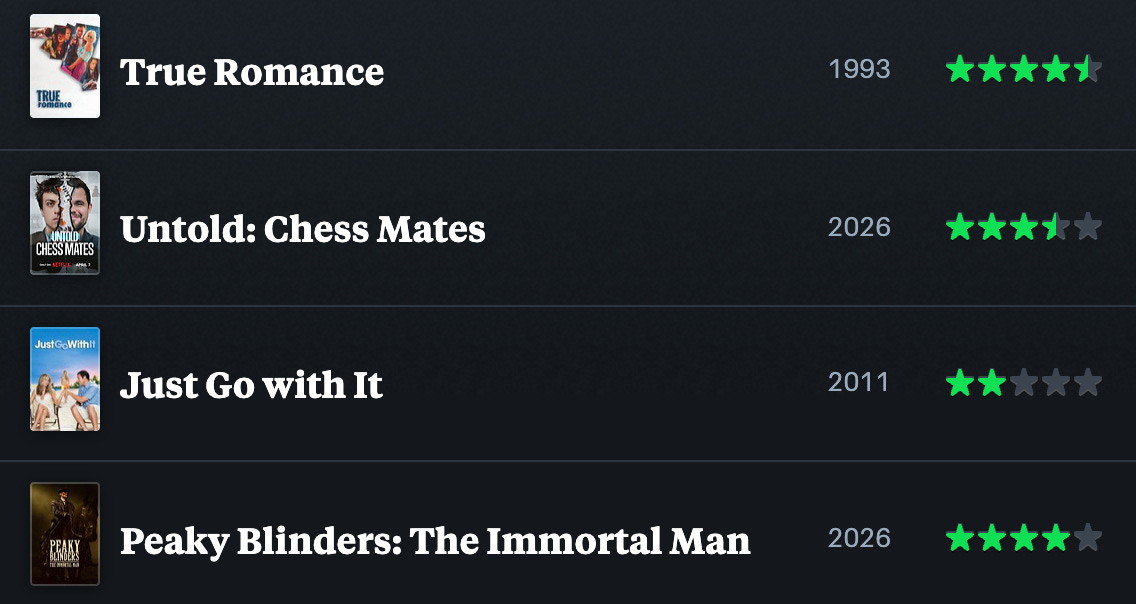
I fancy myself a cinephile, so it’s a little embarrassing to admit to you that I just watched True Romance for the first time. Such a good movie and an absolutely incredible cast. Highly recommended.
Not recommended: Just Go With It, a seriously dumb Adam Sandler - Jennifer Aniston rom-com. And it pains me to say that, as a certified member of the Adam Sandler Fan Club.
No posts
Comments
Nothing yet. Say the first thing.
Sign in to join the conversation.