
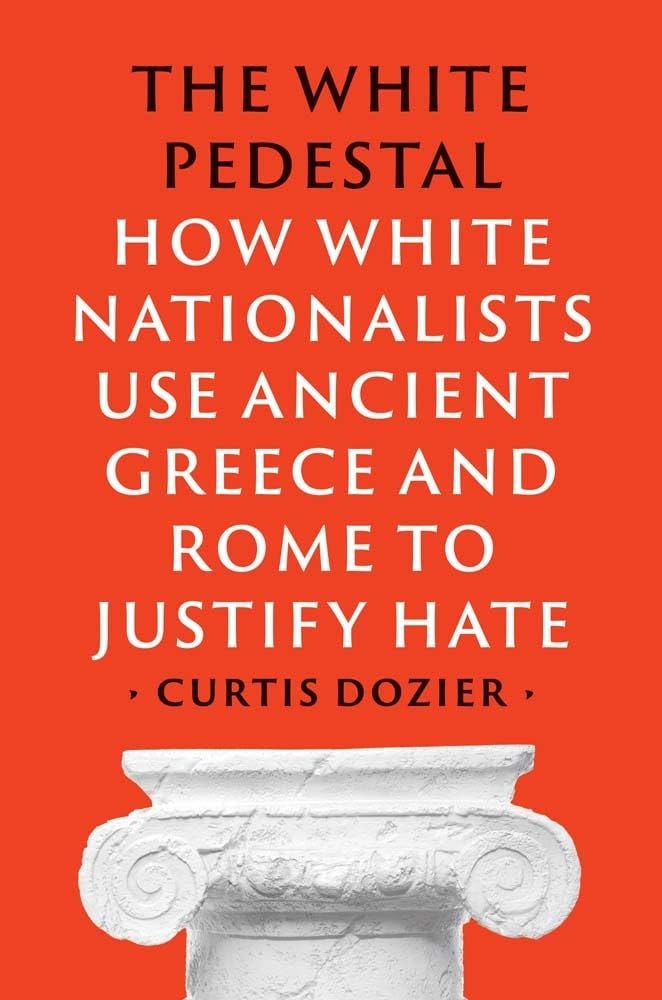
If one wishes to see mainstream academia discover that the ancient world was not written by the interns at NPR, with all the palpable discomfort attending so elementary a revelation for everyone outside the faculty lounge, then Curtis Dozier’s The White Pedestal probably merits your attention.
I picked up the book because I wanted to know what now passes for serious scholarship among those entrusted with preserving the legacy of Greece and Rome, especially when that legacy is said to have been “appropriated” by the contemporary Right. In that respect, it did not disappoint. However, beneath its scholarly sheen lies a politically nervous argument whose unintended comedy is more revealing than its intended warning.
The absurdity begins with the book’s central premise. Dozier proceeds from the familiar academic assumption that “White Nationalists,” a category now broad enough and specious enough to include any White person not ashamed of being White, are projecting anachronistic ideas back into the classics, especially present-day notions of “race” where none supposedly existed.1 The accusation is familiar enough, and amounts to the oft-repeated charge that the Right is bending the historical past toward ideological ends in the present. Yet the further he pursues these readings toward their natural conclusion, the more awkward his own case becomes. His evidence repeatedly suggests that many of the supposedly dangerous ideas are not being smuggled into Greece and Rome from the outside. They are, in fact, already there, unmistakable in the ancient texts and inseparable from the civilization that produced them.
The book sets out as a warning about the scourge of “White Nationalism” and its alleged misuse of antiquity, but often reads as something closer to a reluctant admission by Dozier himself: classical civilization was less liberal, less egalitarian, and far more willing to embrace the older, harder foundations of political life than modern academics would prefer. Long before Hobbes gave this harsher vision its modern formula, bellum omnium contra omnes, the war of all against all, the ancients understood instinctively that political order is born from the conquest of a harsher condition, where life is governed less by sentiment than by the cold logic of an indifferent natural world. Therein lies the deeper irony. The scandal is not that the wrong people are misreading the classics. The scandal is that they are reading them without the therapeutic varnish of the prevailing liberal-humanitarian delusion under which the modern mind now labors.
Dozier is most persuasive when he ceases to treat the matter as a simple case of bad-faith distortion. He knows, and in places tacitly concedes, that so-called “White Nationalist” readers do not need to fabricate either the racial consciousness of antiquity or its conviction that culture, and thus regime, grow out of the native character of a people; these are not modern projections thrust backward upon Greece and Rome by contemporary “radicals.” They belong to the texts themselves, and to the civilizational order from which those texts emerged. The ancient world was not a faculty diversity statement. It was rooted in a fixed sense of inherited identity, treated as sacred because it reflected the normal and natural facts of man’s existence. Political life was thus governed by the bonds of descent, ordered by hierarchy, animated by masculine excellence, and openly contemptuous of many assumptions that now pass for enlightenment in polite Western society.
This is what makes the book useful, though not in the manner its author intended. It functions less as a refutation of the Right’s attraction to antiquity than as an unwilling catalogue of the reasons for that attraction. Dozier wants the reader to recoil from the fact that so-called “White Nationalists” find in Greece and Rome not merely convenient material for the arguments that sustain their worldview, but, perhaps most heretically, a civilization still worthy of admiration. A less timid reader may draw the more obvious conclusion: that such admiration is neither an error imposed upon the evidence nor a historical distortion produced by ideology, but the judgment toward which the evidence itself inclines.
There is, however, a serious defect in the book, and it is not simply ideological. Dozier refuses to cite certain “White Nationalist” sources according to ordinary scholarly convention, on the grounds that doing so would confer legitimacy upon them. For a book published by Yale University, this is a remarkable concession. Proper citation is not a courtesy reserved for sources deemed respectable by the reigning political consensus, but rather one of the elementary conditions of scholarship itself. When a writer obscures his sources in order to manage their supposed political contamination, he does not protect the reader. He shields his own argument from scrutiny.
This creates the book’s central and most damning contradiction. It seeks the authority of academic seriousness while suspending one of the elementary duties by which such seriousness is earned. It asks to be received as scholarship, yet selectively refuses the scholarly obligation to make its trail of evidence fully visible. This may satisfy the political anxieties of modern academia and the regime of inversion it serves, but it does nothing to strengthen the argument.
The result is a book worth reading almost against itself. It reveals how fragile the liberal custody of antiquity has become. The modern academic wishes to preserve the prestige of Greece and Rome while preventing the ancient texts from speaking too plainly. He wants antiquity to remain “noble” and “inspiring,” but only after it has been rendered serviceable to the ruling zeitgeist of the age. The classics are permitted to retain their authority only insofar as that authority can be redirected in defense of the present regime. What cannot be permitted is antiquity speaking on its own terms, because the marble refuses to lie. Beneath every curatorial polish, its moral and political assumptions remain unchanged: alien to the governing falsehoods of modernity, and dangerous precisely because they cannot be made serviceable to them.
Of course, this effort is futile for the simplest of reasons: the classics remain dangerous because they are not modern. They do not flatter equality, nor do they treat democracy as the sacred telos of political life. They do not imagine mankind as an interchangeable and increasingly amorphous mass awaiting technocratic administration by a deracinated custodial elite managing the West’s decline.
Greece and Rome began from harder premises. The city was not a neutral arrangement of bodies under law, but the organized life of a particular people, bound by ancestry, formed through custom, consecrated by cult, and compelled by necessity into a life-or-death struggle against rival peoples and hostile powers. Politics emerged from that older and more primordial soil. It belonged to the household and the bloodline as much as to the assembly or the battlefield, and it remained joined to the sacred rites through which a people remembered what it was.
The Greeks expressed this through the polis, the city-state, where citizenship meant participation in the common life and could not be severed from ancestral descent or military obligation. The Romans expressed it through the family as it widened into the gens, the ancestral clan, and through the civic religion that joined private blood to public destiny. Neither people treated political order as a theory floating above the nature of those who composed it. For Greeks and Romans alike, a regime was the reflection of the people who gave it form, not a roseate abstraction suspended in the clouds.
Dozier seems to understand this, which is why the book never quite loses the visceral unease that runs through its pages, as though its author has discovered something in antiquity that his own moral worldview cannot safely contain. If he presses too deeply, the whole liberal edifice begins to crack, because beneath its sanctimonious language lies a fragile and unnatural structure of fantasy that antiquity exposes by remaining true to itself. It is not really a question of the Right stealing the classics. It is the more disturbing possibility, or, to use the modern parlance, the more problematic one, that the classics were never safely the exclusive possession of liberals in the first place. Greece and Rome cannot be rendered harmless without first being falsified, because their civilization rests upon assumptions the modern regime exists to deny. Race is real, peoples are not abstractions, and political order cannot endure once severed from the biological and spiritual inheritance that gave it life. That is why Dozier’s argument trembles beneath the weight of its own contradictions. It has come close enough to the truth to recognize it, yet remains too captive to the falsehoods of its age to countenance what it has found, much less follow it to its necessary conclusions.
The ancients did not possess a scientific definition of race, nor did they understand genetics in the conceptual language available to us today. Yet belonging by blood and ancestry remained central to their understanding of collective existence. Descent, lineage, peoplehood, citizenship, and kinship were not incidental attachments, but the substance through which a man entered the moral and political order of his people. Race, understood here in the older sense of inherited peoplehood carried across time and space, was therefore grasped implicitly, even where it was not named according to later taxonomic categories. The absence of such terminology does not prove the absence of the reality it describes. Much of the confusion of the present age begins with the attempt to sever identity from inheritance and recast it as a chosen abstraction rather than a received condition.
No posts
Comments
Nothing yet. Say the first thing.
Sign in to join the conversation.