
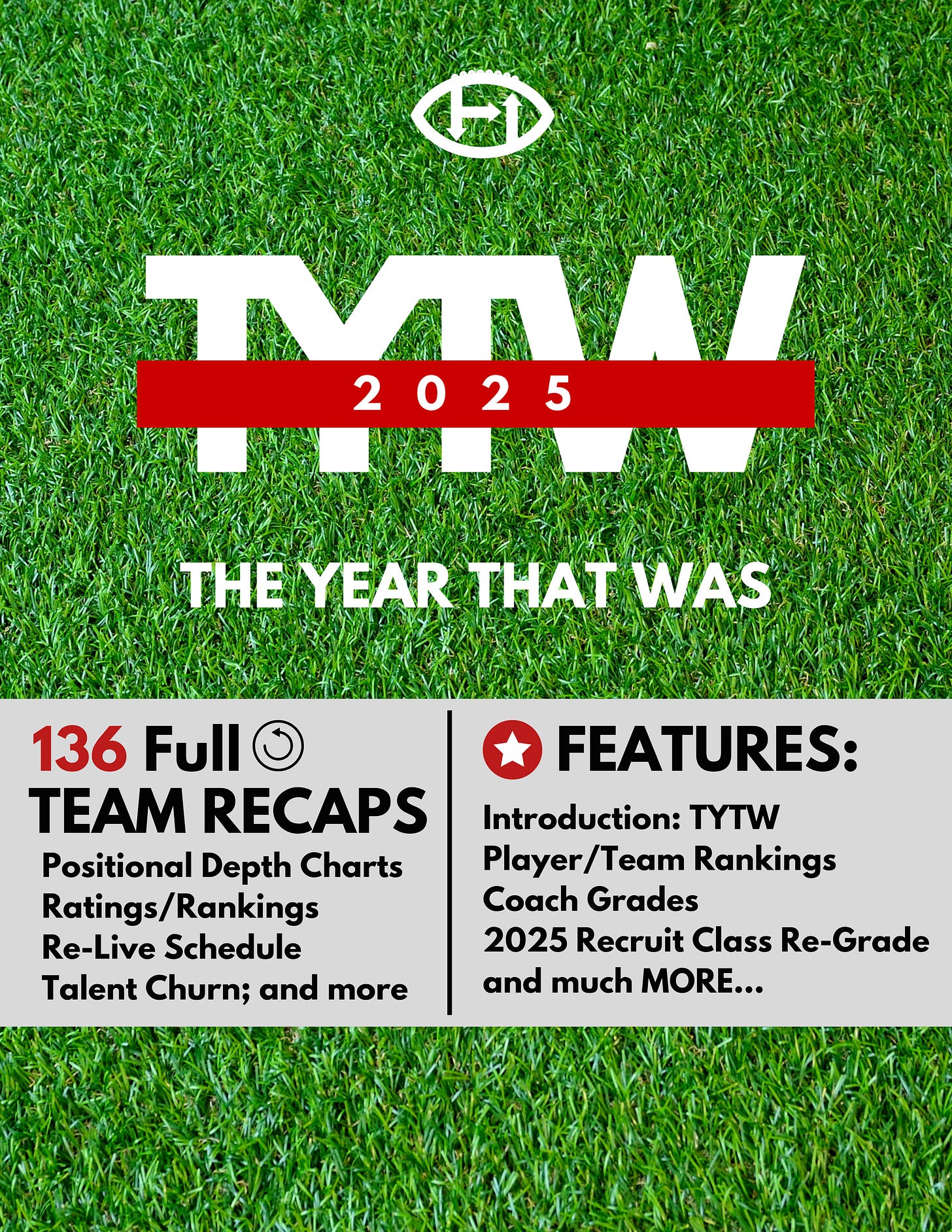
We have released our first-ever, almanac-style, data-driven, ‘close out’ of the 2025 season to help our readers understand what happened in this crazy season. The full 865-page, jam-packed digital publication is available at our site. Please consider checking that out by clicking the button below:
The Year That Was: 2026 Magazine
We ran the six loaded pages of Indiana information through Copilot to get a quick analysis and roll up what we learned from the season. Here are the results:
Indiana didn’t just climb the mountain in 2025. They built a new one. They finished 16–0, won the national championship, and posted the cleanest statistical résumé in the country. The Hoosiers opened the year ranked 14th in our “All‑In Rankings” and finished No. 1 across every major composite — SP+, FEI, Sagarin, and the AP poll. It was the most dramatic two‑season transformation the sport has seen in the modern era.
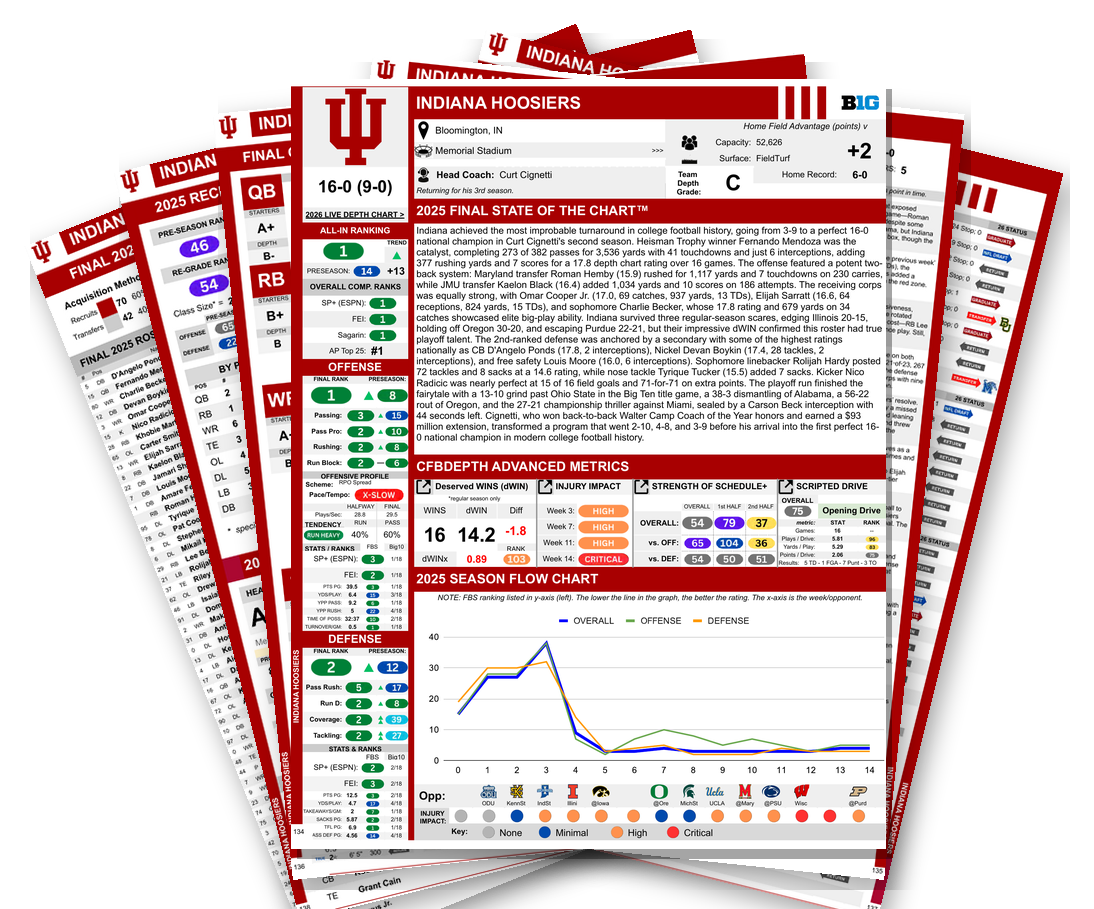
The offense operated with a calm, almost clinical confidence. Fernando Mendoza delivered a Heisman Trophy-winning season that blended efficiency with explosiveness, throwing 41 touchdowns with just six interceptions and adding seven more scores on the ground. Indiana didn’t rely on him alone. The two‑back system of Roman Hemby and Kaelon Black gave the Hoosiers a steady, physical identity, combining for more than 2,100 rushing yards and 17 touchdowns.
The receiving corps was just as complete. Omar Cooper Jr. and Elijah Sarratt were dependable, high‑volume targets, while Charlie Becker emerged as the big‑play threat who stretched defenses vertically. The offense finished top‑three nationally in scoring, passing efficiency, and rushing efficiency, and it did so without leaning on tempo or gimmicks. Indiana played slow, stayed balanced, and simply beat teams with execution.
If the offense was polished, the defense was suffocating. Indiana finished second nationally in defensive SP+ and ranked top‑five in every major category that matters: pass rush, run defense, coverage, and tackling. The secondary was the backbone of the unit, with D’Angelo Ponds, Devan Boykin, and Louis Moore forming one of the most complete back-end trios in the country. Moore’s six interceptions and Boykin’s versatility gave the defense answers for every matchup.
Up front, the Hoosiers were relentless. Tyrique Tucker and Mario Landino combined for 14 sacks, while Rolijah Hardy emerged as one of the most disruptive linebackers in the Big Ten. Indiana didn’t just stop teams. They took the ball away, flipped fields, and forced opponents into mistakes they weren’t built to overcome.
The perfect record wasn’t built solely on blowouts, though there were plenty of those. Indiana dismantled Illinois, UCLA, Wisconsin, Purdue and Oregon (in the CFP semis) by margins that left no doubt about their ceiling. But the season also included moments that tested their resolve. Illinois pushed them early. Iowa turned the game into a rock fight. Penn State nearly ended the dream before Omar Cooper Jr. delivered a last‑minute touchdown in one of the defining plays of the year.
Those close calls didn’t expose flaws as much as they revealed a team capable of winning in every style. Indiana could overwhelm you, outlast you, or out-execute you. The advanced metrics back it up. The Hoosiers posted 14.2 deserved wins on the season — an elite number — and their second‑half performance rating was among the best in the country. They didn’t just start fast. They finished stronger.
The playoff run turned a great season into a historic one. Indiana beat Ohio State in a 13–10 slugfest for the Big Ten title, then dismantled Alabama 38–3 in the Rose Bowl — a performance that announced the Hoosiers as the sport’s new standard. They followed it with a 56–22 demolition of Oregon in the semifinal, then held off Miami in a tense 27–21 championship game sealed by a late interception.
It wasn’t just a title. It was a coronation. Indiana became the first team in modern FBS history to finish 16–0.
The depth charts show a team that peaked at exactly the right time. Mendoza, Cooper, Sarratt, Hemby, and Black all played their final seasons at once, giving Indiana a veteran core with elite production. The offensive line was experienced and physical. The defensive front was deep and disruptive. The secondary was loaded with NFL‑caliber talent.
Even the injury report tells a story. Indiana endured multiple high‑impact weeks and still never cracked. The roster was built to absorb hits without losing its identity.
Curt Cignetti didn’t just win. He reshaped the program’s trajectory. Back‑to‑back Walter Camp Coach of the Year awards and a $93 million extension reflect what Indiana now believes: this wasn’t a one‑off miracle. It was the beginning of a new era. Cignetti took a roster that had been wandering in the wilderness and turned it into the most complete team in college football.
Indiana’s 2025 campaign wasn’t just the best season in school history. It was one of the most remarkable seasons the sport has ever seen. A perfect record. A Heisman quarterback. A top‑two offense and defense. A playoff run that left no doubt. A program that went from irrelevance to the center of the sport in 24 months.
The Hoosiers didn’t just win a championship. They rewrote what was possible.
Want to make your own interpretation? Get all of the data and information on the season that was by purchasing our magazine »
Thank you for your support.
Comments
Nothing yet. Say the first thing.
Sign in to join the conversation.