
Jack Walsh was born and raised in Eugene, Oregon, and grew up near the University of Oregon. He seized the opportunity to attend and graduate from the institution that helped raise him. He is passionate about using data to understand the great game of college football at the institutional and structural levels. Not just his favorite teams (you can guess it), but yours as well.
One football team has achieved consistent success at Protective Stadium. This team has stacked winning seasons, captured multiple league championships, and built a winning culture that players embody. They even boast a fanbase called the “Pyramid of Flesh” (yes, this is real—search at your own risk).
That team is the Birmingham Stallions. However, there is another team that calls Protective Stadium home—the UAB Blazers football team—and their story couldn’t be more different. Unlike longstanding powers built on decades of stability, UAB football has had to fight just to stay alive. Founded in 1991, the Blazers program quickly rose through the divisions of college football, moving from Division III to Division I-A (now FBS) by 1996.
Early success was elusive, but the program found its rhythm in the early 2000s under head coach Watson Brown, highlighted by a division title in 2004 and a bowl appearance in the Hawaii Bowl. But what followed defined UAB football more than wins and losses ever could. In December 2014, the university shockingly decided to shut down the football program entirely, citing financial concerns. The move sparked massive backlash from players, alumni, and the Birmingham community at large. Rallies were held, donations poured in, and the outcry became a national story, turning UAB into a symbol of how much college football can mean to a city.
Then, as suddenly as it was taken away, football returned. In 2015, the program was reinstated, with a return to play set for 2017 under head coach Bill Clark, who had remained unwaveringly committed to UAB even during the shutdown. What followed was one of the most remarkable resets in the sport. UAB returned in 2017 and immediately finished 8–5, reaching a bowl game. By 2018, they won the Conference USA Championship Game, capturing the first conference title in program history. They repeated that feat in 2020, establishing themselves as a consistent winner in Conference USA.
Clark stepped away from UAB football in 2022 mainly due to ongoing health concerns, specifically chronic back issues that had affected him for years. Clark had undergone multiple procedures and dealt with persistent pain, and by the time the 2022 season approached, it was clear that coaching was taking a physical toll he could no longer sustain. Rather than continue at less than full capacity, he chose to retire and prioritize his long-term health. UAB now faced the challenge of replacing a campus and college football icon while steering a transition to a more competitive AAC.
Enter Trent Dilfer, the opposite of Bill Clark. Dilfer had no college head coaching experience, having worked his way up through the high school ranks. Not surprisingly, the transition proved rocky—something expected outside of the University of Alabama at Birmingham administration. Clark was a player-first builder who developed UAB Blazers football from the ground up; Dilfer, on the other hand, promoted himself as a pro-style scheme architect and QB whisperer, someone who could elevate the program through design and execution. But that promise never materialized on or off the field.
Over roughly two and a half seasons, Dilfer produced a 9–21 record, with ongoing struggles in quarterback play, offensive consistency, and overall player development. Beyond the box score, concerns emerged. UAB, once known for cohesion and accountability, began to show cracks: sideline confrontations between players and coaches, roster turnover, and a culture that at times felt disconnected and directionless. The steady, no-nonsense identity that defined the Clark era gave way to something less stable, raising serious questions about whether the program’s foundation had been traded for a vision that never fully took hold.
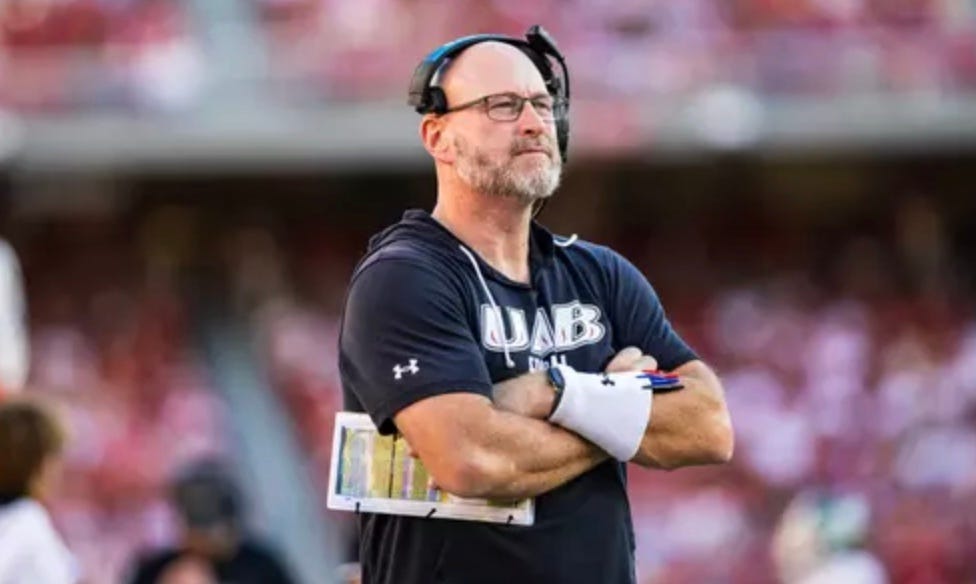
After the high of the UAB Blazers football team’ s return and multiple conference championships under Bill Clark, the program entered a new era with momentum—yet also uncertainty. The move to the American Athletic Conference and the hiring of Trent Dilfer signaled ambition. However, that optimism never translated into consistent success on the field.
Over the next two- plus seasons, the numbers told a clear story. UAB finished just 9–21, including a losing record in AAC play, and saw its scoring margin turn negative after being comfortably positive during the final years under Clark. Yards per play—once a quiet strength linked to efficiency—slipped into the lower half of the conference on both sides of the ball. The offense routinely averaged under 6. 6.0 yards per play, while the defense allowed well above that, creating a steady efficiency deficit each week.
Situational football became a major weakness. UAB ranked near the bottom of the AAC in third- down conversion rate offensively, often sitting in the low- to- mid 30% range, while allowing opponents to convert at a significantly higher percentage. Red zone efficiency also lagged. Turnover margin, another key measure of discipline, stayed in the negative, compounding issues in close games where UAB repeatedly fell short.
Defensively, the decline was significant. After allowing around 20–25 points per game at their peak under Clark, UAB’ s defense slipped into the 30 + points per game range during stretches under Dilfer. Explosive plays allowed increased, and success rate against the defense decreased, indicating an inability to reliably win downs. Opponents controlled tempo and stayed ahead, something that rarely happened to UAB teams in previous years.
Offensively, an identity never emerged. Despite expectations of a quarterback- driven jump, UAB went through inconsistent quarterback play, finishing near the bottom of the conference in passing efficiency metrics. The explosive pass rate stayed low, and the offense struggled to generate big plays without turning over the ball. The result was a unit that neither dominated on the ground nor consistently threatened defenses vertically.
Roster construction added a further challenge. Transfer portal usage increased, but so did attrition, leading to one of the higher turnover rates in the conference. High school recruiting classes and incoming portal talent showed slight improvement on paper, but the lack of continuity and development offset that gain.
Trent Dilfer was fired by UAB on October 12, 2025, and replaced by longtime assistant and eventually permanent Head Coach, Alex Mortensen.
A quick plug for the “The Year That Was: 2025” magazine that we are actively working on. This is a data-driven, almanac-style publication to relive the year on and off the field. It’s a must-have for true college football fans. Release: Mid-April.
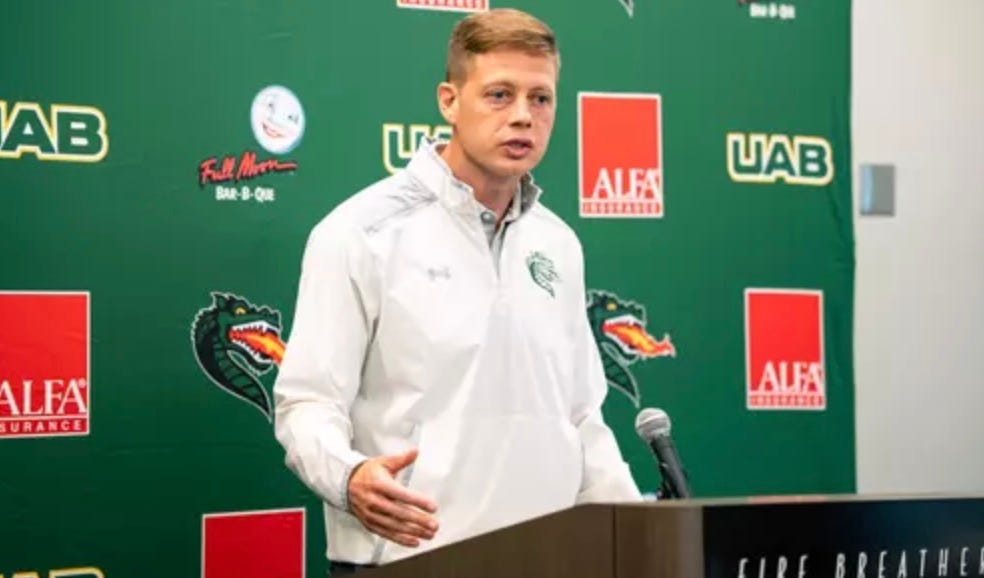
Alex Mortensen’s stint as UAB’s head coach began in the middle of chaos, taking over on an interim basis after Trent Dilfer was fired in October. He led the Blazers through the final six games of the season, finishing 2–4, but the record alone doesn’t fully capture the situation he inherited.
The team had already quit before Trent Dilfer was fired, resulting in noncompetitive games and a visibly checked-out roster. When Mortensen took over, he immediately delivered a jolt, leading UAB to its first AP Top 25 win since 2011 with a 31–24 upset over No. 22 Memphis at home (his silver bullet game). For a moment, it looked like the program had life again, but that spark proved fleeting as the Blazers fell back into the same pattern, finishing 1–4 the rest of the way.
Any remaining focus on football quickly became secondary on November 22, when a shocking off-field incident rocked the program just hours before a home game. UAB player Daniel Mincey was arrested after allegedly stabbing two teammates inside the team’s football operations facility, leading to charges of attempted murder and assault. Both players were hospitalized with non-life-threatening injuries and later stabilized, but the emotional toll was immediate. Some players chose to sit out, while others took the field in support of their seniors, ultimately suffering a 48–18 loss in a visibly shaken performance.
The incident laid bare just how unstable the program had become, placing Mortensen in an almost impossible position: tasked with managing not just a struggling team, but a locker room dealing with real trauma. In that context, his ability to hold things together, more than any on-field result, became a defining reason UAB ultimately viewed him as a stabilizing presence moving forward. They decided to hire him as the full-time head coach starting in 2026.
That relatively modest number says as much about the roster as it does the firing itself. Talent acquisition under Trent Dilfer had been underwhelming, resulting in a top-heavy roster that lacked depth and consistent quality across the board; one that was already due for a full-scale reset.
Four players stand out in the departures: Iverson Hooks [15.1] was one of the highest-rated wide receivers in the portal this cycle who landed at Oregon, and a pair of linebackers in Devin Hightower [12.9] and Eddy Toussom [13.1], along with starting OT Brandon Sneh [12.9]. Wondering what those numbers in the brackets mean? Check this out »
Iverson was certainly the biggest loss, as he projects to be a high-quality Power Four starter and likely WR1-2 in a loaded Oregon receiving room.
While it’s never great to lose starters to the portal, Mortensen did work to earn a positive portal churn rating (+29.9), bringing in 38 new players to evolve the program. That ranks 30th in all of FBS level football, impressive, especially compared to Dilfer’s portal performance in recent seasons.

Visit the website for the full breakdown of the additions and losses by clicking on the button below:
Any major head coaching firing or dismissal is a trigger event that can lead to a wide-ranging ripple effect. Let’s take a look at how this firing and eventual new hire impacted other jobs around college football:
Obviously the Trent Dilfer experiment didn’t work out, and he has yet to find another program that would be interested in trying it again. I would expect Dilfer to find a home as an offensive assistant somewhere, but as of right now his firing has limited ripple impact as an internal hire/promotion does just that.
Trent Dilfer dismissed at UAB »»» Alex Mortensen takes over as interim »»» UAB hires Alex Mortensen as head coach.
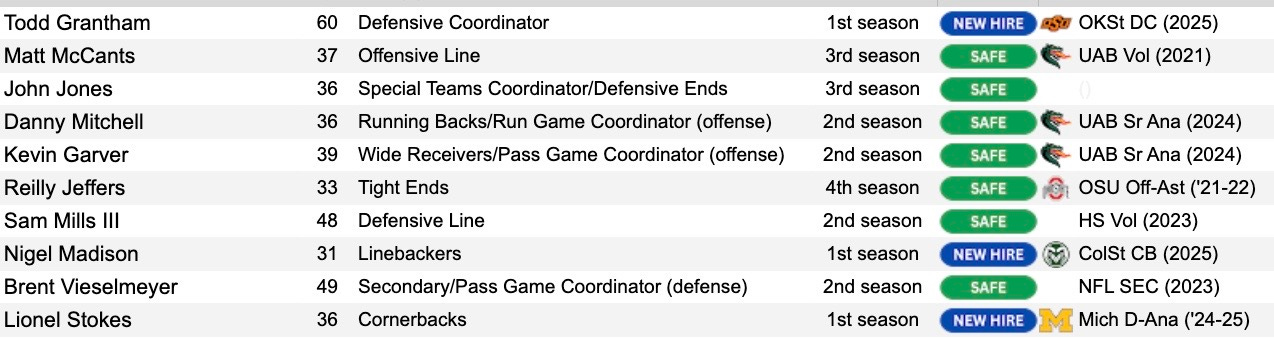
The ripple was just as insignificant when you look at the assistants. Mortensen retained a large portion of Dilfer’s staff, only bringing in 3 new hires (fancy seeing you here, Todd Grantham).
There’s a real argument that it can work under Alex Mortensen, but only if UAB fully commits to a true reset, not a patch job.
The team didn’t quit on him, he delivered a signature win, and most importantly, he navigated one of the most volatile situations any program faced without losing the locker room. That matters especially in an era where player buy-in can disappear overnight.
UAB’s issues weren’t limited to culture, they were structural. Poor roster construction, lack of depth, and uneven talent across position groups don’t get fixed by leadership alone. They require consistent talent acquisition, portal evaluation, and development; areas where UAB lagged badly in recent years.
That’s where this hire becomes a bet. Mortensen doesn’t need to be a schematic innovator as much as he needs to be an organizer: someone who can rebuild the roster from the ground up, identify undervalued talent, and create a sustainable pipeline of quality prospects. If he can pair his steady leadership with improved personnel decisions, there’s a path forward.
Alex Mortensen has seen firsthand what can happen when a negative culture is allowed to sink it’s teeth into a program, now he just has correct the path and bring UAB back to relevancy.
Comments
Nothing yet. Say the first thing.
Sign in to join the conversation.