
I am still buzzing from our last Wildfire post. With so many new subscribers, I thought it helpful to provide context. The CEO Dinner is a monthly gathering of leading Silicon Valley CEOs. We’ve been meeting for 16 years to exchange entrepreneurial experiences, discuss technology trends and support each other professionally and personally. Each CEO takes a turn hosting, inviting guests and often posing a Jeffersonian question for us to answer.
Our discussion follows Chatham House rules, allowing us to share what was discussed while keeping speaker identities confidential. The combination of 1) an abundance mindset to share these discussions and 2) a new phase of empty nesting where I have more time yielded The CEO Dinner substack. It’s thrilling to see the response. You can look forward to regular insights from our dinners as well as special pieces we’ve considered for years. With a meaningful audience, 2026 will be the right year to begin sharing more resources and frameworks with aspiring entrepreneurs!
This month’s gathering took an unconventional format. Rather than traditional Jeffersonian questions, we borrowed from the old All Things D conference: each attendee had to declare one company they’re long and one they’re short, based on current valuations versus one-year outlook. The game forced participants to take real positions rather than hedge with qualifiers.
The table at the end of the report captures the full range of positions discussed. It’s important to note that most of these are individual opinions, not group consensus. The results revealed wide ranging commentary: Waymo was a favorite long, appearing multiple times. Perplexity was the biggest short, with multiple attendees citing distribution challenges and ethical concerns. In the model wars, Google’s timely Gemini 3 release indicates they’re heading in the right direction with model quality joining their other formidable hyperscaler assets. Positive sentiment around Anthropic was equally matched by concern for Meta. OpenAI is still king but sits under the Sword of Damocles.
Outside AI darlings, Apple is ready to pop once they have something worth popping about. Netflix got shade for being a pick ‘em, not platform, story. Microsoft is well-positioned for the AI wildfire aftermath. Robinhood is ready to steal from Coinbase and give better experiences to their customers. Disrupting innovation still abounds at every level, especially with startups, and BigTech will need to stay on their toes with acquisitions being critical to stay relevant.
More broadly, we discussed how labor economics have as much focus today as during the Industrial Revolution - - virtual machines squeezing out human costs while improving quality. (Note: I’ve always enjoyed em dashes and am reclaiming them with the traditional typewriter solution, two hyphens.)
One safe space is fine dining, defined by service experience where customers never have to ask for what they want. This requires higher ratios of service staff to guests. Of course, when white tablecloth robots arrive in a decade, all bets are off.
Finally, it was fun to hear that one dinner participant coined “Cerebral Valley” during an early gathering with AI entrepreneurs - - now part of tech lore.
— Dion Lim
Lively CEO Dinner tonight hosted by Dick Costolo. Special guests included Sara Beykpour (CEO, Particle), Steven Schwartz (CEO, Whop), James Proud (CEO, Substrate), Markie Wagner (CEO, Forge), and Kevin Hartz (Co-Founder, A*). Scintillating conversation topics included how AI coding is a Malthusian Thunderdome right now, an upcoming change in leadership at Apple, the rise of assisted suicide, how hot Zipline is, making so much money for someone they loaned you their Ferrari, the declining brand name value of top name VC’s?, new AI-based law firms charging flat fee per task as opposed to hourly rates, Google heading to $10 trillion?!, the dangers facing entrenched enterprise companies (Oracle, etc.), how hot Gemini is, how China chip making is poised to make a Great Leap Forward, how a Waymo ride is the #1 tourist activity in SF now, how in the USA all big capex trends end up way overbuilt (railroads, fiber, and data centers??), how the definition of fine dining is based on the number of servers and not the food, a hospital clown stripper, and so much more!
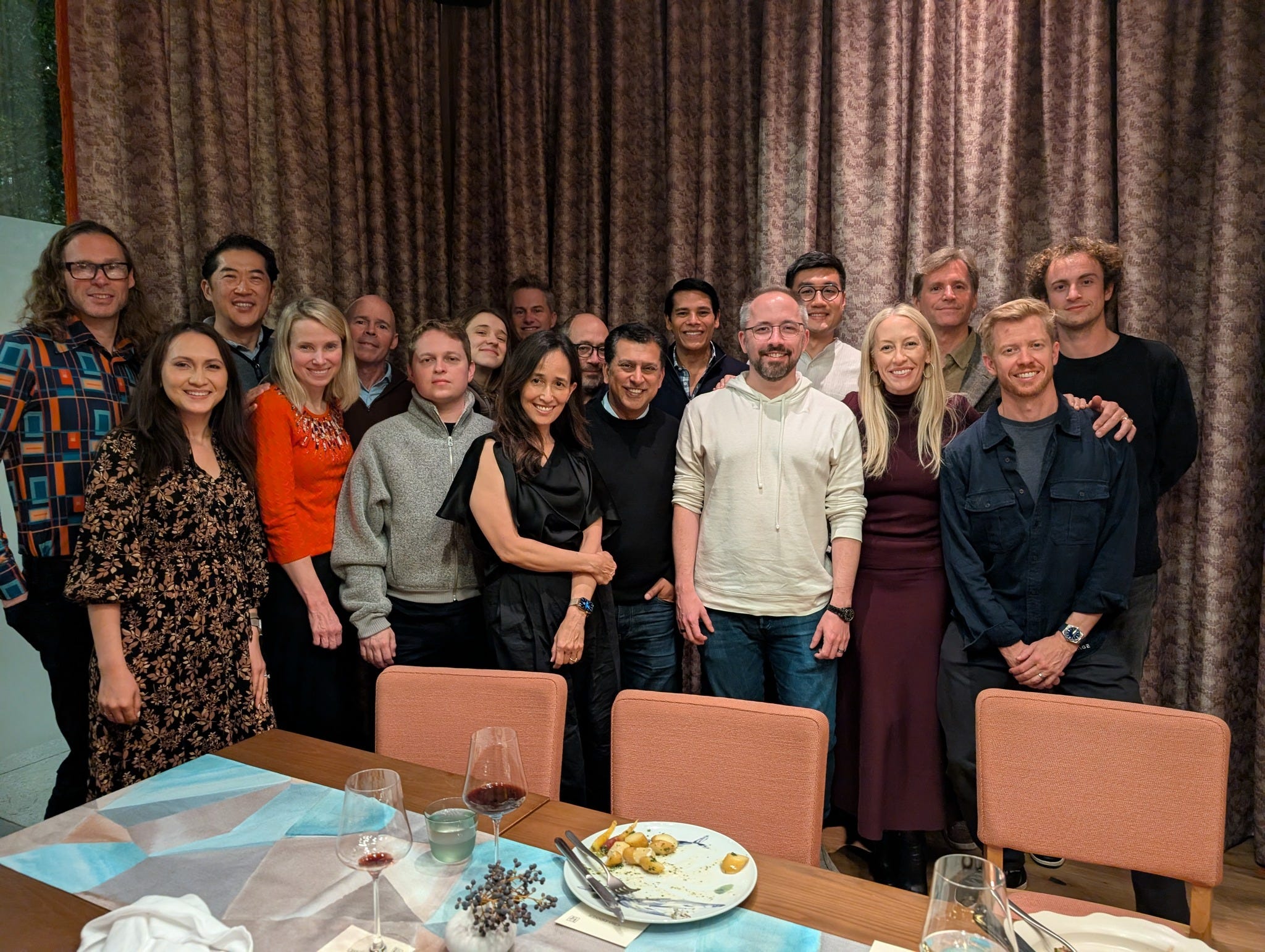
Eighteen technology leaders gathered for a long/short stock game that revealed five critical insights about market positioning and competitive strategy:
A strong consensus long position emerged immediately: Waymo’s product superiority combines with devastating unit economics to create an unassailable moat. At $21 for rides that cost $105 in Uber Black, Waymo demonstrates 75-80% cost reduction by eliminating labor. Leaders who’ve experienced the product universally prefer it to human drivers, citing safety, consistency, and price. The training data advantage (millions of miles weekly) creates a flywheel competitors cannot match. Tesla’s full self-driving lags significantly (2x the accident rate in Austin), and the training data narrative is false. Tesla sends back only intervention data, not general mileage. Uber and Lyft face existential threat.
“The most shocking thing about Waymo isn’t that it drives itself. It’s the price. A 20-minute ride from the wharf to the Four Seasons that would have been $105 in Uber Black cost me just $21.”
Perplexity emerged as the consensus short despite product quality, revealing a harsh truth: consumer AI companies cannot overcome platform distribution advantages. Multiple leaders noted that besides TikTok, no consumer company has broken free of existing monopolies in years. Perplexity’s deal announcements with major platforms consistently fail to materialize into meaningful business impact. The AI search space will ultimately be absorbed by Siri, Google, and other platforms with existing user bases. Even excellent products without distribution paths face zero outcomes.
“It’s almost impossible to get consumer distribution these days. As good a product as Perplexity is, it will ultimately be part of Siri or something like that.”
Multiple leaders identified legacy enterprise software as vulnerable to AI-driven disruption. Companies like Salesforce, Oracle, SAP, ServiceNow, and Workday have survived for decades on switching costs, requiring dozens or hundreds of people to customize implementations, creating lock-in. AI code generation will “decimate that kind of integration,” enabling companies to try alternatives without year-long, multi-million-dollar switching costs. While current Gen AI cannot yet handle systems of record reliably, leaders predict 3-5 years until this becomes viable. Oracle’s massive AI investments signal recognition that their switching cost moat is evaporating.
“These companies have survived for so long on switching costs. You need 50 sales engineers to customize Workday for your organization. AI is going to decimate that.”
Multiple leaders questioned whether 80% margins on semiconductor infrastructure represent a durable advantage or a temporary bubble. The comparison to Cisco’s dot-com era dominance (expensive hardware with high margins that got commoditized rapidly) surfaced repeatedly. As AI models become capable of chip design at human expert levels (expected by decade’s end), the moat in chip design evaporates. Fabrication becomes the only remaining bottleneck, potentially benefiting TSMC while threatening Nvidia’s margin structure. The certainty: some player will find a way to attack that margin at the infrastructure layer.
“The amount of money going into depreciating hardware with high margins is the exact same story as Cisco. Somebody will find a way to eat that margin.”
Leaders identified a major shift in legal services: companies providing outcome-based pricing by owning law firms and powering them with AI platforms. Rather than helping law firms become more efficient (which creates perverse incentives against adoption), these platforms acquire 300-person firms, empower attorneys with AI tools, and offer flat-fee pricing to Fortune 500 companies, promising 90% cost reductions. The billable hour model prevents traditional law firms from capturing AI productivity gains, creating vulnerability to disruptors who align incentives properly.
“Traditional law firms are facing a conundrum. Why do you want to be 300% more efficient? Now you have to bill 3 times as many hours. AI-Native law firms like Eudia are killing the billable hour.”
The Problem: Labor represents 75-80% of costs in most service businesses, and AI’s ability to eliminate those costs is creating unprecedented pricing power for early adopters.
Waymo’s pricing advantage illustrates the magnitude of disruption. A $21 ride replacing a $105 Uber Black ride represents an 80% cost reduction, precisely the labor component eliminated by autonomy. We’re seeing order-of-magnitude transformation here. One leader observed: “75 to 80% of every business is labor. All these things are coming and taking labor out. Everything’s going to start just collapsing.”
The implications extend beyond transportation. Zipline’s drone delivery captures 3% of DoorDash’s business in Dallas alone by eliminating driver labor. Sierra and similar enterprise AI companies provide “shovel ready” customer service automation that companies can deploy immediately. Legal tech platforms cut costs 90% by eliminating attorney time on routine work.
First movers in labor automation can underprice incumbents so dramatically that competitive response becomes impossible. Uber cannot match Waymo’s $21 price point with human drivers. DoorDash cannot compete with drone delivery’s 15-minute coffee delivery economics. The winner-take-all dynamic isn’t about slightly better products but about fundamentally different cost structures.
The Insight: Labor cost elimination creates moats so deep that late followers cannot compete on price, quality, or experience simultaneously. The first company to achieve reliable automation in a category can price at levels that make the entire existing industry unprofitable while still maintaining healthy margins.
Leadership Implication: Identify your labor-intensive processes and attack them with extreme urgency. The first mover advantage in labor automation is more durable than typical technology advantages because it’s structural, not feature-based. Once a competitor eliminates 75% of costs, you cannot gradually catch up. You must completely rebuild your business model. In categories where automation is viable, assume you have 12-18 months before a competitor makes your entire cost structure obsolete.
The Problem: Consumer AI companies face an insurmountable distribution challenge. Existing platforms control all access to consumers, and no amount of product excellence can overcome this structural disadvantage.
Multiple leaders noted that Perplexity, despite strong product quality, cannot escape the fundamental distribution problem. One observed: “In the last couple of years, besides TikTok, there hasn’t really been anyone who’s been able to break free of any of the current monopolies that control all the consumer distribution.” Another noted Perplexity’s pattern of announcing partnerships that “don’t add up to anything. Literally nothing.”
The structural challenge is total: iOS and Android control mobile distribution. Google and Microsoft control search distribution. Apple controls Siri integration. Meta controls social distribution. Amazon controls voice distribution. New entrants must convince consumers to download apps, create new habits, and switch from integrated defaults, a nearly impossible task when incumbents can simply copy features.
The Google-Anthropic-OpenAI positioning illustrates this dynamic. While leaders debated model quality, the consensus viewed distribution as decisive. Google’s search monopoly, Android control, and Chrome dominance create structural advantages that model superiority cannot overcome. Multiple attendees reported their children switching from ChatGPT to Gemini, not because they sought it out, but because it’s integrated into platforms they already use.
The Insight: In consumer AI, distribution moats matter infinitely more than model quality or feature superiority. Platform owners will always win by copying successful features and integrating them into existing user flows. Standalone consumer AI companies face binary outcomes: acquisition by platforms or gradual irrelevance.
Leadership Implication: If building consumer AI, solve the distribution problem first, product second. This means either: (1) building on platforms as features they’ll want to acquire, (2) targeting B2B where distribution follows different rules, (3) creating new distribution channels (like TikTok’s algorithm-driven discovery), or (4) accepting you’re building to be acquired. Don’t compete on model quality alone. It’s necessary but insufficient and easily copied by platforms with distribution.
The Problem: Enterprise software incumbents have relied on implementation complexity and switching costs for decades, but AI code generation is about to eliminate these moats entirely.
One leader described the vulnerability: “These companies have survived for so long on switching costs. You have 100 people that need to customize your Oracle license. You can’t take Salesforce out because you need 50 sales engineers to customize Workday for your organization. And then they’re in and they’re just never going to take them out.”
The AI disruption arrives on multiple fronts. First, AI code generation dramatically reduces the cost and time to implement competitive solutions. Tasks that required year-long, multi-million-dollar integration efforts become weeks-long, affordable experiments. Second, AI enables “try before you commit” dynamics where companies can test alternatives without burning bridges. Third, AI democratizes technical complexity. Non-technical buyers can interrogate codebases and understand implementation details previously hidden by specialist gatekeepers.
Multiple leaders identified specific vulnerabilities: ServiceNow faces disruption from AI-native alternatives like Serval. Oracle, SAP, and Workday face challenges as switching costs evaporate. One leader noted Oracle’s aggressive AI investments signal “they just realize their switching costs lock-in model’s about to just get cooked.”
The Insight: The enterprise software stack faces existential disruption not because AI creates better features, but because AI eliminates the switching costs that made these systems defensible. When implementation drops from 12 months to 2 weeks, the entire strategic calculus changes.
Leadership Implication: If you’re an incumbent: recognize that your moat is evaporating and pre-emptively invest in making your system the easiest to implement and switch to (counterintuitive but necessary). If you’re a challenger: attack the implementation and switching cost problem directly. Make it trivial to try your system alongside incumbents. If you’re a buyer: 2025-2026 is the window to renegotiate relationships before this becomes obvious to everyone. The balance of power is shifting dramatically toward buyers.
The Problem: Massive capital investments in AI infrastructure are creating hardware monopolies with unsustainable margin structures that will collapse when software commoditizes the value layer.
Leaders repeatedly drew parallels between current AI infrastructure and the dot-com era’s Cisco dominance. One noted: “Cisco was buying every company, margins were insane for a product that eventually got commoditized. When it did, it happened right away.” Nvidia’s 80% margins face similar vulnerability.
The mechanism differs from typical commoditization. Rather than competitors building equivalent hardware, AI itself will redesign chips. One leader explained: “By the end of the decade, models will be as good as designing chips as humans. It takes hundreds of people years to do an advanced chip right now. It’s going to be like 10 people in hours.” When that happens, “what is the moat?”
Multiple leaders questioned whether value accrues to chip designers (Nvidia) or fabricators (TSMC). The consensus: fabrication becomes the only bottleneck when design commoditizes. One picked the spread: “I picked TSMC because I’m sitting next to the one I think is the best investment,” referring to a semiconductor manufacturing startup achieving ASML-equivalent lithography resolution.
The data center buildout compounds vulnerability. Leaders noted massive overbuilding: “If you remove training and coding, a single one of these data centers in Virginia could support all the compute needed right now. Every time there’s CapEx investment, it’s always overbuilt.” Core Weave and similar infrastructure plays face “going to zero” predictions if Nvidia doesn’t acquire them.
The Insight: AI infrastructure is simultaneously over-capitalized (too many data centers) and structurally vulnerable (margins will compress as AI designs chips). The dot-com fiber optic playbook applies: infrastructure survives company failures, but shareholders get wiped out before consolidation creates value.
Leadership Implication: If you’re investing in infrastructure: ensure you can survive long enough to acquire failed competitors’ assets at distressed prices. If you’re consuming infrastructure: prepare for consolidation and shifting power dynamics as suppliers collapse or merge. If you’re Nvidia: the margin structure is indefensible long-term, so use current dominance to build moats in other layers (software, ecosystem, services) before hardware commoditizes. The window is 2-3 years, not 10.
The Problem: AI enables professional services transformation from hourly billing to outcome-based pricing, but only for companies that restructure incentives by owning the delivery capacity.
One leader described the legal tech breakthrough: “Instead of being like Harvey, which is trying to help law firms be a lot more efficient, Eudia actually purchased a law firm (a 300 person law firm) and they’re acquiring additional ones. They’re empowering those attorneys with their platform and providing outcome-based pricing.” The go-to-market targets Fortune 500 general counsel with promises of “cutting your legal bill by 90%.”
The incentive structure explains why this works where traditional legal tech fails. Law firms resist AI adoption because “why do you want to be 300% more efficient? Now you have to bill 3 times as many hours to cover your expensive infrastructure.” The billable hour creates perverse incentives against productivity gains. Companies owning AI-native law firms where outcome-based pricing is baked in from the get go eliminate this misalignment. They benefit from efficiency rather than being threatened by it.
The model extends beyond legal. Any professional service billing by time rather than outcomes faces disruption from AI-powered, outcome-based competitors. Management consulting, accounting services, customer support, and IT services all share the structural vulnerability. Leaders noted Sierra’s success comes from being “shovel ready right now.” Companies can deploy immediately because the business model aligns with their interests.
The Insight: Beyond efficiency gains, AI enables completely different business models in professional services where providers own capacity, leverage AI for productivity, and guarantee outcomes at fixed prices. The winners won’t be SaaS companies selling to incumbents but vertically integrated providers who align incentives properly.
Leadership Implication: In professional services, don’t sell AI to incumbents. Their incentive structures prevent adoption. Instead, acquire or build delivery capacity, power it with AI, and compete on outcome-based pricing that incumbents cannot match without restructuring their entire business model. In services industries, prepare for a wave of vertical integration as AI enables providers to own capacity profitably at price points that eliminate traditional players.
Waymo’s Las Vegas Zoox deployment transports 1,000 riders daily, demonstrating commercial viability beyond San Francisco. The training data advantage has become insurmountable. Waymo captures millions of miles weekly while competitors struggle to match even a fraction of that volume.
Tesla’s full self-driving narrative faces reality check. Accident rates in Austin run 2x human drivers (one accident per 350,000 miles versus 700,000 for humans). The training data collection myth collapsed. Tesla doesn’t transmit driving data due to cost, only capturing intervention moments. One former team lead confirmed: “The idea that they’re training on everybody driving around is actually not what’s happening.”
The one dissenting view was that Tesla has a GTM advantage in capacity of production as well as consumer demand profile. The majority of Americans would prefer to own their own self-driving car vs always relying on automated taxis. Further, when Tesla allows you to contribute your car to their Robotaxi network on a revenue-share basis when you are not using it, their cars will be more affordable. Is LA more likely to be overrun with Waymos or FSD Teslas?
Key Insight: Autonomous transportation has moved from experimental to execution phase with viable unit economics. The winner-take-all dynamics favor companies with operational deployments generating training data, not those with installed fleet advantages that don’t transmit learning.
Sierra emerged as the consensus enterprise AI winner, with one leader reporting: “I sit on all these big company boards and they’re like, we try all these AI experiments, and the only thing that’s shovel ready right now is Sierra.” The ability to deploy immediately rather than require eight-week Palantir-style implementations creates decisive advantage.
Competing platforms include Decagon, Giga ML and a host of others. While customer service startups are the VC flavor-of-the-year - - several dozen companies have been funded in this vertical - - the market is large enough for multiple winners. While Sierra has just eclipsed $100M in ARR, customer service still represents a massive untapped automation opportunity across industries.
The ITSM space faces similar disruption, with Serval disrupting ServiceNow through AI-native employee onboarding, offboarding, and workflow automation. Major corporations, including at least on Fortune 500 automotive manufacturer, are replacing ServiceNow implementations with AI-native alternatives, validating the switching cost thesis.
Key Insight: Enterprise AI adoption follows power law distribution. A tiny percentage of applications (customer service, ITSM) demonstrate immediate ROI and deployment feasibility, while most proof-of-concepts continue failing. Winners concentrate in categories with clear value propositions and rapid implementation cycles.
The U.S. and the Netherlands (specifically ASML) may be facing their Sputnik moment in 2026. China’s semiconductor advancement creates strategic vulnerability for U.S. tooling companies. One leader predicted: “I would not be surprised if in the next 12 to 18 months it is revealed that China has working EUV lithography tools.” When that happens, it creates a “Deep Seek moment on steroids” as the entire semiconductor export control strategy collapses.
U.S. response includes startups achieving ASML-equivalent lithography resolution, making the United States one of only two countries (with Holland) possessing advanced lithography capability. The strategic imperative: ensure domestic semiconductor manufacturing capability before China achieves EUV tooling independence.
The short thesis on semiconductor tooling companies: any company deriving 40%+ revenue from China faces existential risk when China achieves self-sufficiency in advanced semiconductor manufacturing.
Key Insight: Semiconductor national security concerns may drive massive government investment. De-Globalization is in full swing with companies solving manufacturing independence capturing disproportionate strategic value regardless of commercial market dynamics.
Robin Hood emerged as consensus long, with multiple leaders citing Vlad Tenev’s execution and platform positioning. The combination of payments, social features, crypto integration, and retail investor focus creates defensible moat that Coinbase cannot match. Leaders contrasted Robin Hood’s crypto-native, retail-friendly approach with Coinbase’s “not crypto native, not friendly” positioning.
The spread opportunity: long Robin Hood, short Coinbase, capturing both crypto industry growth and competitive dynamics within that market. One noted: “Robin Hood is going to corner the retail people and has all the same functionalities, way ahead of Coinbase.”
Prediction markets (Polymarket, Kalshi) face regulatory uncertainty but massive growth potential. Leaders debated whether markets will remain viable after administration changes, with consensus that scale provides protection. The insurance application alone (using prediction markets to properly price risk) represents enormous opportunity beyond political betting.
Key Insight: Fintech winners combine multiple value propositions (payments, distribution, community) rather than competing on single features. Regulatory risk remains high for categories like prediction markets, but scale creates defensive moat against political shifts.
SpaceX dominance in launch vehicles makes competition futile. At $10 million variable cost for Starship launches carrying 100 satellites versus competitors charging $7 million for 1/50th the mass, unit economics create insurmountable advantages. Leaders questioned why anyone continues building competing launch vehicles.
Starlink’s business model mints money: 8 million subscribers at $100-150 monthly generates $10-12 billion annually. Direct-to-device capability threatens the entire $300 billion telecommunications industry. The $17 billion EchoStar spectrum acquisition signals aggressive expansion beyond current satellite internet positioning.
The government maintains competition artificially due to Elon concerns, but leaders view this as temporary. Short thesis on Firefly, Relativity Space, and similar launch competitors despite Blue Origin’s $10 billion Amazon contract.
Key Insight: Space launch has become a solved problem with one dominant provider. The strategic question shifts from “who will provide launch services” to “what applications become viable when launch costs drop 10x.”
Crispr genetic editing represents the long-term healthcare transformation play. One leader has a friend receiving genetic therapy for serious health issues, demonstrating that gene editing has moved from experimental to therapeutic reality. The stock volatility reflects uncertainty about commercialization timing, not technology viability.
Key Insight: Genetic medicine transforms from possibility to practice over the next decade, creating investment opportunities for those willing to tolerate volatility in companies with proven science but uncertain commercialization timelines.
Multiple leaders cited Starlink as a forcing function for evaluating technology adoption. One keeps a dish in his small plane for $50/month, providing better internet than his home. Another noted Walmart’s plane struggles to break Starlink despite 10 people simultaneously Zooming and streaming video.
Application: Use extreme use cases (small planes, international travel, remote locations) to evaluate technology maturity. If a technology works flawlessly in challenging conditions, it’s ready for mainstream adoption. If it struggles in ideal conditions, it’s still experimental regardless of marketing claims.
One executive noted Trump faces an impossible choice in 2026 midterms: maintain AI-friendly posture that built tech industry support, or respond to MAGA base connecting job losses to AI deployment. One observed: “MAGA hates AI. It’s coming for all their jobs. When the midterms come next year, Trump has to choose: are you AI friendly or are you MAGA? He’s totally gonna choose MAGA.”
The schism extends beyond Trump to factions within Republican Party (America First / Steve Bannon anti-transhumanist wing versus tech-friendly pro-growth wing). Regardless of which faction wins, some form of AI regulation appears inevitable by 2026.
Market Implication: Plan for AI regulation regardless of current administration’s friendly posture. The political dynamics are structural, not personal. Job displacement creates populist backlash that politicians must address. Companies should prepare for scenarios including: training data restrictions, deployment limitations in certain sectors, mandatory disclosure requirements, and workforce transition requirements.
Leaders noted severe data center overbuilding relative to actual compute demand: “If you remove training and coding, a single one of these data centers in Virginia could support all the compute needed right now.” The pattern repeats historical infrastructure buildouts (railroads, fiber optics) where 10-20x overbuilding precedes consolidation.
The power constraint compounds the issue: many data centers lack power to turn on equipment. Core Weave faces “going to zero” predictions if Nvidia doesn’t acquire. The infrastructure builds value long-term but destroys shareholder value short-term.
Market Implication: Short neo-cloud providers and data center infrastructure plays unless they have genuine demand absorption (not speculative capacity). The survivors will be those who can outlast competitors and acquire assets at distressed prices. For compute consumers, expect pricing pressure as supply overwhelms demand.
“Neo-clouds” face extreme customer concentration: “Revenue without their number one customer is sometimes 50-75% lower.” This creates fragility where single customer decisions eliminate majority revenue. Similar dynamics appear in AI coding companies where “revenue without Cursor versus revenue with Cursor” represents material differences.
Market Implication: Evaluate AI infrastructure and platform companies based on customer diversification, not absolute revenue scale. Concentrated revenue structures create consolidation opportunities as single customer losses trigger distress sales. Customer concentration risk is systematically underpriced in current valuations.
Che Fico’s pandemic restaurant initiative illustrated authentic impact versus virtue signaling. When lockdowns hit, one CEO immediately called: “Let me just start writing checks to you (to keep you in business).” The money was spent on feeding the community with a new program that served 3,000-4,000 meals weekly to laid-off workers. When the CEO suggested building a website to streamline signup, the restauranteur responded: “Are you serious? You want to make it easier to give away your money?”
Leadership Lesson: The distinction between claiming to make impact and actually making impact is ruthlessly simple. Are you willing to immediately deploy resources without optimizing for credit, measurement, or efficiency? True impact orientation sometimes means accepting messiness and inefficiency in service of urgent need. The leaders who matter are those who act first and optimize later, not those who plan extensively but never move.
“Anthropic is being built in a more durable way than some of their larger competitors.” → B2B revenue resilience matters more than consumer mindshare in AI model competition.
“Gemini’s gotten a lot better. You never underestimate Google when they’re back on their heels.” → Platform distribution advantages overcome temporary model quality gaps.
“The atomic unit of product ownership is oriented around the workflow, not the backing database.” → Systems of record companies face disruption as product focus shifts from data to experience.
“The scarcest resource in Silicon Valley are people who can produce new things (bangers, miracles) consistently.” → Talent differentiation accelerates as AI handles routine work, making miracle workers 100x more valuable.
“The bull case on Tesla was always that they’re, that they’re recording all, all of this mileage in addition to what Waymo’s doing. I spoke to someone on their team and they send none of that data back because it’s way too expensive to send it back. So it all sits in the car. The idea that they’re training on everybody driving around is actually not what’s happening.” → Having millions of cars on the road means nothing if the data stays in the cars; Waymo’s deliberate data collection beats Tesla’s theoretical fleet advantage.
“If you build a great business, no one can hurt you. If you build a bad business, no one can help you.” → External support matters far less than fundamental execution quality.
“The brand power of VCs as kingmakers has waned dramatically. No one feels like they need to be king made anymore.” → Revenue and team quality now signal success more than prestigious investor backing.
“Chinese wealth growth is plateauing, so people are differentiating through consumption instead of income. This creates a domestic luxury arms race. Chinese EVs went from trash to better than American in years. With a billion people competing, expect multiple global luxury brands to emerge from China purely from domestic competition intensity.” → China’s massive internal market creates quality pressure that will produce globally competitive brands.
“Neo-labs are all just tweaks on the margin. You need distribution, a product, and a boatload of compute.” → Model architecture innovations alone cannot overcome structural advantages of established players.
“How sticky is Anthropic revenue? It’s like search because of the coding. And then coding is like a Malthusian Thunderdome.” → Coding is the highest value for AI currently, but the ability to switch between coding copilots may prevent anything from developing a moat.
“Robin Hood is crypto native and retail friendly. Coinbase is neither.” → Platform positioning and user alignment matter more than first-mover advantages in fintech.
“SpaceX can launch 100 satellites for $10M variable cost. Why would anyone compete in launch vehicles?” → Some markets reach winner-take-all endgames where competition becomes irrational.
“DoorDash and Instacart face Zipline doing 3% of DoorDash business in Dallas alone with drones. They can deliver a cup of coffee to your doorstep in 15 minutes.” → Labor elimination in delivery creates cost structures traditional players cannot match.
“Core Weave goes to zero if Nvidia doesn’t buy it.” → Infrastructure overbuilding during AI boom mirrors dot-com fiber optic bubble dynamics.
“The only people who make sense to bring on are those who can produce 10x work (bangers).” → Hiring philosophy shifts from competent executors to miracle producers as AI handles routine work.
“MAGA hates AI. Trump has to choose in 2026: AI friendly or MAGA? He’s gonna choose MAGA.” → Job displacement creates political pressure for AI regulation regardless of administration.
“California Republicans become president, but California Democrats don’t.” → Ideological positioning that works locally may fail nationally in presidential politics.
“The future of American politics is nationalism versus socialism.” → Political alignment increasingly reflects economic security fears rather than traditional party lines.
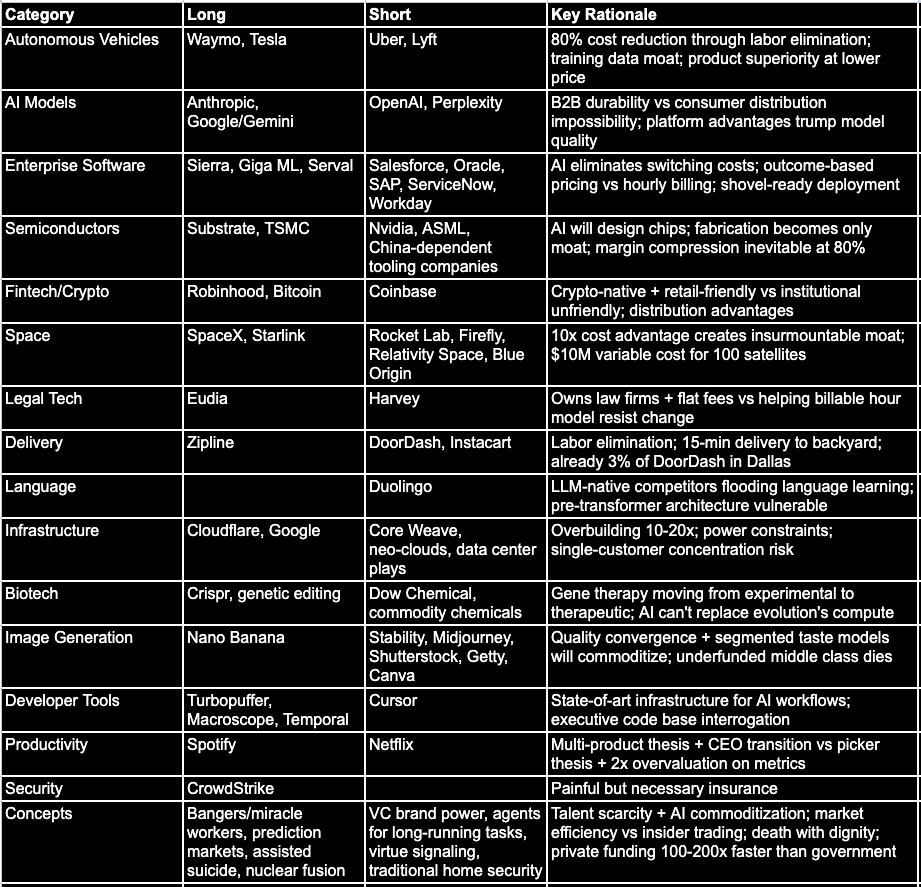
Started in 2008, CEO Dinner is a monthly gathering of leading entrepreneurs in Silicon Valley.
© 2025 Dion Lim
No posts
Comments
Nothing yet. Say the first thing.
Sign in to join the conversation.