

By Dion Lim
I am a little slow getting this month’s CEO Dinner Insights out as I was traveling for my youngest child’s college graduation last week. It was a wonderful celebration of four years of hard work.
We were especially happy that he achieved his goal of getting a job before he graduated. Literally, six days before his commencement he received an offer for an Associate Product Manager program. One of his sisters called it a buzzer beater! We were elated for him, and relieved as well. Today’s new grad job market is as tough, if not tougher, than any in my lifetime. There were thousands of applications for a handful of slots in his program. Those odds make elite college admissions pale in comparison.
The broader job market is equally dicey. Having spoken to a few dozen CEOs in the last month, leaders fall into three camps in responding to AI productivity: 1) layoffs for companies which face an existential threat to their business or who want to offset their AI investments with headcount reductions, 2) for most others, freezes in hiring is the strategy du jour as companies seek to grow without making new hires or by redeploying employees with institutional knowledge into new roles, and 3) for a select few, growth means hiring in all areas.
As we make our way through these uncertain times, it’s often helpful to look to the past. As Spanish-American philosopher George Santayana famously said in his 1905 work The Life of Reason: ”Those who cannot remember the past are condemned to repeat it.”
This month our dinner was hosted by Michael Birch who always sets the bar for fun and original programming. He gave our dinner a title for the first time. “Please refrain from mentioning our future overlords.” He had two Jeffersonian questions, “What is something that used to be better?” and “What’s one thing we improved until we ruined it?” Speaking of titles, for the first time we had two attendees with a title, one Baroness and one His Excellency!
The discourse was nostalgic leaning towards wistful. For such high agency people I was at times surprised how helpless and hopeless some of these answers felt. A maelstrom of emotions included, sorrow, guilt, ennui, frustration and resignation. In the end, however, there was, as always in Silicon Valley, a sense of hope and faith in the possible.
I also invite readers in the comment section to name something that used to be better and/or one thing we improved until we ruined it!
This is the fourth CEO Dinner Insights report written by AI. I edit. For my original thought pieces, the roles reverse. As usual, our dinner followed the Chatham House rule -- no individual attribution, just the collective wisdom of the room.
Mike’s ICYMI Facebook Post
Wistful CEO Dinner this month hosted by Michael Birch. Special guests included Will Marshall (CEO, Planet), Dambisa Moyo (Baroness), Stan Chudnovsky (Co-Founder, NFX), Sami Senapathy (CEO, Endeavor), and Aria Finger (Chief of Staff, Reid Hoffman). Notable tonight: no discussion of AI, 3 British accents, one member of the House of Lords, a CEO who previously worked on the floor of a steel mill, a CEO who got his first job in database management at age 11, a CEO who got a security clearance before he had his first girlfriend, an attendee who was born in Zambia, and a CEO whose 27th grandfather signed the Magna Carta. Topics today included why men are less manly, how only 4% of people today read at all for pleasure, how the birth rate in Mexico has plummeted, how 1 in 3 teenage girls used to get pregnant, how China’s population is projected to drop from 1.3B to 600M by the end of the century, how Italy’s population will similarly fall from 60M to 20M, how we miss volume knobs on car radios, how democracies historically decay if there is no significant external threat, how 90% of people in China don’t believe they are in competition with the USA, how it would only cost $10B to protect 80% of all the biodiversity in the world, how Bhutan is teeming with 800,000 poor people who actually aren’t that happy, how many things (kids playing after school, family dinners, music, science fiction, philosophy, etc.) used to be better than they are today, and so much more…
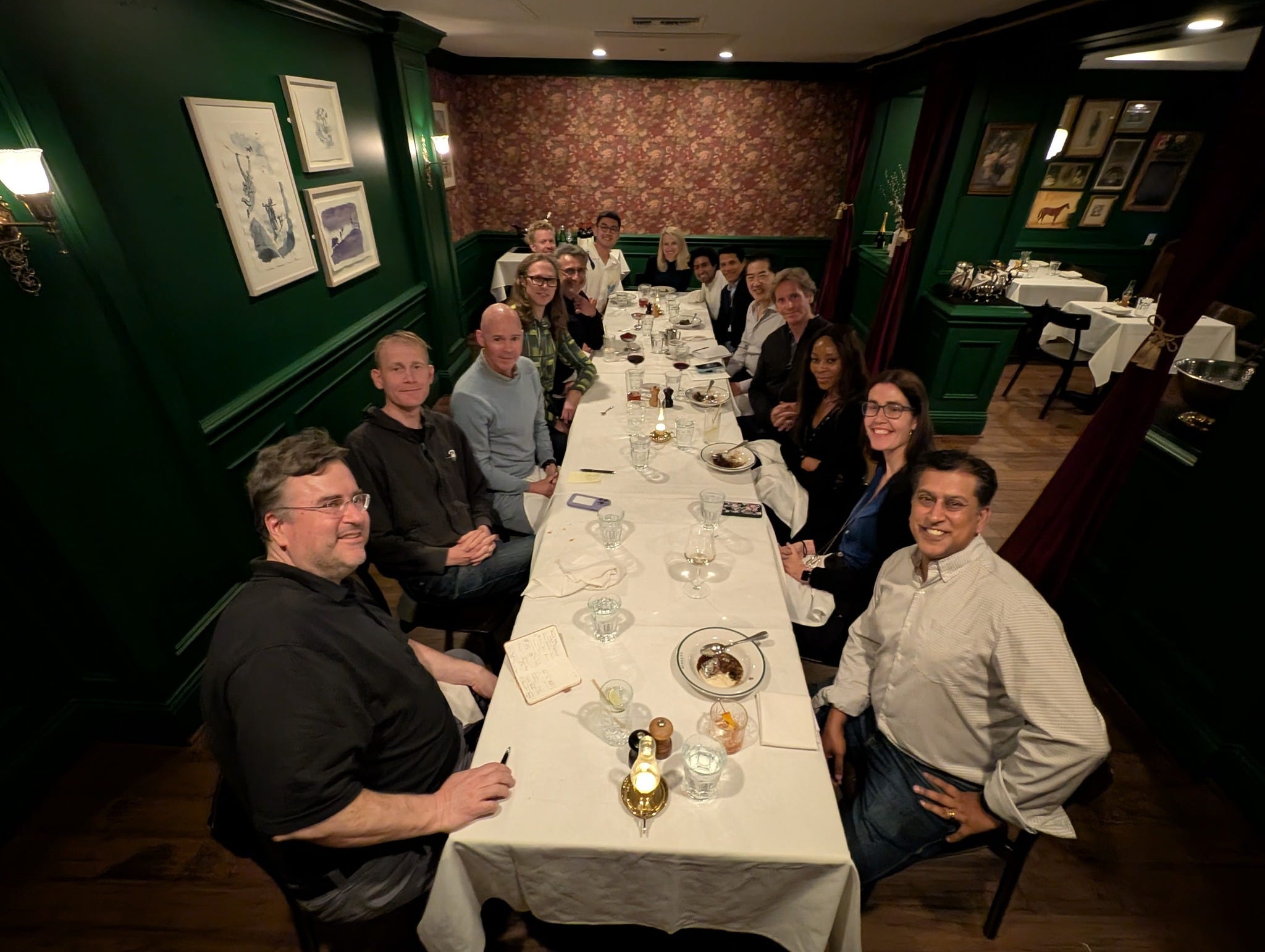
The host’s mandate -- pretend AI does not exist -- was a discipline. The Jeffersonian question -- what used to be better, what did we improve until we ruined it? -- was an invitation. What the room produced over three hours was not a victory lap and not nostalgia. It was a remarkably consistent diagnosis of what fifty years of relentless optimization has hollowed out.
The answers clustered. Almost every speaker described a place, a time, or a ritual where people used to be in the physical presence of other people, and the substitute that has replaced it. The third space -- the bar, the front yard, the dinner table, the dance floor, the train compartment -- has been gradually eliminated, and its replacement is mediated, asynchronous, and lonely. Demographic collapse follows the same shape. So does the crisis in childhood. So does the rise of two political religions where one civic culture used to be.
A second cluster, related but distinct, described systems we kept improving until they broke. Music delivery refined itself from live performance through vinyl through cassette to MP3 to playlist -- and is now reverting to live concerts at premium prices. Car interiors went from intuitive knobs to touchscreens that no one can operate while driving. College admissions went from a couple of essays to 1,150 essays and a 3% acceptance rate. Startup financing went from a check to a labyrinth of stages. 物极必反 -- when things reach the extreme, they must reverse. The room had a great deal to say about extremes.
A third cluster touched the natural world and the public sphere -- wildlife populations and fish stocks devastated over a generation, mammal biomass now overwhelmingly humans and livestock, public discourse fractured into two warring tribes, Watergate as the first crack in American exceptionalism, a sitting president expressing satisfaction at a competitor’s death without measurable consequence.
The host’s own answer came at the end. He named the meta-pattern under everything else: pleasure has become too easy, friction has been engineered out, and the over-easy life has eroded the very capacity for meaning. Sine labore nihil -- nothing good comes easy. What struck the table, though, was less anything he said than the silhouette of his own career, which has spanned both halves of the diagnosis -- the building of the substitute, and, later, the building back of the original. The room sat with that for a while.
Our host kicked off the evening with a request. “Please refrain from mentioning our future overlords. For tonight, the thing we never stop talking about does not exist. Pretend it has never been conceived.” He had two questions for the table. What used to be better? What did we improve until we ruined it? The room laughed, agreed, and then spent the next several minutes failing the assignment with a kind of helpless honesty before settling in.
We will come back to charters before this evening is over.
The cluster that dominated the night, by far, was the loss of physical places where people used to be in the presence of other people.
One CEO opened with drinking. Drinking used to be better -- or, at least, drinking used to do something it no longer does. For most of human history, alcohol was social infrastructure. It functioned as a third space -- between work and home -- where inhibitions came down, conversations went deeper, friendships were forged, and the social fabric got re-stitched. That third space is being replaced by screens. The downstream effects are not subtle. “Birth rates are dropping. Teen pregnancy is dropping, which by itself may be a good thing -- but it’s symptomatic of the same withdrawal. People are not meeting other people.” A Financial Times piece from the previous week was cited, showing that the global replacement rate has fallen below 2.1 across all countries simultaneously, with end-of-century projections of China dropping from 1.4 billion to 700 million, Italy from 60 to 20 million, and Japan from 120 to 50 million. Nigeria still grows.
A second CEO picked up the thread with concerts. “People used to be present at concerts.” No phones held aloft. No videos shot through the front row. And -- a darker note -- no fentanyl turning a night of escape into a lethal lottery. The third space has not only thinned; it has gotten more dangerous in the few places it still exists.
Another CEO went further: dancing used to be better. A few weeks earlier, this CEO and a spouse had flown to Las Vegas to see the Eagles at the Sphere. Afterward they went to a club where a famous DJ was performing. They were the oldest people there by a considerable margin, with one other older couple beside them. The four of them were the only people actually dancing. Everyone else was bopping in place with one hand raised, holding a phone, shaking it up and down. That was the dance. Kids came up to them all night to say they thought they were cool, that they were such good dancers, that they wanted to grow up to be like them. At one point the DJ pulled a hat off the rack and handed it across in recognition of the spectacle of someone actually moving to the music. The framing offered to the room: playdates used to be two kids playing, and have become two kids in the same room doing parallel play on their own screens. The grown-up version, it turns out, is the dance floor.
Another CEO made a related observation about must-see TV, having been watching the old shows with their kids -- Full House, MacGyver, Mork and Mindy, Gilligan’s Island. The point of must-see TV was that everyone watched the same thing on the same night and talked about it the next day at school or work. It was connective tissue. Today the abundance of content has so thoroughly fragmented audiences that nobody is sharing a story anymore. Then, picking up the music thread, a small but important observation was added: the resurgence of live concerts is people paying premium prices to get back to the original form. Every layer of mediation we added subtracted something. The native form remains the best.
A fourth CEO spoke about neighborhoods. The physical observation was specific and sharp. American homes used to face the street. Front yards, front porches, neighbors on stoops. Today’s homes have rotated backward, away from the street, toward private backyards. The 4th of July block party is the lost ritual. The exodus to private schools compounds the architectural retreat: kids in the same neighborhood don’t know each other because they’re being shipped in different directions every morning. Two converging trends, one structural and one educational, that together have dismantled the neighborhood as a coherent social unit.
A fifth CEO spoke about family dinner. Family dinner used to be better. In an earlier shared-living arrangement at college, forty people had eaten together every single night. Today, that is unthinkable. The frame offered: family dinner used to be sacred time. Nothing was scheduled during it. Today, extracurriculars schedule right through dinner without hesitation. A body of research on the correlation between number of family dinners per week and downstream child outcomes was cited -- the curve is steep and unforgiving. Five nights a week tracks to good outcomes; the negative correlations climb as the number drops to four, three, two, one. The ritual carries measurable weight.
Another CEO offered a related piece, in the form of friendship. We kept improving friendship until we ruined it. Social media initially reduced the friction of staying in touch with people you had lost track of, and that was a real gain. Over time, that improvement evolved into a performance economy where the quality of a friendship is measured by likes and comments and reshares of the friend’s well-curated life. The original function of friendship -- being there when someone is genuinely struggling -- has been quietly outsourced. When we hit hard times now, we no longer call a friend. We schedule a therapist. There is a real place for trained professionals in the treatment of trauma. But we have over-rotated, and the cost is the kind of friendship that used to constitute a life.
The host had been listening to all of this. He waited until the end of the evening to make his contribution, but the thread he closed on was the one this section is named after, and we will return to it.
The room turned, more than once, to children.
One CEO defined childhood by what it used to train: resilience, the capacity to handle boredom, and the ability to sit with uncertainty. Childhood, in other words, used to be better. All three capacities have been engineered out of contemporary American childhood. The litany was brutal: kids more isolated, fewer of them, less joy, no tolerance for frustration, parents fearmongered into not letting kids bike around the block, neighbors who are strangers, a third of teens on anti-anxiety medication. Social media constantly undermines a child’s sense of what their own thoughts and feelings even are. A whole generation has been taught, in different ways for different genders, that nothing they perceive about themselves or each other can be trusted.
Another CEO, picking up the same theme, named a second-order effect no one wanted to name. The expansion of professional opportunity for women was an unambiguous gain. But one of its downstream consequences was a quiet, decades-long depletion of the teaching profession. For generations, many of the most capable women in any community had become teachers, in part because their other options were artificially limited. The teacher was a community figure with standing -- a standing that, in retrospect, was partly subsidized by closed doors elsewhere. When those doors opened, correctly, the teaching profession lost a generation of talent that had been flowing into it by default. We have not yet built a substitute. The country now faces a significant and worsening teacher shortage, and the role no longer reliably attracts the talent it once did. A number was added: eighty-eight percent of parents do not feel safe letting their ten-year-old leave the block. Safetyism has become structural.
A third CEO described the college application system their child had just survived. Twenty-six schools applied to. One thousand one hundred and fifty essays written, in the course of those applications. Let that sit for a moment. The top schools are now selecting at three to four percent, optimizing for yield -- the best candidates likely to say yes -- and have largely abandoned standardized tests as a shared currency of comparison. The result is total uncertainty paired with crushing consequences, beginning in middle school. We have improved the system until it broke its users.
A fourth CEO closed the childhood cluster with something quieter. Education itself, this speaker suggested, used to be better. Adam Smith’s Wealth of Nations is now two hundred and fifty years old -- a fact almost nobody in their circles is aware of, much less marking. The cultural baseline of shared intellectual reference points has collapsed. Then a sharper point on elite American education: the large majority of Black students at Ivy League schools, by this speaker’s count, come from overseas populations rather than from the descended American population the system was ostensibly designed to serve. Their own education came from a public school in their home country -- preparation sufficient to take them to two of the most selective universities in the world. The implicit indictment was sharper than anything else said on education that night.
A different cluster -- related but distinct -- described systems that kept being improved until they broke.
The music chain came up first. We kept improving music until we ruined it. Live performance to phonograph to vinyl to eight-track to cassette to CD to MP3 to streaming playlist. Each step added convenience. Each step subtracted from the album as a coherent artistic statement. People do not sit with an album anymore. They sit with playlists. And then they pay premium prices to go see the music performed live, which is where they started.
Television followed a similar arc. One CEO offered the most mundane version of the point and somehow it landed the hardest. “Just logging in to watch something now requires too many passwords.” The medium has been improved until the friction at the front door rivals the value of the content.
The example everyone seemed to enjoy most was the car interior. We kept improving car interiors until we ruined them. A guest invoked the wisdom of Ray Dolby on the intuitive perfection of the volume knob -- the way the body knows exactly what to do with it before the mind catches up. Touchscreens have replaced almost every knob in every modern vehicle, and the result is a generation of cars that nobody can operate while driving without taking their eyes off the road. The killer line: “The designers at these auto companies are cosplaying Steve Jobs.” An entire industry chasing an aesthetic that does not fit its actual use case.
Startup financing earned a quiet mention from one investor. It used to be simple: a check. Now it is pre-seed, seed, seed extension, Series A, A1, A2, bridges, SAFEs at varying caps. The labyrinth has not produced better companies; it has produced more lawyers.
The common shape: each generation of optimization made a marginal improvement and slowly accumulated into a system that was strictly worse than where it started. The classical Chinese chengyu for this is 物极必反 (wù jí bì fǎn) -- literally, “when things reach the extreme, they must reverse.” It comes out of the Yi Jing and centuries of Daoist commentary, and it names a principle the room had been circling all night: that any quality, pushed to its limit, generates its opposite. Convenience pushed to the extreme generates friction. Connection pushed to the extreme generates isolation. Choice pushed to the extreme generates paralysis. The reversal is not a moral judgment -- it is a physical law of systems. We may have been watching it operate, in real time, across every domain the table had named.
Several speakers stayed with the public sphere.
One CEO opened with reading for pleasure. Reading used to be better -- or at least more common. Twenty years ago, thirty percent of people read books for pleasure. Today the figure is four percent. Forty years ago no one spent thirty minutes arguing over what to watch because there was almost nothing to watch. The 1990s explosion of entertainment options ended the practice of sitting with a long-form text. Attention spans dropped from a sixty-minute reading session to a three-to-five-minute video clip. This speaker was, at the time of the dinner, working through Crime and Punishment and War and Peace. Putting money where mouth was.
Another CEO turned to news, and the framing was personal. News used to be better. Anyone who still believes the news is better than it used to be has not personally been the subject of fake news. Once you have, the blinders come off and the skepticism becomes permanent. The inference was left to the room. The same speaker also picked up the music and TV thread that had been running all night, with an added wrinkle: YouTube has rewired the attention spans of children specifically. Constant context-flipping, no settled focus, all disposable time spent on short-form. Then a separate observation: office culture has been improved until ruined -- a little flexibility, then full remote, then the contested attempt to drag people back to the office, with no one happy where we have landed.
The deepest exchange of the evening came around values. One CEO argued that values used to be better, and that the loss of internalized social values has rippled through everything else. The frame was Dostoevsky’s Ivan Karamazov, who argued for the unification of church and state on a specific theological-political ground: excommunication from a social group is a steeper punishment than civil sanction, and so internalized social values do enforcement work that law cannot. When social fabric enforces norms, people self-regulate to remain inside the group. The downstream consequences -- dating, fertility, social cohesion -- improve. Religion used to do this work. Politics has stepped in to fill the vacuum. We now have two political religions at war. Party affiliation has become identity, deviation gets you excommunicated, and leaders are being deified.
Another guest pushed back, carefully. Silicon Valley was framed as a kind of religion of technology -- but the deeper point was that the impulse underneath is the oldest human one, not a recent one. The urge to build, to reach past what exists toward what is possible, predates the Valley by tens of thousands of years. The risk, in this framing, was not that we build too boldly; it was that we stop believing building matters at all. The personal position was placed somewhere between traditional belief and outright materialism: “I don’t believe in a supreme being. I also understand that Newtonian physics doesn’t explain everything.” A useful counterweight to the unification thesis.
A third CEO returned to the public mind from a different angle: democracy itself. Politics used to be better, in the sense that the median voter used to matter. Gerrymandering and redistricting have made the median voter functionally irrelevant. Politicians no longer need to court the middle; they need to survive primaries against more extreme versions of themselves. The selection pressure runs to the extremes. The line that landed: “The average of your constituents is very low value for most politicians today.”
A fourth CEO closed this cluster on public discourse and science. The public’s belief in science has eroded. Science fiction itself has gotten worse, and the television adaptations are even thinner -- compare contemporary sci-fi to the Iain Banks Culture novels, which are genuine thought experiments about how to reorganize a society. Then a thread on train travel that produced a useful flicker of warmth: there is, apparently, a train in Japan with such limited capacity that seats are allocated by annual lottery. Another guest jumped in with the Beijing-to-Harbin train, where people used to meet and connect. The train used to be a third space. Then a closing observation that this CEO had been holding for a while: Watergate was the beginning of the break in American exceptionalism, and we have been losing public decorum ever since. The example offered without dwelling on it: a sitting president expressing satisfaction at a competitor’s death, with no measurable cost to the speaker.
The longest sustained exchange of the night was about China. It is worth noting that this was the section of the evening that pushed hardest against the host’s mandate -- because of course China is the country that everyone in this room thinks about every day in connection with the topic we were not allowed to mention. The room found a way to discuss the great-power question without invoking the forbidden subject. It was not entirely successful, but the discipline was instructive.
One CEO opened with the thesis. China is the most potent competitor the United States has ever faced, and the unsettling part is that Americans are not organizing around it. In the Cold War, Reagan and Tip O’Neill had to collaborate across the aisle. Today we face a more capable adversary and cannot muster the same coherence. The Chinese self-narrative is striking: the last hundred years are the exception to their five-thousand-year history, an aberration of weakness. They are not innovating for innovation’s sake. They are focused on control and access to the open sea.
The room then divided. One CEO argued the Chinese are not expansionist and offered a remarkable statistic about Chinese public opinion: most ordinary Chinese do not perceive themselves as in competition with the United States. Only about ten percent do. Of that ten percent, half do not know what the competition is about. The remaining five percent understand it is about sea access. Same CEO argued that China’s interests -- sea access, oil, African partnerships -- are not fundamentally different from how the United States has historically operated.
Another CEO pushed back hard. China is not interested in collaboration. They want domination. The evidence: Cuba, Venezuela, and Iran as three sub-surface plays to gain leverage against the United States. The structure of the loans is the tell -- recourse loans designed to put China at the top of the food chain, not the development-bank model of mutual benefit.
The closing observation came from a third CEO, and it was the most quotable line of the section. In a future where atoms matter more than bits, China owns a lot more of the atoms. The manufacturing-capability argument, distilled to a sentence.
A CEO whose work involves the natural world returned, late in the evening, with a contribution that closed the loop of the dinner without anyone yet realizing it would.
Three things were named that have degraded. Philosophy used to be better. Entrepreneurship is no longer asking why we do things, only what to do next. Founders are no longer interrogating the implications of their work for the society it will reshape. Religion used to be better -- not as theology, but for the community it generated, which has dissipated as the institution has thinned. And nature used to be better, which is the one this speaker had numbers ready for.
The numbers were offered loosely: roughly seventy percent of wildlife gone in a generation, seventy-seven percent of fish, similar figures across other categories. The biomass number was the one that sat hardest with the room: humans, cows, and pigs together are roughly ninety-seven percent of all mammal flesh on the planet. The wild mammals -- all the elephants and tigers and bears and deer and wolves and whales -- are what’s left.
The argument kept going. Of perhaps a thousand planets with conditions hospitable to life, ours is singular in its diversity. If Elon succeeds in getting humans to Mars, the first thing they will want is to come home, because Earth is so much nicer to live on. The conservation math was striking: roughly one percent of the Earth’s land mass holds eighty percent of its biodiversity, concentrated in the Philippines, Indonesia, and the Amazon. About ten billion dollars would preserve it. And the good news, this speaker insisted, is that when we stop hurting nature, it recovers fast. We saw it during the pandemic shutdowns. Trees do not need us to plant them. They need us to stop cutting them.
Then the close that bookended the evening, though it may not have been intentional. The table was told about the Terra Carta, a charter being championed by the current King of England, derived explicitly from the Magna Carta of 1215. King Charles launched the Terra Carta in 2021, taking its name directly from the original document and asking the world’s CEOs to commit to protecting fifty percent of the biosphere by mid-century.
The first charter granted rights to people. Its companion, the Charter of the Forest, granted rights to the woods and the land. The newest charter, eight centuries later, attempts to grant rights to the planet itself. We had been listening to a continuous tradition the whole night and had not realized it until that moment.
The host had let the table run for nearly three hours before he offered his own answer. He had been listening carefully.
He said the thing that used to be better was human happiness itself. Every other speaker had named a specific casualty -- dancing, friendship, neighborhoods, family dinner, childhood, music, nature. He named the meta-pattern. We have spent the last several decades adding layer upon layer of dopamine access -- more sources, more frequency, lower friction, faster delivery -- until the entire system has gone off-calibration. Pleasure is now too easy. Sine labore nihil, he said. Nothing good comes easy. The Roman line is old-world wisdom that the modern delivery system has steamrolled.
The room sat with that for a moment. What hung in the air, listening to him, was not anything he said -- it was the shape of his own career. He had spent an earlier chapter helping to build tools that let people connect at scale without ever being in the same room. He had spent the chapter since trying, in his own way, to build back the in-person original. The man who had helped build the substitute had spent his second act trying to rebuild the original. The whole evening, in one image.
The formal answers gave way, over the dessert course and after, to scattered observations. A few worth preserving.
On testosterone. One CEO, riffing on the “improved until ruined” question, offered men as the answer. Testosterone down. Sperm count down. Everything we did to improve men measurably degraded the biology of being one. The room laughed. The data is real.
On the host’s other ventures. The same CEO, joking, named the host’s original social network as the textbook case of “improved until ruined.” The host, gracious, took the punch.
On mental health acceptance. One CEO argued, against the grain, that mental health acceptance has tipped into overpathologizing -- where ordinary stress, normal sadness, and the natural friction of life are increasingly treated as clinical conditions. A different version of the same point that has been made tonight about therapy replacing friendship. Both observe that an originally healthy correction has been over-rotated until it does new damage.
On the DJ’s hat. A small fragment of the dancing story above that the table appreciated: the DJ, watching someone over fifty actually move to his music, reached for one of the hats on his rack and handed it across. It has been kept.
Here is what the room arrived at, collectively, over the course of the evening.
The mandate had been simple: pretend AI does not exist. But what we did, for three hours, was describe in granular detail every wound that AI is now arriving on top of. A society whose third spaces have collapsed. A childhood without resilience. A friendship economy hollowed into performance. A public sphere split into two warring religions. A natural world where humans and the animals we raise to eat are nearly all of what’s left. A college admissions process that ate a generation’s adolescence. A dopamine economy that has trained us to expect satisfaction without effort.
None of this was new diagnosis. Robert Putnam published Bowling Alone in 2000, on the collapse of social capital and the disappearance of the bowling league as the canonical American voluntary association. What we were doing at dinner was the 2026 update. The trend lines have not bent. They have steepened.
These wounds did not come from the technology we were not allowed to name. They came from the technologies before it. AI is being deployed into a body that has already lost a great deal of its native immunity. Whatever the next decade does to us, it will be doing it to a society that had already been thinning out its own ability to absorb shock.
It is worth saying what the room mostly did not say. The same fifty years that produced these losses also produced real and measurable gains. Violent crime is far lower than it was at the 1990s peak. Drunk driving fatalities are a fraction of what they were a generation ago. Teen pregnancy has dropped by more than half. Lifespans have lengthened. Workplaces are safer. People who were once invisible -- women in positions of power, LGBTQ Americans, people with disabilities, immigrants of every background -- have a kind of access and dignity that the older world did not extend. The honest version of “things used to be better” is also “and many things used to be much worse.” Both are true at the same time. The dinner was a discipline in saying the part that doesn’t usually get said in this room. It was not a claim that nothing else is real.
And yet. The evening ended on the gentlest possible note. Throughout the night, in different voices and from different directions, the table had been describing what it might mean to write a fourth charter.
The Magna Carta named the rights of people. The Charter of the Forest, its companion document, named the rights of the land. The Terra Carta, eight centuries later, names the rights of the planet itself. Three drafts of the same document, refined across eight hundred years.
We did not, that night, name a fourth. But the conversation we were having -- about what we used to have, and what we improved until we ruined it -- felt like the rough draft of one. Someone, eventually, will write it.
The question is whether we will read it in time.
Before publishing, the AI co-author flagged several of the evening’s statistics for verification. Dinner-party data is a particular epistemological category -- people share figures they read somewhere, half-remember from a study, or extrapolated from a different one entirely. Some of what was said checked out perfectly. Some of it pointed in the right direction but with different numbers attached. Some could not be independently sourced at all. In the spirit of transparency about how data travels through conversations among informed people, here is what was offered at the table and what the AI was able to find. We are not asserting any speaker was wrong -- only noting what the AI could and could not confirm.
On reading for pleasure. At the table: thirty percent of people used to read for pleasure; four percent today. What the AI found: the four-percent figure could not be sourced. The closest analog is the UCL / University of Florida study (iScience, August 2025), which shows that daily reading for pleasure has fallen from about twenty-eight percent of Americans in 2004 to about sixteen percent in 2023 -- a forty-percent decline. The annual rate of reading at least one book has fallen from sixty-one percent in 1992 to under fifty percent today (NEA, 2022).
On historical teen pregnancy. At the table (per Mike’s recap): one in three teenage girls used to get pregnant. What the AI found: the Guttmacher Institute estimates that at the 1990 peak, roughly three in ten American girls became pregnant before age twenty -- a cumulative rate that aligns with “one in three.” The annual peak rate was about eleven percent.
On Black students at elite universities. At the table: the large majority of Black students at the Ivy League come from overseas populations rather than from the descended American community. What the AI found on first pass: a 2007 Princeton-Penn study (Charles and Massey, American Journal of Education) putting the figure at 41% across four Ivy League colleges; Lani Guinier and Henry Louis Gates Jr. estimating at Harvard specifically in 2004 that between one-half and two-thirds of Black undergraduates were from immigrant or biracial backgrounds. What further checking surfaced: in a separate interview from his America Beyond the Color Line series, Gates stated that “only 25 percent” of his Black Harvard students had four African American grandparents -- meaning 75 percent were of immigrant heritage. Stanford economist Caroline Hoxby has written extensively on these admissions dynamics. The Ivy League has also been the subject of multiple lawsuits alleging collusion in admissions and financial aid practices whose effects fell unevenly on Black American applicants. The speaker noted that the underlying numbers were widely cited in the years before the post-2020 institutional changes, and may have shifted materially since -- though few schools publish ancestry breakdowns. The “large majority” framing is well supported across the available scholarship; precise figures vary by institution and survey methodology.
On safetyism. At the table: eighty-eight percent of parents do not feel safe letting their ten-year-old leave the block. What the AI found: the eighty-eight percent figure could not be sourced precisely. The closest analog comes from a 2004 survey cited in Jonathan Haidt’s The Coddling of the American Mind: eighty-five percent of mothers report their children play outdoors less than they did at the same age, and eighty-two percent cite safety concerns. Haidt’s more recent The Anxious Generation (2024) treats the pattern at length.
On Chinese public opinion. At the table: only about ten percent of Chinese citizens believe their country is in competition with the United States; of those, half don’t know what the competition is about. What the AI found: the ten-percent figure could not be located in any published survey. The most recent Chicago Council / Carter Center survey of Chinese public opinion (2025) finds a more competitive picture -- fifty-five percent see economic competition with the United States as a major threat, fifty-seven percent see potential Taiwan conflict as a major threat, and eighty-three percent say the United States is not a friend to China. It is possible the speaker was referencing a different question or a different survey the AI could not surface.
On biodiversity concentration. At the table: roughly one percent of Earth’s land mass holds eighty percent of the world’s biodiversity. What the AI found: Conservation International’s biodiversity hotspots framework is directionally similar but with different numbers -- 36 regions covering 2.5% of land surface contain more than half of the world’s endemic plant species and forty-three percent of its endemic vertebrate species.
On the cost of conservation. At the table: roughly ten billion dollars would preserve the world’s biodiversity. What the AI found: the ten-billion figure could not be matched to any specific published estimate. Targeted programs to reduce extinction risk for threatened species are estimated at $3.4 to $4.8 billion annually. Broader frameworks for protecting biodiversity at scale -- the Paulson Institute / Nature Conservancy / Cornell Financing Nature report (2020) -- put the annual global funding gap at $598 to $824 billion.
On the Charter of the Forest. At the table: the Charter of the Forest was ratified alongside the Magna Carta. What the AI found: the Charter of the Forest was issued on 6 November 1217, two years after the 1215 Magna Carta, by the regency council of the ten-year-old King Henry III. The substance of the speaker’s framing is correct -- the Charter of the Forest is widely regarded as the earliest English statute granting environmental rights to the common people. And there is a lovely footnote: it is the document that gave Magna Carta its name. Before 1217, the 1215 document was just called the Charter of Liberties.
On the wildlife and biomass numbers. At the table: roughly seventy percent of wildlife and seventy-seven percent of fish have been lost; humans, cows, and pigs are now around ninety-seven percent of mammal biomass. What the AI found: these directional claims were verified and, if anything, slightly understated. The WWF Living Planet Index 2024 reports an average seventy-three-percent decline in monitored vertebrate populations between 1970 and 2020, with freshwater populations down eighty-five percent. Humans now account for about thirty-six percent of all mammal biomass on Earth, and domesticated livestock about sixty percent. Wild mammals are about four percent of the total.
-- the AI co-author
The CEO Dinner Series is a monthly gathering of technology executives, founders, and investors in San Francisco. The dinners operate under the Chatham House Rule. This report reflects the author’s synthesis of the evening’s conversation and does not attribute specific views to any individual attendee.
-- Dion
No posts
Comments
Nothing yet. Say the first thing.
Sign in to join the conversation.