
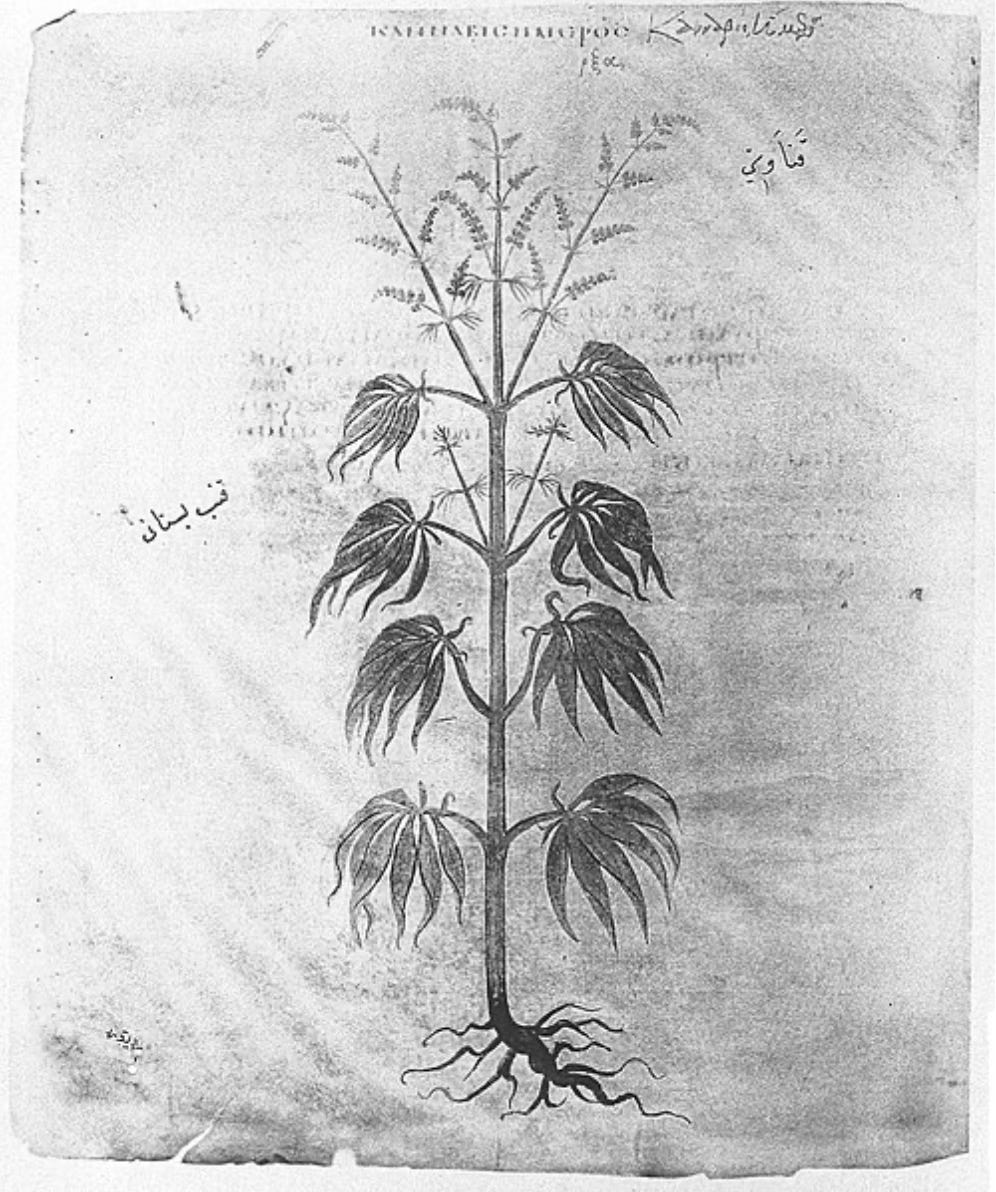
Growing up, there were two surefire ways to ruin your life: get pregnant, or smoke pot. These were the lessons I took from health class and public service messages. The intent was to scare us straight, and it worked on me. It was pure manipulation of my fears as a kid. Already, we couldn’t drive cars, we had no money, and kidnappers were lurking in the food court of every mall. Strangers were giddy to slip razor blades into our Snickers. The world was a dangerous place.
By high school, classmates were questioning marijuana warnings. They would show up to fourth period smelling a little funky, eyes glassy. While I sensed a new, hazy energy had entered the building, I couldn’t quite identify it. Experimentation wasn’t emerging from within my closest girl friends yet—our consumer interests skewed toward Guess jeans and sunglasses over drugs. We partied, but still respected the categorical distinction between Fuzzy Navels and Maui Wowie. Then, seemingly overnight, everyone was listening to Bob Marley and Pink Floyd, and people were asking me if I got high, or if I wanted to, and why not.
Honestly, I felt more pressure to cliff dive at Lake Powell than do drugs. Still, I didn’t know whether to believe the adults, sourcing medical research and data, or the kids, speaking from experience and citing the counterculture. Who got to define the truth—lawmakers or stoners? My internal debate continued until I had an epiphany. I would do my own research.
My god. Research! It was as though I’d invented the concept altogether. Finally, I understood why my fourth-grade paper on elephants mattered beyond knowing for all time that the African species have large, fan-shaped ears while their Asian counterparts have tiny round ones. My entire academic career had led me to this.
This wasn’t the first time I’d embarked on an independent study, though it was the first one charged with real-life consequences. I’d spent the previous summer trying to comprehend the origins of organized crime through a deep-dive into mobster Lucky Luciano. I remember rotting in the sun in the backyard, amidst the columbine and strawberry plants and bees, reading his memoir and other accounts. By the time I’d moved on to the marijuana curricula, my mom began to worry about what brand of outlaw her daughter was becoming. Nevertheless, I persisted. I checked out as many books on marijuana as I could find from the Flagstaff Public Library. Surprisingly, very few addressed the pros and cons of smoking it.
But one book changed everything. Cash Crop: An American Dream? by historian Ray Raphael, published in 1985, was a journalistic account of hippie farmers who had settled in northern California to live bucolic lives outside of mainstream capitalism, only to get caught up in violence, paranoia, and corruption. It was sympathetic to the growers as people, but clear-eyed about the underground industry’s dark forces, including abuses of power, and especially toward women and labor.
Raphael was open-minded and discerning about a topic that others flattened and moralized, and he had embedded access that was practically unbelievable to me. I’d never read anything like it. It didn’t only give me a stance on marijuana, but also helped me identify my emerging values. As a result, I became a principled, and later more flexible, abstainer. It was my first act of consumer activism. My solidarity aligned with the women riding the back-to-the-land wave, or arriving in Humboldt as seasonal workers, only to find themselves in danger. Some were murdered, vanished. I felt kinship with them. I was still a kid, after all. Still powerless myself.
Something fundamental has shifted since then. Research, the idea that empowered me to think critically, has become weaponized. Ironically, pot is legal in most states today, but to “do your own research” is often to mainline disinformation from the darkest corners of the internet.
I remember the first time someone came to me with genuine concern for my well-being, presenting evidence of government conspiracies. It was January 2012. A friend since childhood, this person had traveled to Tucson to warn me that the Federal Emergency Management Agency was turning empty warehouses into internment camps, and would be using railways to move people into them. He texted to ask if we could get together before he moved to South America. I suggested dinner downtown, where his convictions unfolded over grilled cheese, pickles, and craft cocktails.
“Do your own research,” he said. “You’ll see.”
Our conversation would have unfolded differently today, but this was a few years before social media algorithms and elected officials propelled conspiracies into the mainstream. So while my friend worried for my physical safety, I wondered about his mental health.
With trepidation, I watched the videos he recommended the next day. In them, an anonymous narrator skulked around abandoned warehouses surrounded by chainlink fence, plastered with security cameras, and I felt it too. Paranoia, like a bad trip. Conspiracies are a potent drug.
It’s weird that research can get you high. New information can feel thrilling or disorganizing—especially when it challenges, even dismantles, our beliefs about the nature of the universe, or who we are, or how we should live.
I remember reading Dianetics by L. Ron Hubbard in my early 20s and feeling confused because I liked its rigor. My boyfriend’s parents were Scientologists, and I would flip through the expensive-looking brochures on the kitchen counter—pearly-white and churchy seeming, not cool at all—when no one was around, trying to determine what was cultish about it. Reading Hubbard’s book, however, I saw how his philosophies would appeal to the likes of Tom Cruise and Giovanni Ribisi, or anyone with ambition and drive.
A few years later, I read a paperback about recalling past lives, given to me by a friend of my dad’s. This one threw me into a tailspin. I cried as I tried to explain how convincing it was to a friend who was grounded, rational, but also spiritual. I thought he would be sympathetic, that we would have an existential discussion about the nature of death. Instead, he laughed. Not cruelly, but matter-of-factly, like if the milk is sour, dummy, stop drinking it.
His reaction shook me out of my fragile state because I knew that wasn’t the answer. People I loved believed in these ideas so wholeheartedly as to organize their lives around them, and I wanted to understand why. I felt similarly when I watched the videos my friend recommended on the supposed FEMA activity.
It reminds me of a story from elementary school and how quickly fear can overwhelm our ability to think. Some younger girls and I had been invited to the slumber party of an older girl from gymnastics. For fun, the older girls made up an elaborate story that the police were stalking a serial killer in the country club neighborhood in real time. When I say it was elaborate, I mean they’d recorded fake news reports on cassette tapes and pretended it was the radio, and pre-arranged phone calls with reports that the killer was outside our house. I was terrified. I lost my ability to think. Later, we played light as a feather, stiff as a board, and Bloody Mary with a flashlight. Girls would come out of the bathroom swearing they’d seen ghosts. By the time we went to bed, I was too afraid to get up alone to pee, and wet my sleeping bag. I never wanted to feel like that again.
What happens when that destabilization isn’t just a prank, but a feature of our daily information environment? Fear like that, paranoia, is a hybrid state. It’s emotional, cognitive, and social at once. It feeds on a collapse of trust in institutions and communities, plus information overload, plus technological amplification, plus loneliness and isolation, plus cultural strife. When our threat-detection system is already heightened, we become susceptible to conspiracy thinking.
The digital information environment exploits this cycle. It’s just like that slumber party. Social media companies, among the largest corporations in the world, make hundreds of billions of dollars soothing our need for connection and belonging, while also incentivizing fear and anxiety. Then it seeps into our physical lives. The other morning, I followed a Ford F-150 for several miles in traffic. It had a red, white and blue sign in the camper window that read “YOUR GOVERNMENT HATES YOU.” A few hours later, I saw an old, beat-up sedan in the parking lot of my gym with a bumper sticker that said, “Don’t believe everything you think.” This sums up our cultural moment—the tension between paranoid certainty and reflective doubt.
Paranoia was something clinicians used to measure in individuals. Now it's a cultural condition we all navigate. In my junior year of high school, I asked my mom if I could go to therapy for the first time. “Do you need it?” she said. “Because that’s expensive.” She was in the backyard pulling weeds when I ginned up the courage to ask. I wasn’t necessarily depressed, or anxious, but intuitive and lonely. I’d begun reading books about family disfunction and wanted more context from an outsider I could trust.
I remember completing a psych evaluation during my first appointment. So many questions had to do with paranoia: Did I believe someone was following me? Was someone out to get me? I remember rolling my eyes at the eval and thinking, “omg I’m not crazy.”
That memory reads like a relic. What was clear-cut in a therapist’s office years ago is much murkier today. Sam Harris said we’re experiencing “mass psychosis.” He wrote that last week in response to political activist Charlie Kirk’s assassination while speaking at Utah Valley University.
Kirk’s death seemed a tipping point, codifying this as an age of political violence. Now we weren’t just speaking of paranoia, but also real threat. Reactions weren’t only fear, but also grief, and seething rage. I spent several days going down a rabbit hole of online research into who Kirk was, his politics, allies, and enemies. I revisited theories of what radicalizes people, and why conspiracies are proliferating. At the same time, urgent voices of left-leaning and progressive pundits, those who compose my typical media diet, rose up more aligned in their analysis than ever before, crying for us to get off line, check out of social media, and read more books.
To answer my mom’s question, the kind of outlaw I’ve become is one fighting for the vulnerable. When I was young and considering my stance on marijuana, research led me to stand with the laborers and women who were unprotected in an unregulated industry. They had no paths for recourse if they suffered injustice. Now it’s our collective curiosity that’s vulnerable and needs defending. I’m in the fight for nuance and complexity in our discourse and culture.
I asked my niece, age 16, a saxophonist and a straight A student, whether she feels pressure to smoke. “Yes,” she said. “Well, not pressure, but my friends do it. I just don’t like the smell.” She might change her mind, and who knows what will inform it. Unlike my teenage self with access to measured journalism, she's coming of age where opinions and arguments seep from every corner of the internet, day and night, dressed as truth.
If only we could capture the naiveté I felt when I embarked on research projects years ago. I was so gleeful and empowered! It felt like total freedom to explore taboo topics because I didn’t know what I would discover. In contrast, today’s invocation to “do your research” is spoken like a dare. It externalizes the question “what are you willing to risk?” Do you have courage, are you loyal, are you with us? Anymore, research isn’t a crowbar but a padlock.
Maybe the answer is as simple as reading more books. Or, if that’s the tactic, the objective is to separate narratives that leave us feeling disoriented and hopeless from those that inspire openness. Please, can we learn to shift our relationship to the unknown. Can see it as an invitation, not a threat. Can we fill gaps with a desire to explore rather than leaping to conclusions. Can we acknowledge ambiguity, not exploit it, and can we appreciate tones that aren’t alarmist but measured, inviting us to consider what else could be true.
No posts
Comments
Nothing yet. Say the first thing.
Sign in to join the conversation.