
Teneice Durrant, creator of Tarot with Ten, will use various tarot and oracle decks to provide monthly readings for writers, with exercises on using imagery and intuition as prompts. July’s prompt is about using the Moon card to lead your main character to face their fears.
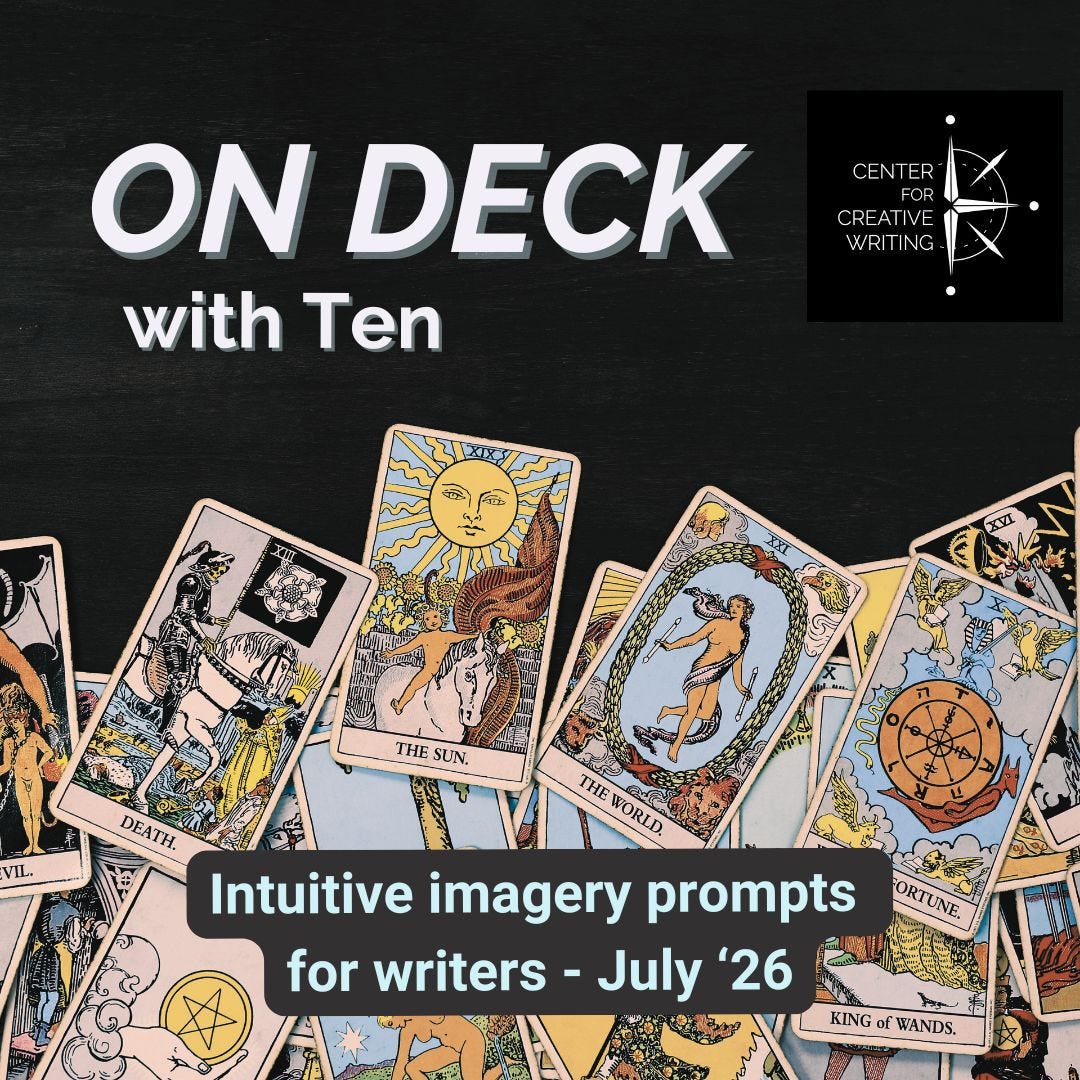
Hi everyone, welcome to On Deck. My name is Ten and I’m a third-generation tarot reader, a writer, and a mentor with the Center for Creative Writing. We are currently working our way through the Major Arcana of the tarot and lining up the Fool’s Journey of the Major Arcana with the narrative arc of our main character. So this month for July, the card is the Moon.
Watch and listen to Teneice’s tarot reading for writers or read the transcript of the reading below.
This is the card of Cancer and we are just about to leave Cancer season and move into Leo season, but this is the card for Cancer. It is a lot about kind of the subconscious, it is about illusions, fear, anxiety, and how we get through it. So if you look at the Moon, we have this lobster here that is surfacing from the body of water and that represents our subconscious coming to the forefront and becoming conscious and motivating and directing our movements, our goals, our path forward.
We see this path, it cuts through the hills and then into the woods over those mountains. We have the dog and the wolf on each side and that kind of represents evolution, right? Dogs have evolved from wolves. So we have this kind of two parts of our inner self, which is the more domesticated side, the more congenial, you know, getting-along-with-everyone side. And we have the wolf side, which is our instincts, you know, that’s the more kind of feral or untamed aspect of ourselves.
So we have these two kind of competing sides that are surrounding us as we move on this journey, okay? The thing that I like to keep in mind with the Moon card is that it’s like you’re going through a forest, right? And there’s a full Moon and there’s just enough light to see the next step in front of you, right? You can’t see what’s around you, you can’t see into the dark of the woods, you can just see enough to make the next step, okay? And when you get through, you reach the top of the mountain or you get through the forest, you think, I don’t know how I made it through that forest because I didn’t know where I was going, I was just taking my next best step. And that’s a metaphor for getting through hard things, facing your fears, dealing with maybe some anxiety you have about something.
And so when we are in the woods and we’re just taking the next best step, what we imagine in the woods around us is often worse than what’s actually there. So when we’re trying to take these paths and get through this fear and, you know, go on this journey, the things that we imagine would happen to us if we failed are usually not real, they’re our own creation, right? So this is to say that, you know, not that there aren’t real dangers and trials and tribulations, it’s just that, not to let our own imagination scare us. Don’t imagine monsters and problems that aren’t actually there, okay?
So when we get to this part in the narrative arc, this is like the Dark Knight of the Soul, if you’re familiar with that. The main character has come to a point where they have to face something alone. They know that they have friends that support them or loved ones or parents or something, but there’s something specific that they have to do and it’s part of their character development, right? They have to change as a character through the process of the storytelling. So, you know, it’s good to have support, it’s good to have, you know, help—somebody trained them, somebody taught them something, somebody gave them something to help on their path, but they are the only ones that can make this journey. This could be an emotional journey, a spiritual journey, a mental journey, or like an actual physical journey that is a metaphor for those things. But however it happens, your character has to go through this deep, dark, learning to trust themselves and overcome fears that nobody else can do for them, okay?
So, let’s take a look at a little prompt here for our scene, for this section, for our main character. What do we think our main character is challenged with? What are they going to, you know, encounter? What are they going to overcome? Are there specific logistics? What is going to happen to our main character? So, you’re going to need to decide if this is a mental journey, if this is an emotional journey, if it’s a spiritual journey, if this is you’re actually going to move your character through a space to represent that journey. And it doesn’t have to take long. It doesn’t have to be a big, you know, long section of your book. Maybe it’s just a chapter, right? All right, let’s see if we can get one more. I’ll take that one.
Okay. All right, so a lot of big, powerful energy here. So, what I’m seeing for our character for this prompt is that when they start out on this path, right, on this specific solo dark night of this whole journey, they’re the Knight of Cups, okay, and they are going forth with just their heart on their sleeve. Emotional honesty, like, raw emotion, that they feel compelled in a kind of heart-based, maybe even romantic way. Maybe the goal here is to save someone or to offer their love or because, you know, they have to go through some kind of trial. They have to figure something out about themselves because there’s this obstacle between them and the person they love. So, they have to go through this process, okay?
The hierophant represents structure, like, rites of passage, okay? So, it may be that the thing that your main character is going through is, you know, a series of steps. When we look at the, like, the apprentice, the novice, and then the priest, right? There’s, like, layers. If you think of it in terms of, like, schooling, it’s like bachelor’s degree, master’s degree, Ph.D, right? There’s a hierarchy to it. So, maybe they are being initiated into a group. Maybe there are things they have to do to be able to be with the person that they want to be with. They have to prove themselves and, like, master different levels of information or, you know, physical trials or things like that. This is all about, you know, some kind of institutional structure and learning to go through the different phases of it, right? The hierarchy of phases.
And then the end is the King of Rods or the King of Wands. The King of Wands is a very charismatic, creative, dynamic person. They are, like, entrepreneurs. They are, like, the CEOs that will get everybody in a room from, you know, the janitor to the, you know, vice president and just be like, hey, throw out the ideas. No bad ideas. Let’s brainstorm. Let’s think of things in a different way. Let’s be creative. A little spontaneous, right? Maybe a little bit irresponsible.
But this could be the person who’s going to judge them at the end. This could be a position that they want, right, that they have to go through these kinds of classes or training or, you know, obstacle courses or however, whatever your setting is for your story. They will, when they get to the end, after they’ve gone through these three trials, these three levels of, you know, knowledge or just acquiring the different hierarchies, the different degrees, they have the ability to take command and be this creative, dynamic leader, okay?
So thank you so much for joining me again this month. We have only three more cards left and we will be all through the whole Major Arcana, so that’s really exciting. We’ll do something fun for November and December. Maybe just a speed run straight through the narrative arc. We’ll see how it goes. Thank you so much for joining me.
Teneice Durrant holds an MFA in creative writing and an MA in Literature. She is currently a candidate for a Ph.D in Psychology and has an affinity for what she likes to call “creative research.” She has 18 years of teaching experience and poetry publications, including four chapbooks and the full-length collection, Glass Corset (2019), and more than 15 years as an editor and publisher of poetry, fiction, and nonfiction. Teneice has been reading Tarot since 2013 and using Tarot as a writing tool with her students since 2019. Teneice is available for mentorship in six-week generative writing sessions for those seeking guidance in poetry, fiction, chapbook-length manuscripts, creative research, and tarot/spiritual practice for generative writing and meditative practice.
If you haven’t already, subscribe to get reviews, author Q&As, craft talks, writing advice, personal essays, tarot readings for writers, and more every Wednesday, plus a motivational quote by a literary great in your inbox every Monday morning and a new writing prompt every Friday. If you seek mentorship, join us in the next six-week writing session beginning July 21. Come write with us.
No posts
Comments
Nothing yet. Say the first thing.
Sign in to join the conversation.