
0:00
-5:08
In my early years as a coach and leader, I thought my job was to fix things to make the world a better place. I wanted to ease the burden for others, offer quick advice, or jump in and make it all better. I loved that I cared deeply about people and the world. However, I was unconscious about how “overcaring” wasn’t always helpful or useful.
Gradually I began to realize the high cost of this habitual helping. While my intentions were good, my behavior often reinforced the very powerlessness I wanted to alleviate. When I learned about the Rescuer role in the Dreaded Drama Triangle (DDT), I was able to step back and view my need to help through a different lens.
Rescuing feels noble, but it can quietly erode growth for myself, and most importantly, for those I want to help.
At the heart of the Rescuer role is a subtle message: “You can’t do this without me.” While we may never say that out loud, our actions speak volumes. When we habitually step into solving others’ problems, we risk:
Undermining others’ confidence. They begin to doubt their own capacity and stop reaching for their inner wisdom.
Creating dependence. Instead of building capability, we reinforce helplessness or reinforce the need for others to come to us for answers.
Draining our energy. Chronic rescuing leads to burnout. We overextend ourselves and eventually feel resentful or depleted.
Distracting from our own growth. While we’re focusing on solving other people’s problems, we often avoid our own inner work, not realizing we have unmet needs.
This is where TED* (*The Empowerment Dynamic)® offers a transformative path forward.
In the TED* frawork, the Coach is the antidote to the Rescuer role. Both the Rescuer and Coach roles are supportive in nature with one very big difference. As a Coach we are not fixing. Instead, the Coach role sees others as Creators—capable, resourceful human beings with the power to choose, grow, and learn.
The shift from Rescuer to Coach is about shifting the quality of support we offer—from dependency to empowerment.
When we relate as a Coach instead of being a Rescuer, we:
Ask generative questions instead of giving premature advice.
Trust others’ wisdom rather than assuming we know what’s best.
Relax into the dynamic tension of not knowing how things will turn out rather than provide quick fixes.
Let go of needing to control the outcome and focus on presence and curiosity. This shift takes humility. It asks us to release the egoic need to be the savior and instead become a supportive mirror that helps others see their own power.
Here are a few practices to support your transition from Rescuer to TED* Coach:
1. Notice when you feel the urge to jump in.
The impulse to help can be strong—especially when someone is struggling. Pause and ask yourself: “Am I helping from a place of control?” Simply noticing this urge is the first step toward shifting your response.
2. As you notice your urge to jump in, ask yourself,
“How do I see the other person? Do I see them as a Creator, capable and empowered?” Your answer will guide you as to whether you relate as a Coach or Rescuer.
3. Ask before you advise.
Before offering your thoughts, ask:
“What would you like from me, if anything, that would support you now?”
This respects the other person’s autonomy and invites collaboration, not control.
4. Let go of the outcome.
I have discovered that when I have on my Rescuer cape and am ready to save the day, my biggest challenge is still letting go of how things are going to turn out.
Coaching means trusting that the person you’re supporting has their own path to walk. It means sometimes staying silent, waiting, relaxing and not orchestrating their journey or ensuring a perfect result.
Coaching is not about being passive, it’s an active practice of empowered presence. It’s choosing to believe in someone more than they may believe in themselves at that moment and gently helping them reconnect with their inner Creator.
So, the next time you feel the urge to jump in and save the day, pause, breathe, and allow the other person to decide for themselves the best way forward. Stay firm in your commitment to seeing them as a Creator and reflect that belief back to them.
Until next time, here’s to the Creator in you,
Donna
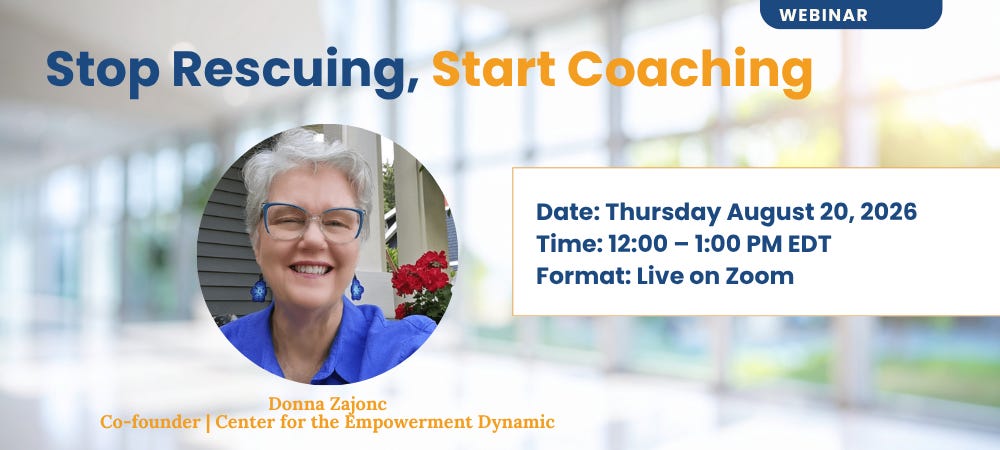
Free Webinar | Stop Rescuing, Start Coaching | August 20
If you’ve ever found yourself over‑functioning, over‑helping, or feeling responsible for things that aren’t yours to carry, this webinar could be especially powerful for you.
We hope you’ll join us.
Go to our website www.theempowermentdynamic to see our new fall offerings.
Comments
Nothing yet. Say the first thing.
Sign in to join the conversation.