
If you’ve ever winced doing a fingerstick on a nervous patient, take some comfort in this: whatever discomfort you’re causing, it’s nothing compared to what capillary puncture used to mean. For most of medical history, opening the skin to get blood wasn’t about collecting a drop for a glucose meter — it was about draining as much blood as the patient could stand.
I’ve written before about bloodletting’s ancient roots and the tools that came out of that era, so I won’t retread it here. What I want to focus on is something narrower and, I think, more interesting: the actual devices used to puncture skin, how they changed, and how one of the oldest, crudest designs is still sitting on shelves today — just not in a lab.
For centuries, opening a vein meant a thumb lancet or a fleam — a blade controlled entirely by the steadiness of the operator’s hand. The cut’s depth and length depended on skill, which meant results were wildly inconsistent from one practitioner to the next.
That changed around 1719, when German surgeon Lorenz Heister described a spring-loaded lancet: a blade held under tension that snapped out and retracted on its own when triggered. For the first time, depth could be controlled by adjusting spring pressure rather than by a physician’s hand. It also meant someone with less training could perform venesection with a reasonably consistent result — an early example of a tool doing the precision work that used to depend entirely on operator skill.
Not long after, in the early 1700s, the scarificator showed up — a small brass or steel box housing multiple spring-loaded blades that fired at once, making several parallel cuts in a single action. If one blade was good, the thinking went, twelve were better. It’s a strange-looking object by today’s standards, but it tells you something true about the era: the goal was volume. Nobody was trying to get a “sample.” They were trying to get blood out, and a lot of it.

The scarificator didn’t replace the lancet — the two coexisted for well over a century — but it got used constantly, especially paired with cupping, where a heated cup placed over the fresh cuts created suction to draw more blood to the surface. It also solved a real problem: instead of a physician making repeated cuts with a lancet, one press of a lever produced a uniform set of parallel incisions at a controlled depth. Scarificators only grew more popular through the late 1700s and into the 1800s, hitting their peak of use and sophistication right alongside bloodletting’s own peak in popularity that century.
Bloodletting’s decline in the mid-to-late 1800s wasn’t instant, but the reasoning behind it eventually caved under the weight of germ theory and a better understanding of physiology and immune response. Once medicine stopped believing that draining blood cured illness, the entire purpose of puncturing skin flipped. Instead of removing blood therapeutically, clinicians started collecting small amounts of it diagnostically — to look at it, not to get rid of it.
This is really the moment capillary puncture as we know it begins. The volume needed shrank from bowlfuls to drops. And that changes what a good tool looks like.
In more recent times, some of you may remember performing capillary punctures with a more modern version of a fleam: a flat metal blade held in the fingers, with no spring lancet mechanism involved at all. Even after those more sophisticated devices existed, a huge number of punctures were still being done with something this simple — a bare, pointed piece of metal with no mechanism whatsoever.

No spring, no depth adjuster, no retraction, no built-in stop of any kind. The blade — a thin, fully exposed stainless steel point, commonly 36 gauge — stayed out and exposed the entire time you held it, not just at the moment of puncture. Going by the photo above, the exposed point looks to be roughly 3-4mm, noticeably longer than the 1.5–2 mm depth most modern safety lancets are calibrated to. That’s a lot more length than most people actually need for a fingerstick — it’s the kind of depth that only makes sense for someone with genuinely thick, callused skin, not a default setting for the general population.
With a plain lancet, there was no such thing as “setting” a depth. Depth was a function of how hard and how far you pushed, full stop — which means the design really wasn’t that far removed from the thumb lancet or the fleam centuries earlier. Strip away the manufacturing and you’ve got the same basic idea: nothing to control depth, and the outcome resting entirely on user technique. The spring lancet had already solved that problem for venesection back in the early 1700s. The plain metal lancet just never picked up that fix for capillary punctures — it stayed the cheap, simple option long after more controlled devices existed right alongside it.
And going by the length in the photo above — something closer to an eighth of an inch, and noticeably wider than what a modern safety lancet uses — this wasn’t a device built with restraint in mind. It was unnecessarily long and unnecessarily wide for what most fingersticks actually require. That’s genuinely good for one thing: fast, free-flowing blood. It’s bad for everything else. There was no way to dial it back for a patient who didn’t need that much depth, no way to guard against a slip, and no way to protect the person holding it.
An exposed point with no retraction is a needlestick risk to the healthcare worker every single time it’s used, not just an inconvenience for the patient. And because there was no built-in single-use mechanism forcing disposal, it’s worth wondering whether these were always treated as single-use in practice. Needles were commonly cleaned and reused before disposables became standard — there’s no obvious reason lancets would have been held to a different standard, which raises its own cross-contamination risk entirely separate from the needlestick issue.
What ended their clinical use wasn’t the design becoming obsolete. It was OSHA.
In 2000, the Bloodborne Pathogen Standard and the needlestick-safety rules that followed didn’t quietly phase these lancets out the way the scarificator faded once bloodletting stopped making sense. This was a hard regulatory line: an exposed, reusable point posed a needlestick and cross-contamination risk that a multi-patient healthcare setting couldn’t accept. Safety-engineered, single-use, self-retracting lancets became the requirement, not just the recommendation, and the plain metal design was pushed out of clinical settings for good.
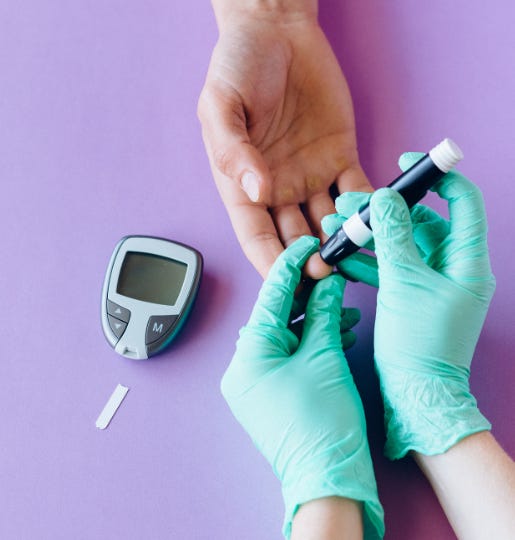
But here’s the thing — it didn’t disappear. I recently spotted these same plain metal lancets for sale on Amazon, still marketed for fingerstick use. The reviews go well beyond diabetes testing, too: estheticians using them for extractions, crafters, even people using them to remove splinters.
The tool didn’t stop being useful or stop being sold — it stopped being appropriate for medical settings. OSHA’s rules govern occupational exposure, especially where one device could touch multiple patients. A single person using their own lancet at home is a different risk picture than a phlebotomist working through a patient list. The regulation targeted a use case, not the object itself.
Meanwhile, on the clinical side, lancet design kept getting more deliberate. Modern devices offer multiple depth settings for different skin thickness and patient age — pediatric and neonatal lancets are built specifically to minimize tissue damage on smaller, more delicate skin.
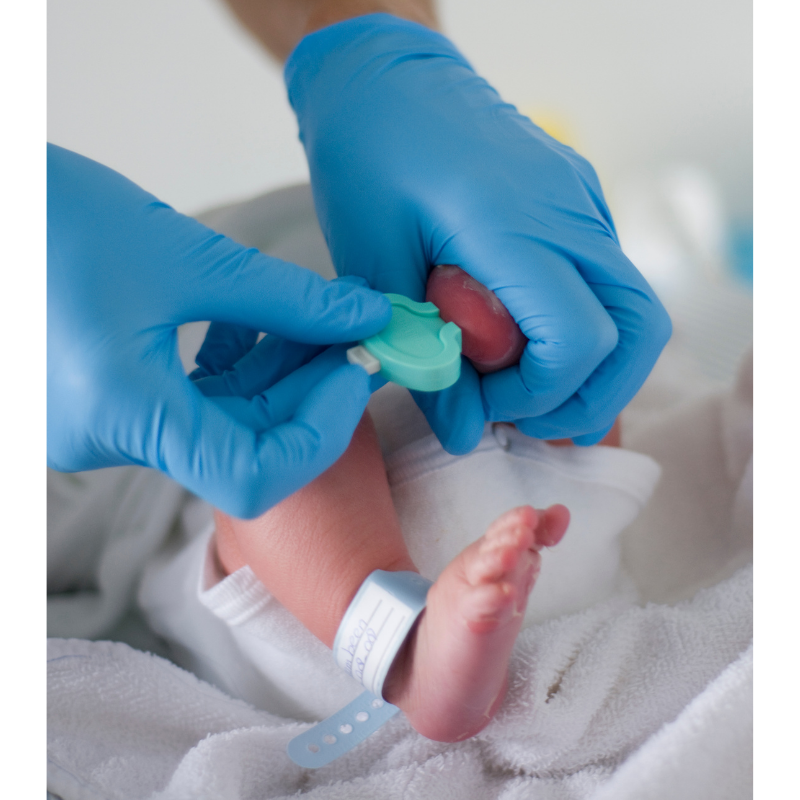
Vacuum-assisted lancing devices, tested for forearm sampling, have shown they can pull adequate blood volume with less pain than a standard fingerstick. None of this existed when the goal was simply “make blood come out.” Once the goal became “get just enough, as comfortably as possible,” the engineering followed.
Which brings us to the part of the title that probably caught your eye. Laser lancing devices, like the LMT-1000 (HandyRay-Lite), use a pulsed erbium-YAG laser instead of a blade to open the skin. Multiple studies comparing laser lancing to conventional lancets for capillary hemoglobin measurement and blood typing found strong correlation in results and significantly lower reported pain scores with the laser — no blade contact at all. It isn’t standard in most clinical labs yet, largely because conventional lancets are still faster and cheaper for routine POC testing, but it’s a real signal of where the field is headed: toward removing pain and mechanical trauma from the equation entirely, not just reducing it.
Not every innovation in this space involves a laser, though. ARUP Laboratories recently partnered with a company called Tasso to offer at-home blood testing built around Tasso’s own collection device. It’s a small device that adheres to the upper arm, releases a tiny spring-loaded lancet that penetrates only about a millimeter, then uses gentle vacuum pressure to draw capillary blood into an attached tube — all without a clinician present. No exposed point at any stage, and a fraction of the puncture depth of even a modern fingerstick lancet.
Between the laser and the vacuum-assisted approach, it’s clear “innovation” in this space isn’t just laser versus blade — it’s also about who can safely perform the puncture and where. Both of these deserve a closer look than I can give them here, so I’ll be covering laser and suction-based lancet devices in a future post. Microneedle arrays and jet-injection devices are being explored for similar reasons, and may be worth a mention there too — ways to get diagnostic blood without a puncture in the traditional sense at all.
Line up the whole sequence and the throughline isn’t really about mechanisms — it’s about what we were optimizing for. A bare metal point optimized for nothing but getting blood out fast. The spring lancet optimized for consistency. The scarificator optimized for volume. Once bloodletting gave way to diagnostic sampling, the optimization target flipped completely, and everything since — depth adjusters, pediatric lancets, laser devices — has been in service of one goal: get the smallest useful sample with the least amount of trauma possible.
The plain metal lancet is a good reminder that this shift wasn’t uniform or instant. Old and new tools coexisted for a long time, and even now, a design with roots in centuries-old bloodletting is still available for purchase — just not on a phlebotomy tray.
Looking to start your own phlebotomy school or program? We’ve packaged over 70 of our most essential phlebotomy-program documents, forms, and checklists---proven and perfected in the real world---and are making them available to you to build your own prestigious program. Check them out here.

No posts
Comments
Nothing yet. Say the first thing.
Sign in to join the conversation.