
Welcome to ‘Close Friends.’ This newsletter series shares a thoughtful piece of content and offers original analysis. Readers also have the chance to share their opinions, and we feature some of them in the newsletter.
This week, we came across an interesting TikTok discussing fan fiction and the gendered expectations surrounding its production. Oddly enough, we have been thinking a lot about fanfiction at Centennial World recently… We actually did an ‘infinite scroll podcast’ deep dive episode about all things fanfiction a couple of weeks ago — feel free to check it out on YouTube, Spotify or Apple Podcasts.
Anyway, the TikTok in question was posted by a user with the handle @marianne0865. She made the claim that “men in fandom spaces expect unpaid labour from women.”
She was specifically referencing the X Reader genre — a type of fanfiction where the reader is the main character. It may be written in a second-person point of view or include reader inserts for personal characteristics such as friends’ names, hair colour, and more. These stories are all about imagining yourself in the plot line.
“I’ve seen this kind of weird comment section talking about fanfiction and how a lot of it is really catered toward female readers... and a lot of people had a problem in the comments, and they were saying stuff like ‘male readers deserve fanfiction catered towards them’... without actually writing it themselves,” she says.
Marianne’s TikTok kicked off a lively debate and discussion in the comment section. There were conversations about the benefits of fanfiction and why women and gender-diverse folk resonate with this kind of content.
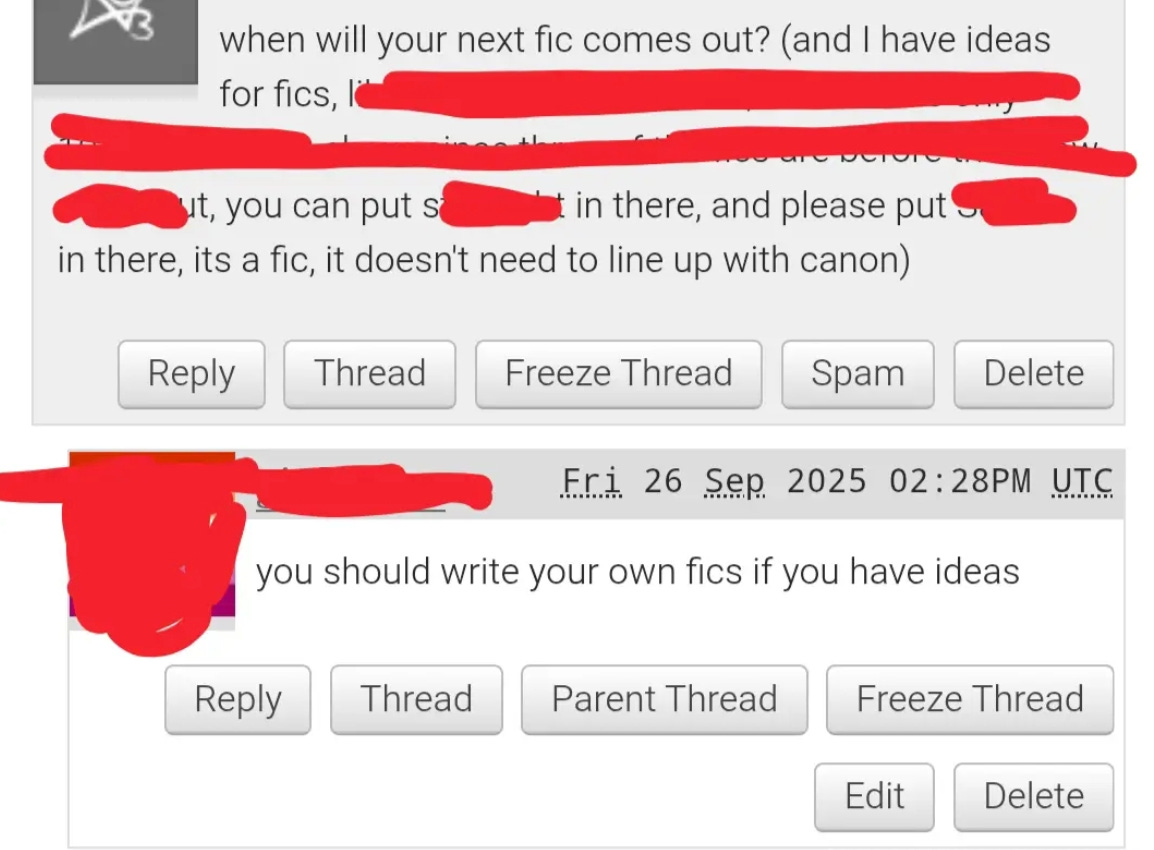
Some users even shared their own experiences as fanfiction writers. One commenter reflected on a time when a reader left a note under a chapter, urging them to change various plot points and characters.
“I had a comment from a dude under my Fanfiction that was like ‘I don’t really like this couple, but I like this villain.' You should write this villain’… I just replied ‘You should write you own’,” they wrote.
Anyway, we had some of our own thoughts on this topic. So let’s get into it…
— by Annabel Bendavid, Deputy Editor at Centennial World
Spending my tween and teen years scrolling through Stan Twitter and Tumblr, fanfiction was something I dabbled in.
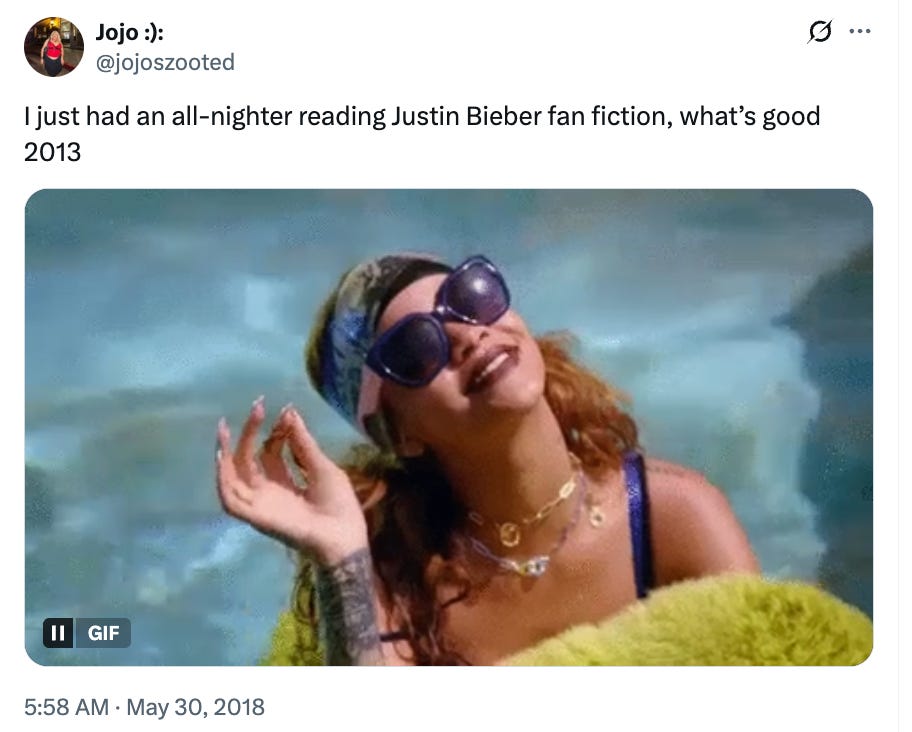
Being a tween and teenage girl in the 2010s, my fan-object of choice was obviously Justin Bieber. I found myself reading longer-form stories about his imagined life on Wattpad, one-shot posts about Jason McCann (IYKYK) on Tumblr and Facebook... There was the occasional y/n that would even pique my interest.
Looking back on my own experience with fanfiction, it was definitely a powerful community-building tool — something Marianne alludes to in her TikTok.
It is a way for like-minded people to connect, discover unique stories, and support amateur authors. For many marginalised groups, fanfiction has also become a rare space to engage with media that genuinely reflects their experiences.
Fanfiction’s strength stems from the fact that it is participatory in nature. If readers feel a lack of context or representation, the power is in their hands. They can quite literally create the content they wish to see.
On top of this, the barrier to entry is low (in theory). Readers are expecting to read the work of amateur authors, and platforms like Wattpad have democratised readership. However, it would be remiss to ignore certain advantages such as fluency in English, platform algorithms, and various social norms that dictate who gains prominence in these spaces.
Nevertheless, anyone can write the story they want to read — whether that be non-canon ships or a celebrity living a totally different life. Fanfiction is essentially a fandom’s imagination put on paper.1
While everyone has the right to see themselves reflected in fanfiction (and to create it), the comments under Marianne’s video raised two interesting points.
First, much of mainstream media is still shaped by the male gaze and heteronormative expectations of relationships. Fan fiction, by contrast, with its diverse authorship and various storytelling platforms, offers a medium that can transcend those constraints.
With that in mind, why should fanfiction cater to a masculine perspective if the majority of media already does?



Over the years, fanfiction has become a space for genuine LGBTQIA+ representation — offering intimacy and nuance that many mainstream stories fail to deliver. Rather than relying on tropes or queerbaiting, fanfiction allows creators and readers to move beyond the cis-heteronormative narratives that dominate traditional media.
This sentiment is also reflected in our own research and reporting. Ahead of our recent podcast deep dive, we ran a short seven-question Google Form and received 65 responses from podcast listeners aged 17 to 39.
We wanted to know when people started reading fanfiction, whether the stories they consumed were appropriate and enjoyable, and what (if anything) they learned from these fics.2
Over one quarter of respondents mentioned that they specifically enjoyed fanfiction because it offered meaningful queer representation: either they saw their own sexuality reflected for the first time, or it became a way to learn about identities and experiences they wouldn’t have otherwise been exposed to.
As one listener put it: “[Fanfiction] was ultimately about rebelling against the writers: rewriting plot points, pairing up your OTP (one true pairing), and inserting queer representation where there was only queerbait. The community created by reading, commenting on, and writing fanfic was also an escape from real life, where we were being bullied for being queer or liking things like Twilight. Writing fanfic was also a much-needed emotional and creative outlet and source of feedback, validation, and confidence.”
The next point raised by Marianne’s commenters was the irony of men feeling underrepresented in a space they are not willing to contribute to. Of course, not all men share this sentiment, but the pattern is something worth pointing out.



Fanfiction (and fandom more broadly) has long been driven by young women. Our own data reflects this trend. The average age at which respondents first began reading fanfiction was 15, and the vast majority of participants identified with she/her pronouns.
This mirrors a broader pattern across pop culture: Teenage girls as the defining demographic shaping the trajectory of modern celebrity culture.
Beatlemania is the classic example, but the same logic applies today. Some of the most dominant cultural figures of the last decade — Taylor Swift, Justin Bieber, Ariana Grande — all rose to prominence on the backs of predominantly young and female fanbases. The same is true for TV and film franchises such as Twilight, Gossip Girl, and The Vampire Diaries.
Even now, in pop music, we are witnessing a significant interest in girl groups, such as Katseye and GIRLSET, who are capturing Western markets and catering directly to teens and tweens.
However, as a lucrative demographic, teenage girls are exploited by industry elites.
Many leaders in the entertainment industry assume that catering to teenage girls will translate into spending power as they enter adulthood. According to this logic, when a creator or celebrity can establish a strong fan base of young women, they are guaranteed years of support and financial backing.
At the same time, though, young women are frequently derided and ridiculed for their interests, with pop culture and fandom often cast as frivolous.
With that in mind, it’s no surprise that young women gravitate toward a niche like fanfiction — a space that feels safe, self-governed, and creatively validating. They have control over the stories being told, both as producers and consumers. They can make the changes they want to see in mainstream content.
So if we circle back to Marianne’s TikTok, the question shouldn’t be whether fanfiction should make room for straight men, but whether these men are willing to respect the space that women and queer fans created long before they decided they wanted in.
— by Lauren Meisner, founder at Centennial World
Something noticeably missing from the discussion in Marianne’s TikTok comment section is the impact that new media has had on our expectations around what creating content is worth.
Over the past two decades, the rise of digital media has influenced a major shift from consumers expecting that it will cost money to engage with art, news and entertainment… to expecting almost all content to be free.
Participatory content spaces, like social media, fanfiction, and podcasting, have also largely contributed to this shift in expectations.
And look, as the founder of a new media company, I recognise that we are part of the problem. It’s important for us to work within the parameters of these expectations to build an audience, generate ad revenue, and keep our business going.
But the free content economy is a lose-lose for creators, media companies, and the general public alike.
For example, a 2025 study by Pew Research Center found that 83% of American adults report they have not paid for news in the past year. Out of those 83%, about 49% of those say the reason they don’t pay for news is because they can simply get it for free somewhere else.
When you consider the amount of misinformation and AI slop out there, this stat becomes incredibly concerning. Can we really be engaging with quality journalism, if it’s almost always free?
Anecdotally, Centennial World is launching a Patreon in December as part of our audience revenue expansion strategy. Though it was made clear that the Patreon would exclusively be for additional content (rather than putting our current free content behind a paywall), we had some audience members voice concern for how this would impact the quality of our free content.
We were surprised that our audience didn’t automatically equate more funding with better work across the board— highlighting just how influential the free content economy has become.
The reality is that “free” as the new default reinforces that currency in news, art, media, and entertainment is eyeballs and engagement over quality and truth, where the loudest and cheapest content rises to the top.
And while this isn’t necessarily an audience problem to solve (especially in this economy!), it is an unfortunate consequence that impacts all of us culturally, socially, and politically.
Because when everything is free, the only content that survives is the content that can afford to be free. And at the end of the day, who do we think is funding that? And why?👀
This week, we are sharing some of the responses from the survey we conducted. We have compiled some of the most interesting commentary and perspectives on fan fiction below.
One participant, Erin, shared that one of the primary reasons she enjoys fan fiction is that it is not driven by profit, but rather by community, passion and creativity.
As she wrote, “Fanfiction creates such a beautiful community of people who have a like-minded interest in a piece of media and a desire to create for it simply because they love it. Fanfiction is not something driven by profit, but rather a creative outlet married to a passion for a book, television show, movie, etc. I’ve made long-lasting friends in people who’s work I’ve read, and people who’ve read my work.”
We found that the anti-profit factor was important to other respondents; one participant, named Victoria, praised fan fiction as a free and accessible tool for identity exploration. Although she did admit that fan fiction isn’t always the healthiest way to learn about love and relationships.
“[Fanfiction] probably did shape my taste in books and literature later on in life. It was a great way to interact creatively with works in an accessible manner as most fan fiction is free and readily available on the internet,” she reflects. “I don’t know if it gave me the healthiest ways to cope with my loneliness. It probably fed into my hyperactive imagination and what I wanted from men. I don’t think it helped me realised what my barometer for ‘safe’ was, but in general, I think it was safe way to start exploring my sexuality without actually physically interacting with boys.”
In a similar vein, a 29-year-old woman (who asked to remain anonymous) shared that she enjoyed fan fiction throughout her teens because it was more likely to cater to the female gaze and experiences.
“[Fanfiction is] a safe, non-judgmental, and non-exploitative space to explore my sexuality that catered to women (me) and not men (such as most porn),” she writes. “I often was inspired to write my own fics and draw illustrations based on what I read. It was fun diving so wholeheartedly into that world of imagination. I also discovered a massive artist community online by searching for my fave characters.”
Breaking down some other content we found interesting, whether that be headlines, commentary or stats about internet culture and the creator economy. Here’s what is happening online:
Will we be chronically offline in 2026? TikTok commentator and social media manager @carmscrolls discusses the growing popularity of offline hobbies... online. Even though we are seeing a “non-digital renaissance,” she isn’t convinced that it will hold in reality — tech companies will find a way to adapt.
Is IJUSTINE an AI-generated song? Ever since TikTok user @kiralovesyaoi dropped IJUSTINE, the song has gone completely viral. Many social media users are convinced the song is AI-generated, even though Kira has repeatedly rejected these claims. Lauren Meisner breaks the story down in a recent episode of mini scroll, check it out via YouTube, Apple Podcasts or Spotify.
The internet weighs in on Wicked: For Good. With the long-awaited film finally hitting cinemas, social media users are watching closely as reviews pour in. Per Metacritic and Rotten Tomatoes, the response has been mixed (so far).
Long-time Wicked fans note that the film’s “problems” mirror the criticism levelled against Act Two of the stage show: a (comparatively) thin plot and fewer iconic songs.
Reminiscing on the forgotten YouTuber magazine. Video essayist tahliaisnotcool explores Oh My Vlog! — the creator-centric magazine that launched in the UK 10 years ago. Tahlia discusses “the inception, the short life, and the collapse of the first (and only) YouTube vlogger magazine.”
The Great Meme Reset is (allegedly) coming. In a new piece for WIRED, Angela Waterclutter grapples with the possibility of a “Meme Reset,” wondering if we can return to the days of Nyan Cat and reject any and all AI-generated brainrot.
“Even if you’re in the camp that understands memes like “6 7” have more significance than they’re given credit for, there’s still a sense amongst the Great Reset crowd that today’s memes are ‘oversaturated and unfunny’,” Know Your Meme editor-in-chief Don Caldwell tells the journalist.
Misinformation sites have an open-door policy for AI scrapers. Chris Stokel-Walker for Fast Company references and extrapolates on a study from Saarland University exploring how different websites treat AI web crawlers.
“Across all 4,000 sites assessed, around 60% of those deemed to be reputable news websites blocked at least one AI crawler from accessing their information; among misinformation sites, only 9.1% did so,” he notes. “The average reputable site blocks more than 15 different AI agents through its robots.txt file. Misinformation sites, by contrast, tend not to shut out the crawlers at all.”
The gendered design of the internet. TikTok commentator @alexwolftiktok discusses how the internet went mainstream because men wanted access to content of women in their most vulnerable state. She points to Pamela Anderson’s sex tape and the origins of Facebook as some examples.
Feel free to share your thoughts about today’s newsletter, or send through any content you want us to cover in the future.
It is worth noting here that there are some questionable moral implications and legal questions when it comes to writing fanfiction about real people. These stories have the potential to be libellous or overtly sexual (with no consent given). Nevertheless, this continues to be a popular genre of fanfiction — and one that I am sure many of us have read or even written.
65 participants is still a relatively small sample size, so it is difficult to make generalisations. But even so, there were some key themes that we took away from the data.
Comments
Nothing yet. Say the first thing.
Sign in to join the conversation.