
Join 35,000 readers for a well-researched dose of clarity (and solidarity) about the invisible power structures shaping our lives, delivered to your inbox every Sunday morning:
If you were given a patriarchy scale for women with hopelessly trapped in a patriarchal cage on one end and liberated free women on the other, where would you rank:
A stay at home mom perfecting her sourdough loaf?
A corporate lawyer leading a team of 40 employees?
A young bride-to-be planning a picture-perfect farm wedding?
A woman rolling her eyes at over-sized wedding rings and bridal showers?
Most of us would probably rank the stay at home mom in a prairie dress as more patriarchal than a girl boss in a power suit.
But those monikers tell us nothing about what those women actually believe and what they actually value.
One of patriarchy’s cleverest tricks was convincing us we could recognize it at first glance.
We think patriarchy looks like pink lipstick, strollers and doting smiles.
We think liberation looks like blazers, law degrees and sarcasm.
But patriarchy isn’t an aesthetic.
It’s a hierarchy of values that ranks men above women.
We can’t determine what a woman’s internal values are merely by what she wears or where she works.
And our attempts to do so often prove woefully ignorant.
Let’s examine three case studies on this point: Jules Potter and Kimmy Wallace, Olivia Pope and Elle Woods and Miranda Hobbes and Charlotte York.
In the movie My Best Friend’s Wedding, Cameron Diaz’s character Kimmy certainly seems like the patriarchal poster girl.

Her blonde bob? Nary a hair out of place.
Her clothing? Dresses with matching headbands and handbags.
Weddings? OBSESSED!
Her career? Not important.
Meanwhile Julia Robert’s character Jules felt downright revolutionary by contrast.

Her hair? Big and chaotic. Every hair out of place.
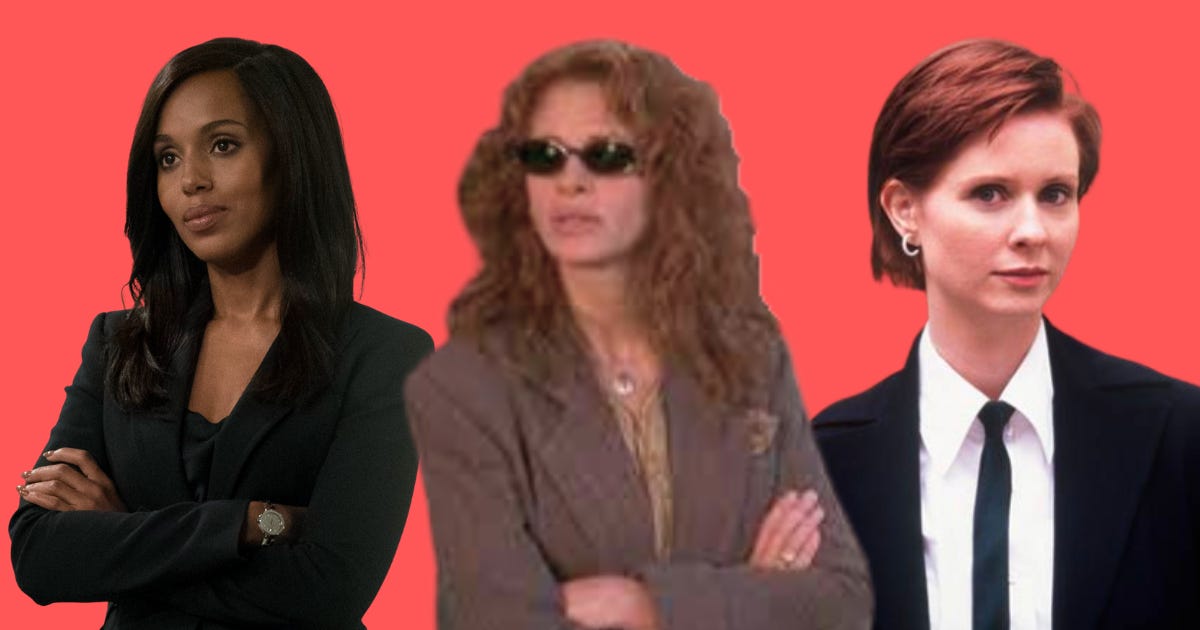
Her clothing? Oversized dress pants and blazers.
Weddings? THE WORST!
Her career? Crushing it.
She was successful. She swore. She did what she wanted.
One trophy wife. One career woman.
On the outside, it’s clear where we would rank them on the patriarchal scale, but dig a little deeper and the waters become far more murky.
Jules practically wrote the script for the I’m-not-like-other-girls girl.
She shuns anything whiffing of feminine on principle. A bridal brunch? BARF! Shopping with the ladies?? Must flee the premises IMMEDIATELY! Prissy salads? UGH bring on the beer and nachos!
Jules is anxious for you to know that she would rather do ANYTHING than hang out with another woman. Her limbs start malfunctioning whenever she is forced to hang out with her fellow females. She trips into a waiter at the bridal brunch, gets into a fist fight in a women’s bathroom and rips her bridal gown the first time she tries it on in a desperate escape attempt. She must call on a man to rescue her from this estrogen prison.
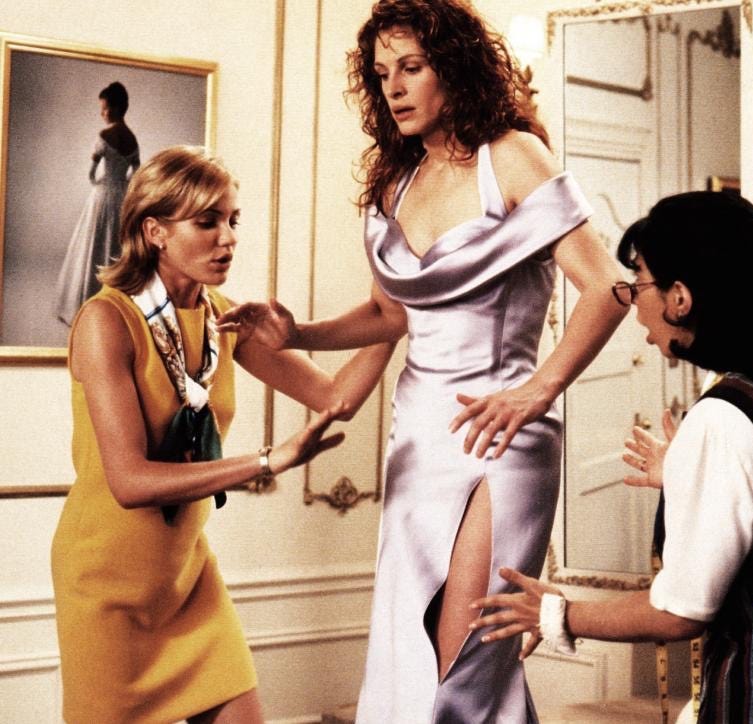
But put her in the company of men? Suddenly the bumbling limb tornado transforms into a woman with the poise of a trapeze artist. She’s got moves you’ve never seen. She struts into a baseball game effortlessly balancing a tray of 14 beers with one hand without dripping one drop.

She strolls into a room with a bunch of corporate muggedy wumps, selects a cigar and makes penis jokes with the best of them.
She’s one of the guys. She is definitely NOT like those other girls.
And hey, there is absolutely nothing wrong with preferring baseball and beer to shopping and bridal showers.
The problem isn’t her preferences, it’s that she sees herself and her masculine preferences as being above those of other women.
Particularly above Kimmy.1
Jules makes fun of Kimmy’s age, her clothes, her wedding, her lifestyle choices and her personality. In a quote that is a little on the nose, Kimmy says to Jules, “You’re not up for anything conventional, or popularly assumed to be female priorities.” - Kimmy about Jules2
Kimmy, by contrast, even though she has every reason to hate and resent Jules, instead immediately wants to be friends with her.
From the jump, she outright refuses to compete with Jules by telling her, “You win.”
Kimmy accepts that Michael will always hold Jules in high esteem and doesn’t try to discourage their friendship.
While Kimmy is the most mocked and dismissed of any of the characters in the movie, she is the only one who never lies, manipulates or deceives anyone. She never mocks or belittles Jules.
Kimmy is not a perfect model of gender equality, but her and Jules show that patriarchal values and patriarchal aesthetics are not one in the same.
Olivia Pope (played by Kerry Washington) from ABC’s Scandal is one of television’s great female powerhouses.
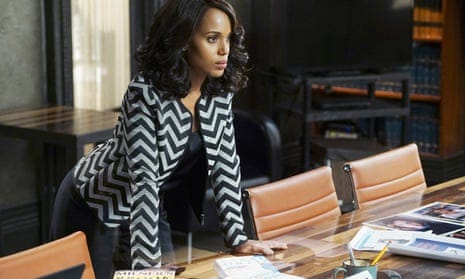
She’s brilliant. She’s authoritative. She’s feared.
She strides through the White House in her tailored suits commanding crisis rooms full of senators, generals and has the President hanging on her every word.
She has wrestled with the corporate ladder and come out conqueror.
And yet...
Much of the series revolves around her repeatedly abandoning herself for a powerful man.
She structures enormous portions of her emotional life around the president, accepts crumbs instead of reciprocity with men, and sacrifices her own well-being to maintain a relationship that is fundamentally unequal.
Instead of holding fast to her own values she holds at the beginning of the show, she ends up falling to the level of corruption surrounding her.
Olivia shows that holding power isn't the same thing as escaping patriarchal values.
While not from the same show, Elle Woods (played by Reese Witherspoon) in the movie Legally Blonde, is also a lawyer.
But while Olivia seeks to put as much distance as possible between herself and femininity to survive her male-dominated field, Elle leans all the way in.
Everyone assumes Elle Woods is shallow because she loves make up, feathers, diamonds, sorority life, romance and all things pink.

She’s exactly the kind of woman we’ve been taught to not take seriously, and her fellow law students, professors and friends certainly do not take her seriously.
But Elle consistently refuses the notion that intelligence and femininity are opposites.
She takes herself seriously. She builds relationships with other women instead of treating them as enemies. She refuses to abandon the things she loves to earn the respect of men.
And unlike Olivia, when she is mistreated in a relationship, she leaves.
Compared to Olivia, Elle more overtly represents the aesthetics of patriarchy, but unlike Olivia, Elle does not equate femininity with stupidity, incompetence or submission.
Charlotte York (played by Kristin Davis) from HBO’s Sex and the City certainly has all the outside trappings of a stereotypically patriarchal woman. She unabashedly and enthusiastically wants marriage and children. She dreams about linen napkins, the perfect Park Avenue apartment and Christmas cards with children in matching sweaters.
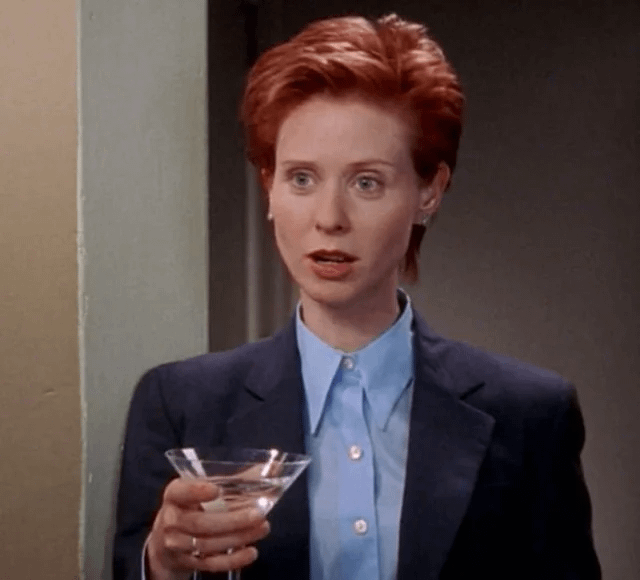
Miranda Hobbes (played by Cynthia Nixon) on the other hand is a no-nonsense, independent, proud feminist. Also a lawyer. She’s not looking for marriage or even commitment. She mostly uses men for sex.
At first glance, Charlotte certainly seems to embody patriarchal values more than Miranda.
But Charlotte doesn’t look down on other women when they want different things than she does. She is not ashamed or embarrassed to want to be a caregiver because she doesn’t see caregiving as embarrassing.
She knows exactly what she wants and never apologizes for it.
She never says “I’m not like other girls” because acting like a girl is not cause for shame.
She also has surprisingly strong boundaries in her romantic relationships. She leaves Trey when the marriage isn’t working. She tells Harry she won’t convert to Judaism unless he truly wants to marry her, and later walks away when he hurts her. She wants marriage, but doesn’t abandon herself for it.
Miranda on the other hand is quick to belittle women who openly long for marriage or romance.
Her dating life is driven more by a need to prove she can compete on men's terms than a quest for companionship. She keeps emotional distance, treats vulnerability as weakness, and is desperate to be seen as rational, independent and not like those other needy women.
By aesthetics alone it appears that Miranda has escaped patriarchy while Charlotte is trapped by it.
But if we are looking at:
holding masculine traits as superior,
looking down on other women, and
evaluating one’s worth around male-defined success,
Miranda embodies those values more than Charlotte does.
I’m not arguing that all women should be feminine, all men should be masculine, or that either category has fixed boundaries. I don’t believe that. Gender expression exists on a spectrum, and people should be free to embody whatever combination of traits feels authentic to them.
My point is that if we truly value equality, then traits coded as feminine—caregiving, emotional openness, beauty, softness, collaboration, domesticity and nurturing—should not be treated as less serious, less intelligent or less worthy than traits coded as masculine.
The goal isn’t to push everyone toward “femininity.” It’s merely to stop ranking “masculinity” above it. The goal, as always, is equality and freedom.
It’s about one of patriarchy’s cleverest slight of hands.
For centuries, patriarchy explicitly said: men are superior to women.
Theses days that blatant framing of men’s superiority makes us uncomfortable.
And yet, we are still very comfortable with holding masculine expression3 as superior to feminine expression.
Masculinity is often seen as synonymous with intelligence, success, rationality, leadership, ambition, courage and seriousness.
Femininity is often seen as synonymous with vanity, frivolity, submission, softness, deference, drama, domesticity and weakness.
The feminist movement challenged this hierarchy, but then instead of abolishing the hierarchical ladder, sought to climb it instead.
Instead of asking, “Why do we value traits associated with men more highly?” We said, “Well women can act like men.”
And then said, “Women who act like men are better, smarter and more serious than women who don’t.”
But expanding who gets access to the top of the gender hierarchy is far different than leveling it.
If a little girl says, “I want to be an engineer.” Everyone cheers.
But if a little boy says, “I want to be a ballet teacher.” People get uncomfortable.
We’re uneasy when men strive for feminine traits because that is seen as a demotion.
It’s cool and inspirational to move UP the gender hierarchy ladder towards men. It’s an embarrassment to move down towards women.
Meanwhile Kimmy, Elle Woods and Charlotte refuse to accept the premise that femininity is demoting or embarrassing.
These characters expose an uncomfortable truth: in our quest to liberate women, we’ve mistaken distance from femininity for freedom.
Julia Robert’s character Jules thought she was better than other women not because she was more intelligent, wealthy, kind or attractive than other women. She thought she was better specifically because she was less feminine than other women.
Miranda Hobbes respects women who are tough, detached and career-oriented. She rolls her eyes at women who are romantic, emotional and domestic.
But these women aren’t rejecting or escaping the gender hierarchy.
They are merely placing themselves on the winning side.
And what’s more patriarchal than that?
Want to gather to de-patriarchify our brains together? Cool me too. Come join us at our Matriarchal Blessing book club. This quarter we will read The Flowering Wand: Rewinding the Sacred Masculine by Sophie Strand. We will meet on zoom in July to discuss. Join us:
When Jules’s best friend George (correctly!) feels bad for Kimmy, Jules says, “ Oh don’t go feeling all sorry for Miss Pre-Teen Illinois.”
Jules is basically the embodiment of the “Cool Girl” monologue from Gone Girl:
“Men always say that as the defining compliment, don’t they? She’s a cool girl. Being the Cool Girl means I am a hot, brilliant, funny woman who adores football, poker, dirty jokes, and burping, who plays video games, drinks cheap beer, loves threesomes and anal sex, and jams hot dogs and hamburgers into her mouth like she’s hosting the world’s biggest culinary gang bang while somehow maintaining a size 2, because Cool Girls are above all hot. Hot and understanding. Cool Girls never get angry; they only smile in a chagrined, loving manner and let their men do whatever they want. Go ahead, shit on me, I don’t mind, I’m the Cool Girl.”
As Marion Teniade put it in her character analysis of Jules:
“She’s the kind of girl whose idea of loungewear is a men’s bowling shirt with “Red” embroidered above the breast pocket… It’s a wardrobe that says she’s laidback (but still hot), and not shallow (but still hot), and one of the guys (but still hot).
She is, as she implies to Kimmy in the final stages of her BREAK UP THE WEDDING plan, the Jell-O to Kimmy’s crème brûlée.”
Again, I don’t believe masculinity and femininity are a set of biologically set traits, but ever-shifting societal norms.
And while this essay focuses on only two genders, I recognize that gender is a spectrum, not a binary.
No posts
Comments
Nothing yet. Say the first thing.
Sign in to join the conversation.