
In 2005, Sheryl Glaser of Albion, California was arrested for indecent exposure.
She was protesting the Iraq War. Glaser was part of the protest group Breasts Not Bombs which claims that “breasts are not indecent, wars are.”
The group—comprised of both men and women—protested topless at the California State Capital. Only women of the group were arrested.
In September of 2016, a police officer in Columbus, Georgia went up to Savannah Shukla at the Piggly Wiggly grocery store and threatened to arrest her for indecent exposure.
She was breastfeeding her one month old baby.
She informed him it was not against Georgia law to breastfeed in public. He then told her, “No ma'am that's not the case. You just think you know what the law says and if your nipple becomes exposed I really don't want to have to arrest you for being offensive.”
He told her he could already see her areola and if the nipple were to be exposed, he would arrest her.
A passerby snapped a pic of the exchange and soon the story made international news.
Boobs, you see, are illegal.
Except… for when you look for them on that little device in your pocket, then you can see endless boobs, millions of boobs, all day everyday if you’d like.
And that’s perfectly legal.
You can also use boobs to sell burgers and that’s fine. Or you can use them to sell wine, cars, website hosting, chicken wings, political parties… the sky is the limit really.
So boobs are illegal, you can’t see them.
Except when they are for sale or for sexual appeal. Then they are legal and you can see them.
A woman’s breasts while breastfeeding at a public park is seen as offensive, obscene and inappropriate.
But if that same woman were to show those same breasts in a strip club, a movie, a Carl’s Junior commercial, porn or on only fans, suddenly baring her breasts is not only perfectly appropriate, but enthusiastically encouraged.1
If Sheryl Glaser, who was arrested for exposing her breasts, were to walk up the street and use those same breasts to sell chicken wings at Hooters, well then her breasts would be admired, not condemned.
If Savanna Shukla, who was threatened with arrest for almost exposing her nipple were to almost expose that same nipple in a wet T-shirt contest, she would be cheered, not chastised.
The rule seems to be: if a woman’s nudity is for herself or her child, that’s a nope. If her nudity is for male enjoyment or marketing, that’s a yep.
As Kat George puts it,
“If you were wondering what the most offensive thing a woman can do in public is, it’s to show her breast when a man wasn’t specifically asking to see it. Whether it’s an accidental reveal, a breast in the name of activism, breastfeeding a baby, a scarred breast or even a breast intended to be attractive, but not quite meeting the prerequisites needed to satisfy male desire, these breasts are, bottom line, unwelcome.
Whereas breasts abound for male pleasure, when that pleasure stops, they become taboo.”
This is not a new rule.
In 1922, one-piece bathing suits were brand new on the American scene. Previously, women’s bathing suits went to the knee.
The new ones were more functional, but they were illegal.
Swimsuit police would patrol beaches with tape measures in hand to make sure women’s swim suits weren’t too short.
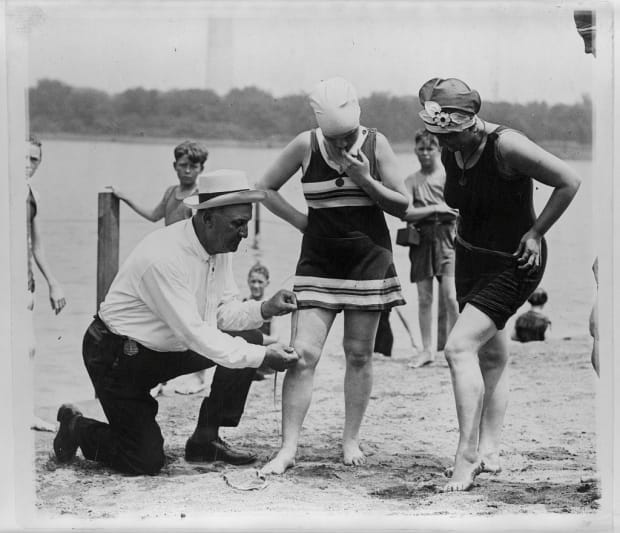
Women wearing the new one-piece bathing suit were arrested.
This is a picture of two women getting arrested for their inappropriate bathing suits in Chicago in 1922.
Which is ironic because Chicago’s burlesque shows were among the “bawdiest and most risqué in the nation” in the 1910s and 20s.
If you walked just a short way from those Chicago beaches you could go to the Gem Theater to see the showgirls, where not only was the exposing of women’s thighs encouraged, it was a requirement.
Going to see these showgirls was not illegal. But if one of those showgirls showed their same thigh on the beach, that was illegal.
The issue, then, has never really been nakedness itself.
If society truly found women’s bodies too obscene for public view, breasts and thighs would be banned everywhere—not just at protests, beaches and grocery stores, but in advertisements, movies, porn, music videos and billboards too.
But women’s bodies are not hidden from view, they are displayed constantly.
It’s just that women’s bodies are only acceptable when they are consumable.
Last week we talked about Jacob, the Mormon missionary who grew up surrounded by women who covered their chest, thighs, shoulders and stomach.
When Jacob encountered women in bikinis on his mission in the Dominican Republic, he struggled to see these women as anything other than a sexual temptation. He literally could not look them in the eye.
Meanwhile his companion who grew up in Hawaii seeing his neighbors and his mom’s friends in bikinis everyday, had no problem seeing women as human regardless of what they were wearing.
We also talked about Emily who moved to Germany from the US and noticed just how many places there are for non-sexualized nudity in Germany. She also noticed she is much more likely to be treated as a human rather than a sex object there.
There is a difference between a naked woman and a sexualized naked woman, but that difference is lost if the only place we see nakedness is in sexual contexts.
What do we mean when we say objectified?
An article in the academic journal Nature entitled The Sources and Consequences of Sexual Objectification defines objectification this way,
“Sexual objectification—treating a person as a body or collection of body parts— involves a cultural prioritizing of women’s sexual appearance and appeal over other attributes.”2
It goes on to explain why this prioritizing of women’s sexual appeal over everything else is problematic:
“In general, sexually objectified women are perceived more negatively, and as less competent and less fully human than women who are not sexually objectified. Exposure to this cultural messaging has broad consequences and fuels sexist attitudes and violence towards women. A central consequence for women is self-objectification, which is associated with a more negative body image; diminished mental, physical and sexual health; and impaired cognitive performance.”
Sexually objectified women are not only seen as less smart, less competent and as inhabiting a smaller range of human emotions by other people, they are seen as dumber, less competent and less human by THEMSELVES.
Even AI has learned to associate women’s sexualization with diminished humanity.
A recent study out of Cornell tested nine different AI systems and found that AI was able to recognize anger and sadness in the facial expressions of fully clothed women, but when the women in the pictures were partially clothed, AI could not recognize or name those women’s emotions.
Yikes!
Another study researching the captions generated from automatic image captioner technology found that generated captions included words denoting emotion 50% less often when women were partially clothed than when they were fully clothed.
Yikes!
This is objectification at play—turning a human with thoughts and feelings into an object of sexuality.
As the dial of sexual depiction increases, the dial on humanity decreases.
The more a culture sexually objectifies women, the more likely the women in that culture are to see their own body as the most important thing about themselves. (In case you’ve ever wondered why so many women struggle with body image issues…)
Also, sexually objectifying women fuels violence against women. Because if a woman is not a human, but an object, well, you can treat an object however you want.
None of this is to say that women shouldn’t be sexual, just that when a woman’s sexual appeal is seen as the most important thing about her, then she is treated by others, computers and herself as less human.
A nationwide nonprofit breast cancer support group called The Breasties, have repeatedly had their Instagram account banned and their posts deleted for posting pictures of mastectomies.
Here’s an Instagram post published by the nonprofit showing Instagram threatening to delete their entire account:
Their mastectomy photos were taken down because they were “inappropriate sexual content.”
The last line of their message to Instagram is “stop sexualizing our bodies and experiences.”
Those mastectomy images are not sexual. Women’s bodies aren’t inherently sexual, but when they are policed and labeled as inappropriate sexual content, suddenly the non-sexual becomes sexualized.
A woman’s nipple while breastfeeding is a source of sustenance for her baby. It is not sexual. But when that police officer called her nipple offensive, he sexualized it.
When I was 21, the Mormon prophet (then an apostle) gave a talk about the evils of pornography. In that talk he said that I, as a young woman, became pornography whenever I dressed immodestly.
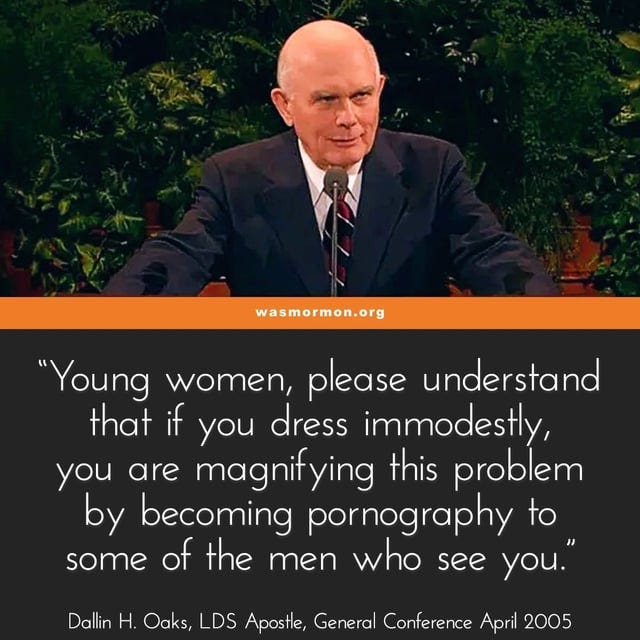
My body is not pornography. No matter how much of it is shown. My body does not exist for men. Not for their visual pleasure, sexual temptation or religious avoidance. My body exists for me. To walk, dance, think, write, feel and dream. It exists for so much more than just sex or sexual appeal. That is such a minuscule part of its existence and function.
My body is not inherently sexual, but Dallin Oaks made it sexual by saying my skin is inappropriate.
Human bodies and especially ‘sexual content’ is seen as inappropriate, but sex is not an inappropriate thing in and of itself. We all have sex to thank for our existence.
But breaking human women down to their parts, selling those parts, critiquing those parts, thinking of women’s main function as sexual— now that is inappropriate.
It is appropriate for a woman to feed her baby, post about surviving breast cancer or exist in her body outside the framework of consumption.
If women’s bodies were able to be seen in more non-sexualized settings, perhaps we would have an easier time seeing the human behind the body.
But if the only time we see the female form is when that form is consumable —to be looked at, seduced, avoided or purchased—the harder it becomes for everyone, including women themselves, to remember that they are more than a body.
Do you love to talk about patriarchy and about how we can get patriarchy out of our own heads? Cool me too. Come join us at our Matriarchal Blessing book club. By popular demand, this quarter we will read The Flowering Wand: Rewinding the Sacred Masculine by Sophie Strand. We will meet on zoom in July to discuss. Join us:
Which is so inconvenient, since a woman is the sole possessor of nipples that are functional instead of just decorative.
A man can show his nipples in public and this is perfectly legal. A child can show their nipples in public and this is not illegal. But a woman, the only one whose nipples actually do something productive and necessary, the only one for whom the legality of nipples would provide an inconvenience, her nipples are illegal.
Researcher Martha Nussbaum identified 7 features of the objectification of women (treating women as objects rather than human):
instrumentality: the treatment of a person as a tool for the objectifier’s purposes;
denial of autonomy: the treatment of a person as lacking in autonomy and self-determination;
inertness: the treatment of a person as lacking in agency, and perhaps also in activity;
fungibility: the treatment of a person as interchangeable with other objects;
violability: the treatment of a person as lacking in boundary-integrity;
ownership: the treatment of a person as something that is owned by another (can be bought or sold);
denial of subjectivity: the treatment of a person as something whose experiences and feelings (if any) need not be taken into account.
Nassbaum has found that “The object status of women is the cause of men seeing nothing problematic with violent behaviour towards women.”
No posts
Comments
Nothing yet. Say the first thing.
Sign in to join the conversation.