
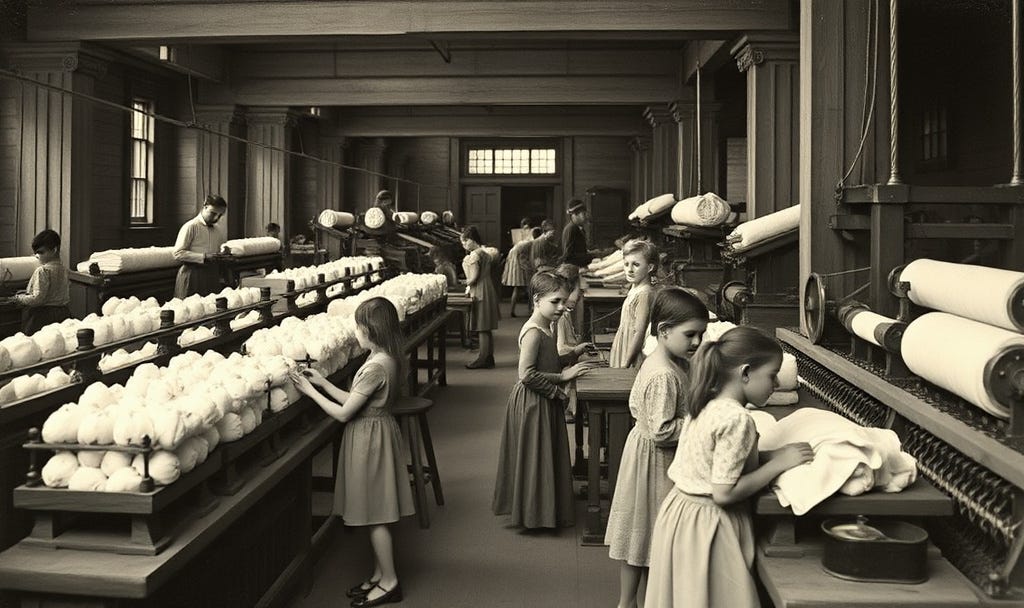
Good day! So, as I am perusing this 1911 copy of American Primary Teacher, my initial thought upon seeing the title “Eight-Hour Day for Children” was more along the lines of “Goodness, eight-hour school days are awfully long days for kids to endure.”
Wow, was I mistaken. Clearly, I had “forgotten” I was steeped in the world of 1911.
[Begin article.]
*Spelling and punctuation as shown in the original article.
One of the great services rendered the public by the National Child Labor Committee is in relation to the eight-hour day for children.
The eight-hour day was established in the following states for children up to sixteen years of age: Colorado, Missouri, and Wisconsin. In California and Washington the eight-hour day was established for women and girls. The following important reductions of hours in other states were secured: Massachusetts, a fifty-four-hour week for males under eighteen and all females in manufacturing and mechanical establishments; Missouri, a nine-hour day and a fifty-four-hour week for all females; Utah, fifty-four-hour week for boys under fourteen and girls under sixteen; North Carolina reduced the working hours of children from sixty-six to sixty per week in manufacturing establishments; Georgia reduced the working hours from sixty-six to sixty per week for all employees in cotton and woolen mills; Indiana established what amounts to a nine-hour day and a fifty-four-hour week for all children under sixteen. Ten states and the District of Columbia have now established the eight-hour day for working children. They are Ohio, Illinois, Nebraska, New York, Wisconsin, Colorado, Kansas, Oklahoma, North Dakota, Missouri, and the District of Columbia.
[End article.]
Let me continue by saying how grateful I am that I was not one of those “working children”.

Nowadays, we’re awfully hard-pressed to find adults who will work a soft job, let alone jobs that take actual labor. I know I’m not alone when I say I’ve been seeing and hearing that very familiar quote being floated around quite an awful lot lately — "Hard times create strong men. Strong men create good times. Good times create weak men. And weak men create hard times." – G. Michael Hopf
Do the young adults in the room even understand what that means?
The more I look around, the more I see how true it is. Take, for instance, the idea of inherited wealth. The great men and women who build that wealth with their own hands are strong, determined, intelligent, generally practical, economical, and careful.
The kids born into that wealth have no clue how it came to be. They simply … expect. Then they develop that entitlement. Then they squander, having no earthly idea what it takes to earn it.
It’s quite disturbing, actually. Participation awards only taught the kids that they didn’t have to work for or earn anything themselves. They were taught it would just be given to them. And then we wonder why they’re so gung-ho over socialism1. (insert huuge eye roll emoji.)
I mean, they speak Text Language and lost the art of handwriting, especially cursive2. With every passing day, we seem to lose more and more of what once was a purely beautiful language, and with it, the art of the handwritten word. It’s just sad.
Anyway, thanks for being here. See you next time!
Which simply never works, by the way.
That most beautiful script which graces the Constitution of our beloved United States of America. You say “nationalist,” I say “patriot.” Potato, Potahto
Comments
Nothing yet. Say the first thing.
Sign in to join the conversation.