
The pace of progress has definitely accelerated.
After a landmark year in 2025 (documented in detail in my earlier report) the first three months of 2026 have delivered such a concentration of meaningful wins and forward momentum that it felt necessary to publish a quarterly update, rather than wait until the end of this year. Across the Anglosphere (and increasingly beyond) we are seeing something that would have seemed unlikely just a few years ago: sustained, bipartisan, multi-sector progress in recognising and addressing the challenges facing men and boys… And this should absolutely be celebrated.
This isn’t a fringe conversation anymore. It’s entering parliaments, shaping legislation, influencing public health strategy, and being discussed openly by leaders across politics, academia, and civil society. The tone is also shifting: away from grievance and towards constructive, evidence-based, and male-positive solutions. What follows is a summary of the most important wins and achievements from January to March 2026.
The United States continues to lead the way in terms of policy innovation and legislative action for men and boys.
The most significant development of the quarter is the passage of legislation in the state of Virginia to establish the first-ever Boys and Men Advisory Commission in the United States.
Passed with overwhelming bipartisan support (40–0 in the Senate, 91–6 in the House)
Designed to advise lawmakers on education, health, economic opportunity, and family life
Structured similarly to existing commissions for women, signalling parity in policy attention
As Richard V. Reeves noted, this level of bipartisan unity is remarkable in a polarised era and demonstrates that supporting men and boys isn’t a partisan issue, but a governance priority.
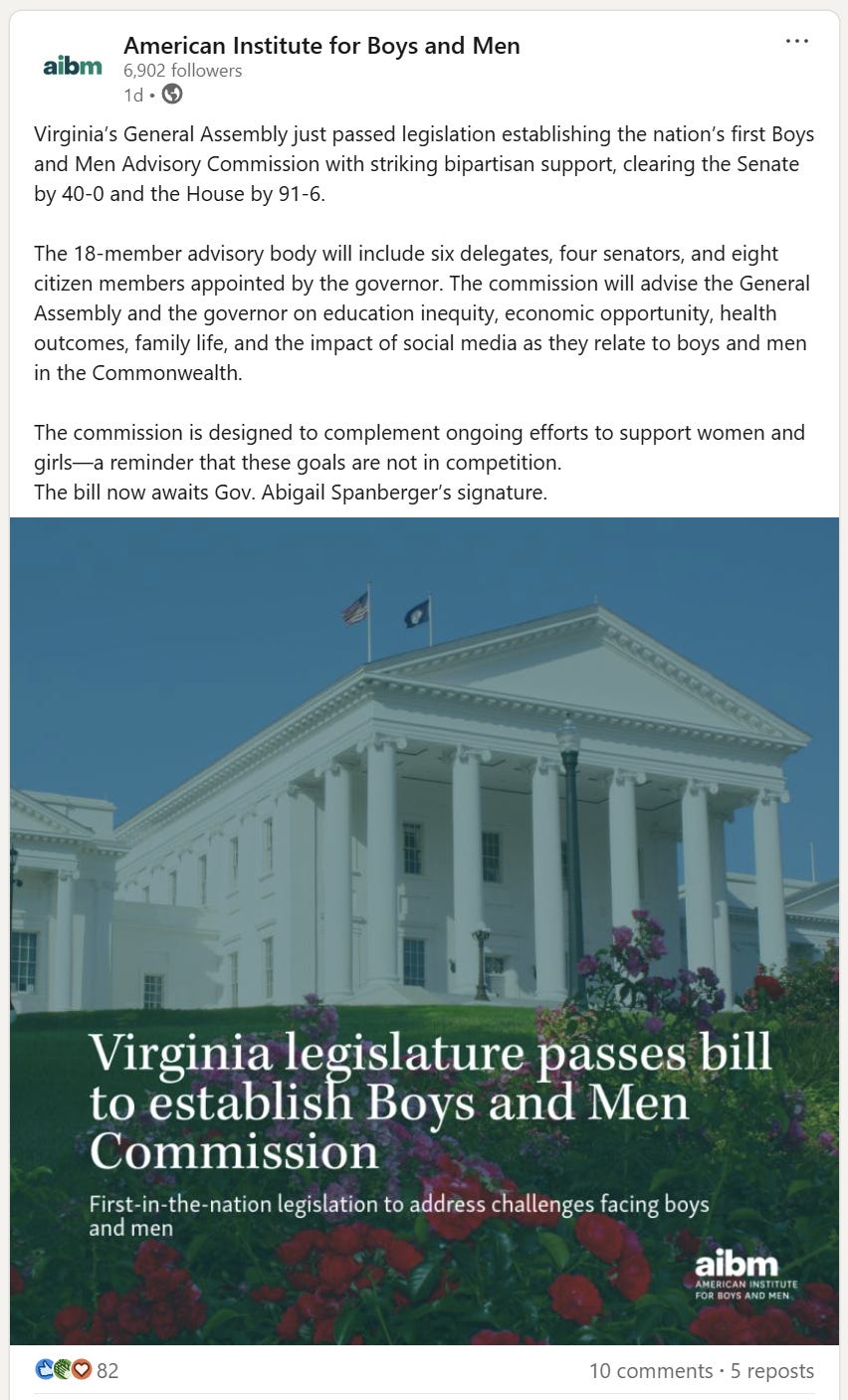
This is a genuine breakthrough. It creates a replicable model for other states, and potentially for federal policy…
Momentum is also building at the national level:
State of Men’s Health Act (H.R. 7602)
→ Proposes a federal Office of Men’s Health within the Department of Health and Human ServicesWhite House Council on Fathers and Sons Act
→ Focuses on strengthening families, fatherhood, and male wellbeing
Both bills have Democratic and Republican sponsors, reinforcing a key theme of this movement: progress for men and boys is increasingly bipartisan.
In addition, states such as California are proposing to formally recognise young men and boys as a priority group in suicide prevention, reflecting the growing alignment between data and policy.
Taken together, these developments represent a shift from:
Awareness → Action
Advocacy → Institutionalisation
The United States is moving toward embedding men and boys within the architecture of public policy, rather than treating their issues as peripheral.
The United Kingdom continues to build on the strong foundation laid in 2025, with further expansion in research, policy engagement, and public discourse.
On 6 March 2026, Liverpool John Moores University hosted a major Male Domestic Abuse Conference, bringing together practitioners, researchers, and advocates.
This is significant for two reasons:
It advances recognition of male victims of domestic abuse
It strengthens the evidence base and professional capability in this area
For decades, male victimisation has been under-recognised. Events like this signal a shift toward more inclusive, evidence-based policy and practice.

Following the May 2025 launch of the Centre for Policy Research on Men and Boys, the UK continues to:
Expand policy dialogue
Engage cross-party political support
Integrate men’s issues into mainstream debate
There is also continued recognition at senior levels of government, including commitments toward a national summit on men and boys.
Canada is making meaningful progress toward a national Men and Boys’ Health Strategy, a long-awaited development.
Key elements include:
Federal commitment to developing a coordinated strategy
Growing collaboration between government, researchers, and advocacy groups
Formation of a multi-partisan parliamentary caucus focused on men’s issues
This reflects a broader shift:
From fragmented initiatives → to a coherent national framework
Canada’s approach is particularly notable for its emphasis on:
Mental health
Suicide prevention
Homelessness
Family and social support systems
Australia continues to make incremental but important progress, with growing political recognition across multiple jurisdictions.
In January 2026, Opposition Leader Kellie Sloane appointed a Shadow Parliamentary Secretary for Men’s Health.
This is significant because:
It elevates men’s issues within the largest state of Australia
It signals growing bipartisan recognition
It includes a positive framing, encouraging society to celebrate masculinity

Australia is increasingly moving toward a more structured approach to male-focused policy, as outlined by:
Expansion of roles to include men’s health and wellbeing
Appointment of a federal Special Envoy for Men’s Health (May 2025)
Growing parliamentary engagement across parties
At the same time, the case for a Minister for Men and Boys continues to strengthen very significantly, given:
Educational underperformance of boys
Male suicide rates
Workforce risks and mortality disparities
The direction of travel is clear: from symbolic recognition toward institutional responsibility.
Local initiatives also continue to play a vital role, including:
Community forums on men’s health and wellbeing
Collaboration between organisations such as Movember, The Man Cave, and local networks
Expansion of community-based support services
These efforts reinforce an important principle:
Sustainable change happens when policy and community action align
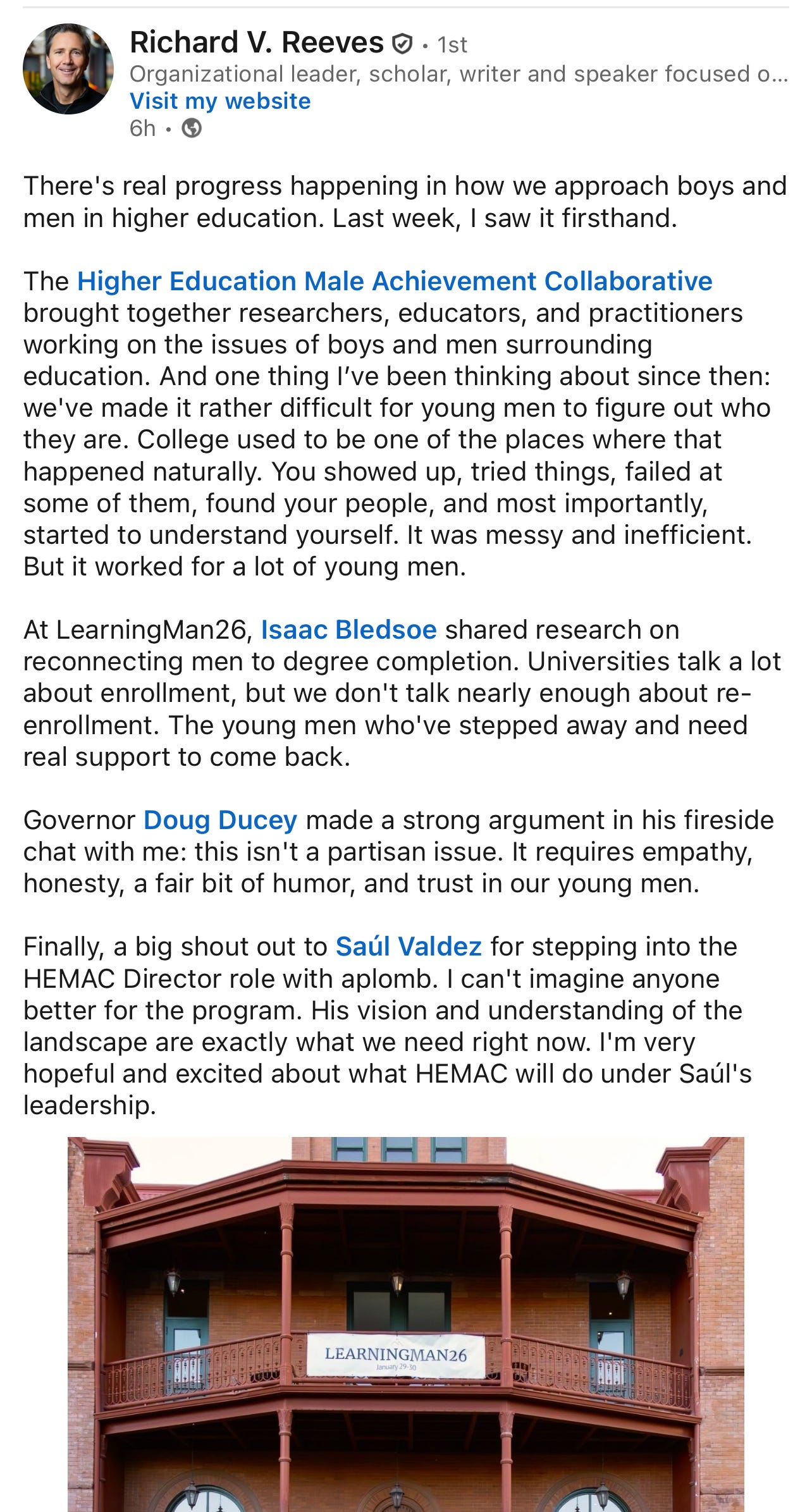
While the large English-speaking countries remain the primary drivers of policy progress, important developments are occurring globally.
Legislative and advocacy efforts are continuing, or emerging, across multiple U.S. states
Continued calls for commissions on men and boys in other jurisdictions
Growing international coordination through organisations such as the International Council for Men and Boys (ICMB)
Conferences, symposiums, and public events across Europe, Asia, and Africa
Increasing research output on male disadvantage
Continued growth of global advocacy networks
Ongoing public debate around education, masculinity, and social cohesion
Increased willingness to engage with difficult questions about male outcomes
Broader recognition that supporting men strengthens families and societies
One of the most encouraging developments is not just what is happening, but how it is happening…
This movement is increasingly characterised by:
Bipartisanship (U.S. legislation, Australian political support)
Evidence-based thinking (health strategies, academic research)
Constructive framing (complementing and not competing with the support for women and girls)
Institution-building (commissions, caucuses, policy offices)
As highlighted in Virginia:
Supporting men and boys isn’t a zero-sum game. We rise together.
The issues facing men and boys are now widely recognised:
Educational disengagement
Mental health challenges
Suicide and mortality disparities
Workforce risks
Family and social disconnection
But what is changing rapidly is the response…
We are seeing:
Governments acknowledging the data
Legislators acting on it
Institutions forming around it
Communities mobilising in response
This is how lasting change begins, and accelerates towards exciting progress (that is long overdue).
The first quarter of 2026 has confirmed what 2025 began: this is no longer a marginal conversation. It’s a global movement gaining structure, legitimacy, and momentum…
From Virginia’s landmark legislation, to bipartisan bills in the U.S. Congress, to national strategy development in Canada, to political recognition in Australia, and to growing research and dialogue in the United Kingdom, the trajectory is unmistakably positive.
There is still much work to be done. Policies must be implemented, refined, and properly resourced. Cultural resistance must continue to soften. Additional data must be collected and analysed. And above all, the focus must remain on practical outcomes that improve the lives of men and boys. In doing so, this will strengthen families, communities, and society as a whole…
For the first time in a long time, there is real cause for optimism.
The pace of progress is accelerating. The conversations are maturing. The solutions are becoming clearer.
And perhaps most importantly, a simple but powerful idea is taking hold across countries and cultures:
Caring about men and boys isn’t controversial, it is essential for our societies.
No posts
Comments
Nothing yet. Say the first thing.
Sign in to join the conversation.