
Saluto,
This newsletter is about populism.
Here, I’ll first give you three articles I used for the class that I taught this Monday on the rise of populism. Afterwards, I’ll explain the populist playbook by showing you the 4 key steps populist leaders use.
I will use three cases to show you how the populist playbook works: Viktor Orban, Hugo Chavez, and Lord Voldemort (Yes, you read that correctly. Trust me on this one).
But first, the three articles 🗞️
‘What is Populism?’ - The Conversation
A good first introduction to the concept, explaining what we traditionally use as a definition for populism in academic circles.
‘One in four Europeans vote populist’ - The Guardian
This gives you numbers from 1998 to 2018 and shows how populism has grown across Europe.
‘Defeating populism: First, admit there are reasons for its success’ - Friends of Europe
The article makes the case that in order to defeat populist leaders, mainstream politicians need to first acknowledge that populism's rise is not accidental, people have real grievances that aren't being addressed.
💭 My takeaway: Populism is not only something from the far-right
One of the biggest misconception is that populism is only by leaders on the right.
Sure, today we’re seeing people around the world blaming foreigners for all of the problems, but populism isn’t exactly that.
It’s something that attaches itself to pre-existing ideas, that leaders use to rise to power and then to keep it.
But enough talk and let me show you as if you were a politician that wanted to rise to power.
You have 4 key steps in the populist playbook.
Step 1: Create ‘the people’
This is the group you’ll mobilise, the ones who will come to your rallies and form the base of your support. Present them with positive traits: hardworking, honest, decent, smart.
The crucial insight here is that 'the people' can be anyone (seriously, anyone). It doesn't have to be the poor, or the working class, or any specific group.
What matters is that you present them as pure: morally uncorrupted, authentic, the real people.
Step 2: Create ‘the enemy’
Now you need someone to oppose to 'the people.'
This enemy must be powerful, corrupt, and dominating the situation unfairly. The Jews, Muslims, poor people, rich people, foreigners. Even vegans.
They are the reason your people aren’t getting what they deserve.
Again, this can be anyone. Your job as the politician that wants to rise to power is to create that enemy.
Step 3: Link all your problems of ‘your’ people with this enemy.
This is where emotion does the heavy lifting. Don’t lead with facts, lead with feelings. Make it personal.
Show how the enemy has directly damaged the lives of ordinary people: their neighbourhoods, their jobs, their children’s futures.
At the same time, make clear that institutions (courts, media, international bodies) are either co-opted by the enemy or deliberately failing your people. The goal is to deepen mistrust in anything that might challenge your narrative.
Step 4: Offer simplistic solutions and present yourself as the one speaking truth to power
Nuance goes out the window. You need one-sentence solutions and simple slogans. And when those solutions don’t work, because they won’t, blame the enemy again.
This is the self-reinforcing cycle at the heart of populism: the enemy is always responsible, you are always the only one willing to fight them, and your people always need you. Repeat until elected. Once in power, repeat to stay there.
Now rather than just giving you the theory, let’s apply it to three different cases across the political spectrum: Viktor Orbán, Hugo Chávez, and Voldemort.
Here’s how it looks when you map all three cases side by side:
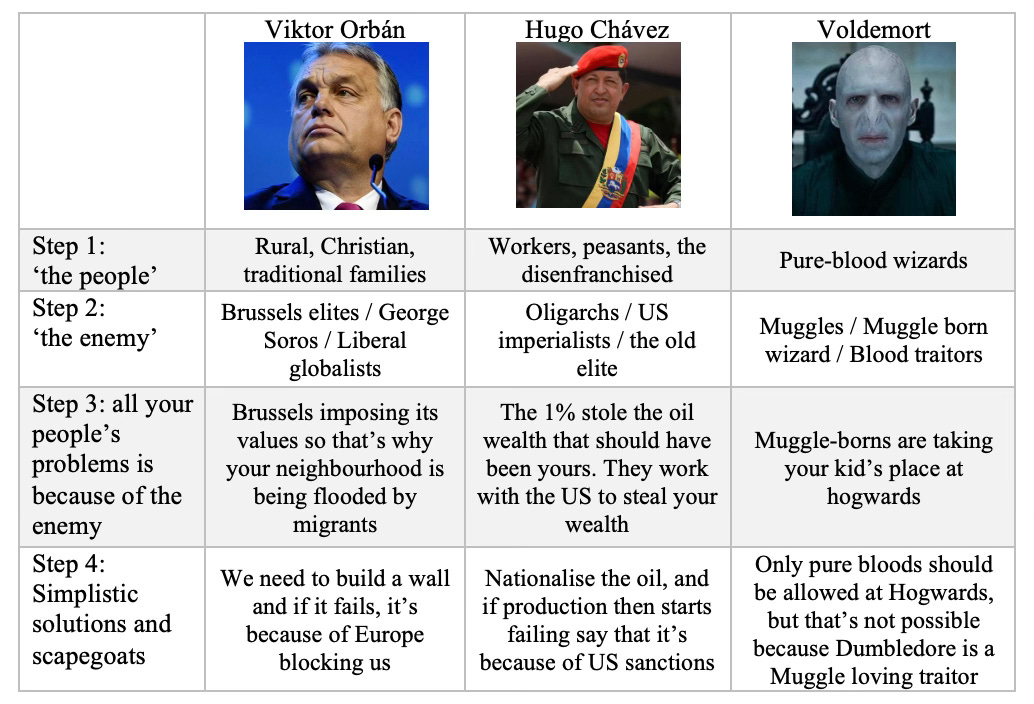
These three examples show that populism is a method, not an ideology. The enemy changes, the people change, but the structure is always the same.
Knowing that structure is the first step to recognising it when it's being used on you.
Happy readings,
Dr Cedric Pfanner
No posts
Comments
Nothing yet. Say the first thing.
Sign in to join the conversation.