
Saluto,
Direct Democracy is when citizens participate in democratic decision making not by electing politicians, but by voting directly on issues.
Something bothers you, you gather signatures, and then normally the community, region, or state votes on a solution to the issue.
From the city states of Ancient Greece to referendums in Switzerland today, the practice has existed throughout history and across regions.
Here, I’ll suggest three articles to help you make sense of what direct democracy actually is. Afterwards, I’ll explain why I believe that direct democracy is not a magic solution that many people think it is.
🗞️ The articles
A great starting point. It gives you a brief history and explains some Pros and Cons if the United States would adopt such a system.
The seven weirdest Swiss votes of all time - SwissInfo
When direct democracy is firmly established, expect some weird votes. So here’s a list of the weird votes that Switzerland had to do over the years.
Direct democracy can force governments to better represent the people, but it doesn’t always work out - The Conversation
The most analytical of the three. It explains well how the value of direct democracy depends on context.
💭 My takeaway: Direct Democracy is not the magic solution many present it to be.
Don’t get me wrong, I am a big fan of direct democracy. And, there’s no doubt it’s appealing.
You vote directly on issues, circumventing politicians who sometimes gain power for the wrong reasons.
But three reasons can make it problematic if your aim is to have a more democratic society.
First, referendums are often used to send a message rather than to govern.
Several referendums have been used to sanction governments rather than actually decide on policy. People vote to express frustration, not to choose a direction. Brexit is probably the clearest example of this.
Second, without a culture of compromise, you risk tyranny of the majority.
When referendums become protest votes, minorities pay the price. The majority can steamroll those with less political power, producing outcomes that look democratic but aren't.
Third, direct democracy can be hijacked by autocrats.
Referendums provide legitimacy. Which is exactly why many autocrats love them. It all depends on how they are conducted and the political culture behind them.
🇨🇭 This is where Switzerland stands out.
They managed to build a culture of voting on referendums.
You receive a booklet at home with neutral arguments for and against, party positions, and government recommendations. Then you vote on the actual issue, not to send a message.
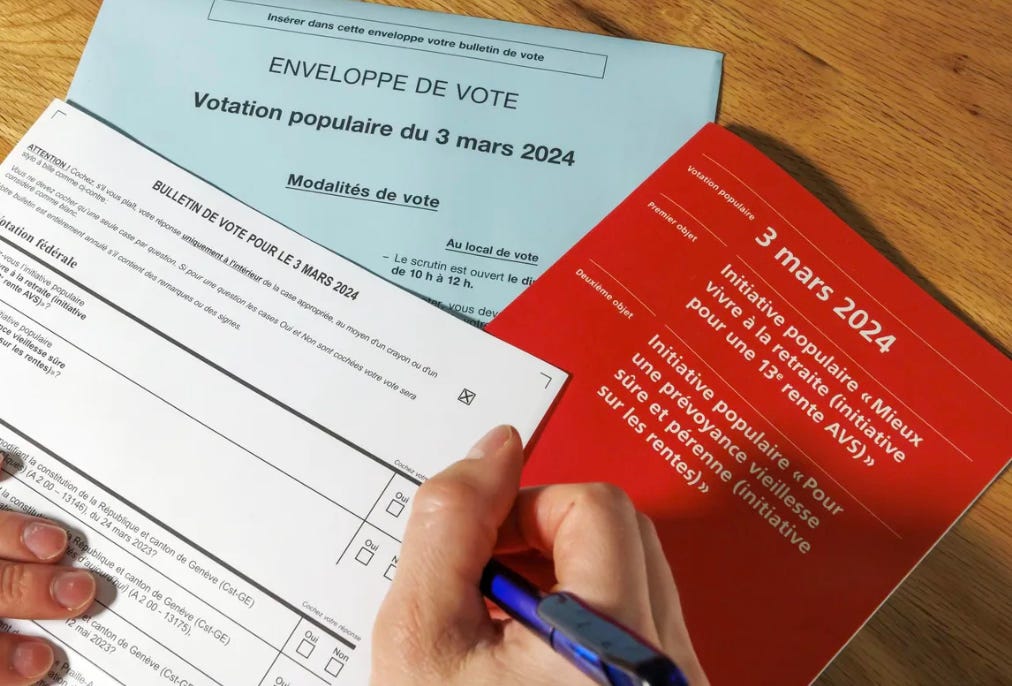
But even Switzerland is showing cracks. As the country grows, populist initiatives are increasing.
The vote that is happening now, whether to keep Switzerland’s population at 10 million is a perfect example.
A complex issue involving immigration, housing, and economic growth, reduced to a yes or no question. This is political messaging more than a vote aimed at governing.
The lesson here is not to avoid direct democracy.
It’s that the voting mechanism alone is not enough. Without a culture of compromise alongside it, referendums are more likely to cause chaos than solve anything.
On that note, I’ll read through my booklet and vote.
Happy readings,
Dr Cedric Pfanner
No posts
Comments
Nothing yet. Say the first thing.
Sign in to join the conversation.