
Every year since 2019, the Confederation of Tomorrow survey has been asking Canadians the following three questions about respect, influence and spending in the federation:1
• In your opinion, is your province or territory treated with the respect it deserves in Canada or not?
• In your opinion, how much influence does your province or territory have on important national decisions in Canada: more than its fair share, less than its fair share or about its fair share?
• Thinking about all the money the federal government spends on different programs and transfers to the provinces and territories, do you think your province or territory receives more than its fair share, less than its fair share or about its fair share?
The latest results for some provinces have been featured in the reports we’ve already published (including the update of the resentment index); others will be explored in more detail in a new report that will appear early in the next year. But, since we aren’t able to write separate reports each year on every province or region, we decided to post the complete results in a series of charts on our website.
You can find the presentation here.
This year, the survey was conducted in May – immediately following the federal election. One of the goals was to see how much difference the change of prime minister (from Justin Trudeau to Mark Carney) made to opinions about how fairly one’s province (or territory) is treated within the federation.
The overall results show a modest improvement in mood. For instance, in terms of the national average, the proportion of Canadians who say their province or territory is not treated with the respect it deserves dropped by four percentage points (from 39% to 35%). The proportion holding this view is now 10 points lower than when the survey series began in 2019.
This modest decline, however, is more pronounced in four provinces: two in the east and two in the west.
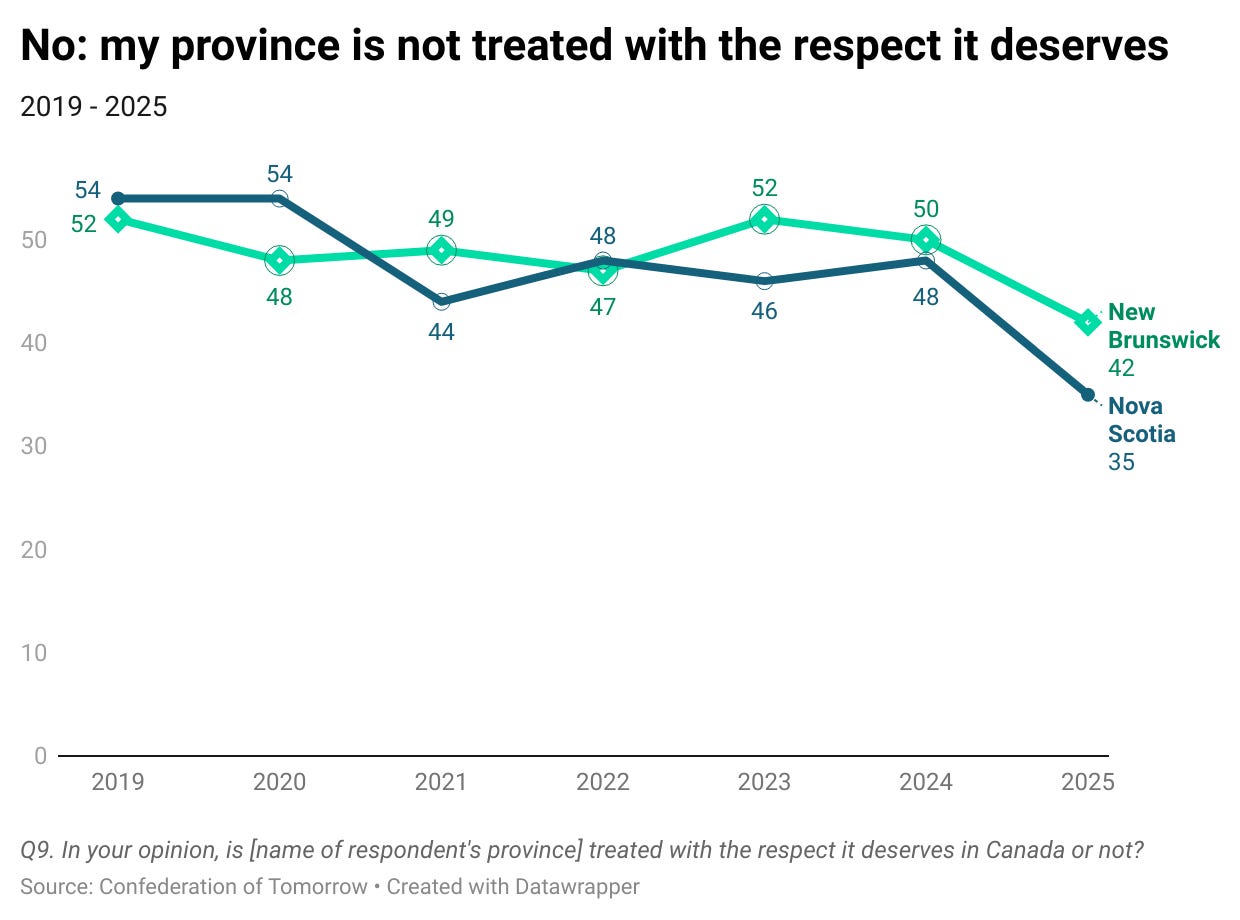
The proportion saying their province is not treated with respect dropped by 13 points in Nova Scotia and by eight points in New Brunswick. This follows not only the change in federal leadership, but also some positive national media coverage of the re-elected Progressive Conservative premier in Nova Scotia and the newly elected Liberal premier in New Brunswick.
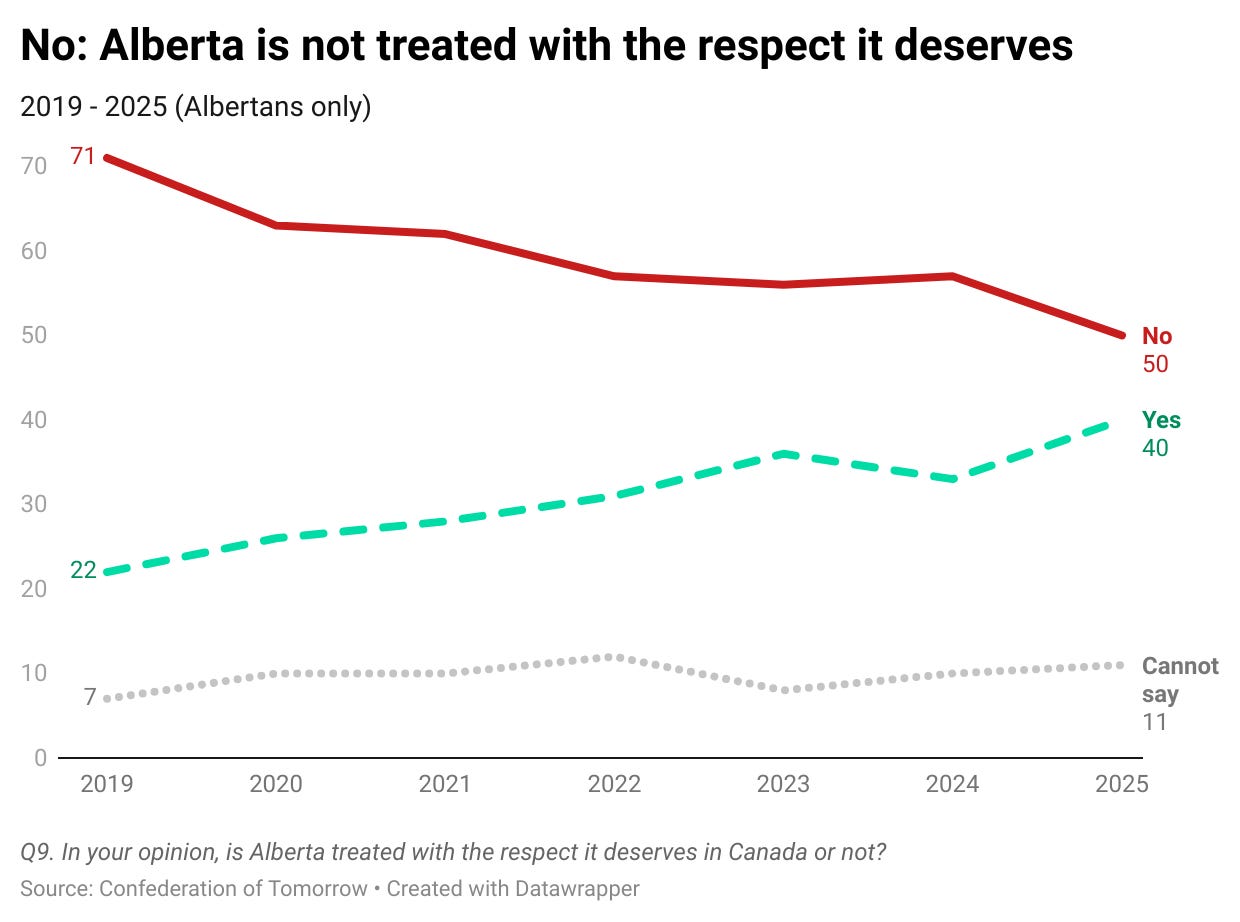
The proportion saying their province is not treated with respect dropped by seven points in both Saskatchewan and Alberta. In Alberta, the latest change is a continuation of a longer-term trend that has seen this figure fall from 71 percent in 2019 to 50 percent in 2025.
There were also big drops in Nova Scotia in the proportions saying their province has less than its fair share of influence on national decisions (down 22 percentage points between 2024 and 2025) and receives less than its fair share of federal spending (down 18 points). Clearly, Nova Scotians are feeling much less overlooked this year than previously – a shift we’ll have more to say about early in the new year.
The declines since last year in Alberta on these same questions about influence and federal spending were more modest than in Nova Scotia – but, in each case, they again continue a longer-term trend dating back to the start of the survey series in 2019. In other words, on each of these three measures of regional alienation, Albertans on average have become less “alienated” over the past five years.
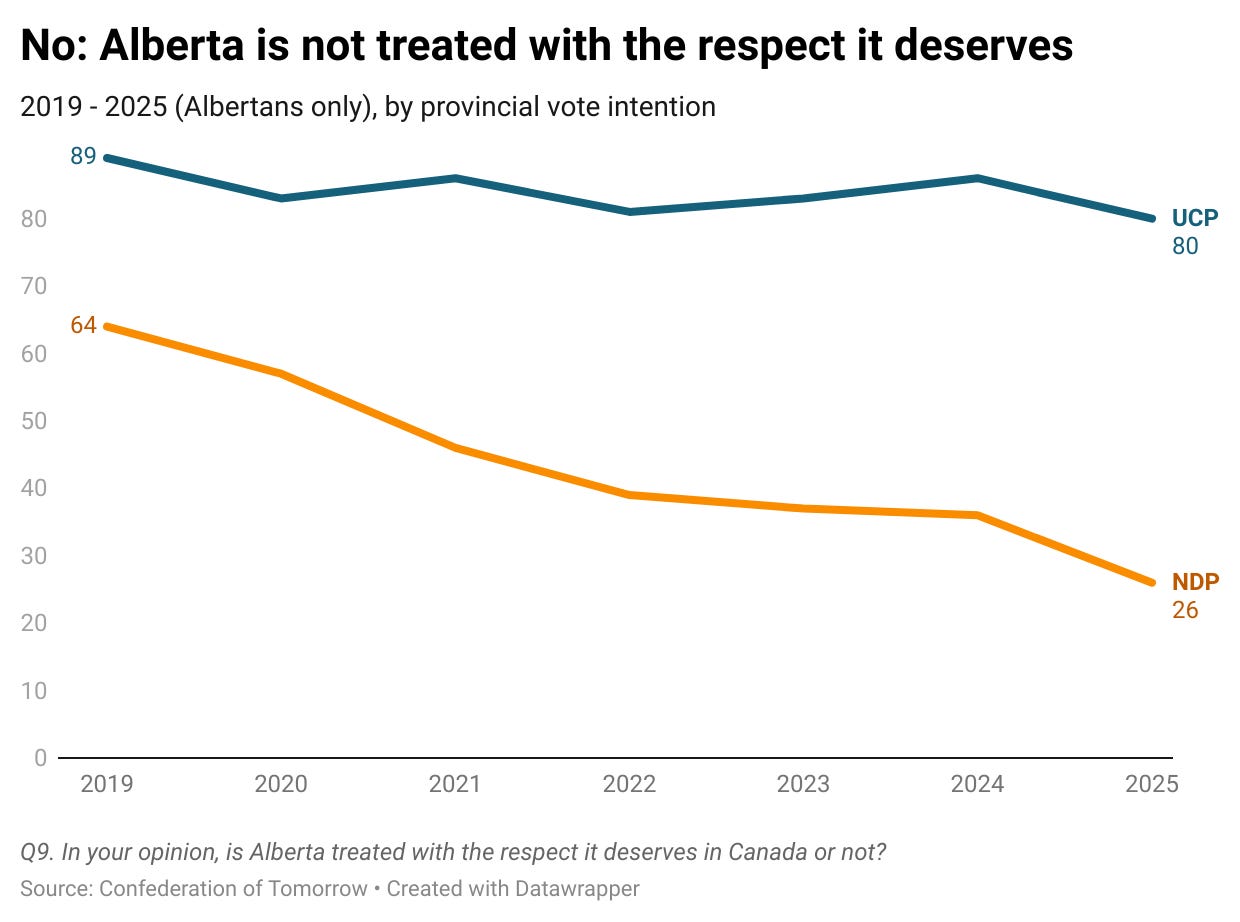
I get the feeling sometimes that this keeps surprising some people, despite our best efforts to share the findings. The key point to keep in mind is that the improvement in opinions isn’t evenly shared across the province. Among supporters of the governing UCP, feelings of lack of respect and influence remain high. Among supporters of the opposition NDP, however, these feelings have diminished. Premiers Kenney and Smith have been successful in rallying their supporters around their message about the province’s unfair treatment by Ottawa, but the effect has been to make this less of a consensus position within the province as a whole.
Here’s how we summarized the trend in our last report on “Western alienation”:
It is notable that, at the beginning of this period (2019), a majority of provincial NDP supporters in the region took the negative position on each question (saying their province was not treated with respect, had less than its fair share of influence and received less than its fair share of spending) – but this is no longer the case. It appears that efforts by provincial conservative party leaders to champion the case that their province, or the West in general, is treated unfairly within the federation has had, as one of its consequences, the effect of gradually pushing opinions among their NDP opponents in the oppositive direction.
This trend is illustrated in the next two charts, the first showing results for the question about respect for Alberta as a whole, and the second showing the breakdown by provincial party support.
All these results came before the recent announcement that the governments of Canada and Alberta had signed an MOU on energy and economic development. How this development, and the reaction to it in other provinces (notably B.C.) shifts opinions on these three questions will be among the topics we’ll explore in the upcoming 2026 edition of the Confederation of Tomorrow survey.
This post features data from the 2025 Confederation of Tomorrow Survey of Canadians. The author is solely responsible for any errors in presentation or interpretation.
The Confederation of Tomorrow surveys give voice to Canadians about the major issues shaping the future of the federation and their political communities. They are conducted annually by an association of the country’s leading public policy and socio-economic research organizations: the Environics Institute for Survey Research, the Centre of Excellence on the Canadian Federation, the Canada West Foundation, the Centre D’Analyse Politique – Constitution et Fédéralisme, the Brian Mulroney Institute of Government and the First Nations Financial Management Board.
The 2025 study consists of a survey of 5,391 adults, conducted between May 1 and June 16, 2025 (92% of the responses were collected between May 6 and May 29); 90% of the responses were collected online. The remaining responses were collected by telephone (both landline and cell phone) from respondents living in the North or on First Nations reserves, or from francophone respondents in New Brunswick.
What is the Environics Institute for Survey Research? Find out by clicking here.
Follow us on other platforms:
Bluesky: @parkinac.bsky.social
Twitter: @Environics_Inst or @parkinac
Instagram and Threads: environics.institute
Photo credit: Marc Bruxelle
In the survey, the words “your province or territory” are replaced with the name of the province or territory where the respondent lives (e.g., Quebec, Alberta, Yukon).
Comments
Nothing yet. Say the first thing.
Sign in to join the conversation.