
In the second part of this series – based on my read-through of the findings of the OECD’s latest report on trust in public institutions – I reported that Canadians are more likely than citizens in most other OECD countries to express high or moderately high trust in their national (or federal) government.
The OECD’s study includes a series of additional questions that go beyond trust – asking about specific functions that governments perform or ways in which they interact with citizens. And, wouldn’t you know it, Canada performs comparatively well on most of those measures too (though not quite all of them).1
Let’s start with education and health care.2 The OECD survey asks people how satisfied they are with the education and the health care systems in their country – though it limits the questions to those who have had recent contact with these systems.3 Canada does much better in education than health care: 70 percent of Canadians say they’re satisfied with education in their country, placing them seventh among the 33 countries in the study (10 percentage points above the OECD average). In contrast, only 54 percent are satisfied with health care, which is only 18th highest (and no different from the OECD average). Moreover, satisfaction with education in Canada has increased by 10 points since 2021, whereas satisfaction with health care has hardly changed (up 2 points).
The next items that caught my eye are emergency preparedness, emissions reduction and regulation of new technologies. In each case, Canada is much closer to the top than the bottom of the list.
60% of Canadians say it’s likely that government institutions would be ready to protect people’s lives if there was a large-scale emergency – higher than the OECD average (51%) and seventh highest out of 33 countries.
Only 44% of Canadians are confident that their country will succeed in reducing greenhouse gas emissions in the next 10 years, but that’s still above the OECD average (38%) and good for seventh place.
49% of Canadians say it’s likely that, if new technologies (for example, artificial intelligence) became available, their national government would regulate them appropriately to help businesses and citizens use them responsibly – again, above the OECD average (42%) and sixth highest.
Next come a series of questions about how governments make decisions. It’s reassuring that Canada ranks near the top when it comes to evidence-based decision-making: 54 percent of Canadians think it’s likely that the (federal) government will draw on the best available evidence, research and statistical data when it makes a decision. This is the third highest proportion among the countries in the study (only Switzerland and Australia rank higher) and 12 percentage points above the OECD average.
It’s reassuring that Canada ranks near the top when it comes to evidence-based decision-making, with the third highest proportion among the 33 countries in the study.
Canada also does comparatively well when it comes to:4
balancing interests (saying it’s likely that the national parliament would adequately balance the needs of different regions and groups in society when debating a new policy), ranking third out of 33 OECD countries;
generational fairness (confidence that the government adequately balances the interests of current and future generations), ranking fourth;
cooperation with stakeholders (confidence in the government’s ability to cooperate with other national stakeholders, such as private sector organizations and trade unions, to better tackle long-term challenges), ranking fifth; and
public consultation (saying it’s likely that the government would adopt the opinions expressed in a public consultation on reforming a policy area), ranking fifth.
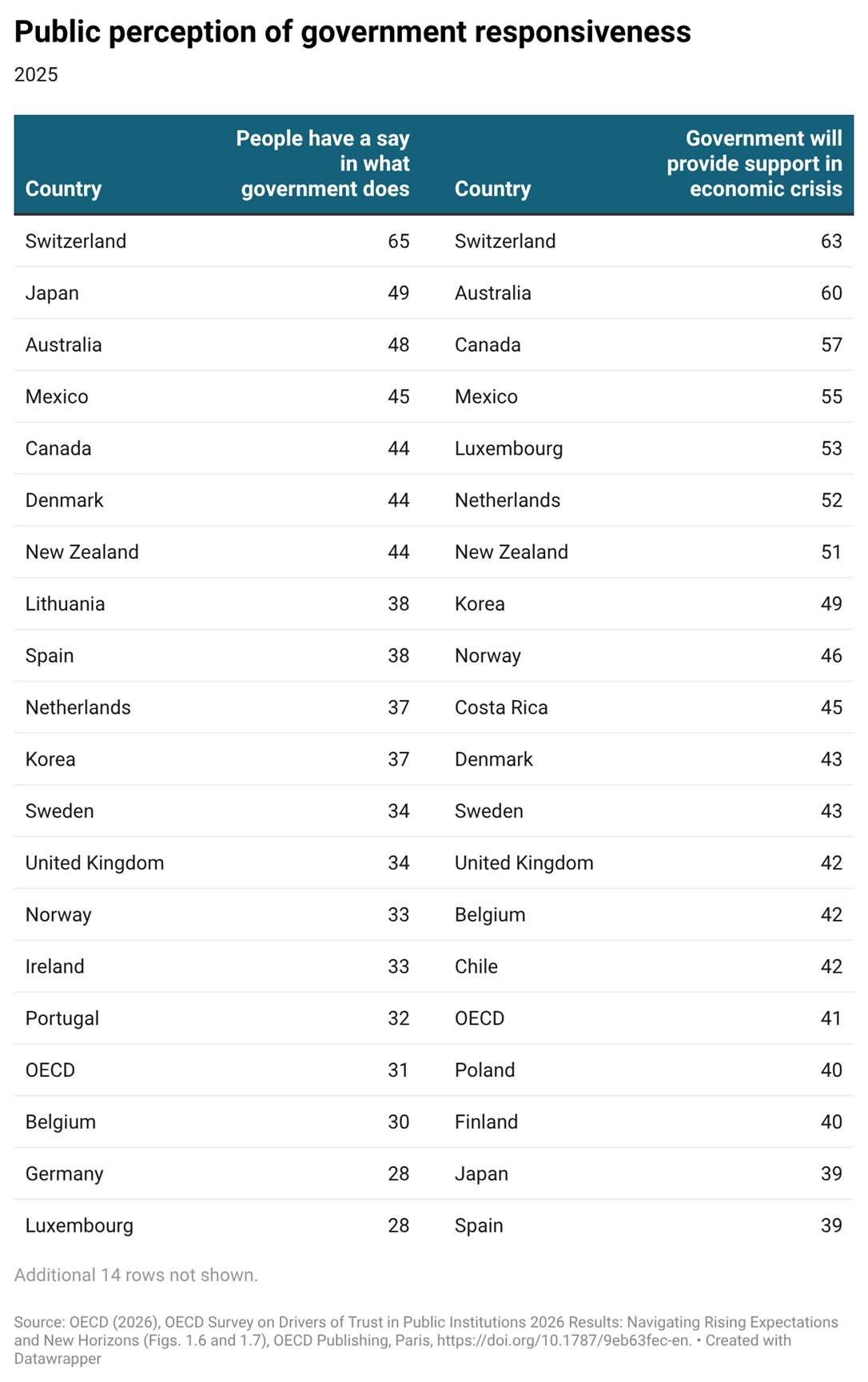
Two final items are worth noting. First, Canada is one of only seven countries in the study where people are more likely than not to believe that the political system in their country allows people like them to have a say in what the government does: 44 percent of Canadians take this view, compared to 38 percent who disagree (14% are neutral). That’s good enough for fifth place.
Canadians are the third most likely among citizens in the OECD to think it’s likely that their government would provide appropriate support to affected people in the event of an economic crisis.
Second – and perhaps most eye-catching of all – Canadians are the third most likely among citizens in the OECD to think it’s likely that their government would provide appropriate support to affected people in the event of an economic crisis: 57 percent of Canadians feel this way, well above the OECD average of 41 percent. Once again, Canada is bested by only Switzerland and Australia. We can speculate that this positive result is shaped by the experience of the government’s response to the pandemic, or more recently to the imposition of U.S. tariffs, or both.
It’s fair to argue that a comparison to the OECD average sets the bar too low. But what’s notable in most of these cases is that Canada isn’t just above average, it’s near the top – almost always in the top 10 (with health care standing out as the exception) and sometimes in the top five. Certainly, there’s ample room for improvement – of course, not just in the public’s perception of government performance, but in actual government performance itself (which would hopefully then boost public support). But, while things in Canada can still improve, when it comes to public trust in government, we’re already in a favourable position compared to most other similar countries.
That seemed like a summer good news story worth sharing.
This post is based on the OECD Survey on Drivers of Trust in Public Institutions 2026 Results. The OECD should be commended for making the data included in the report available and easy to access. The author is solely responsible for any errors of presentation or interpretation.
Photo credit: Sadi Maria
My comparison is with the 32 other OECD countries participating in the study; I exclude the five non-OECD countries that are covered in the report.
Recent contact is defined as having somebody in the household enrolled in an educational institution in the country in the last two years, and having somebody in the household personally making use of the health care system in the country in the last 12 months.
There appears to be one exception to this pattern: as far as I can tell, Canada ranks fairly low when it comes to the public’s belief that the government would refuse the demands of a corporation that promoted a policy that benefited its industry but could be harmful to society as a whole. But the report’s presentation of the results to this question are both confusing and incomplete – so I’m leaving it aside for now.
Comments
Nothing yet. Say the first thing.
Sign in to join the conversation.