
It’s a busy time of year. The parents I know have been attending end-of-school-year competitions and concerts. The empty nesters are preparing their camping gear. The academics are conference-hopping. And we’ve all been watching soccer.1
It’s understandable, then, if you might have missed some of our latest survey reports relating to national unity. Not to worry, here’s a quick review.
Resentment Recap
By now, I think we’re all familiar with the pattern in Alberta: polarization. It’s important to recognize and not dismiss the angriest sect among supporters of the governing United Conservative Party (UCP). But in so doing, there’s a risk of overlooking the fact that a good part of the province’s population has become less angry with each passing year. We have ample charts to demonstrate this – but the most interesting ones come from my colleague Charles Breton at the Centre of Excellence on the Canadian Federation.
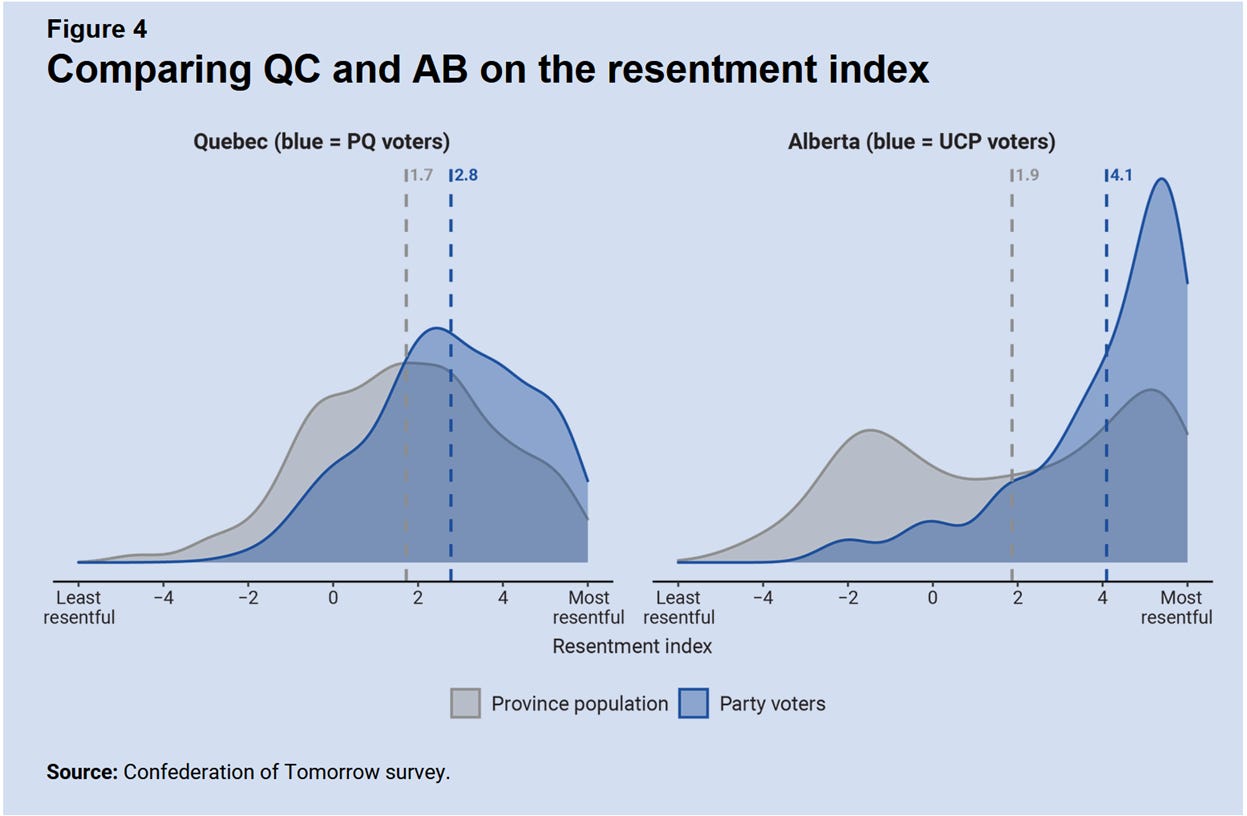
I think the most compelling is this one, from our recent article in Policy Options. It tells three distinct stories:
UCP supporters in Alberta are more aggrieved with federalism than Parti Québécois (PQ) supporters in Quebec.
UCP supporters in Alberta are further away from the average person in their province than are PQ supporters in Quebec.
There is far less consensus on the issue of their province’s place in Canada among Albertans than among Quebecers.
Read the article from Policy Options.
Speaking of Quebec
We also just published the 2026 update of our tracking on opinions in Quebec about the federation. The overall conclusion is a familiar one. Is there a resurgence of support for sovereignty? Not really. But there isn’t a resurgence of support for federalism either. One in two Quebecers agree that sovereignty is an idea whose time has passed. That means one in two don’t agree.
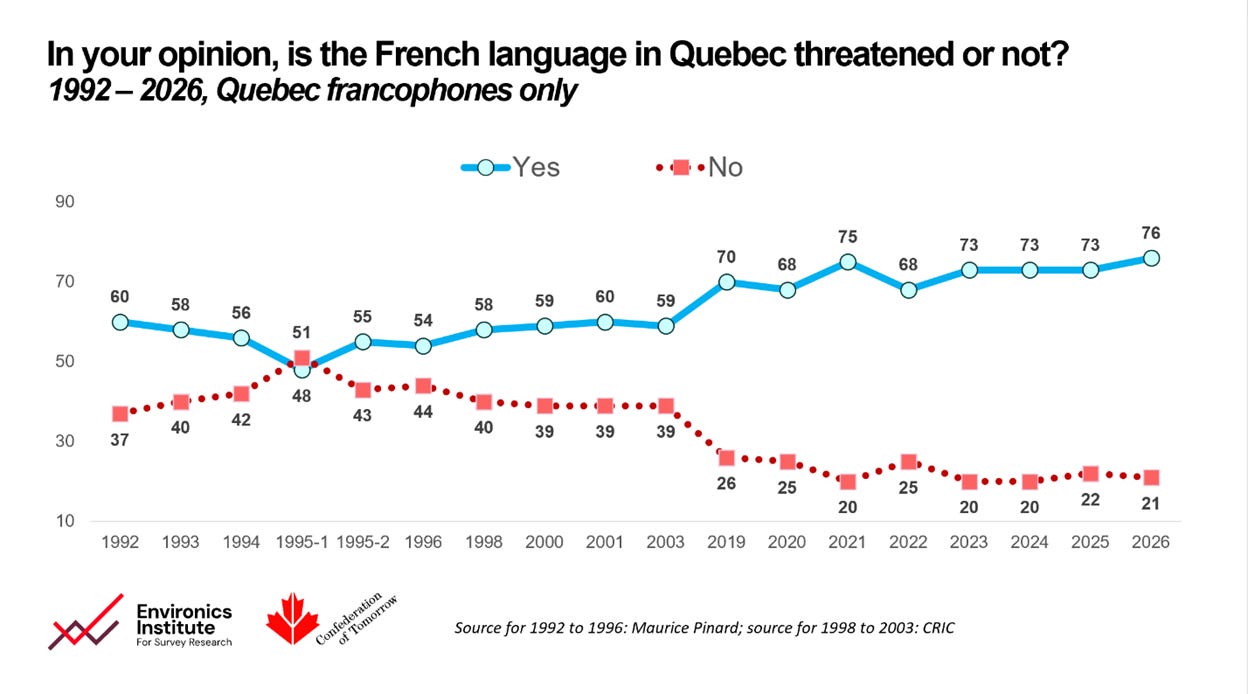
But here are two charts that might matter more than opinions about sovereignty. It just so happens that, on the eve of the Quebec election, the proportion of francophones who say that the French language in Quebec is under threat reached its highest point since tracking began in the early 1990s.
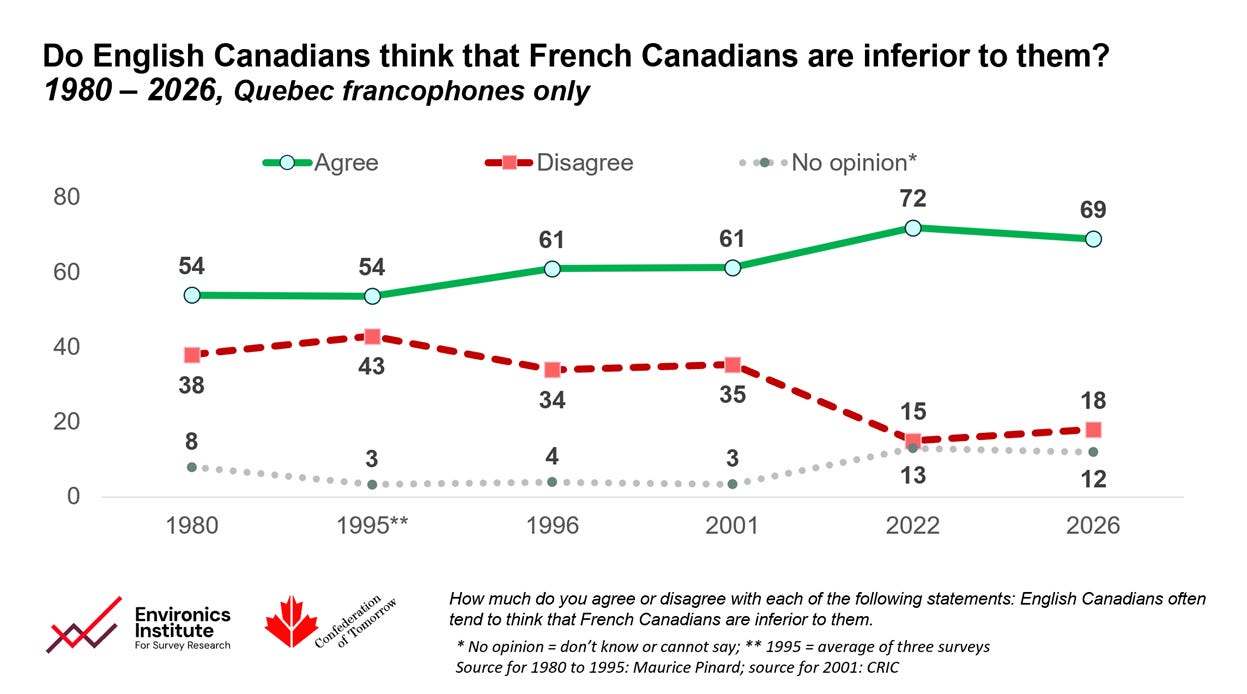
Here’s another good one. Seven in ten Quebec francophones agree that “English Canadians often tend to think that French Canadians are inferior to them” – a proportion higher than at the time of the 1980 or 1995 referendums.
See all the results on Quebec.
My takeaway is that federalists who focus only on the results of the latest poll asking about how Quebecers might vote in a referendum are at risk of missing the point.
Reconciliation
But before Canada Day, and before Quebec’s national holiday, there’s National Indigenous Peoples Day (June 21). On that occasion, we released our latest results on reconciliation and relations with Indigenous Peoples.
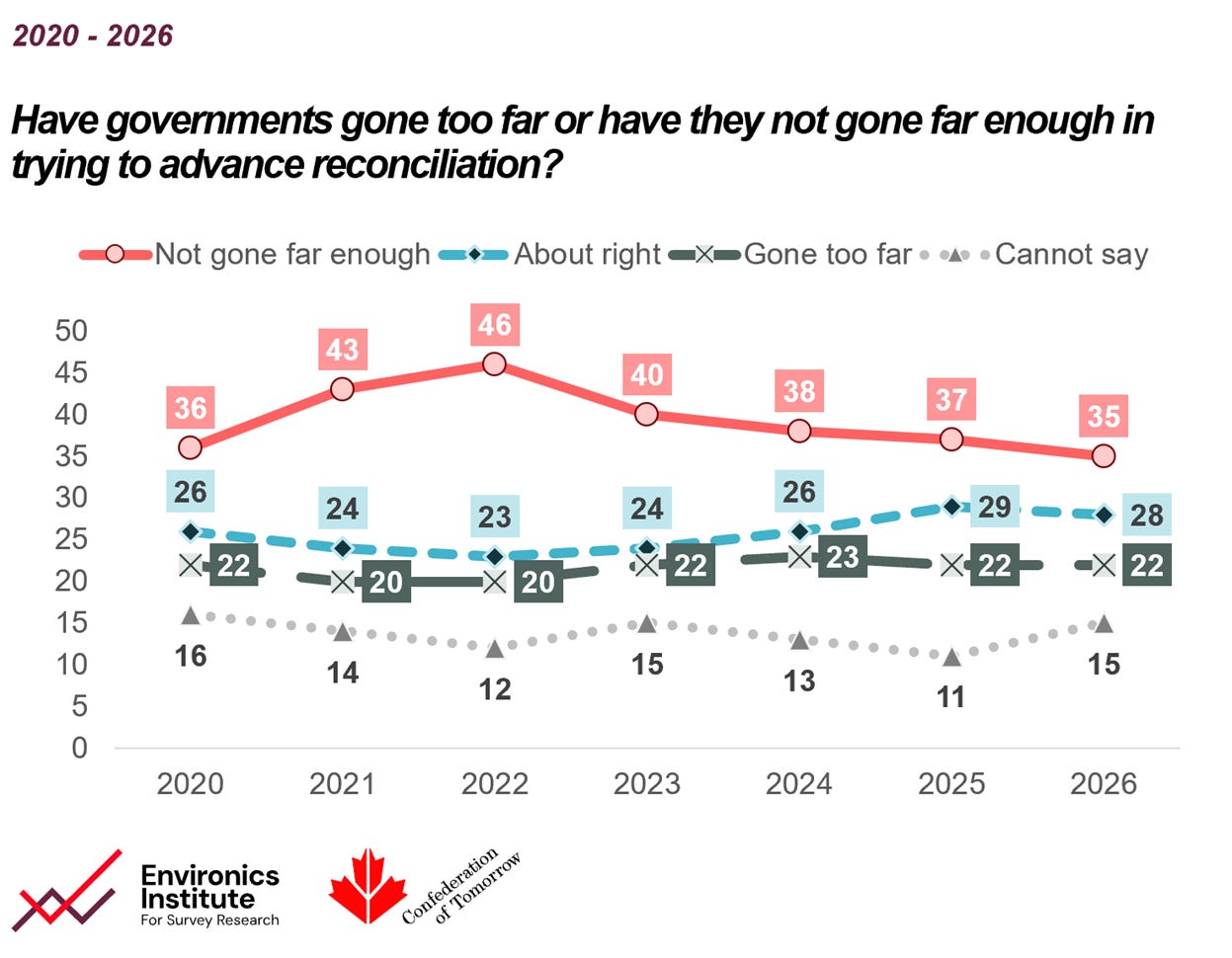
The news here remains mostly positive. A majority continues to feel that individual Canadians have a role to play in efforts to bring about reconciliation; and a plurality continues to say that governments have not gone far enough to advance reconciliation. Canadians are more likely to describe current relations between Indigenous Peoples and non-Indigenous people in Canada as positive rather than negative; and optimism about the prospects for reconciliation outweighs pessimism.
See all the results on reconciliation.
But there have been some recent shifts in opinion. For instance, the proportion of Canadians saying that governments haven’t gone far enough to advance reconciliation peaked in 2022, but has gradually declined since then (although the proportion saying governments have gone too far hasn’t increased significantly).
And, for the first time in this survey series, the proportion of B.C. residents who say that governments have gone too far to advance reconciliation exceeds the proportion who say governments haven’t gone far enough.
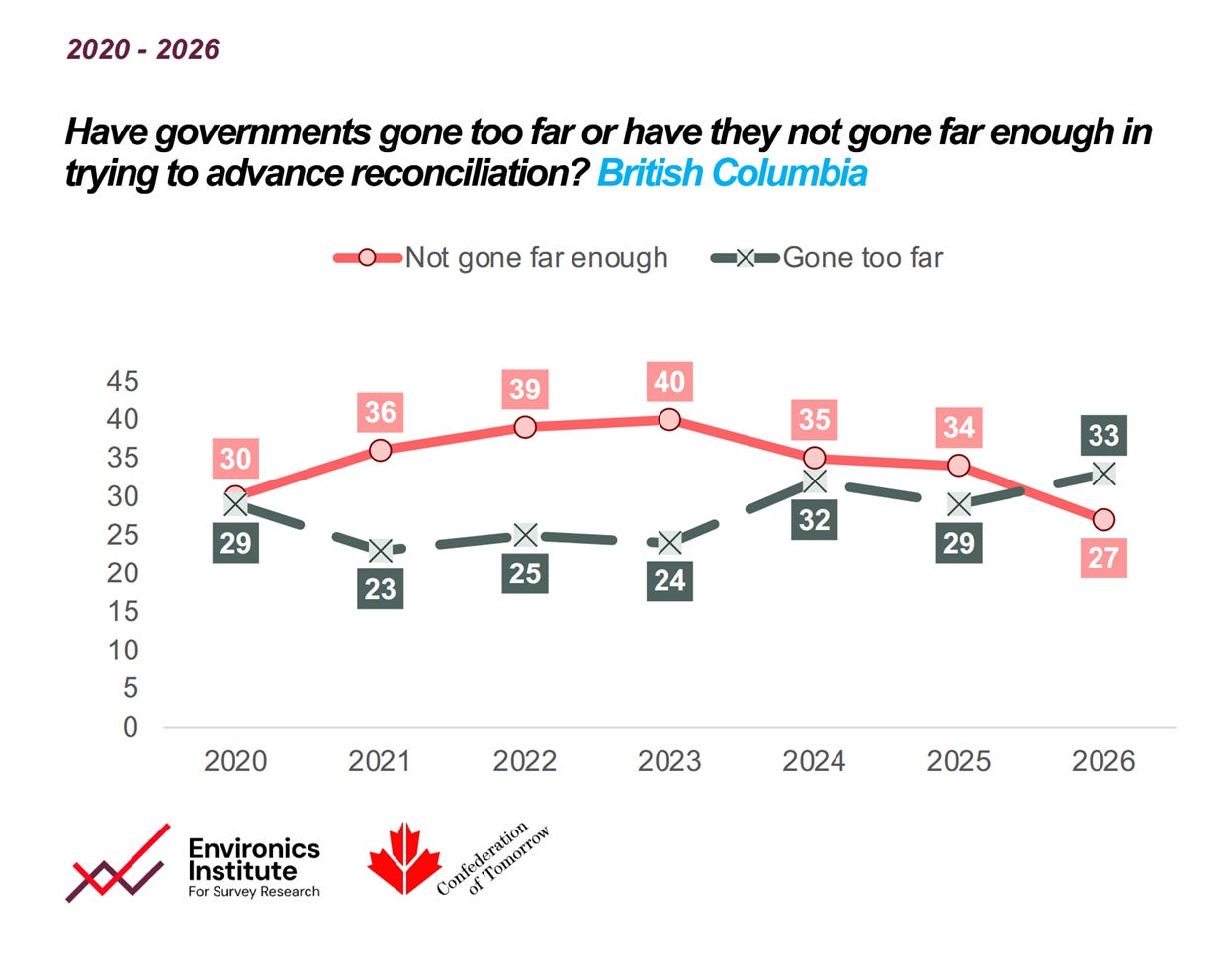
That’s a trend we’ll have to keep watching. Preserving national unity is about more than provincial referendums.
I don’t want to end on a somber note, so I’ll end with a teaser: we’ll have more to say about how Canadians are managing to stick together in the coming days, just in time for Canada Day.
The data in this post are from the Confederation of Tomorrow 2026 Survey of Canadians. The 2026 study consists of a survey of 5,696 adults, conducted between February 14 and March 28, 2026 (92% of the responses were collected between February 19 and March 7); 91 percent of the responses were collected online. The remaining responses were collected by telephone (both landline and cell phone) from respondents living in the North or on First Nations reserves, or from francophone respondents in New Brunswick. More details about the survey are available on our website.
The Confederation of Tomorrow surveys give voice to Canadians about the major issues shaping the future of the federation and their political communities. They are conducted annually by an association of the country’s leading public policy and socio-economic research organizations:
The Environics Institute for Survey Research
The author is solely responsible for any errors of presentation or interpretation.
What is the Environics Institute for Survey Research? Find out by clicking here.
Follow us on other platforms:
Bluesky: @parkinac.bsky.social or @environicsinst.bsky.social
Twitter: @Environics_Inst or @parkinac
Instagram and Threads: environics.institute
Cover photo credit: Aleksandra Aleshchenko
Or football, if you prefer.
Comments
Nothing yet. Say the first thing.
Sign in to join the conversation.