
This is the third part of a series exploring answers to the following survey question:
Which of these two statements comes closest to your own opinion?
Both freedom and equality are important. But I consider personal freedom to be more important, that is, everyone can live in freedom and develop without hindrance.
Both freedom and equality are important. But I consider equality to be more important, that is, nobody is underprivileged and social class differences are not so strong.
Part One of the series introduced the question and presented results for Canadians overall, and by age and gender. Part Two covered differences between Quebecers and other Canadians.
So far in this series, I’ve examined how opinions on whether personal freedom is more important than equality (or vice versa) vary by age, gender and region. But the more important factor is arguably not these demographic factors, but one’s political beliefs.
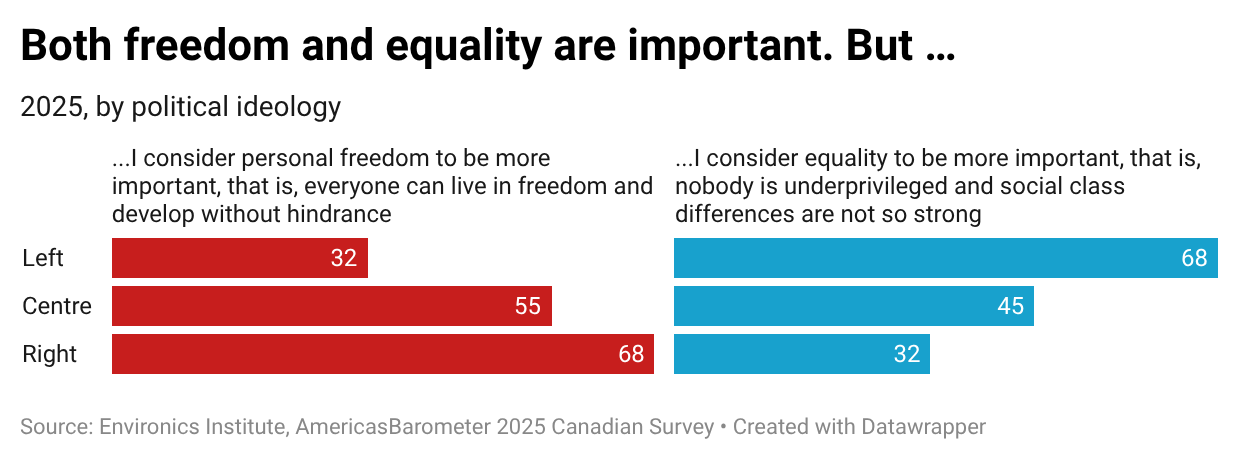
We can start with political ideology: where a person places themselves on the left-right political spectrum. Not surprisingly, Canadians on the left are much more likely to consider equality more important than personal freedom (by a 2 to 1 margin), while the opposite is true among those on the right (by a similar margin). In fact, the results for those on the left and right are mirror images of each other. The opinions of those who place themselves in the centre are naturally in between the two other groups and resemble the Canadian average.
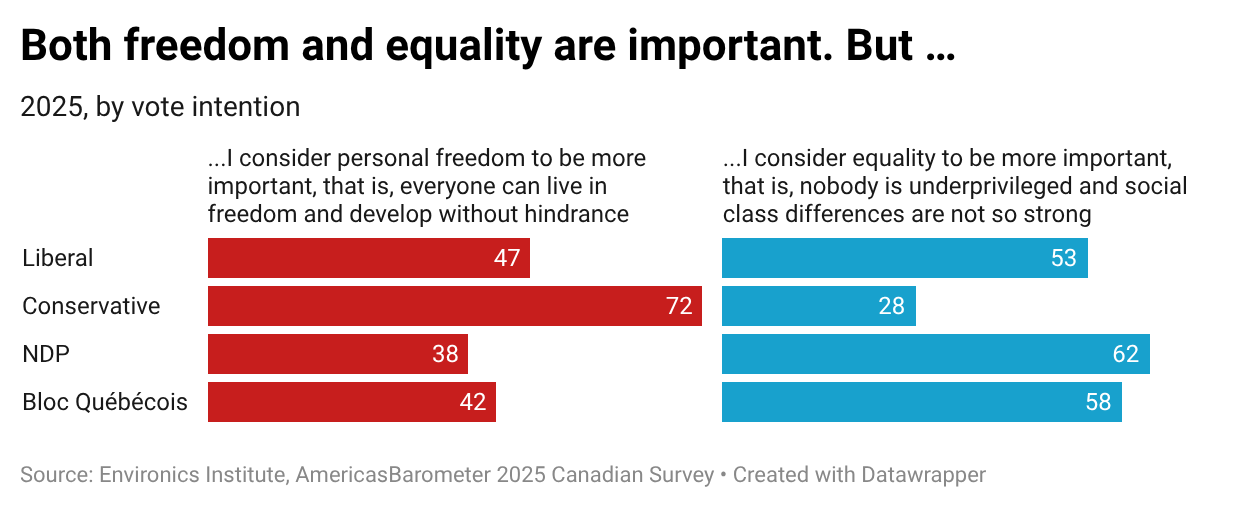
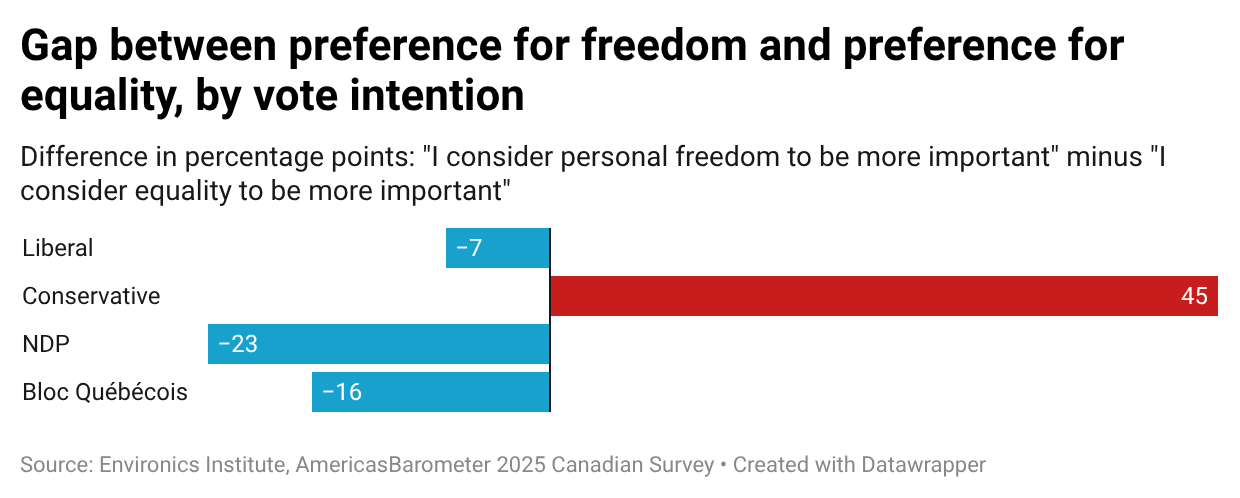
The results based on which political party one supports are also as expected. Among supporters of the main federal political parties, those who back the Conservative Party are the only ones who are more likely to consider personal freedom more important (72%) rather than equality (28%) – and by a wide margin (a difference of 45 points when decimals are taken into account). NDP supporters offer the biggest contrast, with 38 percent considering freedom more important and 62 percent favouring equality. Liberal supporters are more evenly divided, with 47 percent leaning toward freedom and 53 percent leaning toward equality. Bloc Québécois supporters are also more likely to favour equality over freedom (58% to 42%) and closely resemble supporters of the NDP.
These results may not be surprising, but they are nonetheless revealing, in that they confirm that this trade-off between equality and personal freedom remains relevant to the way we think about political differences in our society. Labels like “left” and “right” still mean something, as they clearly correspond to different positions about how competing claims to liberty and equality should be resolved. And, despite the extent to which we assume our politics is personality driven – with the personal likeability (or not) of leaders playing a big role in voting decisions – preferences for one party over another also tend to align with fundamental political values.
The results to this survey question also help us understand the current dynamics in Parliament, and specifically why the Liberal Party might find it easier to govern in a minority situation than the Conservative Party. Of course, nothing is guaranteed: issues will arise at specific moments that will compel members of Parliament to vote for or against the government of the day. But in terms of underlying values – captured here in this preference for either freedom or equality – one party looks more different than all the others.1
This post features data from the AmericasBarometer 2025 Canadian Survey. Results from this survey are posted on our website.
The AmericasBarometer is a regular comparative survey of democratic values and behaviours that covers countries in North, Central and South America, as well as a significant number of countries in the Caribbean (the 2025-26 study will cover 20 countries). The project is led by the LAPOP Lab at Vanderbilt University’s Center for Global Democracy (CGD). The Canadian survey was conducted by the Environics Institute for Survey Research, in partnership with CGD’s LAPOP Lab at Vanderbilt University and with the support of the Max Bell Foundation. The author is solely responsible for any errors in presentation or interpretation.
The survey was conducted online with a sample of 3,550 Canadians (aged 18 and over) between July 30 and August 7, 2025. The results are weighted by region, age, gender, education and language so as to be fully representative of the Canadian population.
What is the Environics Institute for Survey Research? Find out by clicking here.
Follow us on other platforms:
Bluesky: @parkinac.bsky.social
Twitter: @Environics_Inst or @parkinac
Instagram and Threads: environics.institute
Cover photo credit: Rixipix
The point differences in this chart are in some cases one point different from the difference of the values reported in the previous chart, due to the rounding of decimals.
Comments
Nothing yet. Say the first thing.
Sign in to join the conversation.