
Last week, MedZero was launched at the World Health Assembly.
The platform allows users to enter the name of a drug, device, procedure, diagnostic test, or service and receive an estimate of its lifecycle-associated greenhouse gas (GHG) emissions, along with a red-yellow-green assessment of estimate quality. It draws from a curated set of lifecycle assessments (LCAs) where available and uses a multi-region input-output (MRIO) model to fill data gaps. Estimates are customized to the user’s location.
Why does this matter?
Because most health systems currently estimate Scope 3 emissions from purchased goods using environmentally extended input-output (EEIO) models rather than product-specific lifecycle assessments. LCAs remain unavailable for most healthcare products, and conducting them across the tens of thousands of products purchased by a typical health system is extraordinarily labor-intensive.
As a result, most organizations rely on spend-based models that estimate emissions from economic activity categories rather than from the actual products themselves.
Could MedZero accelerate a shift toward more hybrid approaches—combining product-level LCA data with MRIO-based estimates where gaps remain?
It certainly appears to move the field in that direction and signals a broader maturation of healthcare carbon accounting.
More importantly, will better product-level accounting actually change how health systems prioritize Scope 3 reductions?
A recent UCSF study suggests it could.
Researchers compared traditional spend-based input-output models with more bottom-up hybrid approaches for estimating emissions from purchased goods (Scope 3.1). The hybrid approaches prioritized products for LCAs based on either purchasing spend or material weight.
The findings were notable.
Although the overall emissions estimates were of similar magnitude, the more bottom-up approaches produced total Scope 3 estimates that were 24% and 48% lower, respectively, suggesting IO approaches may overestimate emissions. Because purchased healthcare goods account for roughly 20–22% of total healthcare sector GHG emissions, overestimation can significantly distort estimates of healthcare’s overall climate footprint and potentially misdirect mitigation priorities. Other components of Scope 3—including transportation, energy, construction, and general materials—are less likely to be as data-poor and subject to revision as pharmaceuticals, medical supplies, and devices.
Even more important, however, was how the different methods changed the identification of emissions “hotspots.”
Under traditional IO approaches, medical devices accounted for four of the top ten emissions sources. Under the weight-based bottom-up approach, they did not appear in the top ten at all, and under the spend-based hybrid approach only one remained. Instead, gloves and other high-volume disposable supplies—including cleansing pads and disinfectants—rose to the top.
For health systems trying to deliver high-quality care while reducing costs and environmental impacts, these are not trivial differences. Different accounting methods may lead organizations toward very different operational strategies.
Is MedZero a game changer?
It has several notable strengths: ease of access, methodological consistency, comprehensiveness (within the limits of available LCAs, with gaps filled through MRIO modeling), and transparency. Given the current fragmentation and variable methods of health sector LCA’s, the importance of a credible central repository for this information cannot be overstated.
At the same time, the first version appears to have a significant limitation: the data can only be accessed through searches for individual products. Assessing Scope 3.1 emissions for a health system is an enormous and resource-intensive undertaking. The UCSF researchers used heuristic methods to narrow their analysis to approximately 1,000 products from an inventory of more than 25,000—but even that would require extensive manual searching and downloading within MedZero.
A future version could ideally allow batch uploads of product inventories, substantially lowering the data-entry barrier.
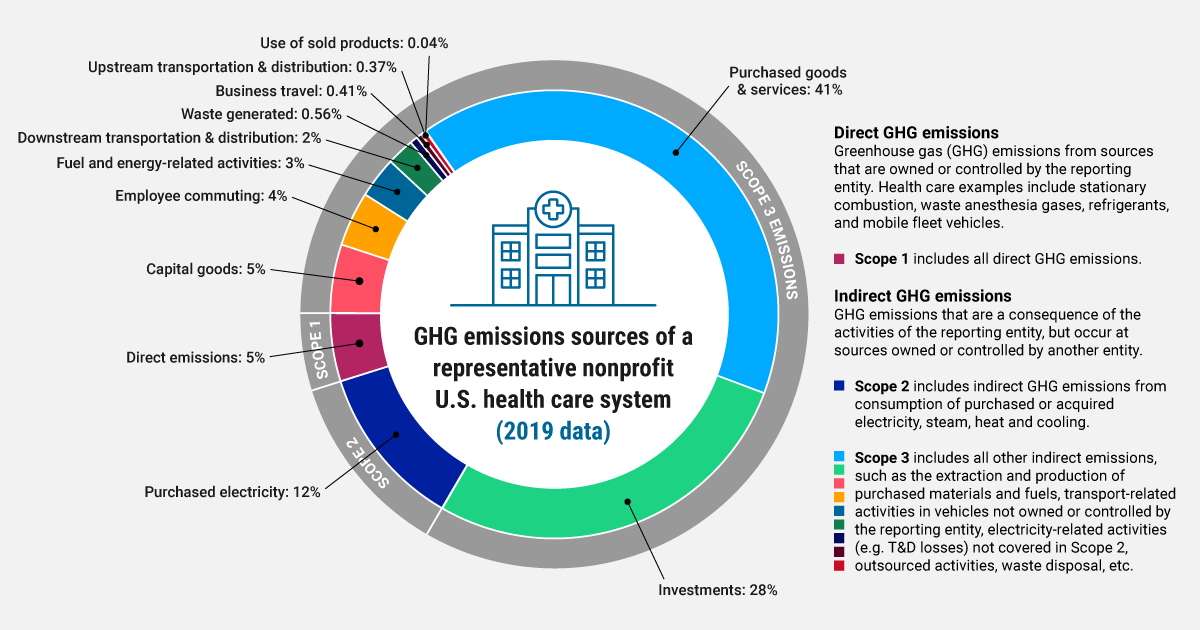
Source: https://practicegreenhealth.org/tools-and-resources/scope-3-ghg-emissions-accounting-tool
What does this mean for policy and practice?
Because Scope 3 emissions span so many sectors and product categories, assessing and reducing them remains an enormous challenge. On one hand, healthcare’s Scope 3 emissions are deeply intertwined with other major economic sectors—including food and agriculture, energy, transportation, and construction—meaning that healthcare’s progress depends partly on broader decarbonization trends.
On the other hand, the healthcare sector’s enormous purchasing power gives it significant leverage as a consumer. Better accounting and identification of carbon hotspots can help motivate change across supplier industries. This dynamic also operates within healthcare itself, as providers, group purchasing organizations, distributors, and others influence pharmaceutical, medical device, and supply manufacturers through procurement expectations and purchasing decisions. The National Academy of Medicine Climate Collaborative’s Health Sector Climate Action Survey is one example of this broader movement.
With only scattered mandatory reporting requirements across a subset of U.S. states and cities, market incentives for sophisticated Scope 3 auditing in healthcare remain limited. Most health systems will likely continue using simpler spend-based IO models for routine reporting in the near term.
But for organizations that have committed to emissions reduction targets—or that view waste and pollution reduction as part of broader strategic transformation—expanded access to credible product-level LCA data is highly valuable.
As the UCSF study suggests, when systems move closer to product-level analysis for their highest-volume drugs, devices, and supplies, they gain more accurate insight into emissions hotspots and can target waste-reduction and procurement strategies more effectively.
By making similar hybrid approaches incorporating product level information more accessible globally, MedZero represents an important infrastructure milestone in the maturation of healthcare Scope 3 accounting.
Comments
Nothing yet. Say the first thing.
Sign in to join the conversation.