
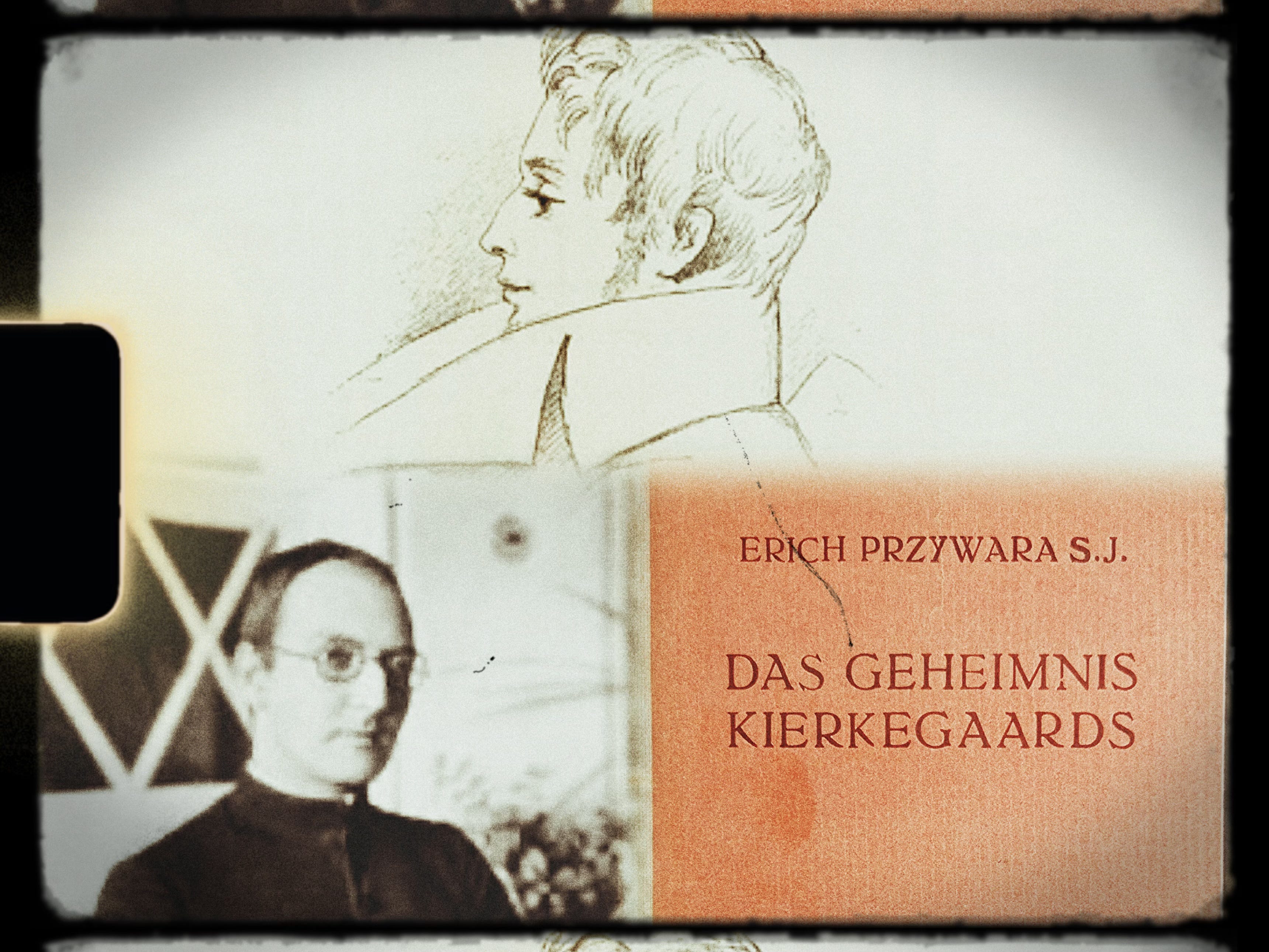
This is the fourth part of a series that, as I wrote last July, I plan to slowly unfold over the next couple of years. In the late 2000s, when I was finishing my doctorate at the University of Oxford, I started translating The Mystery of Kierkegaard (Das Geheimnis Kierkegaards) by the Prussian Catholic thinker Erich Przywara, S.J. In time, I would use this side project as the basis for a proper book chapter—namely, “Erich Przywara: Catholicism’s Great Expositor of the ‘Mystery’ of Kierkegaard,” which was published in the 2012 book Kierkegaard’s Influence on Theology: Catholic and Jewish Theology (Volume 10, Tome III). Now my goal is to present Das Geheimnis Kierkegaards in its entirety.
In my most recent post in this series (linked below), I completed my translation
of the book’s first major division, “Mystery of Style.” Today’s post moves on to Part II of The Mystery of Kierkegaard, which is entitled “The Mystery of the Authorship“ (Geheimnis des Werkes). The first chapter of this part, “Existential Philosophy,” centers on the enduring significance of Kierkegaard in and for modern philosophy.
According to Przywara, Kierkegaard’s thinking continually and variously reappears within what he calls Existenz-Philosophie, where it challenges every closed philosophical system by insisting that truth is rooted in concrete, lived existence rather than abstract speculation. He traces Kierkegaard's influence through thinkers such as Martin Heidegger, Karl Barth, Romano Guardini, and others, observing that each figure appropriates only part of Kierkegaard’s legacy, ranging from his characteristic emphases on “existential spheres” and “paradox” to concepts such as "the moment."
To be sure, the results can be confusing. Przywara insists that much existential philosophy, especially in Heidegger, ultimately transforms Kierkegaard by collapsing his fundamentally religious vision into an immanent philosophy of human existence, replacing humanity's orientation towards God with an inward concern for "care" and “being-in-the-world.” In this way, Heidegger unsuccessfully attempts to resolve the core tension in Kierkegaard’s thinking. In fact, the “philosophical Kierkegaard” is caught between two dichotomous interpretations: either the psychoanalytic reduction of existence to temporality alone, or the theological affirmation that eternity breaks into time. Might there be a better way, Przywara implies, of coming to grips with this profound existential dialectic?
The problem, as it presented itself to us in the “Mystery of Style,” next takes an obvious turn to the main objective of the authorship. It follows that, given the prevailing direction of the inquiry, we shall have to examine Kierkegaard’s work especially in light of its transhistorical character—that is, starting from his present-day revival within the problems of our time and working back to his inner form. For we can reveal his thought more clearly if we attend to its transhistorical continuance.
The second methodological aspect is this: we begin with, as it were, the philosophically neutral Kierkegaard—with the Kierkegaard of existential philosophy in the broad sense. Thus the question of the deeper meaning of “existence,” whether in its psychological or religious aspect, is to be dealt with first.
Yet, since the ambiguity noted at the outset emerges here once again, a third methodological point becomes clear: the relativity of each image of Kierkegaard—the philosophical, the psychoanalytic, the religious, the Lutheran, and the Catholic. It will be necessary to look into each image with real earnestness. But this seriousness must not obscure the fact that what is at issue each time is only a relative standpoint, whose significance is derived from the fabric of the whole. Here the way of the dialectical method has its particular place, even as it also presents a difficulty.
Existential philosophy lies at the foreground of Kierkegaard’s work. Its continued relevance lies it what we might call the aporetic mentality of the present age: the rejection of the all-knowing system with an eye towards the inexplicability of life. Naturally, the task here will not be to look into direct literary dependencies, even though these are evident in certain cases. Rather, given the way we have posed the question, what is at issue is that deeper dimension on which everything must hinge—namely, with that, as it were, subterranean and invisible reawakening, the phenomenon of the inexplicable resurrection of a great spirit in ever different and new forms, of a resurrection that may not be so much tied to a thorough study of his writings, and may even precede such study as its first impulse, and thus bears the most compelling witness to the immortality of spiritual life
The aporetic mentality of the present age, in which Kierkegaard’s existential philosophy again comes to life, has as its first formula: living thought against abstract thought. For living thought is the opened-towardness (Hin-zu) in the inexhaustibleness of life. Therefore it undergirds a thinking that engages life’s aporias. But abstract thought, in the highest degree, aims at the resolution of the aporias outside of time by a conceptual, unified system: statically in Wolff, dynamically in Hegel.
First, this “living thinking” appears as personal thinking—in other words, as a thinking in which the conceptual language has value only insofar as it is a particular expression of the struggling movement of thought. The stationary result of thinking is grasped in the highest degree as a verbum mentis—that is, not so much as a result that, resting in itself, stands over against the contemplating mind, but rather in actu nascendi, in that between state where it is already spoken out and yet still being spoken.
From this perspective, as Guardini and Haecker suggest, it is personal thinking in the sense of thinking as personal act, as persona in actu. In Guardini, this is a mode of thought in which the flowing interplay and mutual penetration of the forces of the personality are given clear expression. In Haecker, there is a stronger emphasis on a mode of thinking in which the resoluteness of personal self-assertion is expressed in opposition to the world. With obvious clarity, both see how Kierkegaard comes alive here. Indeed, Kierkegaard’s journals also explicitly speak in these terms: “I certainly do not deny that I still accept an imperative of knowledge and that through it men may be influenced, but then it must come alive in me.” (TG I, 29). Seen in this light, Concluding Unscientific Postscript to Philosophical Fragments is even clearer:
Instead of having the task of understanding the concrete abstractly…the subjective thinker has the opposite task of understanding the abstract concretely. Abstract thinking turns from concrete human beings to humankind in general; the subjective thinker understands the abstract concept to the be the concrete human being. (TG I, 68).1
What is at stake, then, is the work of recovering “the lost power and meaning of words” (TG I, 68). And, in this sense, it is thinking as a concrete encounter with the concrete, in the living vitality of the one who thinks concretely, but not in the sense of relativistic subjectivism (because, for Kierkegaard, the ultimate sense of “inwardness” is that of a more decisive and more successful way into “objectivity” TG II, 123). Concluding Unscientific Postscript puts it even more pointedly: “Truth is subjectivity” (GW VI, 265).2
This same living thinking presents itself further as ethical thinking—that is, as a thinking that, to an extent, fulfills the demand of a concrete thinking. It does not adopt the posture of a self-sufficient contemplation, nor does it turn inward in self-recollection (Grisebach). Instead, it lives on the level of action—action understood as lived contact with what is other, not the absorption of things into the self, but the encounter of the “I” with the real “Thou” (Du). For only then is there any real assurance that the thinker does not see himself in things, but rather encounters real things as they are different from the thinker. By the same token, the thinker recognizes himself in his concreteness only insofar as he apprehends his distinctness from things. This clearly refers to Eberhard Grisebach’s philosophy, in which two theses are decisive—first, that of action as an encounter that establishes borders between thing and thing, and thus as the stance in which concrete knowledge becomes possible; and, second, “presence” as the key term of such a mode of knowing—the here-and-now of the encounter between subject and object as the “the object as it presents itself within my field of vision—turned towards me or advancing towards me,” as Grimm’s dictionary derives the word (IV, 2281).3
But this is, again, a characteristic revival of Kierkegaard. It is the common epistemological-theoretical formula, as it were, of Kierkegaard’s journals and the Postscript: “True subjectivity is not a matter of knowing but rather that of the ethical-existing subjectivity, for knowledge places one in the realm of possibility” (GW VI, 15).4 “The only certain thing is the ethico-religious.” (TG I, 299). That is why Hegelian philosophy must be rejected outright, because “it has no ethics” (Buch über Adler; ed. Haecker 255): “From this it follows quite simply that every living person who with help of Hegelian philosophy wants to understand himself in his own personal life falls into the most foolish confusion” (ibid.). Hence, as remarks from his journals show, Kierkegaard considers the philosophy of Philosophical Fragments as a collection of all the questions of philosophy under the heading of “ethics.” Aesthetics (Either-Or and Stages on Life’s Way), ethics (Philosophical Fragments), and “religion” (the others) are the three key aspects his work. Thus, it follows logically that the final point is the ethically conditioned “presence” of thinking. “In their religiousness, the majority of people at most become present to themselves in a past or in a future, but not in a present.” (Buch über Adler 227). “It is rare that my thinking is essentially present” (TG I, 403).
Third and finally, then, living thinking thereby becomes dialectical thinking in the living moment. It is dialectical thinking in the Platonic sense of the word—that is, thinking in the conflict of living conversation, yet not in that way a thinking that objectifies its temporally structured environment of past–present–future into a factual nexus to which it stands opposed. Rather, it is a thinking that lives in that ineffable region in which this entire expanse lies gathered together—the past as a future in the making, the future as a past that is evolving, the present as the indefinable intersection of this double movement of becoming: the “moment.”
Therefore it is communal thinking, but in the living act of community: in the intersecting of conversation itself (dia-legein). It is thinking face-to-face, but in the living act of story: in the compressed and quivering moment. In this case, detailed citations are hardly necessary. For it is evident that we have before us here that theory of thinking which was already worked out by Karl Barth in his early work and further elaborated by Emil Brunner (the Gespräch) and Friedrich Gogarten (the “moment”). It is the dialectic of dialogue versus the “solitary” dialectic of Hegel (that is, the dialectic of a “pure” thought that opposes itself to itself, in which the living vitality of individuals dissolves into a mere participation in the universal—the ‘individual’ recast within the idealism of pure thought as an individuum de ratione materiae. This is the historicity of the moment against the historicity of the system found in Hegel. But it is just as evident how this—and indeed in exactly the same way according to the express intent of the tendency identified above—is the most formal renewal of Kierkegaard’s philosophy: the renewal of the Platonic dialectic of dialogue, with which it begins (GW VI, 8ff.), and the theory of the moment, which is its center. “While Greek pathos is itself concentrated on recollection, the pathos of our project is concentrated on the moment” (VI, 18).
If we say dialogue and moment, however, then the deeper aspect of the same aporetic mentality is already pronounced: the explicit failure to penetrate and to master pure thinking; the brokenness and limitation of the movement of thought; the more profound vitality of living thinking—that is, of a dynamic inner being and practical life, of the depth of life (and not only of lived experience): its insufficiency in itself. Living thought is: broken thinking over against pure thinking.
Hence, within a certain initially descriptive and relatively neutral perspective, what we have here is a mode of thinking that ultimately breaks down. This breakdown passes through nearly all the objectively possible forms found in contemporary currents of thought:
In Nikolai Hartmann’s aporetic philosophy: a thinking that finally loses its way amid the disconnected plenitude of reality;
In Guardini: a mode of thought that reaches precisely to the point where the fluid oppositions begin to disclose the whole;
In Grisebach: a collision with the “boundary” that turns into a critical protest against every system that aspires to closure;
In the implicit philosophy of the early Karl Barth, as well as of Emil Brunner and Knittermeyer, there emerges an unsparing humiliation of all definitive thought into a final pure questioning before the ultimate paradox—or dialectic understood as the “qualitative” dialectic of the leap, that is, not a process of continuous advance, but distinct spheres standing sharply opposed to one another;
In the manner of Hedwig Conrad-Martius (above all in her book Time): the “existence of contact,” that is, in having what we have, there is a deeper not-having (cf. Kierkegaard, Buch über Adler, 194).
If we remind ourselves of that which Kierkegaard’s purely formal style revealed to us, then it should now be clear how, throughout all of this, a whole spiritual movement has arisen from his spirit: the radical rejection of every closed, all-explaining system, the fundamental categories of “paradox” and “the leap” (in Philosophical Fragments) as the rallying cry against the same enemy—speculative Idealism, with Hegel as its head—towards whom the whole group of names mentioned above is likewise directed
This becomes even more evident in what could be called the inner emotional tone of this sputtering mode of thought: it is a suffering and strained thinking. For here the most characteristic aspect of Kierkegaard’s thinking breaks through: that the deepest “groaning of the creature” must itself become a mode of thinking—indeed, precisely a mode of thought—if thought is to be the genuine thinking that belongs to this real creature. Therefore we find here the hidden, and often openly acknowledged, paternity of Søren Kierkegaard for all those contemporary movements in which this element is operative.
When Peter Wust and the representatives of the so-called Catholic phenomenology contrast an actively constructive mode of thought grounded in Cartesian doubt (that is, a thinking self-contained within itself) to the thinking of open, reverent, and receptive wonder, then it calls to mind how Kierkegaard took precisely this position against German Idealism:
“Aristotle’s view that philosophy begins with wonder, not as in our day with doubt, is a positive point of departure for philosophy.”
“That which prompts a beginning is wonder. That by which a beginning is made is a resolution,” corresponding to the manner in which wonder stands outside all immanent oppositional pairs, “has no opposite” according to Descartes, and according to Spinoza does not belong “among the three emotions (cupiditas, lætitia, tristitia) from
which he deduces everything” (TG I, 244).
“Wonder is the beginning of every deeper understanding” (Rel. Red. 147).
“If the presuppositionless of the philosophers were the case, an account would still have to be made of language and its entire importance and relation to speculation, because in it speculation does indeed have a medium that it has not provided itself, and what the eternal secret of
consciousness is for speculation as a union of a qualification of nature and a qualification of freedom, so also language is [for speculation] partly an original given and partly something freely developing. And just as the individual, no matter how freely he develops, can never reach the point of
becoming absolutely independent, since true freedom consists, on the contrary, in appropriating the given and consequently in being absolutely dependent through freedom, so it is also with language” (TG I, 148).
If, for Paul Tillich, the ultimate ground of the posture in anxiety consists in a knowing-oneself-to-be-threatened, that is, in the breaking of smug security into a state of constant insecurity; this is, as is evident without many words, a marked revival of Kierkegaard’s The Concept of Anxiety, in the sense particularly emphasized by a diary entry: “The majority of people live far too securely in life and therefore get to know God so little” (TG I, 311-12).
If the Strindbergian dialectic of Ludwig Marcuse (as a type of a certain direction within the philosophy of polarity) is marked by a restless unevenness and an emotional squinting, by a caricatural language for the inner despair of a human being who finds his footing nowhere, then yet another Kierkegaardian work emerges from the depths—namely, his Sickness unto Death, which is centered on despair. We are reminded of the way Kierkegaard singles out precisely these broken, intermediate affects: pathos and comedy as emotional expressions of thought in its constant becoming, in its positive-and-negative relation to truth (GW VI, 167); and irony and humor as the respective confinia between the aesthetic, the ethical, and the religious (GW VIII, 187).
And finally, if for the worldview of Karl Barth and Eduard Thurneysen, two words were decisive: cross and death (that is, the ever-renewed gash that runs straight through a thinking that seeks to attain its goal, and the true apprehension that is attained only in death), then here the most personal accents of Søren Kierkegaard sound forth once again: “to grasp that one cannot grasp it” (TG I, 409); a “crucifixion of the understanding” (GW VII, 245); the spiritual attitude of “living as one already dead” (TG II, 405).
Thus, if we now consider together the two sides of aporetic thinking—that of living thinking and that of failing thinking—we find here the strongest possible contrast to what, in the spirit of German Idealism, one might call “ideal thinking.” In opposition to a mode of thought that, in the strongest sense, ignores the concrete, real existence of the thinking person for a “thinking in itself” stands a thinking that must be described outright as this concrete, real existence in actu: the concretely real existential being as a thinking-being. With that, however, we stand at the resurrection of Kierkegaard’s existential thinking in the way that Martin Heidegger’s phenomenology defines existence as the essence of being and, in that capacity, as the essence of truth and value.
Heidegger’s phenomenology5 can be formally grasped in the following statement. It is occupied (first) with the being of that which presently exists, in the sense that the being in question is always myself (231), and that the substance of the human being is existence (314). It does so (second) on the basis of the epistemological insight that every understanding of being (every apprehension of being) is not only itself a being (something that exists), but is, in its deepest nature as an understanding of being, a self-understanding and self-expression of being itself (34, 165, 171, 183, 207ff). Finally (third), it puts this insight into methodological practice by treating the concretely ethical-affective phenomena (care, concern, conscience, anxiety, guilt, and so forth) as “existentials,” that is, by seeking to penetrate to existence through these “existentials,” and thus looking through them toward existence while at the same time seeing existence within them, so that (fourth) existence is no longer understood abstractly as mere becoming or as a particular mode of being-there, but instead appears in an ethical and affective form (or “care” in Heidegger’s language).
Yet, this is almost entirely the inner formal structure of Kierkegaard’s Concluding Unscientific Postscript to the Philosophical Fragments. In the first place (with regard to the “being of that which presently exists”), the Postscript stresses: “For an existing individual, existence is the highest interest” (GW VII, 13). Interesse should be understood in the sense of inter-esse, that is, in the sense of “actuality” as “an interest between the hypothetically posited abstract unity of thought and being” (ibid.). “Existence corresponds to the individual” (TG II, 128). “The only actuality that there is for an existing person is his own ethical one” (GW VII, 15).
In the second place (with regard to the reduction of understanding to being), the Postscript says:
“That the knowing spirit is an existing spirit, and that every human being is such a spirit existing for himself, I cannot repeat often enough,” (GW VI, 265).
“To understand oneself in existence is the Greek principle” (GW VII, 49).
“Existence has joined thinking and existing…inasmuch as an existing person is a thinking person” (ibid., 13).
In the third place (with regard to the ethical-affective method as existential), the practical orientation of the same Postscript is manifested yet again: to grasp existence in and through the ethical-affective, since anxiety, guilt, despair, faith, and so forth are “determinations of existence” (see ibid., 89).
Finally, in the fourth place (the ethical-affective aspect of existence as such) is expressly articulated in the following statements by Kierkegaard:
“The only actuality there is for an existing person is his own ethical actuality” (ibid., 15).
“The actual subjectivity is…the ethically existing subjectivity” (ibid.)
“The subjective thinker understands the abstract concept to be the concrete human being, to be this individual existing human being” (ibid., 49).
By way of contrast, the content of the resurrection imagery is less uniform, though, at first glance, the points of agreement seem to continue. For Heidegger, existence is a constant “not yet” (243f.); for Kierkegaard, it is “a striving, a constant dwelling in the in-between” (GW VII, 210). For Heidegger, guilt, angst, death, etc. are “existentials,” that is, expressions of the essence of existence, by which existence manifests itself in a “privileged mode of disclosedness” as “the reticent, anxiety-disposed projection of itself onto its ownmost guilt” (297). Here we hear not only the Kierkegaard of guilt, anxiety, and hidden inwardness, but quite explicitly his claim that “an essential consciousness of guilt” constitutes “the deepest possible deepening into existence” (GW VII, 215).
The decisive difference, however, begins when the ultimate meaning of this existence, marked by conscience, guilt, anxiety, and death, is called into question. Here all the directions pointing beyond themselves (towards God) bend back into immanence. Whereas in Kierkegaard the statement about “deepening oneself into one’s own existence” continues by characterizing this deepening as “an expression of the fact that an existing individual stands in relation to an eternal happiness” (GW VII, 215), Heidegger reshapes this deepening formally into the fundamental “being-in-the-world” of all existence and, in terms of its content, into “care” as its essential nature—that is, not an opening up out of oneself, but an anxious withdrawal into oneself.
Hence, when Heidegger repeatedly and in the strongest possible terms denounces philosophy’s corruption at the hands of theological influences, what is disclosed is a stubborn and passionate attempt to break free from something that, in Kierkegaard, can only be stripped off with violence: the innermost religious, and indeed the innermost Christian, heart of his philosophy of existence.
* * *
With this merging of the two levels of the present age’s aporetic mentality into a philosophy of existence, we have reached, however, the high point of our entire first inquiry: the question of the enduring influence of the philosophical Kierkegaard. It is a high point in a twofold sense: a peak, and a point from which one looks into both depth and height. As a peak: in Kierkegaard's continuing influence within Heidegger's phenomenology, the distinctive historical position of his philosophy is revealed. As a view into depth and height: in the way Heidegger presses Kierkegaard into the immanence of the self’s “being-in-the-world,” while Kierkegaard proves to be the explosive material that blasts every immanence into the highest height of transcendence, there reveals itself the consciously provisional character of Kierkegaard's philosophy. It is the coolness of a “philosophy” of existence as a more or less artificial cooling of that ambiguous “life” of existence of which we spoke in the first part; existence as aesthetic-sensuous or as religious-catastrophic, to use Kierkegaard's own expressions
We certainly seem to be standing at the summit. For the philosophy of existence is, according to the explicit intention of its creator, the sharpest “No” to Hegel—and indeed to Hegel as the philosopher of essence: philosophy of existence against philosophy of essence (der Essenz).
Certainly, “movement in logic, that is Hegel’s achievement” (GW V, 6), but “no movement may come into logic” (ibid.). In other words, even when logic takes existence into account within its philosophical inquiry, that very inclusion transforms it into nothing more than “existence as concept, existence as ideality” (TG II, 127). Once the living process of becoming that marks existence is elevated into the timeless repose of concepts, existence itself is consequently transformed into a mode of fixed determinate being. What remains is talk only of the “essence” (Wesen) or “suchness” (Sosein) of existence as existence, not of the surging, living “existence” (Dasein) of existence itself. “The eternal principle of logic is that which the Eleatics mistakenly applied to existence: nothing ever comes to be; everything simply is” (GW V, 6). Therefore:
Kant is right in saying, “Existence brings no new predicate to a concept.”6 Obviously Kant honestly thinks of existence as not being absorbed into the concept, empirical existence. In all the relationships of ideality it holds true that essentia is existentia. … Nothing is added to a concept whether it has existence or not; it is a matter of complete indifference; it indeed has existence, i.e., concept-existence, ideal existence. But existence corresponds to the individual; as Aristotle has already taught…and is not absorbed in the concept. (TG 127-28)
For that reason, if we keep in mind how both the Hegelian and the Heideggerian versions of existential philosophy, in confronting the fundamental problem of all philosophy—the problem of the relation between Dasein (Existenz) and Sosein (Essenz)—set the scholastic analogy between the identity of existence and essence in God and the tension-filled unity of existence and essence in the creature in opposition to the univocality of an identity that unfolds tension from within itself (as the self-movement of the Idea in Hegel, as the care or restlessness of existence in Heidegger and Kierkegaard respectively ), thereby setting the unity of identity and contradiction against the analogia entis (as we always formulated it)7—then it is here that this observation takes on its full force.
Because Hegel's philosophy, in its explicit systematic form, is a philosophy of essence, its unity of identity and contradiction between existence and essence amounts to the absorption of existence into essence: a unity of existence and essence determined from the standpoint of essence, an idealized movement of existence within essence, the ideality of “pure becoming.” When Kierkegaard, as reformulated by Heidegger—that is, once every relation to the empirical vitality of life and to religious transcendence has been bracketed or severed—becomes a philosophy of existence, it amounts to a unity of existence and essence determined from the standpoint of existence—an absorption of essence into existence. Existence becomes a “movement of itself toward itself within itself,” a kind of “curvature back into itself” (corresponding to Heidegger's notion of “care” as the meaning of existence), the reality of “existential becoming” folded back upon itself. Hegel and Kierkegaard-Heidegger represent two opposing yet mutually dependent forms of absolute philosophy—that is, of a philosophy in which the creature becomes God.
In Hegel, where existence is absorbed into essence, absolute philosophy interprets the creature as the self-movement of God and is therefore chiefly theopanistic.
In the philosophy of Kierkegaard-Heidegger, in which essence has become existence, there appears a corresponding absolute philosophy in which the creature closes in upon itself (with “being-in-the-world” as the formal essence of existence and “care” as its material essence), and is therefore predominantly pantheistic
But precisely this extreme intensification becomes a surpassing of itself—a view into depth and height. For even Hegelian philosophy, in the extremity of its “pure becoming” appears historically as the subsequent fate of the profound thought that governs the treatise The Difference Between Fichte’s and Schelling’s Systems of Philosophy (1801): “becoming” (das Werden) against the absoluteness of Fichte and Schelling. And if we add in the influence of Romanticism, which, at the very least, has been identified as an undercurrent of the later Hegel, so must we say that every philosophy of essence, just as it stood before us as a rigid, cold type, is inwardly shaken by the reality creature-consciousness. However, this is now the case to an incomparably greater degree with the opposite pole. For what we have just presented as the typical philosophy of existence is, in its very essence, as we saw above, a single explosive charge: the twisting of Kierkegaard's “anxiety,” originally directed transcendently (towards God), into Heidegger's “care,” fixed upon immanence
In this way, the entire image of the contemporary aporetic mentality is shattered in its apparent self-enclosure and philosophical detachment. For in the form that Kierkegaard's philosophy of existence assumes within Heidegger's phenomenology of existence, two deeper interpretations of this radical concentration upon existence force their way to the surface. On the one hand, this concentration can be understood as a turning inward upon the self—as a disturbance retreating into the ego, psychoanalytically speaking, as inversion, as a being-turned-in-oneself. But then: the concentration as a turning inward into the innermost mystery of creaturely existence, as the tearing open of every worldly idealism (every creaturely “pure,” of a “pure thinking,” “pure willing,” “pure becoming,” and so forth) into the utterly naked “is not,” and therein the immediacy to every true “Is,” to the One for whom alone every “pure” is permissible and required—to God, and indeed to God as He is, in the strictest sense, “separated and distinguished from everything that is outside Him or can be thought” (Vatic. sess 3, cap. 1).
In other words: the Kierkegaard appropriated by contemporary existential philosophy is merely a visible foreground through which one can still see the Kierkegaard of Either/Or between psychoanalysis and radical religion.
If, with good reason, we can say that “existence” (the fundamental word of Kierkegaard’s philosophy and of the whole philosophy of existence today) finds a kind of watchword in the other word moment (Augenblick)—both the fullness of life and the nothingness of the “moment”—then Kierkegaard himself clearly delineates, in sharp terms, this provisional character of the philosophy of existence as a problem suspended between psychoanalysis and rigorous religion. First of all:
The sensuous life is sometimes defined as existing in the moment and only in the moment …; (however this) moment signifies a present that possesses neither past nor future, and therein lies the deficiency of sensuous existence.
Yet, on another level, the moment becomes the most precise expression for the eternal:
The eternal also signifies the present as that which has no past and no future, and this is the perfection of the eternal…; so it clearly emerges that the moment is not only a determination of time; the moment is not properly an atom of time but an atom of eternity. It is the first reflection of eternity in time, its first attempt, as it were, at stopping time. (GW V, 83-85)
The moment is that ambiguity in which time and eternity touch each other, and with this the concept of temporality is posited, whereby time constantly intersects eternity and eternity constantly pervades time.8
And, with that, our conflict rises to the extreme. Indeed, this is already Goethe's deepest inner tension: for him the Augenblick is simultaneously the fundamental term of sensuous existence—the concentration of all pleasure into a single “delicious” moment—and yet the very same word also signifies the unforeseeable gift that comes from above, the “favorable” or rather the “granted,” moment. These two meanings genuinely and ambiguously flow into one another. On the one hand, the word leans toward the sensuous moment, towards Goethe's emphasis on the eye, as expressed in Gottfried Keller's line: “Drink with your eyes what the eyelash holds.”9
I know that nothing is truly mine
Save the thought that freely flows
From the depths of my soul,
And every blessed moment
That a loving providence
Grants me to enjoy from the depths of my being.10
But then again, in a sense that allows the “from-above” character of the moment to flash forth, as Goethe's “eye” comes to understand itself as the medium through which the divine light shines:
If the eye weren’t like the sun,
how could we behold the light?
If God’s own power did not live in us,
how could the divine delight us?11
In the Kierkegaard texts cited above, however, the somewhat domesticated serenity of Goethe has been rent open into the most extreme either-or between earth and heaven. It is torn open in precisely such a way that the two deeper systematic interpretations of existential philosophy today emerge in their sharpest possible opposition.
Psychoanalysis is such a radical “tearing away of eternity by time” that all “eternal life” becomes nothing—death as the purely negative cessation of the only “full” temporality (Vetter 289ff.). But a rigorous form of religion (as seen in Karl Barth’s resurrection of Kierkegaard) is such a “penetration of time by eternity” that time becomes the judged and condemned nothingness of death before the sole reality of eternity.
Once again, the relentlessness of the ancient problem confronts us. We stand between the “aesthetic-sensuous” and the religious.
Curiously, Przywara seems to wrongly attribute this quotation to Philosophical Fragments (die “Philosophischen Brocken”), though perhaps he was making only a general reference to the texts ascribed to the pseudonym Johannes Climacus. Whatever the case, I have corrected (or clarified) his language in the body of the text above.
Here, again, Przywara attributes this line to Philosophical Fragments, when it actually belongs to the Postscript. I have amended his language above.
Przywara’s note: See, i.e., Jacob Grimm and Wilhelm Grimm, Deutsches Wörterbuch, vol. IV (Leipzig: S. Hirzel, 1878), col. 2281. (Tr.)
See footnotes 1 and 2 above.
Przywara’s note: Cf. my “Drei Richtungen der Phänomenologie,” Stimmen der Zeit 115 (1927-28, II), 252ff.
Przywara’s note: See, e.g., Immanuel Kant, Critique of Pure Reason, ed. and trans. Paul Guyer and Allen W. Wood (New York: Cambridge University Press, 1998), A598/B626.
Przywara borrows these quotes, albeit somewhat haphazardly, from Kierkegaard’s 1844 work The Concept of Anxiety: A Simple Psychologically Orienting Deliberation on the Dogmatic Issue of Hereditary Sin (Begrebet Angest. En simpel psychologisk-paapegende Overveielse i Retning af det dogmatiske Problem om Arvesynden).
Przywara adapts this line from Keller’s 1849 poem “Abenlied,” published in his Gesammelte Gedichte (1879).
This stanza is from the introduction to Goethe’s 1810 study Zur Farbenlehre.
No posts
Comments
Nothing yet. Say the first thing.
Sign in to join the conversation.