
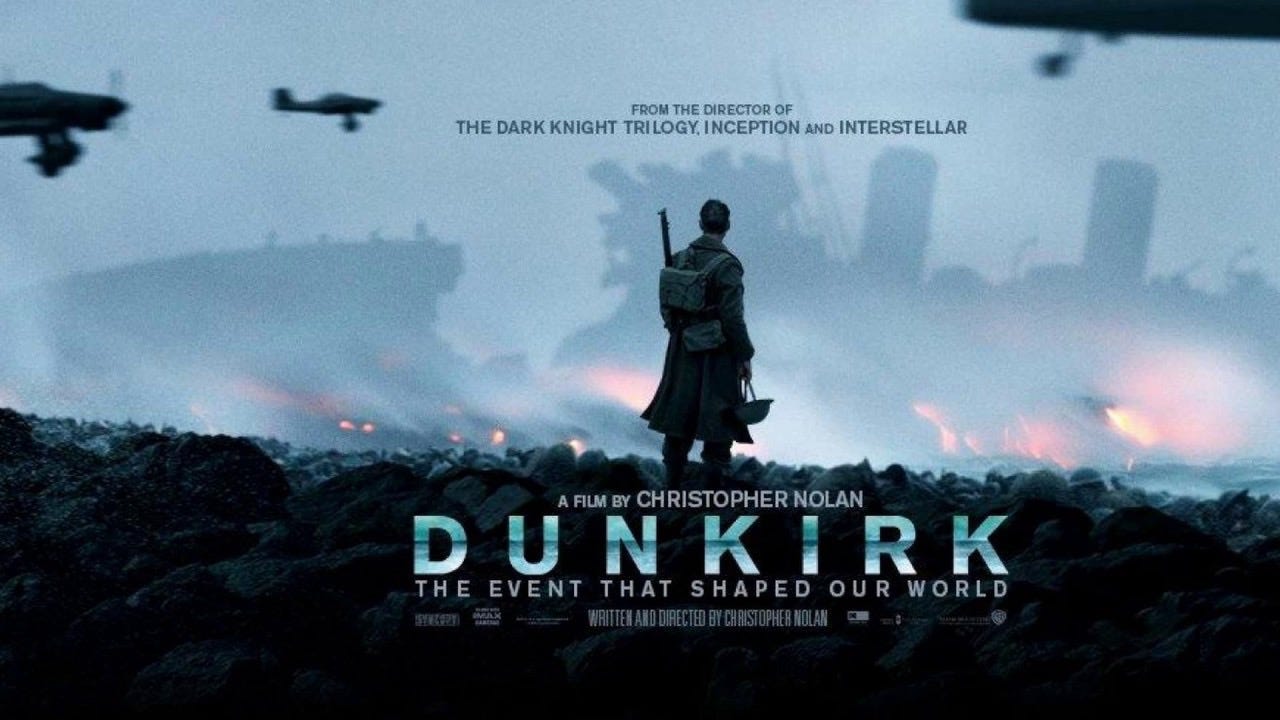
On a recent podcast episode, Amy Welborn and I offered our respective analyses of The Odyssey—the latest film by acclaimed director Christopher Nolan. Our opinions were divided: I mostly liked it; she mostly didn’t. Still, the conversation gave us an opportunity to think about Nolan’s filmography as a whole, and we each named our three favorite films by the auteur. My number one was Dunkirk, which was released in July 2017.
I wrote a review essay on Dunkirk when it first came out, and I have decided to republish it here—a practice that I may repeat on Just FYI, if and when the occasion warrants. While I have only made a handful of revisions to the text, I did elect to add clips from the film itself. For they show (rather than tell) why Dunkirk remains Nolan’s masterpiece—no matter how much money The Odyssey makes!
At just 47 years of age, Christopher Nolan has become an anomaly in Hollywood — a critically acclaimed filmmaker who is also bankable at the box office. Moreover, he has done so with a series of films that, on the surface, bear little resemblance to one another: Memento (2000) is basically low-budget noir; The Dark Knight (2008) belongs to the superhero genre; Inception (2010) plumbs the human unconscious; Interstellar (2014, which I also reviewed) is sci-fi for armchair physicists. There is, then, a protean quality to Nolan’s output, which makes him an enigmatic figure among contemporary directors. Unlike the work of, say, Martin Scorsese, it is hard to define what a “Nolan film” is like. His works tend to experiment as much with Weltanschauungen as with genre and style. Perhaps it is unsurprising, then, that Nolan followed Interstellar, a space opera set in the future, with Dunkirk, a war film set in the past.
Dunkirk is based on the Dunkirk evacuation (codenamed Operation Dynamo) of 1940. Tomes have been written on this event, its impact on World War II, and its role in shaping Britain’s identity, but Nolan condenses this abundant material into a taut, 106-minute film. The decision to prioritize cinematic intensity over historical contextualization has been met with controversy, and it’s fair to say that Dunkirk teaches us next to nothing about the persons behind the event. After all, Tom Hardy’s character is known as “Farrier” (though he is loosely based on the New Zealand pilot Alan Deere), while Cillian Murphy plays a man simply listed as “Shivering Soldier.” What Nolan’s film does capture (or, at least, strives to capture) is the evacuation’s sense of desperation and urgency.
Ever fond of playing with chronology, Nolan divides the film into three plots, each beginning at a different temporal point in relation to the operation’s completion — namely, a week (“The Mole”), a day (“The Sea”), and an hour (“The Air”). The first of these timelines centers on a group of soldiers, stranded on Dunkirk beach, who are trying to board a ship back to England. They are all but defenseless against the bombardment of the Luftwaffe, and they scurry, almost silently, from vessel to vessel in hopes of deliverance.
The second timeline features a civilian, his teenage son, and his son’s friend, who depart on a fishing boat from Weymouth and head towards Dunkirk, hoping to aid in the evacuation. As they cross the English Channel, they pick up a soldier stranded at sea, who is suffering from shell shock — a fateful decision, which puts their mission in jeopardy.
The third timeline centers on a pair of British pilots, who are trying to provide much-needed cover for the evacuation. This is the most sublime sequence in the film. By using genuine Spitfires and mounting cameras on the planes’ wings, Nolan comes as close as possible to recreating an aerial dogfight.
Because the film represents a historical event, the audience already knows how Dunkirk is going to end. Still, the denouement comes as a relief nonetheless. When, at last, Nolan permits us to hear Winston Churchill’s famous “We Shall Fight on the Beaches” address, we have a sense of how it must have been received by the soldiers who survived the evacuation — weary but hardened, traumatized yet grateful.
In many respects, it would seem that this accomplishment alone is significant, and that Dunkirk‘s critical acclaim (including eight Oscar nominations) is merited. I, for one, would agree. Dunkirk is a transfixing experience and, as a technical achievement, bests Nolan’s other tour de force, The Dark Knight. But Dunkirk has its detractors too. As mentioned, much of the criticism has centered on the film’s minimal interest in historical context and character development. This is a problem that at least one commentator views as inherent in Nolan’s “postmodern narrativity”:
By focusing on the visual—elevating image over word—he wants us to feel rather than think, to re-experience rather than remember.” In giving priority to imagery, Nolan gives priority to “simulation,” that is, to overlaying the real event (the Dunkirk evacuation) with a series of sublime images that falsely pretend to repeat them (Dunkirk). That is why there is no God in Dunkirk either. Nolan has set himself up as the quasi-divine author of the world of Dunkirk (if not Dunkirk): “What Nolan does suggest…is that a virtual form of transcendence is available within the world, simply as a heightened experience of the world.”
This is an intriguing argument, which harks back to one of the classic debates in film theory. Is the cinematic medium principally oriented towards recording and disclosing reality (per Siegfried Kracauer), or is cinema an illusion all the way down, giving the appearance of continuous movement when, in truth, it is a series of manipulated photographs projected at a certain speed (per Jean-Louis Baudry)? On the latter view, Nolan’s Dunkirk is surely a master class in illusory technique, cajoling the viewer (for the price of a ticket no less!) into believing that he or she is “right there” in battle, even though nothing could be farther from the truth. On the former view, Nolan’s techniques are persuasive precisely because they indicate and indeed mediate reality, and thus Dunkirk is a means of understanding our world, disclosing, among other things, the elemental human experiences of beauty, fear, love, mortality, and so on.
In the end, I tend towards cinematic realism, and so I am not terribly worried about Dunkirk‘s thin historicity. There is a sense in which Nolan’s approach here resembles that of Terrence Malick, contemporary cinema’s paragon of “realism.” As is well known, Malick was a Heidegger scholar and translator before becoming a filmmaker, and, accordingly, Malick treats art as a site where the “unconcealment” (ἀλήθεια) and “concealment” of entities are manifested, and the presence of “divinities” [die Göttlichen] intimated. Might one say something similar about Nolan’s Dunkirk? Certainly it is a film attuned to things in themselves, to the interplay of earth and sky and mortals. Moreover, as a World War II film, Dunkirk views these elements over against the “enframing” (Gestell) of modern technology: entities are controlled and set aside for use. Air, land, and sea, even the human being as such, are revealed as tools of the technological order. In this sense, the anonymity of the characters discloses their instrumental status.
Still, there are points in Dunkirk where an excess nevertheless breaks through. The sublimity of clouds and sun, the perilous beauty of the ocean, the human being’s primordial urge to live, to be home — all captured brilliantly by Hans Zimmer’s pealing score. In these moments, Dunkirk becomes a conduit for anthropological and theological reflection, perhaps even sacral experience. Here film does not just tell us about these themes; it makes us feel them.
Is this not the genius of cinema itself?
No posts
Comments
Nothing yet. Say the first thing.
Sign in to join the conversation.