
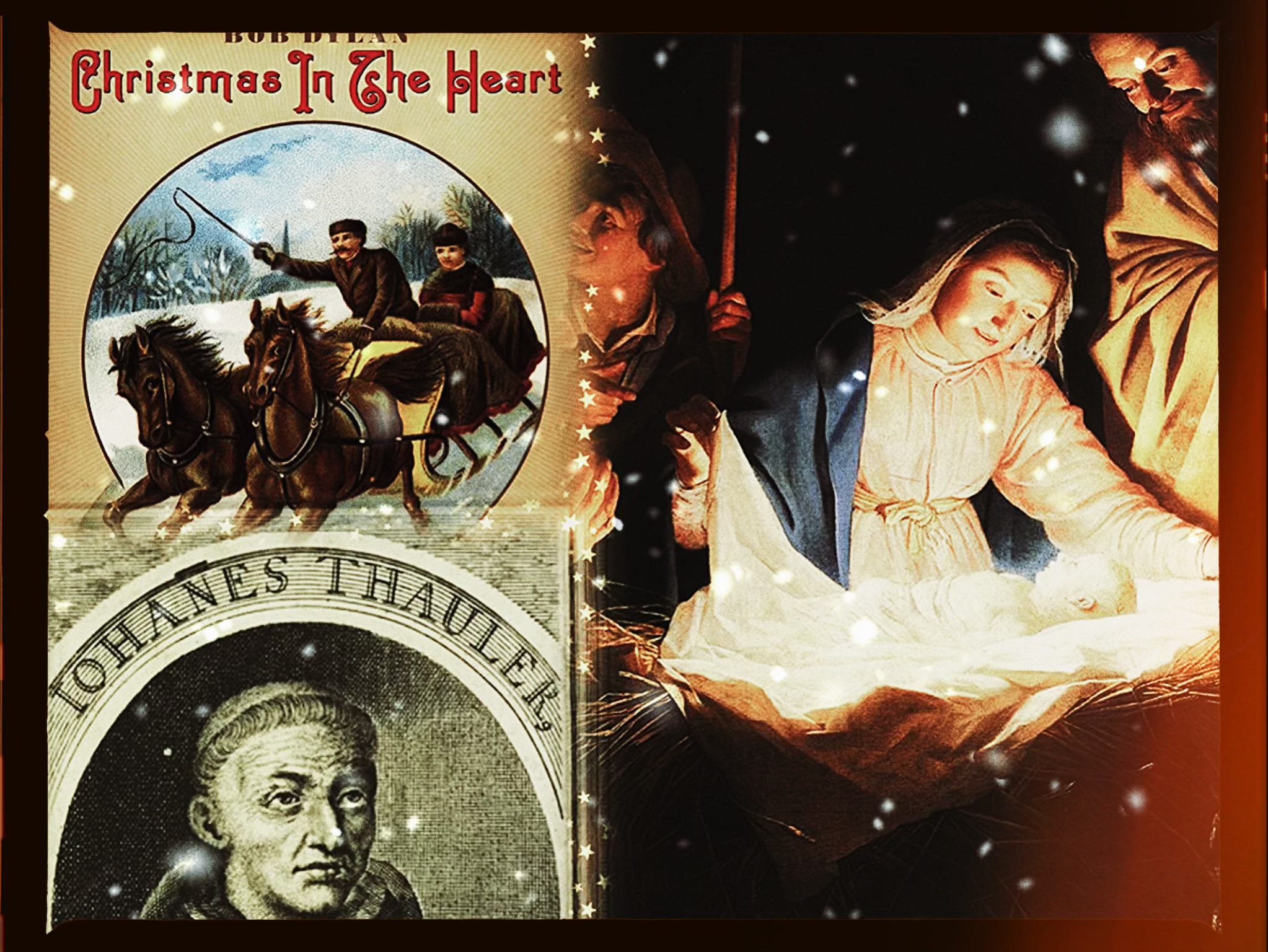
On October 13, 2009, Bob Dylan released his thirty-fourth studio album Christmas in the Heart. For many commentators, it was dead on arrival: “It’s the worst album Bob Dylan has released since 1970’s Self Portrait. It’s a total ear-bleeder. It’s a hoax.” Nor has it aged particularly well. In a February 2024 article, Michael Gallucci named Christmas in the Heart one of Dylan’s twelve worst albums, up there with the aforementioned Self-Portrait (which, in my view, is unfairly maligned) and the synth-heavy, 1985 LP Empire Burlesque (which is not). As Gallucci puts it:
Nobody thinks “Christmas” when Bob Dylan’s name comes up, which makes the motive behind his 34th album all the more puzzling. Including hymns, carols and holiday favorites, Christmas in the Heart is an outlier in a catalog filled with them, from Santa songs “Here Comes Santa Claus” and “Must Be Santa” to the church-approved “O’ Come All Ye Faithful” and “O Little Town of Bethlehem” to “Have Yourself a Merry Little Christmas” and “The Christmas Song,” oft-performed classics that gain no new relevance with Dylan’s shaky versions.
Indeed, as this quote indicates, there are actually two main critiques of Christmas in the Heart. One is that Dylan’s renditions of various Christmas carols, hymns, and popular standards are not up to snuff. This is, I will concede, an arguable point. Even if Dylan’s versions of “Hark! The Herald Angels Sing” (1739) and “O Come, All Ye Faithful” (1751) bear a certain Yuletide charm—perhaps reminding listeners of a grandad or an uncle who, after six mugs of spiked eggnog, grabs the karaoke mic and bursts into song—there’s no denying that they lack the silky elegance of traditional interpretations. Just do a quick comparison of Nat King Cole’s 1960 reading of “O Little Town of Bethlehem” with Dylan’s on Christmas in the Heart:
But the second critique—that Christmas in the Heart is a “puzzling” addition to Dylan’s oeuvre, that it may even be a “hoax”—strikes me as demonstrably false. Of course, a skeptic might note that I’m predisposed to interpreting Dylan through a religious lens, and this is true. Still, it’s not hard to see that Dylan’s interest in the Christmas season in general, and Christmas music in particular, is sincere. For one thing, in December 2006, Dylan hosted a special Christmas/New Year’s special on his excellent SiriusXM show Theme Time Radio Hour:
In many respects, this episode was a trial run for Christmas in the Heart. The former featured Brave Combo’s arrangement of “Must Be Santa”—a Christmas Schnitzelbank, first released in 1960—and Dylan would make his own version of “Must Be Santa” the lead single on Christmas in the Heart. He even released the song with an accompanying music video, which stars Dylan as a wigged troubadour performing at a raucous and ultimately rough-and-tumble holiday bash:
In a fascinating 2023 interview, Los Angeles-based session singer Randy Crenshaw discussed what it was like working on Christmas in the Heart. According to Crenshaw, the well-known jazz drummer Bill Maxwell gave him an unexpected phone call early in 2009 and invited him to attend a May recording session at Groove Masters studio in Santa Monica. In particular, Maxwell wanted Crenshaw and his gospel quartet to sing backup on an upcoming Bob Dylan Christmas album. As Crenshaw recalls, “I think [Maxwell] said when he made the call, Bob’s looking to do a Christmas thing. In our minds, we were dumbfounded. We go, ‘Christmas record? Dylan???’.”
As it turned out, Crenshaw was one of a hodgepodge of artists—including the multi-instrumentalist David Hidalgo of the Mexican American band Los Lobos and the renowned jazz-blues guitarist Phil Upchurch (1941-2025)—that gathered at Groove Masters. The sessions were relaxed but focused. As Crenshaw puts it:
Bob was in the middle [of the musicians], sitting there chain smoking and playing a little Farfisa organ and doing his lead vocals. And then the four of us guys doing backgrounds are at the way far side behind some baffles. Then everybody else is kind of arrayed in their own little kingdoms, where they could watch Bob. They all had sight lines; we could all see him. It was hilarious, ‘cause he would just go [extremely raspy Bob voice]: “All right, follow me.” And he’d jump into it.
Things moved fast, which is not unusual for a Dylan recording. Apparently Dylan did not have a predetermined setlist, so he sat alongside the session musicians listening to classic versions of songs such as “Silver Bells.” and “Here Comes Santa Claus.” After deciding on a track, and (briefly) consulting on arrangements, Dylan and crew would churn out a recording in one or two takes: “One time we did three takes,” Crenshaw remembers, “but that was very unusual. It was because of audio problems. … No, it had to be a disaster to redo it.”
Still, Crenshaw did not ascribe Dylan’s methods to carelessness. If anything, Dylan worked in a familiar, even familial way. “He was very relaxed,” Crenshaw pithily explains. Between takes Dylan talked music with the session musicians, and at one point he had Subway sandwiches brought in for the assembled, including himself. “[He ordered] Subway sandwiches for all. And he didn’t go off like royalty and hide himself. He was sitting in the little lounge with us eating his Subway sandwich.” In retrospect, Crenshaw views Dylan’s informality and, indeed, congeniality as part of his attitude towards Christmas in the Heart in general:
I never got the idea that he was joking on the songs or trying to mock them or be ironic. Not at all. He was real straight ahead. “Oh, these are beautiful songs. A lot of people sing them around this time of year.” And, I gotta say, his giving the proceeds from the project to charity, I thought was the coolest. Because a lot of people do these things, and they try and get rich off of them. So I take my hat off to him. He did it for the right reasons.
In a November 2009 interview, Dylan himself elaborates both on Christmas in the Heart and on Christmas music in general. Early in the conversation, Dylan claims that Christmas songs have been a part of his life as long as he can remember. The iconic beauty of the season—”Christmas carolers going from house to house, sleighs in the streets, town bells ringing”—hearkens back to his childhood in Minnesota. Indeed, when asked why Christmas in the Heart features “traditional arrangements” of various holiday classics, Dylan’s answer is simple: “There wasn’t any other way to play it. These songs are part of my life, just like folk songs. You have to play them straight.” Later, in responding to a remark that Christmas in the Heart seems to be the work of a “true believer,” Dylan’s answer was as pithy as it was forthright: “Well, I am a true believer.”
With this in mind, the title Christmas in the Heart comes to the fore. Dylan could have mimicked Frank Sinatra or Elvis Presley and called his Christmas LP something else—perhaps Merry Christmas from Bob Dylan or Bob Dylan’s Christmas Album. But he chose Christmas in the Heart. Why might this be significant? The obvious answer, to which Dylan himself attests, is that Christmas in the Heart is an album tendered with profound sincerity. Just as the Christmas season is in Dylan’s heart, so is this album from Dylan’s heart. It is not a commercial product but a kind of cri de coeur.
Yet, if we zoom out and take a wider perspective on Dylan’s use of “heart language,” another layer of meaning presents itself—one that is bound up with the Christian spiritual tradition. In his well-known Christmas Day sermon, most likely preached at the Dominican convent (today the site of the Lutheran Temple Neuf) in Strasbourg during the 1340s, the Dominican priest and mystic Johannes Tauler (ca. 1300-61) begins by noting that Christmas does not just commemorate the birth of Jesus Christ but “a threefold birth” which all Christians should receive “with joyful love and jubilation.” As Tauler sums it up:
The first birth, and the most sublime, is that in which the Heavenly Father begets His only Son within the divine Essence, yet distinct in Person. The second birth we commemorate is that of maternal fruitfulness brought about in virginal chastity and true purity. The third birth is effected when God is born within a just soul every day and every hour truly and spiritually, by grace and out of love.
The first two births, then, are essentially beyond the power of a creature. The former involves the so-called “Trinitarian Perichoresis,” or the reciprocal penetration and indwelling of Father, Son, and Holy Ghost in one another. This is a way of conceptualizing Christ’s own words:
“I and my Father are one” (John 10:30).
“If I do not the works of my Father, believe me not. But if I do, though ye believe not me, believe the works: that ye may know, and believe, that the Father is in me, and I in him” (John 10:38).
The second birth concerns the belief that the Son of God—the Divine Person of the Logos—assumed an actual human nature into the unity and dominion of God the Word (Θεὸς ὁ Λόγος). This supernatural and unmerited unity of divinity and humanity is precisely why the Christmas season is often thought of as a time of joy and wonder. The Hypostatic Union is a mysterium stricte dictum or, in the words of the Apostle “the mystery, which from the beginning of the world hath been hid in God” (Ephesians 3:9). It can only be revealed, never proven.
At the same time, however, Tauler insists that the “third birth” of Christmas is patterned after the previous two. “We…must completely turn inward in order to go out again,” he says. This is because the soul’s faculties—memory, understanding, and free will—bear “the true image of the Blessed Trinity.” In each of these capacities, the human being stands “between time and eternity,” though his “sensible and animal powers” often act as a gravitational force, drawing the person “toward time and temporal things” and “away from eternity.”
If this tendency is to be reversed, one has to practice the discipline of “detachment” (Gelassenheit). For Tauler, this is a matter of mystical preparation, rendering one “empty, passive, and free” in anticipation of union with the divine nature: “If [the ear] already perceived a sound, it cannot hear another,” he explains by way of metaphor. Indeed, the spiritual receptivity advocated by Tauler and his Dominican predecessor Meister Eckhart (ca. 1260-1328) is realized in and through the cultivation of interior silence. As Tauler writes:
You should observe silence! … For surely, if you choose to speak, God must fall silent. There is no better way of serving the Word than by silence and by listening. If you go out of yourself, you may be certain that God will enter and fill you wholly: the greater the void, the greater the divine influx.
This insight is crucial if one is to experience the third birth imaged by the events of the Christmas season—namely, the birth of God in one’s inner being. Here, drawing on Saint Augustine, Tauler instructs his listeners to view Mary as a spiritual archetype. That she was chosen by God to give birth to the Logos in the flesh stems from her “qualities [as] a spiritual mother.” Her status as a virgin mirrored her inward state, which did not seek compensation from “exterior things.” Yes, she was destined to “bring forth great and rich fruit,” but this fruit is none other than “God Himself, His Son and Word, He Who embraces and contains all that is.” In short, as Tauler puts it, “Mary’s heart was fixed solely on the divine.”
For Tauler, then, to celebrate Christmas in truth is to celebrate it in the heart. “If God is to be truly born in us,” he concludes, “we must imitate [Mary] in this [way].” And yet, with this in mind, one also can’t help but wonder: is this why Dylan entitled his holiday album Christmas in the Heart? Is Dylan somehow channeling Tauler’s spiritual guidance?
On the surface, it is tempting to chuckle at such a suggestion. Dylan and die deutsche Mystik?! Still, there is undoubtedly a mystical strain in Dylan’s songwriting—one that evokes his Jewish upbringing along with his much-debated 1978 conversion to Christianity. From his 1962 cover of the traditional gospel song “In My Time of Dying” to his own 1981 classic “Every Grain of Sand,” Dylan’s music consistently meditates on the nature and presence of God. Consider the song “Father of Night,” the final track on Dylan’s (underrated) 1970 album New Morning:
Father of grain, Father of wheat
Father of cold and Father of heat
Father of air and Father of trees
Who dwells in our hearts and our memories
Father of minutes, Father of days
Father of whom we most solemnly praise
More recently, in a 2022 interview, Dylan expressly discusses his personal interest in religion and spirituality:
I never watch anything foul smelling or evil. Nothing disgusting; nothing dog ass. I’m a religious person. I read the scriptures a lot, meditate and pray, light candles in church. I believe in damnation and salvation, as well as predestination. The Five Books of Moses, Pauline Epistles, Invocation of the Saints, all of it.
These quotations certainly don’t demonstrate that Christmas in the Heart is an homage to Tauler. But they do help explain why the title was not randomly chosen. As “a religious person,” Dylan understood (and understands) that Christmas is only Christmas when it is, quite literally, heartfelt. It is not a formality on one’s iCalendar but a state of mind, an interior disposition, a way of being-in-the-word. Consider the lines that conclude Christmas in the Heart, aptly taken from Phillips Brooks’ 1868 hymn “O Little Town of Bethlehem”:
How silently, how silently
The wondrous gift is giv'n;
So God imparts to human hearts
The blessing of His heaven;
No ear may hear His coming,
But in this world of sin,
Where meek souls will receive Him still
The dear Christ enters in.
Tauler could not have said it better, and Dylan, quite fittingly, punctuates the lines (and his album) with a protracted “Aaaaaaaaaaaa-meeen.” Thus Christmas in the Heart ends with an affirmative declaration that simply signifies: “It is true” or “So be it.” For faith is only faith “in the heart.” It is only faith when it is received without external force and intrusion (“silently, how silently”), in a sincere confession of assent—indeed, in a “yes” to “every good and every perfect gift” from “the Father of lights” (James 1:17), the One who “dwells in our hearts and our memories.”
Merry Christmas to all Just FYI readers, old and new!
No posts
Comments
Nothing yet. Say the first thing.
Sign in to join the conversation.