
Any digital search about “Denmark and Easter” will turn up a number of articles about the nation’s folk traditions. Unsuprisingly, many of these cultural practices are formally present in other countries, though the content tends to vary. For example, while a typical Easter lunch in England will consist of roasted leg of lamb (paradoxically enough!) along with potatoes and vegetables, the Danish Påskefrokost centers on open-faced rye sandwiches called Smørrebrød, which are topped with boiled eggs, pickled herring, fresh cress, and various cheeses.
Other Danish traditions, however, are more unique. For well over a century, Danes have celebrated Easter (Påske) by sending decorative notes called Gækkebreve. The word itself can be clumsily (but not inaptly) translated as “tricky letters.” The person who sends such letters includes a riddle designed to tease, but also fool, the recipient. The recipient must guess the name of the sender. If they fail on the first guess, they owe the sender a prize. If the guess is successful, the sender is responsible for the gift. In the eighteenth century, this practice was largely associated with courtship, but, in time, it emerged as an Easter tradition, with children bestowing chocolate Easter eggs as the prize in question. This connection is not incidental. In both cases, Gækkebreve are linked with lightheaded fun and, on a deeper level, communal celebration. Just as eggs (even chocolate ones!) symbolize fertility and new life, so, it seems, they are fitting icons for the Christian celebration of the resurrection of Jesus.
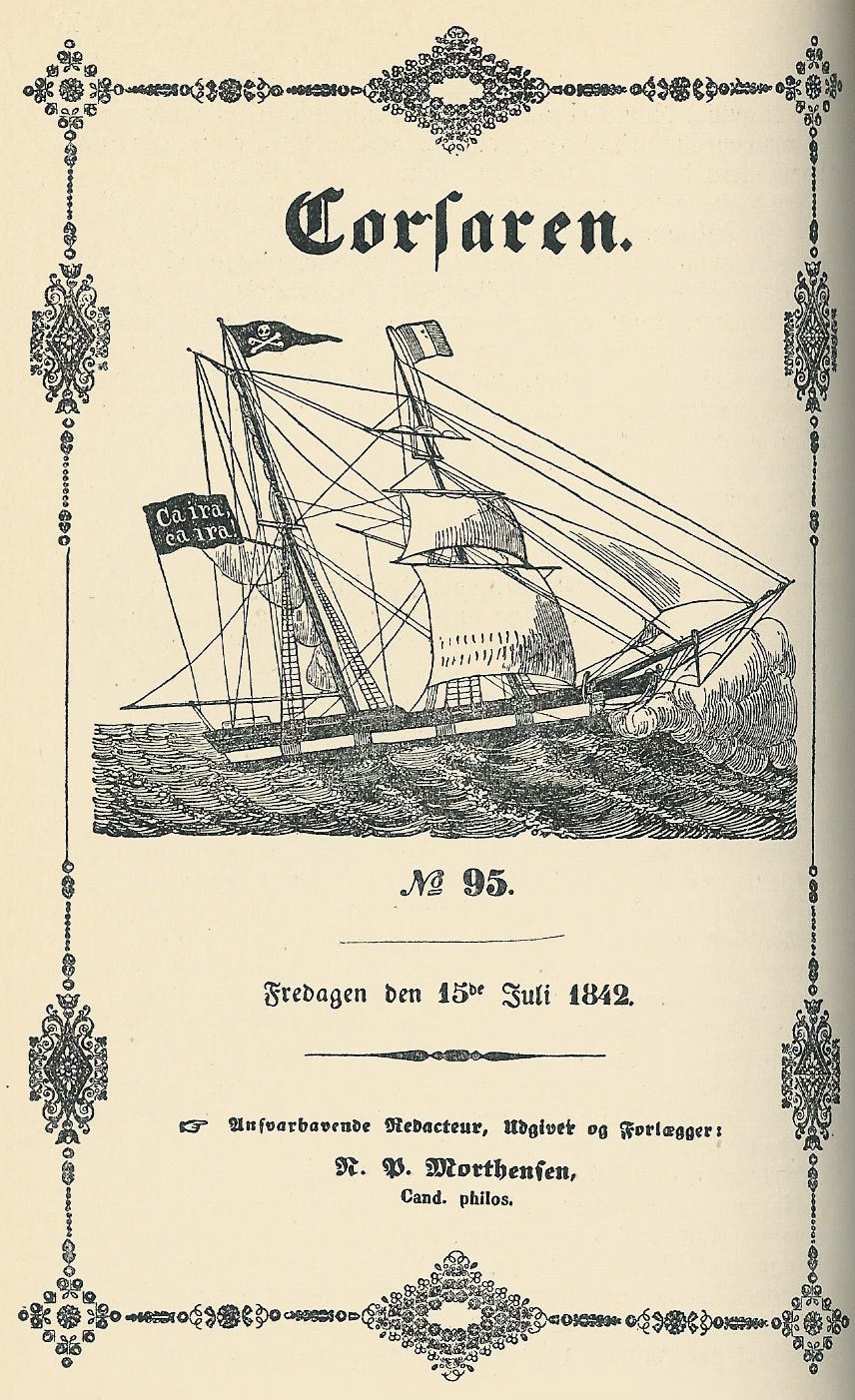
Such an understanding of Easter wouldn’t have surprised Kierkegaard. It is well known that significant portions of the Dane’s authorship—particularly in the wake of his public clash with the satirical magazine Corsaren in the mid-1840s—are dedicated to lampooning and ultimately attacking the blithe conformism of the Danish church.
He viewed Easter in related terms. To celebrate the Paschal mystery with chocolate eggs and “tricky letters” is to miss the existential weight of the solemnity. It is, for Kierkegaard, a holiday “about the incomprehensibility of faith” (NB 13:54). Indeed, in an 1852 journal passage, Kierkegaard outlines a sermon for the second day of Easter, drawing on Luke 24:24: “And certain of them which were with us went to the sepulchre, and found it even so as the women had said: but him they saw not.” The theme of not seeing Jesus, he points out, is crucial to the post-Resurrection narratives. When Jesus conversed with a pair of disciples as they walked to a town (probably located in today’s West Bank) called Emmaus, the disciples failed to recognize their Master until they shared a meal together, at which point “he vanished out of their sight” (Luke 24:31). Yes, they could literally interact with Jesus, but, as Kierkegaard puts it, “him they did not see” (NB25:94).
Of course, this raises an additional question: why is it so hard to see the resurrected Christ? What is it, in other words, that obscures our view? Perhaps it’s the aesthetic delights of the holiday, which are symptomatic of a decidedly secular perspective. For example, on the VisitDenmark website, Easter is associated with “happy times” and explicitly distanced from supernatural meaning:
Påske, as we call it, brings not only great food and festivities, but weird and wonderful traditions too. Less of a religious holiday these days, it’s more focused on welcoming spring, celebrating with family or friends and injecting some colour into our usually toned-down homes.
Still, isn’t the problem deeper than “tricky letters” and Easter schnapps? After all, the disciples didn’t celebrate Påskefrokost, and they too struggled to recognize the risen Savior. Despite his bemused and ultimately polemical stance towards secular-minded jocularity, Kierkegaard underlines precisely this point. As he sees it, what unites those who cannot discern the Paschal mystery is a failure to transcend historical categories. When Jesus confronts Cleopas on the road to Emmaus, the latter adopts the tone of a social-media watchdog: “Art thou only a stranger in Jerusalem, and hast not known the things which are come to pass there in these days?” (Luke 24:18). Cleopas then goes on to more or less describe an abuse of political power, in which a social and spiritual leader was unjustly executed by local authorities, thereby dashing his followers’ hopes for a “redeemed Israel” (Luke 23:21). Sure, he goes on, a few people (“certain women also of our company”) have reported that this leader’s body was no longer in the tomb, but Cleopas shrugs it off as so much gossip. For when additional partisans went to check for themselves, “him they saw not” (αὐτὸν δὲ οὐκ εἶδον).
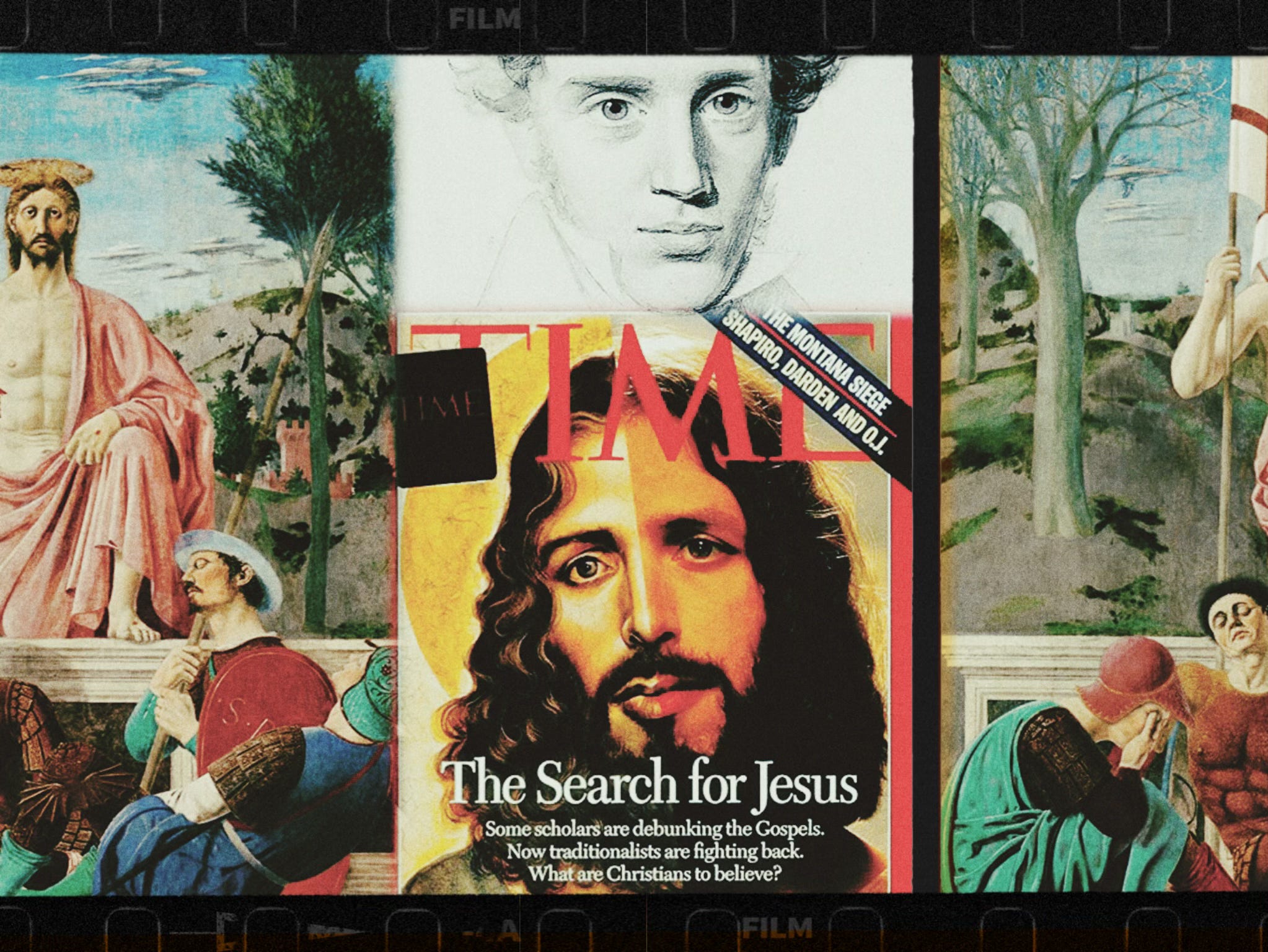
Famously, it is at this point that Jesus scolds Cleopas and others whose perspectives have failed to account for God’s transcendent activity in the world: “O fools, and slow of heart to believe all that the prophets have spoken” (Luke 24:25). In an 1852 journal passage, Kierkegaard applies Jesus’ insight to the prevailing historicism of modern thinking, particularly vis-à-vis the historical-critical method of biblical scholarship and the person of Jesus Christ:
It was just the same with the disciples who walked to Emmaus while Christ walked along with them—but him they did not see. So also with us. Here a little skirmish about historical knowledge, which also comes and looks and finds it exactly as related—but him it does not see. (NB25:94)
Notably, in his 1844 “trial sermon” (Dimisprædiken) for ordination in the Church of Denmark, based on 1 Corinthians 2:6-9,1 Kierkegaard already links the Emmaus story to sight—in particular, to the tension between “the earthly eye” (det jordiske Øie) and “the eye of faith” (Troens Øie). As Kierkegaard explains:
The glory of which we speak was not pleasant to the earthly eye, since it was an offense to the Jews and foolishness to the Greeks. Consequently the eye that saw it was not the earthly eye but the eye of faith, which looked trustingly through the terror in order to see what the earthly eye did not discover, what the seer was unaware of, what there was to see, just as the disciples did not see it when they walked to Emmaus, and Mary Magdalen did not see it when she stood by the grave—in order to see what would trouble earthly eyes if the seer knew what he should see. (Papir 306)
Kierkegaard did not idly take up this position. In fact, he came of age in the midst of a number of spirited debates about how to read and interpret the Bible. To cite just one example, he studied under the theologian, biblical hermeneut, and liberal politician Henrik Nicolai Clausen (1793-1877). As a “rationalist,” who thereby insisted that reason (rather than, say, faith or sensory experience) is the best adjudicator of human knowledge, Clausen pressed a critical (if not entirely unsympathetic) reading of traditional church teaching. Kierkegaard knew Clausen’s work well, attending his lectures on the synoptic Gospels in 1832-33 and, later on, taking his courses on New Testament hermeneutics and the Acts of Apostles. It is notable, then, that Kierkegaard would soon grow tired of Clausen’s approach to the material. In an 1835 journal entry, Kierkegaard even wondered if “the enormous mass of interpreters has on the whole done more harm than good to the understanding of the New Testament.”
As has been seen, this comment was proleptic. Kierkegaard was already anticipating an objection to the historical-critical method—one that he would further develop in the latter half of his authorship. Perhaps the most programmatic example of this concern is found in the discourse “What Is Required in Order to Look at Oneself with True Blessing in the Mirror of the Word?”, which opens the last proper book that Kierkegaard would publish in his lifetime, For Self-Examination: Recommended to the Present Age (Til Selvprøvelse: Samtiden Anbefalet, 1851). The “Mirror of the Word” was first conceived as a sermon, though, in its present form, it would’ve been far too long for the pulpit. Still, its homiletic origins are noteworthy, since Kierkegaard based his reflections on James 1:22-27, which was the scheduled epistle reading for the fifth Sunday after Easter.
That Kierkegaard would link questions about biblical historicity and interpretation with the Easter season is hardly surprising. First, as has been seen, this was a connection he would make elsewhere in his authorship—an extension, no doubt, of the fact that the Paschal celebration of Jesus’ resurrection from the dead forces biblical hermeneutics to the surface. Indeed, just a few decades before Kierkegaard’s birth, the German litterateur Gotthold Lessing (1729-81) issued parts of Hermann Reimarus’ previously unpublished treatise Apology, or Defense, for the Rational Worshippers of God (Apologie oder Schutzschrift für die vernünftigen Verehrer Gottes). Reimarus, who had died in 1768, drew a sharp distinction between the “Christ of history” and the “Christ of faith.” As he saw it, the former was a political revolutionary, the latter an unnecessary fiction, conjured up by his disciples for their own gain. Reimarus’ position, as it happens, is neatly dramatized in Martin Scorsese’s 1988 film The Last Temptation of Christ, in which a smarmy Paul of Tarsus (Harry Dean Stanton) has an unexpected encounter with Jesus (Willem Defoe). When Jesus balks at Paul’s tales of healings and miracles (“He conquered death!”), Paul reminds him that it’s the “resurrected Jesus,” and not the historical Jesus, who gives human beings what they need:
Since Reimarus, the so-called “Quest for the Historical Jesus” has undergone a number of “waves”. Lessing’s own notion of “the ugly broad ditch” (der garstige breite Graben) separating Christian revelation from historical truth was prominent enough to draw a notable response from Kierkegaard in the pseudonymous Concluding Unscientific Postscript to Philosophical Fragments (1846). What really intensified the Quest, however, was the publication of David Friedrich Strauß’ The Life of Jesus, Critically Examined (Das Leben Jesu kritisch bearbeitet, 1835-36), which, not incidentally, Kierkegaard makes a note of reading during the summer of 1838. Decades later, Albert Schweitzer (1875-1965) would reinvent the field with his 1906 treatise From Reimarus to Wrede: A History of the Research into the Life of Jesus (Von Reimarus zu Wrede: eine Geschichte der Leben-Jesu-Forschung). And, of course, the Quest is still raging today. Just a few weeks ago, New York Times columnist (and avowed Catholic) Ross Douthat issued a lengthy, Easter-themed interview with well-known New Testament scholar-turned-atheist Bart Ehrman, who has updated Reimarus’ core argument in works such as How Jesus Became God: The Exaltation of a Jewish Preacher from Galilee (2014).
It is plain, then, that the historicization of Easter was a major topic in Kierkegaard’s day, and it remains so in 2026. Yet, in contrast to Douthat’s searching curiosity, Kierkegaard chooses to approach this problem in characteristically provocative fashion. Rather than “outhistoricize” the historical-critical method, he probes the existential implications of adopting such a mindset.
Consider, for example, “There Will Be the Resurrection of the Dead, of the Righteous—and of the Unrighteous” (De Dødes Opstandelse forestaaer, de Retfærdiges—og de Uretfærdiges), the fourth discourse in “Thoughts That Wound from Behind—for Upbuilding,” a seven-part collection included in Kierkegaard’s 1848 book Christian Discourses (Christelige Taler). Kierkegaard begins by drawing a correlation between modern bourgeois society and modern intellectual proclivities: people want and expect security. Just as the denizens of Copenhagen “calmly walk home even late at night without fearing any danger,” so do people desire assurance and safety when it comes to what they buy, sell, or vow.
But can the promises of Easter be approached in the same way? The Apostles’ Creed professes that Jesus “was crucified, died, and was buried” and yet “rose again from the dead,” thereby achieving “the resurrection of the body” and “life everlasting” for those who believe in him. It is, then, a feast bound up with “immortality” (Udødeligheden). But, Kierkegaard underlines, Scripture does not treat immortality as if it were an object for academic analysis, much less a podcast discussion! Kierkegaard cites Acts 24 to make this point. In this chapter, Paul the Apostle appears at a hearing before the Roman procurator of Judea, Antonius Felix. Accused by the Sanhedrin of being a seditious, “pestilent fellow,” who has “gone about to profane the temple” (Acts 24:5-6), Paul responds that he believes “all things which are written in the law and in the prophets,” including the common (if not uncontroversial) belief in bodily resurrection and personal immortality. “[I] have hope toward God,” Paul declares, “which they themselves also allow, that there shall be a resurrection of the dead, both of the just and unjust” (Acts 24:15).
According to Kierkegaard, Paul’s association of the resurrection of the dead with a question about individual righteousness is “unscholarly and uncultured.” That is precisely why it’s crucial. Paul is not interested in a debate about, or a test of, the Paschal mystery. “Do not doubt whether you are immortal,” Kierkegaard imagines Paul saying, “tremble, because you are immortal.” This may seem like a version of fideism, but, in Kierkegaard’s view, it is a precondition for taking the question seriously at all: “Truly, the one who never had his immortality decided in such a way that he became anxious and afraid has never really believed in his immortality.”
Of course, as Kierkegaard points out, this sort of personal investment is jettisoned whenever the Easter story is cast into a speculative, historical-critical register—whenever the quest for immortality is “turned into a question for thought.” One may dismiss this shift as a necessity in the context of contemporary Western culture—after all, people do enjoy debating issues on Facebook, podcasts, Twitter, and so on—but Kierkegaard detects a deft yet problematic maneuver at play:
Would not the most corrupt of all ages be one that managed to have “duty” completely changed into a problem for thought? What is duty? Duty is what one ought to do. There ought not to be a question about duty, but there ought to be only the question about whether I am doing my duty. There ought not to be a question about immortality…but the question ought to be whether I am living in such a way as my immortality requires of me.
Underlying Kierkegaard’s point is the tension between modern reflection and biblical proclamation or, as he puts it elsewhere, the difference between a genius and an apostle. Indeed, in Acts 24, what is precisely not at stake is the scholarly question about Jesus’ resurrection from the dead. Instead, Paul takes this kerygmatic assertion as a jumping-off point to discuss what he’s really interested in—namely, the eschatological revelation of righteousness and unrighteousness. On this understanding, eternal life is not a “controversial subject,” nor is it an occasion for holiday games and sweets. It is the falling away of all early differences—those obtaining between genders, educational backgrounds, socio-economic statuses, religions, nationalities, linguistic forms, political ideologies, even sports allegiances—except for a final one: “What, then, is the eternal? It is the difference between right and wrong. All else is transitory.”
For Kierkegaard, this realization not only changes how we look at the Easter story; it also changes how we relate to other people. If eternal life is real—and the apostles do not doubt that it is—then ipso facto it’s not permeated by the ambiguity of human life. It cannot be bought off, shrugged off, or thrown off. It simply is. No individual can escape the resurrection of the dead, and thus it becomes an intensely personal and passionate concern: Eternal life “pertains to me, in my view it pertains to me most of all, just as in your view it pertains to you most of all.”2
In and through this mindset, one comes to relate to Easter in the right way. The resurrection of the dead and eternal life are tasks to be pursued, not treats to be consumed or concepts to be parsed. The one primarily invested in the latter is, as Kierkegaard envisions it, akin to a wife who has come to take her husband for granted. She is certain of his affection, certain of her standing in society, certain that she is superior to other wives—and it’s this certainty that secures her downfall. “She is not trying to find anything; she…is now pleased with herself; she is completely sure.”
So it is with one who takes Easter for granted. As soon as the Paschal feast becomes a cultural event or a topic for speculative chatter, it is lost. “The true, the essential expression of [something] being by grace is the very fear and trembling of unsureness. There lies faith—as far, just as far, from despair as from sureness.”
Howbeit we speak wisdom among them that are perfect: yet not the wisdom of this world, nor of the princes of this world, that come to nought:
But we speak the wisdom of God in a mystery, even the hidden wisdom, which God ordained before the world unto our glory:
Which none of the princes of this world knew: for had they known it, they would not have crucified the Lord of glory.
But as it is written, Eye hath not seen, nor ear heard, neither have entered into the heart of man, the things which God hath prepared for them that love him.
This is Kierkegaard’s emphasis.
No posts
Comments
Nothing yet. Say the first thing.
Sign in to join the conversation.