
I read a couple of nonfiction books recently (see the post about Blood In The Machine), which of course meant I needed to immediately retreat into some genre. Sci-fi is my usual jam, and frankly, I am willing to kind of read whatever within the genre because I find the use of tropes and references interesting, even if the book is bad. This is what I reach for when I want to read something, but don’t want to spend too much brain power on it.
A friend of mine categorizes a certain type of book as a “chuggable”. Like the cocktail (or beer?) variety in question, this sort of book needs to meet a couple criteria:
Good enough- somewhere between good and okay, nothing that would immediately put you off, but also not so good that you need to spend extra time on it.
A decently fast read, maybe a few days. Not a project read.
Ideally, part of a series, such that you can get another without worrying about it
Engaging, not surprising, fun, but not a shock in any way
This is a book you might grab for an hour after a long work day, with no concern that you’ll miss important details. You shouldn’t need to remember all that much from a previous book in the series, maybe a few key plot points. These books should resolve about how you expect, with every main character either fine or dying gloriously, any big crises resolved, maybe a wedding or a funeral. Notable examples include the Honor Harrington series, most things by Seanan McGuire, the Laundry Files, and the Strange Practice series. If you can read 5 of it in a month, it’s a chuggable.
I’ve started developing another mental category of book in direct comparison to the chuggable- the “shot”. This is a very short book, ideally experimental or otherwise odd, that you can inhale over the course of an evening and spend several days considering. Something you feel the need to immediately reread, and can’t find an easy equivalent to. Ideal reactions include “what the FUCK what that” and “I…liked that? maybe???”
Here are a couple recent “shots” that I have read. If the book description when you google it appeals, go ahead. If not, don’t. Also, shoutout to my local library, I was able to borrow the first two of these—
Walking Practice by Dolki Min (translated)
The Employees by Olga Ravn
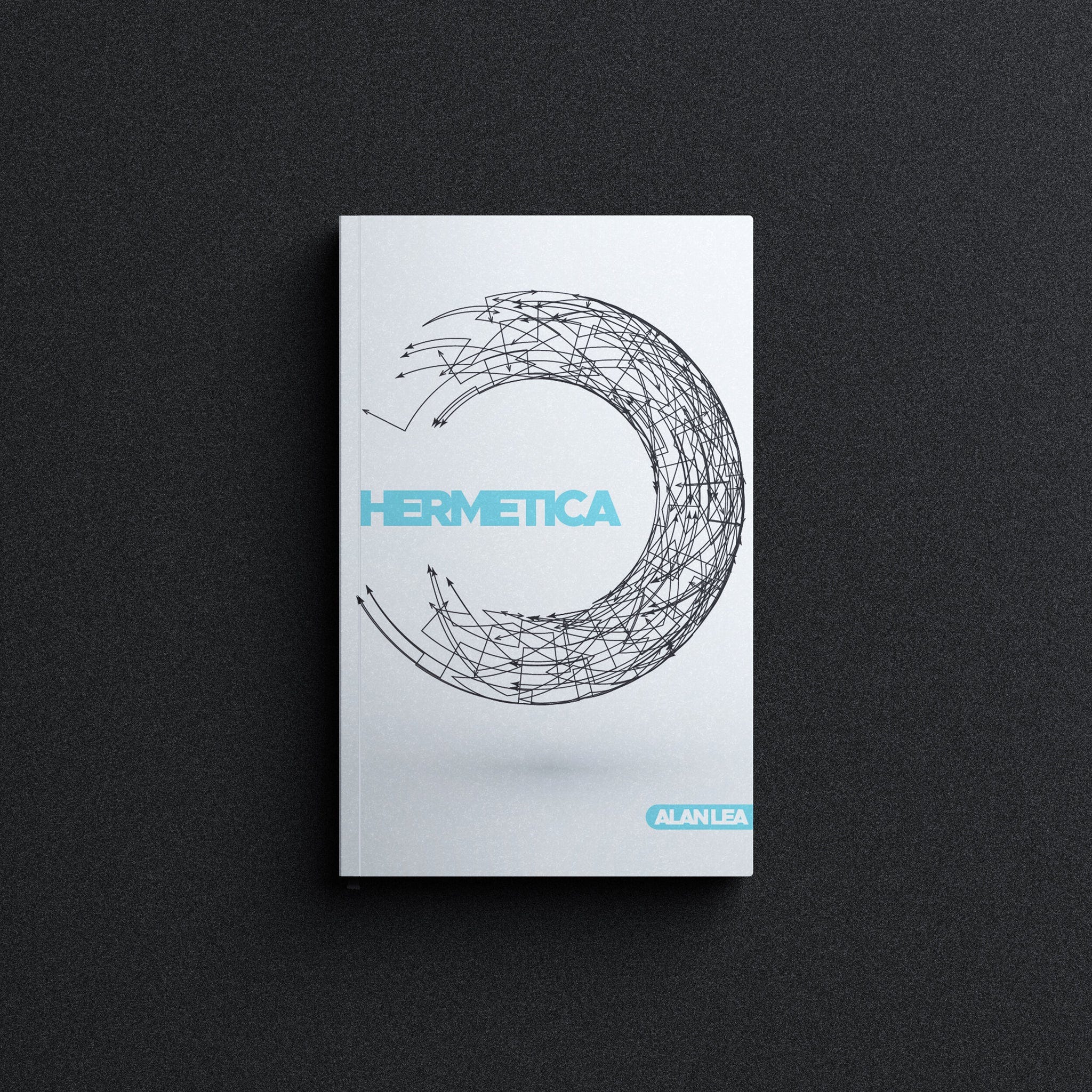
Hermetica by Alan Lea
The first two are SO baffling that I am not going to attempt to describe or respond to them here, maybe later. The third is at least in the realm of things I can generate immediate comment on.
Hermetica is nominally in a genre favorite of mine, the generation ship book. I love a long haul spaceship story, and I love a reason for people to be in forced proximity and stressful situations. What is the human condition if not navigating stressful things with groups of people you didn’t get to pick and can’t escape? This was recommended to me by an IRL friend who I hope is not reading this but if you are, hello, I liked it, we have already discussed this.
[from here, spoilers abound for Hermetica. It is 8 dollars and fairly short, if you want to read it go do that, there’s an ebook version]
.
.
.
.
.
Okay neat. Anyways, Hermetica is not actually a generation ship book. It’s a book about the trope of generation ships being used to confine a bunch of people on earth and prompt them to make advances in science. It’s also a pandemic novel- the idea of an airborne disease and reduced human contact play a huge role in how the fake-ship of the book functions. It is fundamentally a book about the human affinity for stories and struggle and how you might use this to control people. It’s published by a small avowedly anarchist publisher, and you can see this ideological bent throughout. The best parts of the book are the protagonist using scientific practices which they were brought up with to unravel their reality. Maybe this is nerd shit, but it was utterly delightful to watch the characters go “hang on, we CAN check if we’re in a rotating ship, with a fairly simple experiment”. If you’re going to do a book where the setting as presented is basically false, this is the kind of ingenuity I want from your characters.
The worst are the bits where the protagonist (or a exposition character) faces the camera reader and explains their politics, or how the world of the book functions. Given a little more space to breathe, I think the author could have handled the exposition gracefully. In a worse book, this exposition would have been boring. Here, it isn’t even boring! It’s cool as hell! It’s just something I wish I would have been able to discover via clues like I did the main setting’s entire deal. The concept is that the government figured it would be easier to slice the population up into chunks and give each the narrative that fit their biases, rather than trying to govern under a shared reality. There’s a group that thinks they’re succeeding from the US (or, presumably the US) and fighting some kind of border war, there’s the generation ship folks who think they’re in space, there’s another group that thinks they’re in Mad Max. The exact purposes of these groups are lightly defined- the secessionist folks do farming (but like, also capitalism), the gen. ship folks do science, everyone else does…..stuff. I would read a vignette from each of these (except perhaps the secessionist folks, I got quite enough of that with the character from that culture that we briefly meet). The Ship people feel much better thought out, with lots of attention paid to education systems and jobs and living arrangements. There’s a lovely balance between extreme detail and lightly sketched concepts that lets you fill in the rest.
As far as I can tell, this is the only work by this author. This is, imo, a shame. There’s a lot in here that speaks to an interesting authorial voice, and novel ideas. As with many first-or-only novels, it could probably benefit from an editor, but so could my blog posts, so I can’t judge. The biggest thing I can say for this book is that it is a “the premise of this was fake” book that didn’t feel like a cop-out. I loathe fiction that tries to meta-lie to the reader (“it was all a dream!”, shut up, you’re a book of fiction, don’t give me this) because it usually feels unfair or deceptive. Hermetica doesn’t feel like that. It feels more like a good detective story, letting you discover things along with the protagonist.
If you too need a short little weird book, consider this one. If you know of short little weird books, I am interested (admittedly, far more interested if I can get them from the library).
No posts
Comments
Nothing yet. Say the first thing.
Sign in to join the conversation.