
On Monday Xbox’s rather new CEO, Asha Sharma, decided that they needed a “reset” which meant laying off a bunch of people, getting rid of a few studios by either selling them or letting them go independent, and “exploring the future of Arkane Lyon with the French government because that’s the law over there before a closure or other massive change in a company”. This has lead to renowned studios like iD software basically cutting their workforce in half to the point where them making their own games again seems rather unlikely, possibly dooming them into being a support studio. These are not popular decisions in the workforce, Xbox was already facing a hell of a precarious position with confusing decision after confusing decision under Phil Spencer, now Asha is cleaning up a mess at the exact moment when a mess is most needed to be cleaned up and cleaning up messes are hard and risky.
All of this leads me to worry. Not just because of the loss of jobs but because I’m suspicious that Microsoft putting Asha in charge is them engaging in a sadly common occurrence of putting any kind of minority in charge of the company during times of risk for the company and when decisions are gonna be made that are incredibly unpopular among employees thus possibly leading towards the minority taking the blame and, eventually, resigning because of the unpopularity of their decisions. This is called a Glass Cliff.
Today I want to cover how these decisions could lead to an actual resurgence of Xbox gaming where they’re not focused on Gamepass as the end all be all of their business, or it could lead to closures of studio after studio and a far larger shrinking of Xbox as a whole. But, first I want to go into more detail of what a Glass Cliff is and what other companies have engaged in them before. Finally, I’m gonna end with my hope for the future for the industry and what I think the workforce needs to do to fight back against the c-suites insistence on cost cutting coming down not on their heads but on the common employees heads. Let’s dive in.
Let’s start with some examples. Back in 2021, Liz Truss became PM of the UK. It was a hell of a time for the country still dealing with the Brexit clusterfuck, COVID shit, the economy falling apart, and the former PM (Boris Johnson) facing a massive scandal about how he handled COVID as well as his own disregard for his own COVID restrictions. As such Liz Truss was put in charge and was not someone that people expected to succeed as, since 2016, they had been through 3 PMs. So she was coming off of a hell of a run (they are now actually preparing for the 7th in 10 years). She also was not at all charismatic and people just genuinely disliked her. She did a horrible job, both because her policies just couldn’t fix what the economy was going through largely since those policies were partially the cause of it and that the impacts of COVID around the worlds economy was just getting worse.
So, after 50 days, she resigned. She is a great example of the Glass Cliff because she was put in an impossible situation where she just couldn’t succeed (course I completely disagreed with her politics so I never thought she could succeed as her policies were part of the problem), there was even a meme about if her time in office would outlive a cabbage (the cabbage outlived her). The next PM was Rishi Sunak, who faced a similar situation of being a minority and someone who just wasn’t able to succeed. His party eventually lost an election in 2024 and he left office. The Glass cliff shows that these people are elevated to positions of power during times of strife because of multiple reasons, but one of the most relevant to this article is because it makes the company, or governmental party, have someone to blame when shit falls apart and so they don’t have to risk the crashing and burning of their “more valued employees”.
CEO of Pinsight, Martin Lanik, phrased it like this1:
“In times of crisis, companies don’t want to risk the loss of who they believe to be their most valuable, high-potential talent—white men. In tough times, they are more likely to sacrifice employees who they perceive as less valued and more dispensable—women and racial minorities,”
As you can see by my totally relevant example to the segment of my readers that aren’t in the know about UK politics (which I only am because I’m a political nerd from the States), the public sector is guilty of the Glass Cliff phenomenon as much as the corporate side of the economy. An example of that side is Marissa Mayer who was appointed CEO of Yahoo in 2012 when the company has lost massive market share to Google and was headed towards irrelevancy. Not 7 months after her appointment she made the decision to completely ban remote work for employees. A tremendously unpopular move inside the company made worse by the fact that she had spent money to make a soundproof office at her home so she could have her newborn son at work. So she banned remote work but was actively engaging in it, which went down as well as you’d expect. A few months later Yahoo bought Tumblr for a billion bucks, a massive deal for the time and a dumb one as Tumblr very quickly lost value post acquisition. Which, given that the company was having less revenue, seemed rather odd.
Then, she implemented a performance review system that was incredibly unpopular and lead to a multitude of firings that might have actually just been layoffs disguised. Despite all her “attempts” to save the company there wasn’t a whole lot she could do. She was put in an incredibly risky situation to somehow turn a shrinking business into a success and even though the stock price for the company increased for a time due to a decision to buy Alibaba stock made prior to her tenure, her time as CEO was a dud. She was pushed to resign by multiple stakeholders for what they believed was poor performance and eventually did about a year and a half later after she sold Yahoo to Verizon for 4.48 billion. I mean, the only successful thing she lead to was her getting richer when she got a 23 million dollar payout for resigning after Yahoo was bought by Verizon. Sure, the company didn’t collapse, which was great, but Yahoo is still irrelevant in modern day, the only people I know who use it are older folks.2

Importantly, everything I’m saying here about Mayer and Truss are massively understated. They aren’t even the Cliffsnotes, there’s just too much that happened for me to fully go into all the details that make both of them perfect examples of the Glass Cliff phenomenon for both the public and private sectors. They both suffered from times of difficulty for the jobs they entered, they both ended up failing at what they were hopefully brought in to do. They both made unpopular decisions and were blamed and made fun of (mostly Truss for that one) or heavily criticized because of them. They were then both pushed to and eventually did resign due to being unable to fix the problems they were in charge of fixing.
So basically, the Glass Cliff isn’t about women or minorities being put in charge being a problem, that would be just blatant sexism or racism or even both depending on the person. It’s about women and people of color being put in charge as a scapegoat. As a way of keeping the “more worthy” employees safe while these not white men make the tough decisions that lead to backlash. This is what is starting to happen at Xbox, Asha might be making decisions that she thinks she genuinely has to make, but that doesn’t mean they aren’t also lining up with the Glass Cliff phenomenon. The real question is what will come next, and particularly, if Asha will stick around for years to come (I actually hope so). Which, actually, this is a great segue to the next section.
Asha has talked about these decisions as a reset for Xbox. It seems like she’s wanting to re-frame what the future of the company should be. With the reintroduction of exclusives (a damn difficult genie to put back in the bottle), the question becomes, what’s next for Xbox. What path will they head down. Personally I believe there are two paths in their future (hence the title of the section).
First, they might end up collapsing. Asha stated that in a typical year they lost 64 cents for every dollar they invested3. That’s not a sustainable model. Now, they might be turning a profit but not a sustainable one. They’ve poured so damn much into Gamepass that the fact that it’s not growing as much as it used to has really fucked them. So, if that doesn’t change it’ll just get worse. This change in direction might seem like a reset when you layoff some of the teams that are actually producing games instead of getting rid of layers of management like you mentioned there’s only so much you can do before you’re not making many games anymore. With a shrinkage in good games that you’re making you’ll end up having less and less reasons for people to buy into your ecosystem and, even worse, as it seems Asha is also wanting to drastically change Gamepass (maybe even eliminating third party games from the service), people won’t even want to use that. So then what do you do? Continue cost cutting, because you don’t know how else to have a successful business.
Follow and read for free on my Patreon!
This is a spiral path where layoff after layoff will continue to happen over and over and over and over again. They’d get worse each time until eventually the only studios actually making games at Xbox will be the Call of Duty studios, Blizzard will continue churning out Overwatch and WoW stuff, Bethesda and almost all of Zenimax will be solely focused on Elder Scrolls 6, Forza Horizon games will continue to be one of the successful parts, and Halo Studios will crash and burn just like it did before the rebrand from 343. Gears might get a new game here and there but it won’t be successful leading to that being put on Ice. Put simply, this path is one of restructure after restructure that, while not Asha’s fault as she didn’t make the mess that Xbox got itself into, is absolutely up to her what direction she heads down and how much time she is willing to give Studios to start producing stuff that people want to play. This spiral path also comes with price increases to games, Gamepass, and consoles.
Then, there’s the second path. One where this reset for Xbox actually is that. It undoes the fuck ups that happened under Phil Spencer’s tenure (and even Don Mattrick’s from back when the Xbox One was announced). This path would start with this massive layoff, help studios re-asses where they want to go, then hire some new folks for their next game, or simply become more focused on the game they’re making instead of incubating other projects needlessly, where Asha could give them some actual time to produce a game that doesn’t have mismanagement everywhere. Plus maybe she could even allow some games to not cost 70 bucks (for instance, Avowed should have cost 50 bucks and would have sold much much better at that price as it would have been a great game for a great deal, like Clair Obscur).
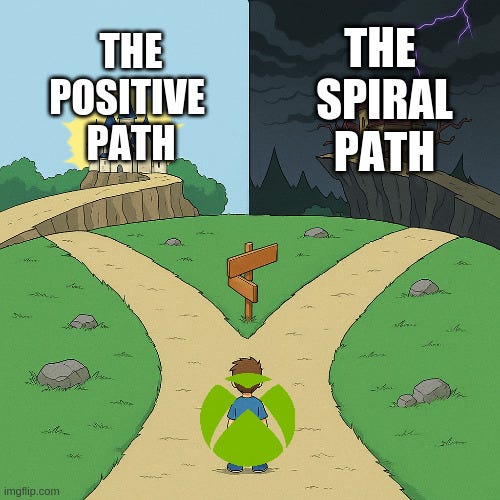
Now, the problem here is that, as you are probably already feeling, this doesn’t seem possible and is a damn nice reading of the situation currently centered in Redmond, Washington. But that’s the thing, this is the positive path. A path that leads towards a resurgence. In reality though both paths have one thing in common, Gamepass needs to change. It’s an unsustainable part of their business, cannibalizes sales, and has lead to a lot of really good games falling by the wayside because other games on gamepass take the spotlight a lot. The positive path is a good path for the company, but it’s also a long term one. One thing about business is that you don’t think years and years ahead, you think by quarters and single fiscal years. That’s it. So this positive path isn’t going to happen without some massive leeway from Microsoft’s own c-suite. Which, while possible, seems unlikely.
Technically, there is a third path (gasp) that’s actually just a mix between the two. I think a mix of both is most likely, I don’t think Asha will be able to undo all the BS she has to, and I don’t think she even wants to. She is there to make unpopular decisions and finally make Xbox more of a “sustainable” business (despite already being profitable that doesn’t matter in business because you gotta keep growing, she’s even said in her letter to Xbox that she wants to reach a billion players a DAY). She’s changing the direction of the company and even though these paths I’ve put forward are just the directions I see, it doesn’t mean I’m not missing something, I’m not a Jason Schreier, I don’t have any inside knowledge, I’m just an outsider who is basing my thoughts and opinions on the shitty industry direction we’ve been headed towards for a while, and my own views on how unsustainable the current corporate approach to business is.
So with all the layoffs happening in the industry, there’s a real possibility this could lead to a flashpoint moment for the common workers. What could that flashpoint lead to? Put simply, unionization.
The tech industry is not a fan of unionization, which is rather disappointing. Workers collectively advocating for each other is democracy in action and is often the only way many of them will get respect. I mean, all the benefits we know as workers in any industry is because of unions. People died for the ability to collectively organize, and all industries should take advantage of that ability. Videogames though have started on their path towards industry wide unionization but the problem right now is that they’re all studio unions or even just department unions, not industry wide unions. This is a massive problem.
See, the industry is facing AI massively changing the landscape for workers, it’s being integrated everywhere by corporations and people are being laid off because of it. The problem is that when only one studio unionizes to try and limit the integration of AI to only specific aspects of development, something that a union contract can definitely do, it only helps that studio. Other studios still suffer the problems that that studio managed to keep at bay. If an industry union emerged for videogame developers in general then they as a whole could fight back against AI integration.
Support me with a one time coin toss?
What’s more, unions provide recourse or, at least, warning and requirements. When a layoff happens there’s not a ton a union can do but they can provide public political pressure to the company so they face ramifications and, even more, they can limit how layoffs are implemented and provide requirements for when layoffs happen both in how much warning people get and the amount of benefits people get in severance.
Unions might not have prevented all the layoffs and studio closures that are sweeping the industry. But they could have limited the impact, saved some people’s jobs, and helped people recover post layoff for a time with good severance benefits being required.
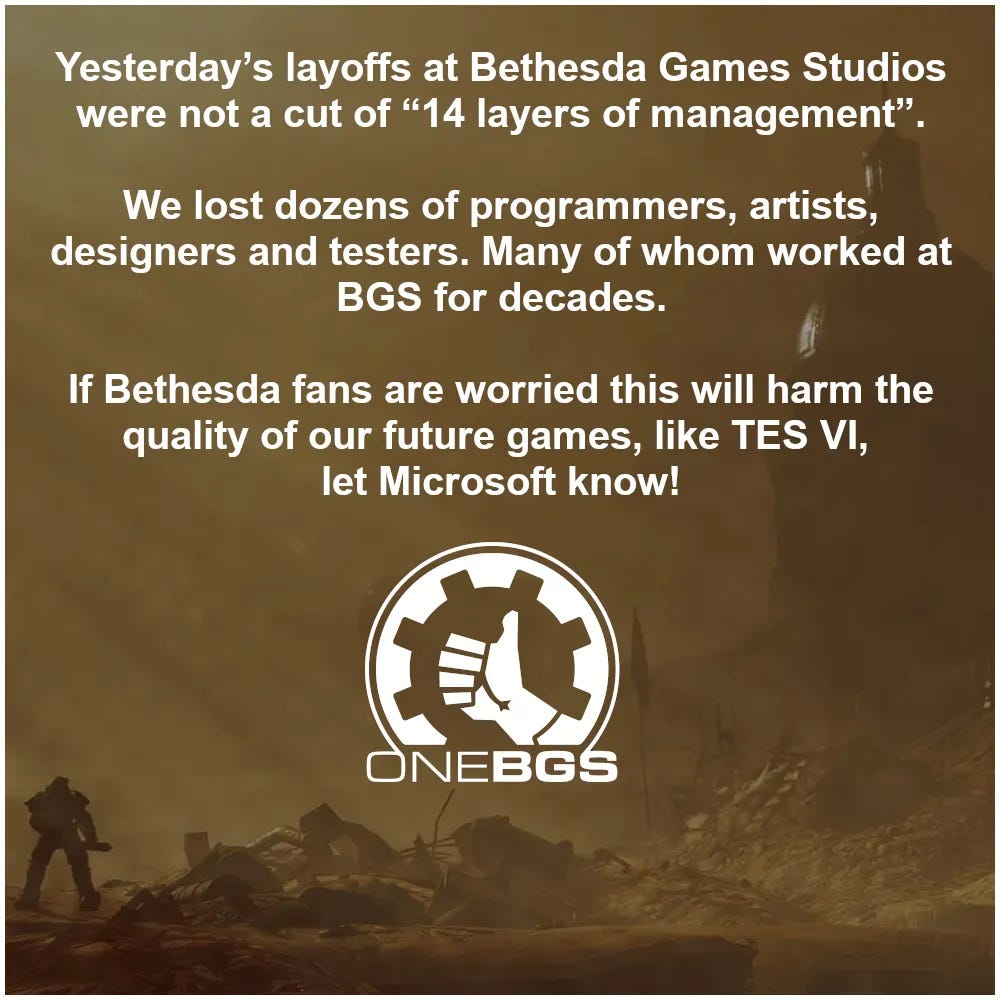
Unionization also strikes fear in management. Management that is currently going largely unpunished for the decisions they made that lead to these layoffs. They deserve to be afraid. They shouldn’t be patting themselves on the back that they managed to cut costs (through layoffs) to meet profit expectations, they should be quivering in their fucking boots. Management needs to take a pay cut, they need to be fired more often, they’re the fuck ups, not the developers who just poured their blood, sweat, and tears into a game. Strikes do this.
Imagine if this situation happened again and again (like it currently is), well an industry wide union could have had a clause that layoffs can only be implemented when all other avenues for cost cutting have been exhausted, including managerial salary reductions, and if that didn’t seem to be happening then they could strike or even pursue legal action. Strikes aren’t perfect of course, paying for your bills during that time can be difficult, but it’s still possible. The Screen Actors Guild recently struck (if you consider 2023 to be recent), as did the voice actor equivalent, both of which lead to improved union contracts. And AI can’t scab all the jobs that the striking workers filled. What’s more, when a contract expires the union could put forward terms of a new contract which included some level of limitations of how and when a layoff can be implemented and if the different studio/publishers didn’t agree to that then the union could initiate a strike to get their demands met (this was the actual situation happening with the SAG-AFTRA strike).
Again, put simply, the recourse to all of this, the flashpoint and call to action this needs to be, is that the industry needs to collectively bargain together, not studio by studio. I believe this is possible, course I’m not an expert. And anti-union propaganda is so ubiquitous that its a tough battle to convince people. But I still think it’s possible.
Important note: I am not an expert on unionization, I know there’s a fuck ton of work that goes into negotiations and creation, I fully accept that I am drastically oversimplifying the whole process and what can happen because of a union. That doesn’t change though that industry wide unionization is the correct direction for developers to pursue.
So with that, I remain concerned about the future of Xbox. I think competition is good and, as you can see with how Sony has been acting with getting rid of physical media without introducing any kind of extra features to make up for the loss of being able to do things like loan your friend the game (maybe a Steam Family like thing), they need to be knocked down a peg by competition. Personally, I think a big change for Xbox that needs to happen is to drastically change Gamepass, maybe to more of a per game rental service, similar to Kanopy where you get a certain amount of tickets per month and you can choose to use those for specific games that you want to play and different ones cost a different amount of tickets (my partner came up with this kind of idea, I had originally thought that Gamepass should just be phased out). There’s a whole lot more to go into there so that’s a completely separate topic for a different article but still.
The industry is facing a cliff, and Asha Sharma is facing an incredibly risky situation that might collapse around her causing her to be blamed in a classic Glass Cliff situation. Or she’ll be one of the lucky ones and survive for a decade like Phil Spencer did. Who knows, certainly not me, I left my future telling cards in my other pair of pants.
What about you? Are you concerned about the future of the industry and Xbox? Do you have an idea that you think might help them pull through? Do you think these recent decisions will lead to collapse of the Xbox brand or that they’ll lead to a resurgence in their relevance? And most importantly, what do you think are ways developers could fight back? Sound off in the comments!
Meow,
Cat
This is for the whole section about Mayer, here’s her Wikipedia. Yes Wikipedia, this isn’t English class and I’m not a professional journalist, I use it. It’s in the Yahoo section of her page. https://en.wikipedia.org/wiki/Marissa_Mayer
Comments
Nothing yet. Say the first thing.
Sign in to join the conversation.