
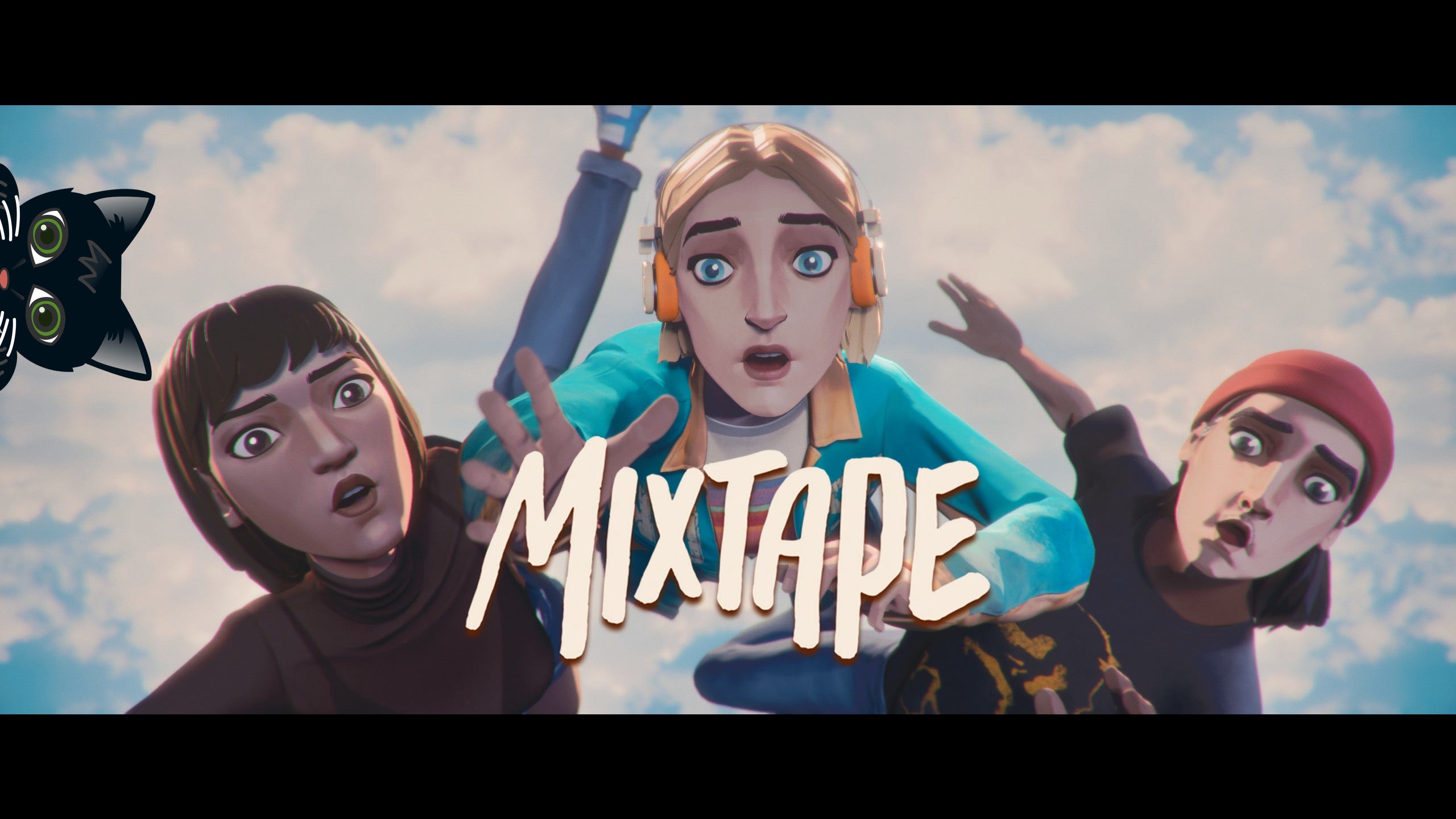
I’ve been having an issue deciding what game I wanted to play next after finishing Life is Strange: Reunion (review here). It left me feeling kinda empty, that feeling you get when you finished something that meant a lot to you and took up so much of your thoughts. Well, last Friday, I got my Steam Controller and I knew I needed to play something to test it out. So I decided that I wanted to test not any of it’s special features yet but actually just what it’s like to use it as a normal controller. Which lead me to a game I was seeing receive massive praise around the Internets, Mixtape.
I heard it was more of a walking simulator as well and, personally, I enjoy those types of games. What Remains of Edith Finch was a thoroughly enjoyable experience for me and one that left me wanting more. I feel like games come in all types and there’s plenty of room for games that only really have a story without much complexity gameplay wise. So it was easy for me to sit down and play it without being fixated on how I wasn’t going to get anything complex.
What I found was a game that made me feel, that was filled with nostalgia that, even if I didn’t get all of it, made me remember both good and bad parts of my childhood. I found a game that might have some issues, but one that seems to not be held back by them. One that might have missed me on some things because of my unusually different late teens, but that still allowed me to relate to it because of the emotions being rather universal for the age of the characters. Mixtape is a game that isn’t long, but it is intriguing and wonderful and one that kick-started my want to play more games again. Plus, playing on the Steam Controller was easy peasy, although that won’t come into this review at all. So let’s get into it and find out more about Mixtape and why it’s a game I think you should play despite a pretty glaring flaw.
Mixtape is a nostalgia fueled trip back to small town 90’s American culture. You play as Stacy on her last night in her home town before she takes a trip to New York City to try and make it as a person that finds the perfect song for every moment. She’s spending the last night with her friends as she skateboards between her and their houses, drinks underage, goes to a party of people who are largely college aged, has emotional last night fights with said friends because of her leaving causing the ruining of plans that had been set up for months, and ends up doing everything she can to make the last night in what she has so lovingly named The Big Suck a night to remember forever. Will she succeed? Will everything fall apart in a characteristically teenage filled drama that is very filled with nostalgia for people who had drama filled teenage years? Or will things go completely according to plan as she has completely predicted the night down to every last detail? Time to find out that the last one is definitely not a yes.
I’m not someone who got to live through a lot of the 90s as a conscious person, being born in ‘94, I was only aware from ‘98 on. But I do remember a lot of what the characters were doing, primarily because I went through some similar experiences with my own teenage years in the mid-late 2000s even if there were obviously some differences. The thing is, the nostalgia still hit home for me. I remember a lot of what pre-9/11 America was like. I remember being able to run around my neighborhood with my friends without my mom being super worried about us being kidnapped. I remember burning CDs and watching VHS tapes on my CRT TV. I remember, in my teenage years disliking some of the restrictions my parents put on me. I remember wanting to be able to escape the town I grew up in. I remember being hurt by my friends not being willing to make plans with me because they were deliberately making plans without me and then hiding it so I would never know but then when I found out I felt like my world was caving in on itself and turning into a black and white moment of depression and all of this happening over a damn landline (just like the video below). I remember putting the headphones of my Walkman on to drown out the anxiety that my life was filled with during the really tough moments. I remember a lot of these things that the characters went through. I fully believe that the game doesn’t just apply to 90s kids, but also kids who straddle the line, who were born in the early mid 90s and were able to remember the times of optimism that the 90s centered on, even people who were born in the 2000s will understand some of this even if they don’t remember a time before social media like the rest of us do.
Mixtape’s nostalgia is also applicable to many. Our main character, Stacy, absolutely hates the world she lives in, she wants out and wants to be able to make a career somewhere new that will allow her to use the talents she’s developed in her small town and bring joy to the rest of the world. She’s smart and, even though she’s abandoning her friends to pursue her dream, she’s willing to accept that this is what she has to do in order to succeed. Now, whether or not that would actually come to fruition is anyone’s guess, but that’s not important. What matters is the promise of the future, that it seems to be ever brighter and it’s coming at us like a skateboarder going down a very steep hill (very fast and cannot stop).
Now, on to the gameplay as opposed to just the nostalgia. I genuinely adored what little gameplay existed. There were moments of wide ranging emotions conveyed simply through interaction and moments of simply walking around and investigating certain objects so you could find out more about the characters like other games of this type. The gameplay wasn’t as prevalent as I might have wanted, but I think what was there was excellent not because it was deep or complex or intense but because the simplicity of it expressed far more emotion and introspection than anything more complex could have.
The game is structured like a Mixtape (go figure) with each moment being defined by the song that Stacy decided fit that moment perfectly. She tells us, the player, with a fourth wall break the song and why it fits. It’s this really interesting way of showing not just the kind of character Stacy is, but the kind of thoughts she has flowing through her head when the moments present themselves. She’s not just a kid who is reading a script, she has made deliberate decisions about why certain songs fit more than others. Then, when the night goes haywire and her songs no longer fit the moment she’s able to come up with songs that fit this new moment on the fly. Obviously, this was written for the character, but the way it happens, the way it develops all feels natural. Teenagers are this awkward, this emotional. They are consumed by their lives that, as adults, we feel were more carefree. The characters even talk once about how crazy it is that adults say teens have a carefree life when it doesn’t feel that way to them. That perfectly captures what it’s like to be a teen who has the privilege of not having to worry about society beating down on them or of questioning their existence and how the world views people like them. I knew I was trans as a teen, I even had a conversation about it with my high school girlfriend. But I was worried that everyone would hate me for who I was (a lot of people do of course) so I had that massive weight pressing down on me. I also went through some medical issues in my late teens causing me to finish high school online so I had my own body betraying me before I could even vote. While that impacts my own personal experience of being a teen I can still see what it was meant to be like, I still think about how care free just going to school was before that. Sure I had issues, just like these kids, but they weren’t necessarily as intense as they are now. I mean, now I have a mortgage.
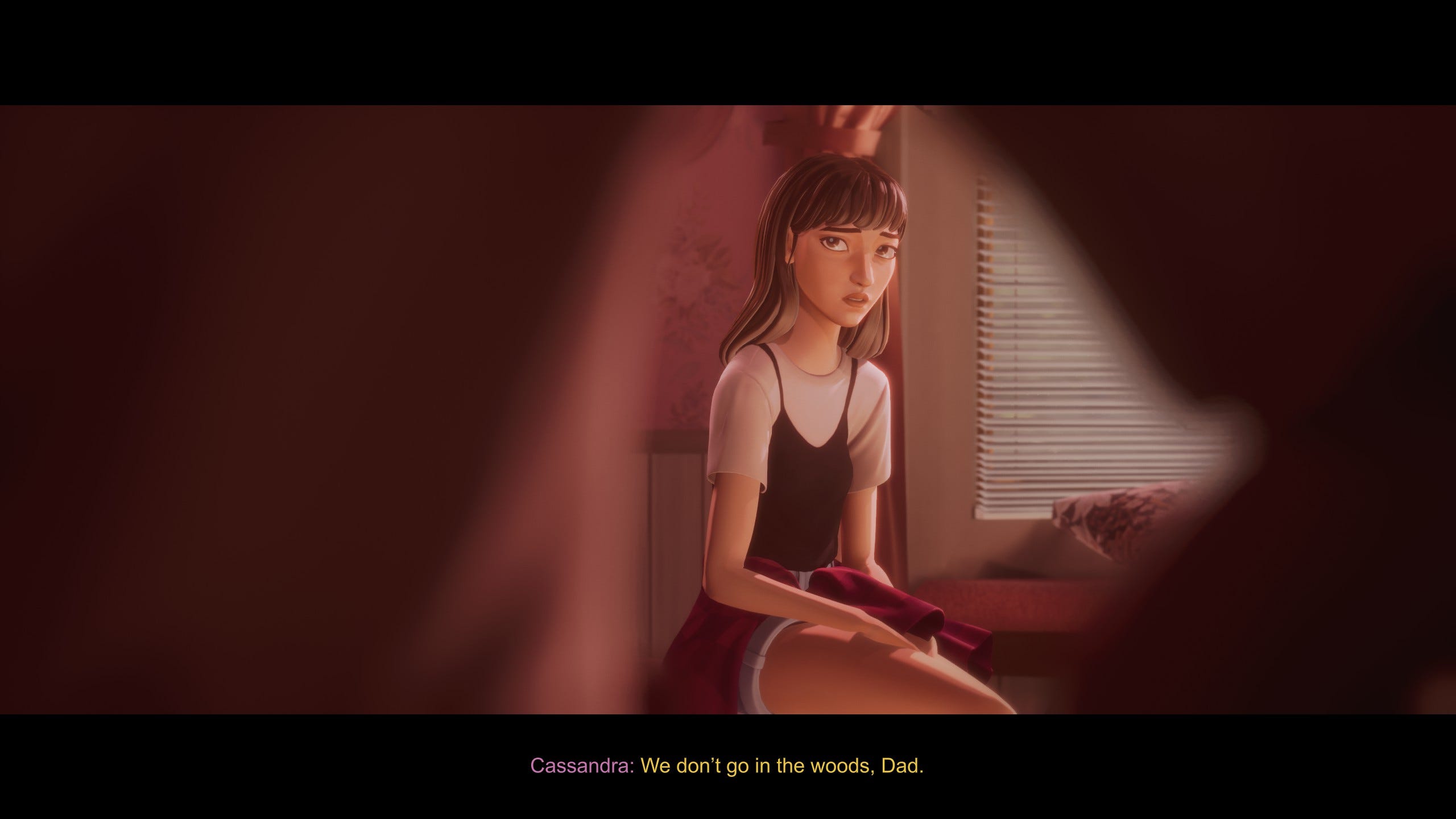
Finally, I want to talk about camera direction. Games aren’t meant to be movies but they can learn from them. I learned a lot in film school about how certain camera angles and other techniques convey emotion with a simple framing. Mixtape uses this knowledge in some rather influential ways. For instance, when we first meet Cassandra’s cop father the camera is almost like a go-pro on his chest looking up at a very low angle on his face. We, as the player, feel disoriented and intimated by how he is portrayed. We feel like how the characters feel, uncomfortable. Then when the shot that I show above happens the framing has Cassandra inside the little window made when your hands are on your hips. It conveys that her dad views himself as controlling her, as he is what decides who she is going to be, not her. She has no escape from him, he owns her. This then is further conveyed both before this scene where we find out that her mother is the one who decorates the entire house including Cassandras room which keeps her in this annoyingly pink princess room that obviously clashes with her personality, and after this moment where he decides that she isn’t going on her road trip with her friends, that she isn’t going to college. He is embarrassed of her which is also shown when we see her listening to her parents talking about how she is, essentially, a screw up who needs to be controlled for her own good. The game conveys so much of this not just through audio but through the camera. Even near the end of the game we have a moment where the camera moves in closer and closer to a character by jumping and pushing forward causing us to feel both the excitement of the moment and the anger the character is experiencing. The game, while could be called a more movie like experience, uses the techniques of movies to tell a story that conveys emotions through the interactivity, the writing, and the camera all in one. It’s truly a wonderful experience all in a pretty tight package.
The biggest issue with Mixtape, in my opinion, is that it’s too emulative of the 90s. Specifically, it focuses largely on the experience of small town white and generic folk and their lives back then as opposed to us seeing more of the experience of those outside of that kind of small town world. Now obviously this is simply because of how the game is structured, how the main characters aren’t really very punk when it comes to their personalities, and how the game as a whole is more focused on the idea that the small town sucks without us seeing the actual reasons it sucks. We see beautiful landscapes, memories with friends, the ability to explore the town before people like Oprah and such decided that kids needed to always be looked after and unable to explore the town without supervision, even easily accessible underage drinking. This town isn’t perfect but we still don’t see the bad side of it, the side of it that makes our main character hate it so much, besides just wanting to find a career in a field that doesn’t really exist in the town.
This isn’t necessarily a horrible thing but I think it left a missed opportunity where we got to see more negatives. I mean the worst thing that happens in the game is one of the characters of the group gets grounded by her asshole cop of a father and Stacy gets arrested without any actual consequences as she doesn’t end up actually being brought to the police station. Also the closest thing you get to seeing the unease around cops that many of us experience every day is in the clip below when cops drive by the trio while they’re headbanging in the car and that only lasts for a few seconds, and for many of us would be a very nostalgia filled moment where we remember headbanging in a car with our friends (seriously, I loved this scene, it was great fun). Basically, there should have been a reason to show why the town sucked because whenever Stacy called the town The Big Suck it just kinda fell flat.
This actually emulates the idea that the 90s were a more idyllic time, but the nostalgia of it is actually more emulative of the media of the time. Things like Friends, Seinfeld, The Nanny all centered on white folk. Hell, even shows like Family Matters and Fresh Prince focused on black people who were palatable to a white audience. Same with the late 90s Will and Grace that provided palatable Gay folk that allowed white straight culture to see us as real people. The 90s were a time when we were slowly moving towards progress that culminated in the massive progress of the 2010s, but it wasn’t perfect. While I adored Mixtape, I just feel like the game could have explored a theme like this more if it wasn’t trying to focus so much on the feeling of the 90s just being a better time for all of us.
Slow walking was constant whenever you are in one of your friends, or your, rooms. It sucked and, while I understood it since the areas were small, I didn’t like it. But at least there was an FOV slider (looking very pointedly at recent games of a similar caliber like recent Life is Strange games and Lost Records). That’s about it.
Skate on over to Buy me a coffee
A game that has to do with nostalgia and having to face that nothing last forever, the future will always arrive, really needs to stick the landing. Fortunately, Mixtape manages to do what most of these types of games don’t, stick that fucking landing. When you see the last few moments you feel the bittersweet nature of the situation, you can remember yourself when you had to face the ever coming future. Having that emotional connection, with these characters, the nostalgia of the moment, all of it swells into the last scene that just has you sit in the ever coming future which just won’t let you go. To me that means thinking about how much time after high school I spent in the hospital, how much time I spent with friends that I eventually lost, how I never could have predicated having what I have now back then. Mixtape’s ending is perfect.
I agree with much of the relational criticism of Mixtape. Yet still I find myself thinking of it a week later after I played it all in one day. Not just because of me writing this review either, because it was a meaningful experience. Sure I couldn’t relate to all of it, sure it wasn’t perfect and I wish they showed some of the negatives of small town American culture of the 90s, but it still is something special. It’s something I think people should play not just if you grew up in the 90s but if you had a childhood that made you wonder if the future is going to be bright or if the fact that it is coming at you full force is a terrifying prospect. You should play it because it’s a short experience that, while not able to relate in every part to everyone, has a little bit of most peoples childhood in it. I highly recommend it.

Overall though, it is 20 bucks for a 3 hour experience. That is....a mildly difficult prospect. I was able to get it at 18 or so and that helps, I mean it’s close to a movie ticket with more time and interactivity and you get to experience it home with all the snacks you have there. It’s also on gamepass so if you have that then you should definitely spend a few hours of your life playing it. If you can find it on a sale then you should get it, it’s a great little indie game and I want to experience more games like it. Not all games have to be complex gameplay experiences afterall, sometimes you just want to sit down and experience a story that makes you feel things.
Meow,
Cat
Comments
Nothing yet. Say the first thing.
Sign in to join the conversation.