
The Central Line is, as always, permeated with black dust and melancholy faces. I stand in front of a businessman sitting down, his head sinking onto the person next to him. I feel my 6pm headache threatening. The tube screeches to a struggled halt at Notting Hill Gate station, and I squeeze out onto the platform, go up the escalator and through the ticket gates. After climbing some stairs, I’m finally back in daylight – the brilliant bright grey of a London summer evening.
At the top, I am greeted by Dr. Amanda Tuke surrounded by a group of fellow nature enthusiasts. Amanda is an urban naturalist and nature writer; I first met her as a lecturer on my MA in Nature and Travel Writing. I haven’t seen her since she left her teaching position to focus on her first book, Wild Pavements, a fascinating exploration of the wildlife found in the UK’s cities. Today, in collaboration with the Linnean Society, she is leading an urban nature walk around Notting Hill, focusing specifically on the little-noticed lives that grow out of London’s pavement cracks. She greets me with a warm hug and a printout of a guide to common street plants: dandelion, groundsel, Oxford ragwort, and some I’ve never heard of – procumbent pearlwort, pellitory-of-the-wall, and so on.
Once all of us have arrived, Amanda introduces herself between screeches of sirens from the main road. She then points out the first plant of the walk sitting right underneath our feet.
“We won’t go very far today; there’s always so much to see. Botanists are the slowest people in the world!” she laughs.
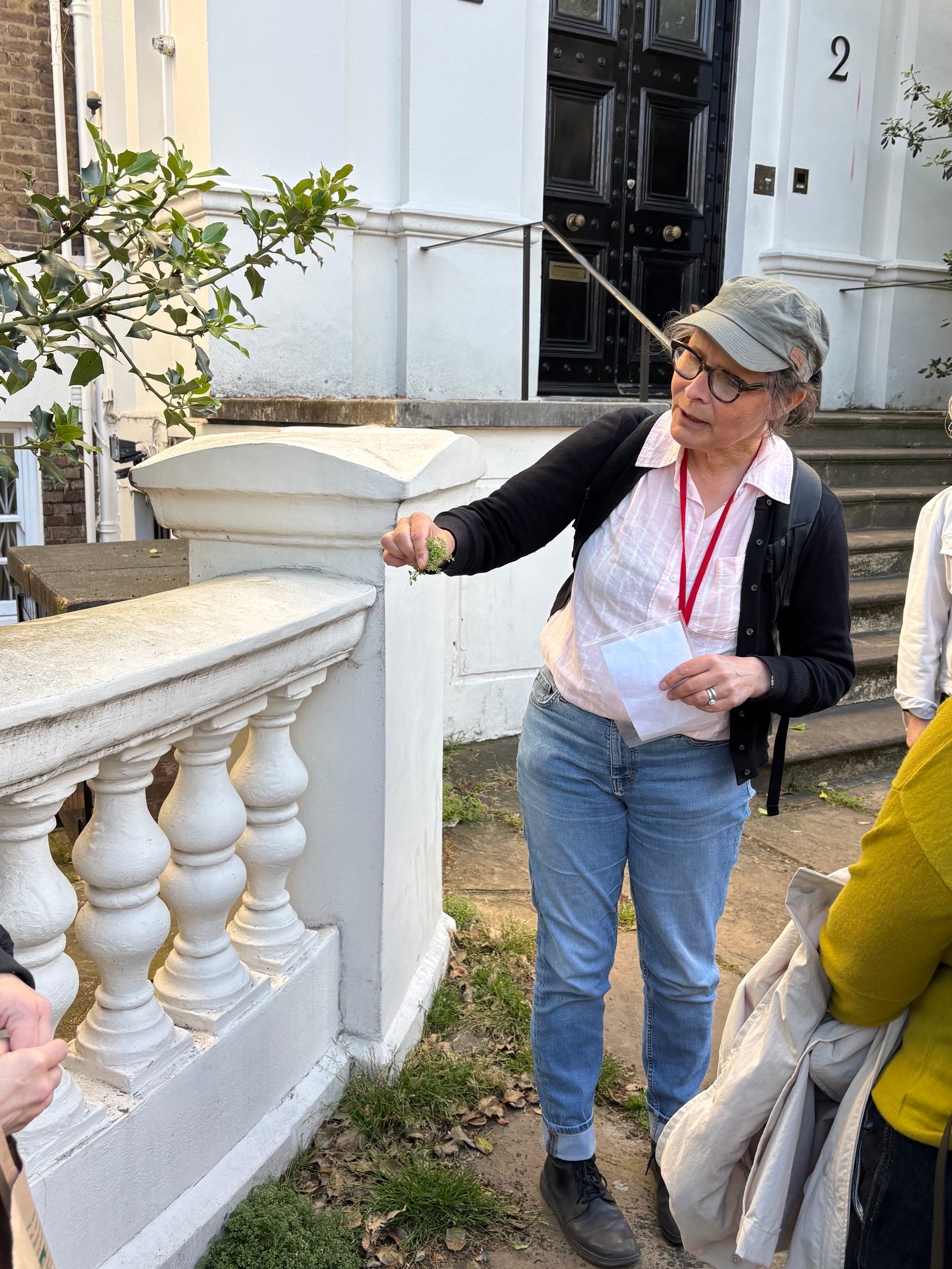
Dr. Amanda Tuke leading her “wild pavements” themed walk.
Between cracks in the pavement, procumbent pearlwort is a low-lying native plant that usually goes unnoticed and unrecognised. It’s one of the first spores to fall on newly laid concrete, an adaptation it developed as a pioneer species colonising new rock after lava has settled. Self-fertilizing, this species is highly independent and provides nutrients to the soil so that other plants can take root. Amanda digs some of it out to pass around. It’s soft and cushioned, almost like moss, except this plant flowers with tiny, pearl-like buds. It roots are waxy and needle-like, helping it retain water.
Leaving the main road, Amanda now takes us to a quieter, residential road and brings our attention to a wall outside someone’s house. A flurry of Adriatic bellflowers, or campanula, have spread across the stone wall from a larger garden plant – “making a run for it,” Amanda jokes. Also here are yellow corydalis, tiny golden trumpets lined up in a botanic procession. Amanda tells us how the felty lumps on their seeds attract ants, who collect and then disperse them elsewhere. At that very moment, an ant, as busy as any human commuter, shuffles toward the corydalis.
We proceed through Notting Hill’s affluent streets, the light shifting between warm evening sun and shadowy cloud cover. We encounter chickweed, abundant due to its historical use as feed for goldfinches, that people (wrongly) kept as pets in cages. Amanda points out pellitory-of-the-wall, a sticky plant that’s taken root in one of the curated green spaces of the neighbourhood. I’m struck by its beauty; it has a multitude of bobbled flowers embellished upon the stems, almost like a delicate necklace. This plant thrives in metallic conditions and acts as a popular food source for red admiral butterflies, with lots of seeds and pollen.
We approach the towering figure of an ailanthus tree, or Tree of Heaven, nicknamed for its rapid upward growth. I’ve often noticed this tree around cities and in parks and not been able to work out what its name was. Amanda explains how this tree, originally from China and Taiwan, is becoming a problem, since it spreads so quickly.
“The trouble with non-native species is that the insects living here aren’t well adapted to these ‘new’ plants,” she says.
This means that insects are less likely to be able to feed on and pollinate non-native species.
We come upon a mews, and Amanda bends down to look between the cobblestones. Here grows more pellitory-of-the-wall and shepherd’s-purse – a finely delicate plant with white, heart-shaped seed pods at the end of each stem. Between the edge of the mews is a rarity – Mediterranean nettle. Distinguished by flower spikes that, from a distance, look similar to a hazel’s catkins. Amanda tells us how she’s seen an increasing number of this species in recent years, and thinks it could be a combined consequence of the urban heat effect and global warming.
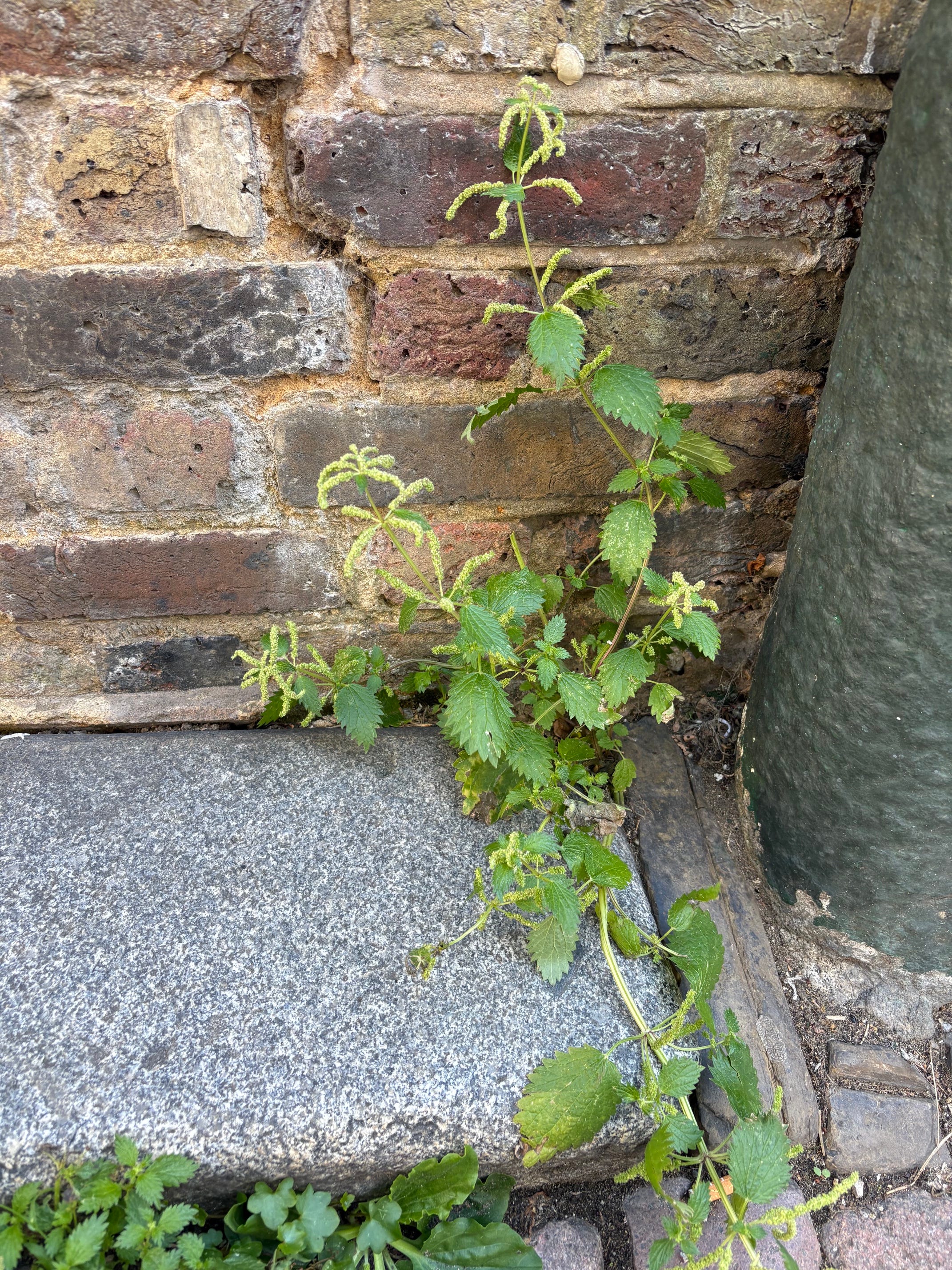
Plants like Mediterranean nettle are signs of the way the planet is changing at a much greater scale than their size lets on.
We carry on walking, down tree-lined avenues with prettily painted houses and susurrating, stained-glass leaves, backlit by a sleepy sun. Past little street libraries and wafts of newly bloomed jasmine that hangs from high walls.
We reach a grand London plane tree. Amanda points out how the soil around it has purposefully been cleared by the council, but one corner, right by the road, houses a diverse population of meadowgrass, chickweed, ragwort, and Guernsey fleabane. Despite the council’s best efforts to keep the area “tidy”, nature insists on prevailing. However, Amanda explains how as the climate changes, the London Plane might suffer, as it’s not as adapted to hot climates. I contemplate London without its signature tree and wonder what else might be lost.
“We must protect our city’s biodiversity, it’s one of the unexpected places that wildlife thrives,” Amanda says.
We end our walk outside one of Notting Hill’s private gardens. Amanda instructs us to stand by the garden’s high, dense hedge and cup our ears with our hands to block out the road’s noise and to focus on the sounds coming from the garden (a technique used by many birders). She then tells us to close our eyes.
We stand in a line, conscious of passersby looking at us strangely. But as I stand there, eyes closed and ears open, I am transported to the trees. The trill of a wren, trees sighing in the gentle breeze, clamorous parakeets zipping above, goldfinch song twinkling like a tiny windchime.
I open my eyes and breathe in deep. Mother Nature turns her face to us one last time, illuminating us in her golden gaze.
“There’s life everywhere, you just have to tune into it,” Amanda smiles.
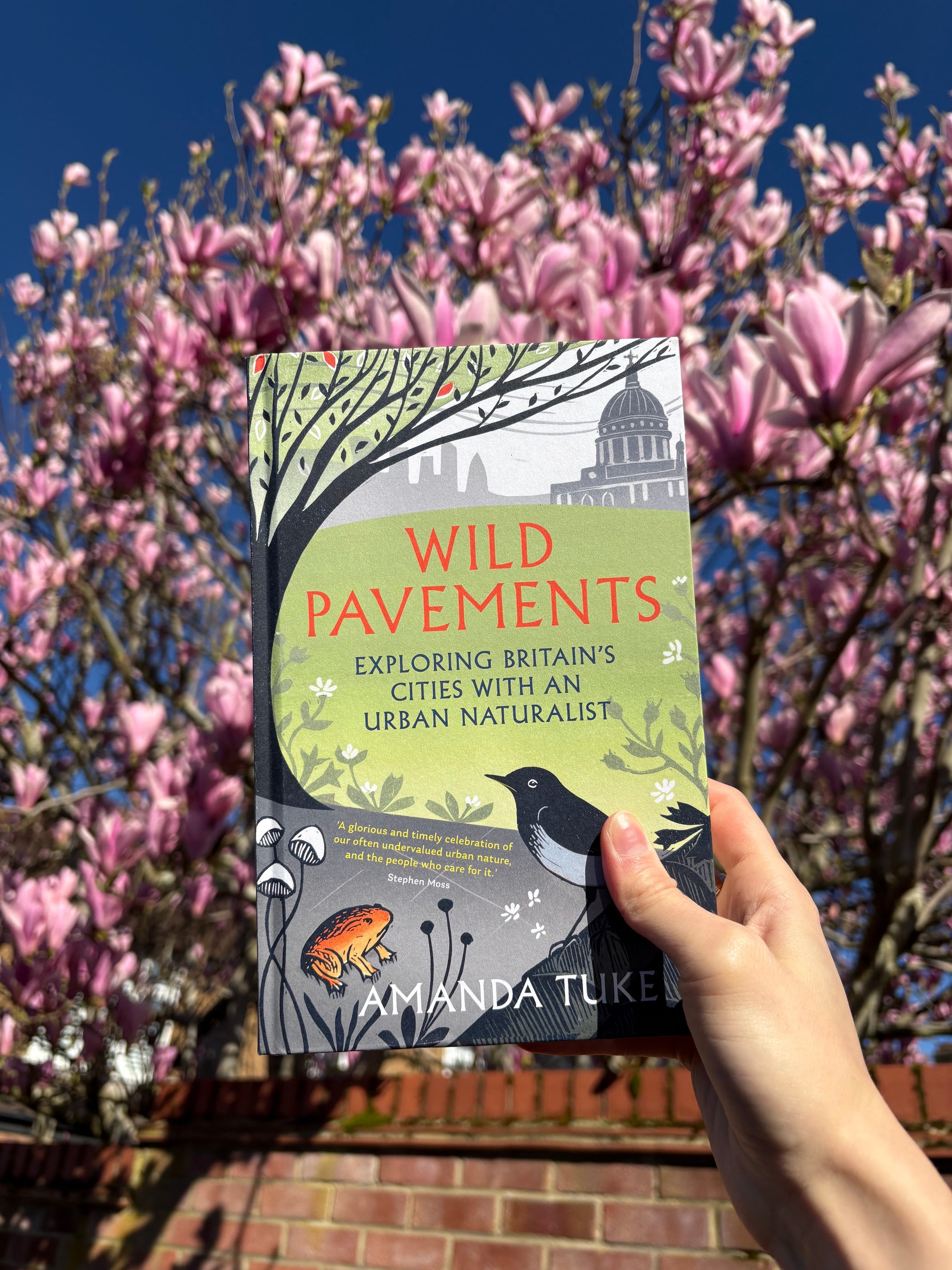
Wild Pavements by Amanda Tuke is out now.
No posts
Comments
Nothing yet. Say the first thing.
Sign in to join the conversation.