
Learn what’s going on behind the news! Here’s why: when you understand that the Western world is run by a small, interconnected group of malevolent Judeomasonic mafia operatives to the benefit of global Zionism and a “new world order” agenda, events in business, politics, and world events take on a whole new meaning. I tell you why they are happening, what the mainstream is leaving out, and what comes next, in this daily report.
These intel reports are for paid members, but will be FREE for all of August as a preview to all my subscribers.
Iran Raises the Price of “Peace”
Trump’s Economic Problem Isn’t Wall Street—It’s Main Street
Israel and Washington Aren’t Reading the Same Script
Ukraine Expands the Battlefield Into Russia’s Consumer Economy
The Carry Trade Nobody Wants to Talk About
Colombia Has an Earthquake Like Venezuela’s – Right after Zionist Regime Change
American defense majors (Lockheed Martin, Boeing, Northrop Grumman, Raytheon, et al): will benefit from a huge surge of incoming defense spending that will need to happen to replenish severely depleted U.S. munitions stocks, overstock new ones, and also supply U.S. subordinate states for its own defenses (though that last group is shrinking)
SpaceX: largely owns the communication and surveillance infrastructure for future wars already (though SpaceX is not being seen as a defense contractor, it is that and more, as I explained in depth in this article)
European defense ETFs: as the continent finds it necessary to go it alone against an increasingly agitated Russia as the U.S. withdraws its security promises (while punishing Europe with high tariffs and energy prices)
The Trump administration spent the last several months insisting it could and would dictate the terms of not only “imminent” Iranian defeat, but the post-war landscape in the Middle East. Now Iran appears to be demonstrating how much leverage the United States actually has – and it isn’t much, since they are now dictating terms more than the U.S. is (exacerbated by rapidly approaching midterms in the U.S.)
At the same time, Israel is publicly diverging from Trump’s agenda in Gaza, throwing a wrench into one of Trump’s only claimed foreign policy victories in his second term (though that was always an illusion anyway!)
Globally, conflict is ramping up, not down, as Ukraine has expanded its drone campaign beyond military targets to strike the commercial infrastructure supporting Russia’s economy. And beneath it all, Japan’s monetary policy continues threatening the hidden financial arrangement hidden underneath global markets – a currency trading arrangement that has been propping up Western stock markets for decades by using the yen as their paypig.
They’re very different stories – but underneath, two dominant themes seem to be converging, that few seem to be putting together.
First, the world’s major powers are increasingly discovering that controlling logistics, finance, infrastructure, and political timing isn’t as important as winning battles – it’s more important. Wars aren’t fought exclusively with bombing raids, naval fleets, and missiles anymore. Today they’re fought through shipping lanes, sanctions, logistics hubs, energy terminals, financial warfare and civilians are directly involved – not through collateral damage, but through direct influence on public opinion.
Second, the world’s major combat theaters are inching toward convergence. Russia/Ukraine, U.S./Iran, and Israel/Arab militias may look like separate conflicts to the uninformed, but the global Zionist mafia is directly involved in all of them – on the side of the U.S., Israel, and Ukraine. This means that Russia, Iran, and Arab militias are finding themselves on the same side against this enemy – and if China gets involved, we are inches away from World War III (which is, of course, part of the Zionist “prophecy” they are obsessed with manufacturing.)
That’s why so many headlines feel confusing today. Everyone is arguing about surface-level events, while the real wars are playing everywhere other than conventional battlefields, and the real “sides” are being determined by an ancient, international financial mafia obsessed with bringing about the “end times” - so they can rule over whatever is left.
Just when Washington appeared eager to wind down its confrontation with Iran, Tehran reportedly decided the exit wasn’t cheap enough – and raised the price of a deal dramatically.
On Saturday, Iran set forth new demands for any deal that would open the Strait of Hormuz. While Tehran backed off of its earlier demand that it would solely control Hormuz traffic and charge tolls, it is now including the following in its list of demands:
Billions of dollars in reparations to be paid by the U.S. as compensation for extensive civilian infrastructure damage (in a war that it did not start)
Termination of economic sanctions that prevent Iran from selling its oil on the global markets
The release of billions of dollars in its own frozen assets
Reduced U.S. military presence in the region
Importantly, a cessation of all military operations against its proxies in the region (i.e. Houthi militias in Yemen, Hamas in Gaza, and Hezbollah in Lebanon.)
What’s interesting isn’t simply the list of demands. It’s the timing.
Only a day earlier, President Trump was publicly portraying the conflict as effectively “won” while boasting on his social media; at the same time, the rest of his administration was sending mixed messages, with VP Vance implying that we are still very much mid-conflict but that the U.S. is dominating, and a White House representative saying the U.S. has completely all of its military objectives, and can win the war anytime it wants (but has chosen not to, for some reason?)
Perhaps Iran chose to up the ante to send a clarifying message to what is obviously an administration in chaos, or perhaps it is playing hardball because it knows that Trump is becoming increasingly desperate only three months from midterms, with public support for Republicans slipping rapidly.
In any case, it is clearly not the U.S. dominating in this war, or even in control of the initiative – it is Iran. And that practically invites all other U.S. enemies to get their kicks in while it is down.
Since Trump first declared he would run for president in 2015, his main “selling point” has always been the perception that he would, if nothing else, run the U.S. economy better than any politician.
Though this claim is debatable, it largely held up during his first term; net approval of his handling of the economy wavered between slightly negative (around -3%) and very positive (hitting nearly 20% late in his term), but it nearly ended where it started, around 3 to 4% positive across the entire political spectrum.
This time around, Trump’s net approval on the economy - which already began negative in his second term at around -12% - has now fallen catastrophically to roughly -35%. Even more significant, polling asking “which political party would manage the economy better” has shifted toward Democrats since 2025, after decades of Republicans holding that advantage.
This is largely because Trump – along with the Wall Street class, investors, and contractors plugged into the AI/tech boom – have a very different definition of what “the economy” is than broad-based American voters do. Financial markets have been surging into the stratosphere, along with mind-boggling investments in AI/data center buildout which has been pumping cash into every good and service-provider in that industry, while many households and businesses in the rest of the economy remain focused on inflation, groceries, housing costs, and declining purchasing power.
Here we have an old lesson in politics that was probably forgotten, but is about to rear its head once again: Stock indexes make headlines; Food and gas prices win elections.
Combined with the shift in perspective among polled voters that the increasingly socialist-leaning Democrats can actually do a better job running the economy than Republicans can, the U.S. is poised for a “Blue Wave” in November. This will likely be centered around two themes: Trump’s foreign policy failures, and the widespread economic struggle of Americans while Trump’s family and connected Wall Street elites become filthy rich through scheming.
(Ignored by this will be the fact that Israeli intelligence and the Jewish lobby control the leadership of both parties, and have for decades – so while domestically there may be shifts, in foreign policy even a reorganized Washington will be as pro-Israel as ever.)
The public disagreement between Trump and Netanyahu appears to be widening, and this is setting up Trump to have to take some potentially extreme measures.
There are two chief areas of disagreement between the two leaders. On the surface is conflict over the second phase of Trump’s “Gaza peace plan” which involves reducing Israel’s military presence in Gaza in exchange for replacement by an international peacekeeping force, along with complete disarmament of Hamas.
Throughout this entire period of “peace” Israel has continued expanding its military operations – killing over 1200 civilians during this period alone - while arguing that withdrawal before Hamas is disarmed would simply recreate the conditions that led to the conflict in the first place.
That leaves everyone waiting for the same impossible first move. Israel says Hamas must disarm first, or it won’t leave. Hamas says Israeli forces must leave first, because it doesn’t trust that Israel will stop bombing it. It is an impossible situation where there is zero-trust (though Israel holds a reputation advantage, due to international Zionist control of Western media.)
The hidden area of disagreement is over Iran. Though it has been largely forgotten about, Israel started the war with its so-called “decapitation strikes” that killed Iran’s former supreme leader (only to replace him with his more hard-line son), but Israel quickly exited stage left to leave its mercenary Army the U.S. to crush its major regional threat while Israel resumed genociding Palestinians and began invading Lebanon.
Well, the U.S. did not crush Iran, which has infuriated Israel (which has long controlled U.S. foreign policy) and Hezbollah forces in Lebanon were far more punishing to IDF forces than predicted. So Israel – which is at the center of all these problems – is struggling, and increasingly angry and desperate – but this is all being completely left out of mainstream media reports which suffer from chronic bouts of amnesia and Zionist narrative control.
Ukraine’s drone campaign is no longer focused exclusively on military facilities. It has recently dramatically increased attacks on Wildberries, Russia’s largest e-commerce platform (basically Russia’s Amazon) causing an estimated $5 billion in damage, while disrupting thousands of independent merchants using the company’s logistics network. The company carries more than $10 billion in obligations to Russian banks and is a pillar of its rapidly modernizing economy, raising discussion of possible government support.
The strategy Ukraine is employing is critical to watch, because it will be duplicated in every modern war from now on.
Economies are the backbone of militaries, and because modern economies run on logistics, warehouses, fulfillment centers, trucking routes, and inventory systems are every bit as important as defense factories were in wars of the past. Disrupt those, and you’re attacking economic resilience as much as military capability – not to mention terrorizing the population, causing public support for wars to plummet.
The clear and obvious developments in military technology and tactics are taking place in drone and counter-drone operations. The less obvious development - but the one more likely to touch us in the future – is that supply chains for commerce and energy are now fair game in war (and easy to hit with rapidly advancing drone and missile tech.)
If one story has the potential to escape the business pages and become tomorrow’s mainstream news headline, it’s Japan and its so-called “yen carry trade.”
Here’s what’s going on: for decades, investors borrowed at exceptionally low Japanese interest rates, and then converted it into other currencies (mainly the U.S. dollar) and deployed that money into higher-return assets around the world – mainly American stocks. But Japan’s currency has been collapsing, forcing Japans central bank to raise its rates in order to strengthen it.
However as Japanese rates rise, that trade becomes harder to maintain, because the formerly ultra-cheap Japanese currency (basically money borrowed for free) is not not so cheap. Borrowers would then either have accept lower returns – which would pump less liquidity into the stock market – or worse, begin selling assets to unwind their positions.
The U.S. stock market has been by far the biggest beneficiary of this, and it is the Wall Street class that has had the heaviest involvement – both on the side of borrowing yen and investing in stocks, and on the side of ownership of stocks that have been surging to insane valuation levels.
The U.S. Treasury Secretary Scott Bessent (who himself became a billionaire by exploiting this same trade while running George Soros’ fund) is now offering unprecedented support in U.S. dollars to prop up Japan’s currency; but if it works, it will simply create more inflation, and if it doesn’t, it could trigger a long over-due financial crash.
A little more than six weeks after twin earthquakes devastated neighboring Venezuela, killing thousands, a magnitude-7.4 earthquake struck western Colombia on Monday morning. The magnitude of the earthquake was 7.4, almost identical to Venezuela’s recent earthquakes, clocked at 7.3 and 7.5 respectively.
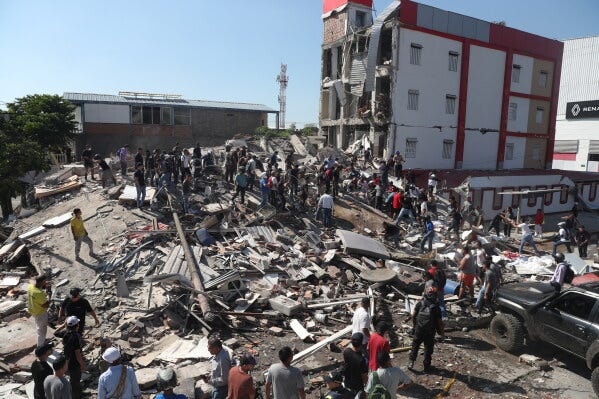
Twin earthquakes like those that happened in Venezuela are virtually unheard of, and another earthquake of nearly identical magnitude in the same region is suspicious. What is even more bizarre is that both countries recently experienced major regime changes, from being anti-Zionist, pro-Palestine, left-wing governments, to suddenly being pro-Zionist and pro-U.S. puppet regimes.
Then immediately after Venezuela’s earthquakes, the IDF showed up in force to “offer aid,” which was later rumored to be a cover operation to infiltrate the new government – only days later, the new government withdrew itself from participation in the International Criminal Court, the international judicial body that drew a warrant for Netanyahu’s arrest for war crimes.
Look for Colombia to do the same in the coming weeks, along with “welcoming” IDF as “international aid.”
Three things stand out.
First, watch whether negotiations with Iran move beyond headlines into concrete agreements, especially with regional governments like the Gulf States. If markets begin responding more to actual Iran’s diplomacy than to Trump’s bloviating, that tells us where investors believe real leverage now resides.
On the other hand, Trump is likely having his hand forced into escalation of the war in Iran – both because Iran is giving untenable demands, and because Israel won’t let him take an off-ramp anyway. Trump’s style is to do things “bigly,” so if the U.S. escalates it will probably be dramatic, and pump defense, oil, and possibly gold.
Third, keep an eye on Japan. Rising interest rates there may sound like a domestic monetary story, but if the carry trade continues unwinding, the effects could extend far beyond Tokyo into global liquidity, Treasury markets, and leveraged investment strategies, possibly even triggering a global financial panic.
What do you guys think of these earthquakes in Colombia and Venezuela - bizarre coincidence, or something more sinister?
Thanks for reading Cato Dezorra's Substack! This post is public so feel free to share it.
No posts
Comments
Nothing yet. Say the first thing.
Sign in to join the conversation.