
I wanted a place where the podcast could be read, returned to and discussed, so I’ve decided to house individual episodes here on subbus stackus starting with Reskillience’s top 10 most popular chats.
This conversation with Brett Cooper from Limestone Permaculture was joyfully recorded outdoors with a gentle breeze in the banana leaves and background turkeys.
I’m unsurprised it gained such traction, especially given that — as one of my wry mates declared — Brett is the Steve Irwin of permaculture; all contagious enthusiasm and educational zeal. It’s a romp.
You can find links to stuff we discussed in the show notes, and I am most eager to hear your thoughts, themes, questions and dreams sparked by this convo in the comments.
Hey, this is Catie, and you're tuned in to Reskillience, a podcast about the hard, soft, and surprising skills that'll help us stay afloat if our modern systems don't. I'm writing this introduction on a train between my mum's house and my dad's house in New South Wales. And it's the same train I used to catch as a teenager, avoiding eye contact, clutching my red discman, and listening to Radiohead like my life depended on it.
This sunny train carriage with its blue carpet seats and patchy passengers has me thinking about when I was a kid, what I was like as a kid, and why I am the way I am now. One big struggle for me, and truly there are many in life, is that I am not so great at learning new things, which is quite ironic given that I host a podcast about skills. It's less about being a slow learner, more like an avoidance of the unknown, an aversion to being a clueless beginner.
I look at people who actively add to their repertoires, taking bikes apart and putting them back together, teaching themselves how to build stuff and all of that jazz, and and I am so impressed and depressed that I am not more like them. I think it's what they call a fixed mindset, an old and unhelpful belief that I know what I know and that's that. So how did it happen?
Catching my reflection in the smeared glass of this increasingly humid train carriage, I see my younger self, a pretty regular public school student in the suburbs. What went wrong, I suspect, was that I was quote unquote “smart” and bathed in the glow of gold stickers and shining report cards. But far from foreshadowing success in later life, this natural ability and the attention it attracted made me kind of lazy, fossilizing my mindset, imprinting the lesson that it's best to play to my strengths and pursue the easy wins rather than learning how to learn.
It's weird to reveal this stuff on a podcast, but by now you're probably familiar with my policy of oversharing, just in case any of you are experiencing similar psychic baggage and could benefit from it being publicly unpacked. So we all know that learning something new can make you feel like a bloody idiot, and yet there are great personal riches awaiting those who can withstand the awkwardness. So now as an adult, I spend quite a bit of time reminding myself that discomfort is a natural part of the growth process and not something to be avoided.
And as much as I blame school for my shortcomings, that old story is really getting quite stale. So if school taught some of us how not to learn, what can we do to address that, to change the story? Well, one thing I'm trying to cultivate is a primordial mindset, which is the opposite of fossilized.
When the swamp of everything I don't know and can't do threatens to overwhelm me, I think of it more like that ancient goop, the primordial soup dripping with nutrients and possibility. Far from brittle and fixed, the primordial mindset is about taking small evolutionary steps in the direction of your best life, because we've all got to start somewhere.
My second suggestion is to listen to this interview with Brett Cooper, who will relieve you of any lingering mental resistance, such is his can do, will do and you can too attitude.
He is truly an anti-fossilizing force, a source of energy and inspiration. And I really think this might be the greatest pep talk in Reskillience history from one of the most passionate permies in the movement. I am super excited to be sharing it with you.
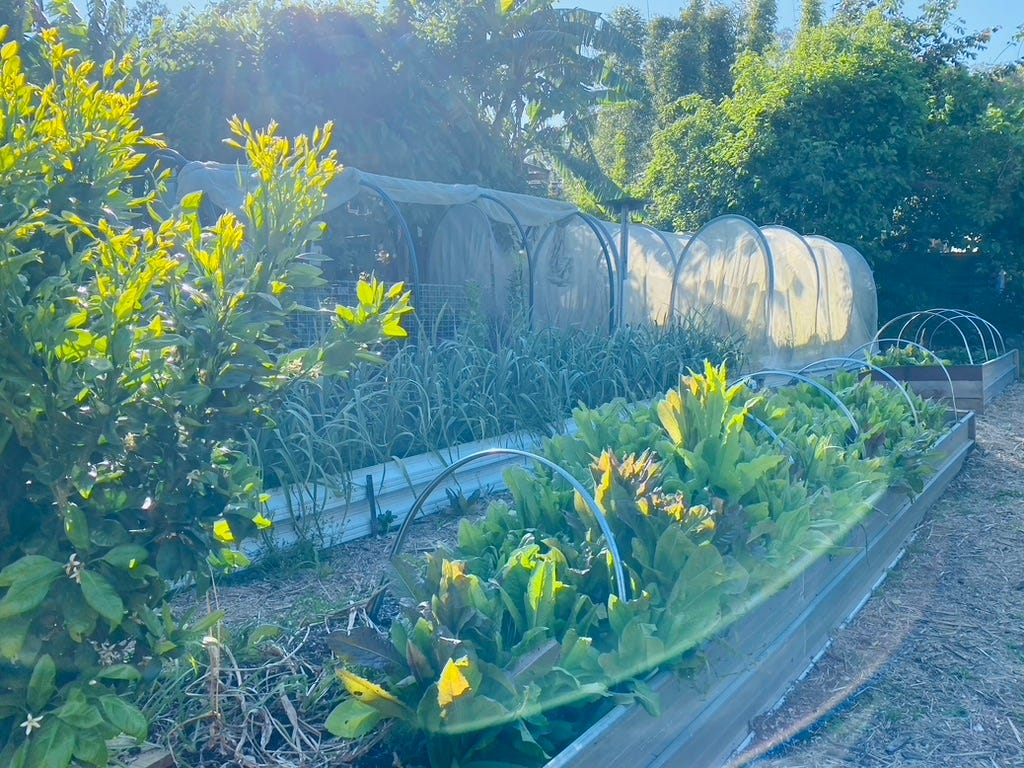
Brett, his wife Nici and their family live on Worimi Country, on the mid-coast of New South Wales at Limestone Permaculture. Not too long ago, their one-acre block was just grass and hoof prints in a sleepy little rural village. Now there are more than 550 fruit and nut trees, dozens and dozens of chooks, ducks and turkeys, veggies galore, herbs, medicine, wildlife, outdoor classrooms, climactic resilience and one legendary pizza oven.
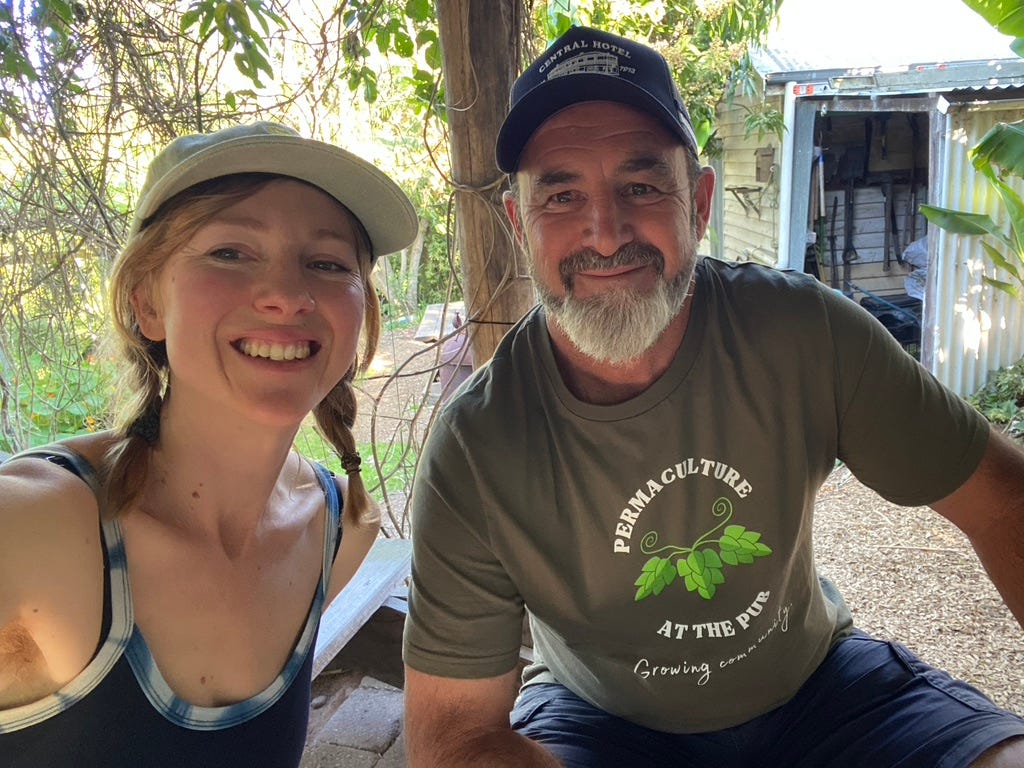
Over 3 million viewers have devoured Brett and Nici's farm tours on YouTube, which I'll link in the show notes, pointing to more than just a fetish for gardening content, but actually a deep yearning for the health, abundance and connection that Limestone Permaculture puts on show. I was lucky enough to record this conversation with Brett in person on a perfect spring day, in the shade of a passion fruit vine with a gentle breeze rustling the banana leaves.
As well as foliage, you'll hear the Limestone Permaculture back story, how to create stability in your life and landscape, why adults need to urgently upskill, why not to get into debt and what to do instead, how to look after Zone 00, which is the inner you, Permaculture Principled homesteading, spring plantings, Brett's one Reskillient thing, and turkeys.
“You will hear turkeys in the background of this interview and other critters too, because it's a biodiversity brouhaha in Brett and Nici's ever-evolving patch because they're primordial like that. If you dig what Brett's about, there are so many ways you can visit or learn directly from the Limestone Permaculture crew, and I've linked all of those things in the show notes. Also, I'm going to switch it up and shout out to all of my patrons on Patreon right now at the top of the episode, because your donations and support are so very appreciated and single-handedly supporting this show.
We're all enjoying each other's company over at patreon.com/reskillience.
And a massive thanks also to those who take the time to leave lovely iTunes reviews, such as you Tony and grubby little earthling. Your kind words not only help people find the show, but also validate my life choices to perplexed family members. Alrighty, here's Brett Cooper from Limestone Permaculture.
And if you think it might inspire someone you know, go ahead and share it. Thanks for being here and enjoy the conversation.
Catie: This is my first outdoor interview.
Brett: Oh really?
Catie: Yeah.
Brett: Oh wow.
Catie: Yeah, I mean, I don't think I've done any others. In-person is my favourite and outdoors is the ultimate, but it's pretty hard to arrange with people.
Brett: It's more El Naturale, isn't it? Like, you know, even the wind rusting through the leaves and like that, just on cue. And like, you know, the chickens and the turkeys and the background, I mean, you know, I love that.
I mean, it's a little bit, I find it more relaxing than sitting in an office or, you know.
Catie: Absolutely. So, yeah. I want people to have the audio soundscape of this place and it actually fits really nicely with what, I mean, I want to talk to you about so many things, but one of them is where you are and what you've created here.
And the fact that there may be a truck or a car or seven rushing past and it's because you're not secluded away in the sticks, you've actually chosen to base yourself in and surrounded by humanity, but make the best of it and make an amazing oasis on an acre. But I don't want to give too many spoilers, but that is a big theme that's been coming up as I think about chatting with you today, Brett.
Brett: Yeah, well, I mean, look, first of all, thank you for having me on. And secondly, I'd like to just acknowledge that we are on Worimi land. We're in the Karuah Valley, so it's called Stroud Road, which is a little bit north of Stroud in New South Wales.
Look, the location was by design. So the idea that we needed a little piece of land, we didn't need much, but something that would allow us to achieve our goals, our vision, and also possibly create some side income. That was the initial thoughts.
And so being a little bit closer to the populace, not too close, but a little bit closer, would allow for farm gates and field days and tours and things like that. So, you know, that's all part of the equation really. Yeah.
Catie: And so what do you get up to here? What is a totally abnormally average day for you at Limestone Permaculture?
Brett: I could give you an average week. So, I mean, generally speaking, all the weekends are taken up with courses, workshops, tours, and they're usually booked in advance. And the weekdays are pretty much organic in the sense that we have a certain couple of days that we devote back to the property for the maintenance, for installing new projects and project maintenance.
And then we're caught up with private tours, we're caught up with consultancies, we guest present for other groups. There's always something going on. We try to schedule it as well as we can to ensure that we have at least two or three days giving back to the property.
We get asked all the time, how much time does this take? And I go, well, it's all in context. But I suppose the appropriate answer is design it well and it takes less than what it would.
Catie: Yeah, because it is only an acre and I know a lot of people aspire to many, many, many acres because the belief is that you need that quantity of land to give back to you all the things that you imagine that you need. But what is possible on an acre?
Brett: Oh, I love that. I mean, seriously, what is possible in a small open backyard? It is so awesome to have spatial awareness as part of that permaculture lens.
You know, the idea that you can be looking at an area, and when I say an area, it could be a dwelling, it could be a shed, it could be land. But you're looking at it with a set of eyes that realises that with the right placement of elements and with the right type of elements and with elements that have good relationships and beneficial functions and connections, then the world is your oyster, anything is possible.
So on the one acre, I can tell you currently, we're over 550 fruit and nut trees.
We average between, we fluctuate between 80 and 140 poultry, depending. And those poultry range from turkey, duck, chicken and quail. Most of it's set up for eggs.
And there is obviously some meat involved in that, but it's obviously ethically raised. So the one acre, then you're thinking about water and energy and thermal comfort and protection and all the other things that go with that. So yeah, the humble little one acres got 80,000 liters of water storage as what would be known in tanks and captured from roofs.
But what it actually has the ability to retain in the landscape via the food forest gardens and the terraced gardens, the Swale Gardens and all the other created areas that we've now got installed in the place is phenomenal. I mean, we did some quick sums just on the water and generally based off, so we're about 4,300 square meters, a little bit over an acre and based on 1,050 millimeters of annual rainfall, from memory, I think that was something in the realms of 4.3, 4.4 million liters of water that falls on this property a year. And our whole goal is we know the water is eventually going to, because we're on a slope, we know it's going to move off the property, but our whole goal is to work it so hard that its retention is not here for days and weeks, it's here for months.
So, you know, again, when you think about what can you get from an acre, you can store water, you can store energy, you can have abundance. And when you get to that level of abundance and that level of storage, it just means also that you are more pronounced in the community, you can offer more back. I mean, it's not all for you, but it's more for more.
Catie: Yeah, beautiful. And so speaking of any space being one's oyster, depending on how you look at it, I know that you were in Newcastle, with more like a courtyard as your oyster. So what was that situation and what was the impetus to scale up just a little bit?
Brett: Yeah, so in Newcastle we had the urban squeeze, which was our little name for our tiny little Mayfield property. 330 square meters with a house on it. So not much land left up there. You're pretty much talking about a pathway at the front and a courtyard in the back. And we also had a rear lane access which ended up being so useful at a later point. But the initial impetus for change was based around the love for what we were doing, the growth of the passion, the idea that the whole thing, I mean permaculture itself for us commenced with Nici's ailments, right?
And so I come from a gardening family and I come from a quarter acre scenario from when I was growing up and chickens and goats and all kinds of things. So I was lucky enough to have a good upbringing with all that. Sort of forgot about it a little while. And then with Nici's early gut related issues, we had to make some serious change. And the initial changes were organic food and eating better and healthier. So that was the reasoning for setting up the urban squeeze.
Catie: What were you both doing at that point?
Brett: Yeah, so I was a carpenter doing the usual drudgery, the slog, just doing whatever I had to do day and night and making it happen. Nici was working for a real estate agent as in the admin sort of side of things and also doing some sales. And it was land sales too, so it wasn't house. But her illness kept her away from work quite a bit at one point and it did get tough there for a while. And we had change forced upon us.
So, you know what, sometimes that's what it takes. A little slap in the face is good for us all sometimes. And so then that change created the Urban Squeeze. It brought on a passion that I never knew even existed inside of both of us. And it just swelled up and could not be contained. So I would say the impetus for change was the fact that we couldn't contain.
We were happy where we lived. We were doing as much as we could where we lived, but we knew we could do so much more, and then realized that there was so much more to life. And so that change coming up here, we originally went looking for two acres. Back in 2010, we couldn't find it, but we found one acre and in a couple of locations. And it was a good time. Places were reasonably priced and we could get, you know, you could get a one acre for half the price you could buy a place in Mayfield which was pretty cool.
Catie: And how long ago was this?
Brett: So 2010 was the move, but we started planning to move in 2008. And we started making change towards organic nutrition and growing around 2001, 2002. And permaculture really came into the fore by 2003 initially just videos and just books and then grew and then was uncontained at that point. Yeah, so yeah, that change was driven by that need to not just look after my wife and my family, but also seeing that there was pathways and benefits and other things. The more I explored, the more it just kept opening up.
And even to this day, it still does. It just does not stop.
Catie: Health challenges are such an epic catalyst I know for so many of us. And we can thank them in retrospect, but at the time it's really bloody annoying and painful. So now coming to this property where we're sitting under the shade of what is this plant that's trailing around here? Is it a banana passion fruit?
Brett: So this, yeah, this one is an heirloom golden passion fruit. So it's seed grown.
My understanding is that as of now, because I've been growing it for a certain timeframe, and from when we got the seed, maybe 38 years. Oh my gosh. Yeah, that's not how old this is, of course, but that's the pass down of the seed. So it is a little bit of an alien one. And yeah, we love a lot of seed growing stuff here.
Catie: Yeah, you just have sensational varieties and I'd love to geek out on some of those a little bit later. But just to kind of give the listeners a sense of the oasis that you and Nici have created here and your family. And also taking us back to a time when it wasn't so verdant and it wasn't so buffered by the types of plantings that you've chosen to do. What was the health of this acre when you found each other?
Brett: Yeah, it was very typical of what you would expect in most rural areas. So it was one acre of grass. So you could say that when we got here, it had nice grass, right? Very minimal tree and shrub. So it had two old mulberries, which are still here today. A couple of old Australian, well, they call bush lemons. They're not really Australian natives, but they're bush lemons. And they'd been, there was no back fence that the cattle were in, because it's an original homestead of a greater dairy farm at one point. It's actually got quite a bit of history, even right down to the Cobb and Co Carts going past. But essentially it was barren in the sense of lacking complexity, lacking that 3D and needing us to come along. So yeah, we've been working on that for 14 years now.
Catie: When we visited not that long ago and you sent us away with an overflowing box of edibles, which was just, I thought if there's one thing that sounds like a healthy goal in life, it's to be able to welcome people and then farewell people with more than they came with, with a surplus, of beautiful nutritious food that then they're taking with them. And I passed some of that food on to friends and family and so your story went a really long way. But I know when we came to visit you shared some of the stories around the kind of climactic changes that you've noticed just in this little pocket because of the things that you've done. So I wonder if you could describe a few of the things that you've noticed climate-wise because you have been able to as you say add complexity to what was once just a beautiful bit of grass.
Brett: Yeah, look, I'll take a quick back step on that really quickly, is that when we first got here, we didn't know, obviously, we researched and you can definitely research the history of a region and understand the bio region and all the rest of it. So, I mean, that's part of Permaculture design process. So you can learn enough, you can talk to neighbours, you can understand, but then you come through the experiences. So by 2013, we had our first drought, 15 and 16, apart from normal decent rain events, we hit our first floods, which actually washed houses down through Dungog and people come close to losing their lives. Even in Stroud they got rescued. So we're what, this is incrementally building our historical knowledge of the climatic and event scenarios.
Then you fast forward that to 2000 and 2018 and 19, which was one of the worst droughts on record, if not the worst drought. And then followed by flood and flood. Huge winds, so we've experienced 110K winds because we live on the shoulder of a hill. It's a challenging site. Yeah, look, it has everything in it to bring about some kind of angst.
Which I think a lot of people, this is when you're moving onto any form of land, and it could even happen in the urban environment of course, but any form of land that you come across, the immediate challenges everybody talks about is usually something to do with pestilence or predators, right? But our worst scenarios are usually climate-based, weather-based, and so then we're thinking, right, when we experience those, you really only want to experience them once. They happen more often than once, but this is your chance to then reflect on that, that experience that's just happened and go, right, what do I need to do to filter that, that effect?
So, you know, we're thinking shelter belts and, and, and where to, where to place things so they, they're not damaged as easily. So then where should animals go to have a comfortable life as much as what humans would, right?
Essentially the idea that the climatic events through this property over the last 14 years, which is a very short period in time, has given us the understanding of what to undertake to ensure stability on your property. We now have created that stability, so now we're in a point where when those weather events now happen, so when we get strong winds and when we get hail and when we get really decent rainfalls we're holding the water where it needs to hold and moving it where it needs to go. The winds are being buffeted and filtered, right? The hail has been filtered by the canopy.
So it goes on and then in drought, at the moment where, you know, obviously the next big drought's not far around the corner. So it's gonna be an interesting time to see how we work compared to back in 2019, but we are so much more advanced. So yeah, it's interesting times.
Catie: Practically and more specifically, what are some of those design strategies or interventions that you've made, like the types of plantings along the road, for instance.
Brett: Yeah, so, shelter belts are first and foremost. When you think about, well, I could take a step back and say, understanding the scale of permanence. Right, so the scale of permanence is by P.A. Yeoman, we're talking about something that's a good 50 years, maybe a bit longer, that's been around, so it's Australian.
And he came up with the idea of what you should look at and understand in the sense of influences and energies and topographies and climates and all that kind of thing when you first walk on the land. And he put them in a sort of a hierarchy, a type of order to look at them, which was really clever because nobody was doing that. PA Yeomans who invented the Yeomans plow, right? Who had a lot of inventions. But the scale of permanence is one of the things that Bill Mollison first met PA Yeomans about.
The scale of permanence is in permaculture design crucial, crucial. So the idea that when you come onto a property the things that you that we need to be considering are based off that. Dan Palmer said it best and I was lucky enough to learn under Dan Palmer, amazing man for advanced design, and he said, basically, the Scale of Permanence, you're starting with climate, and that is the rules of the game. Topography is the board the game's played on. And then water and infrastructure and, um, you know, subdivision and soil and plants and animals are all the pieces on the board. But most importantly, climate, topography, but first up directly under them, as soon as you move to the first piece, and I would call it the king on the board is water.
And then you think about stability. So the idea that the parts that you truly need to consider when you come into a property to help you with event mitigation, so designing for extreme events are things like shelter belts. And those shelter belts can be anything in the context of where you live. If it's narrow, it can be bamboo. If you've got white, it can be rows and leading up to a ramped effect that's in the window over and over the top.
It can be the idea that you're retaining water and moving water on the property to keep it hydrated and give you a prolonged resilience in drought. So it's all about creating the correct water stability. It's all about creating the correct stability using permaculture design process and the scale of permanence. You work with those two guidances if you like, then you are well on your way to being able to handle the next lot of events that get thrown at you.
Catie: Yeah, cool. Scale of permanence. I know that these things come in and out of my awareness, but every time I hear them, it refreshes my appreciation for how sophisticated and helpful that is. But I wonder if I can take a step, a few steps back and ask you where you meet people when — and I think this is a bit of a generational thing — people like me and my cohort, we don't know which direction the wind is coming from. We don't have those basic geographic, observational, in touch with, you know, the elemental forces in our context, I don't think that's as common as my mum's generation and the generation before that.
It seems to me more natural for someone in my mum's generation to say, oh, here's a Southwesterly coming through or whatever. And so it's like, okay, with these design principles and pathways, you kind of got to know this really basic logic of the universe first. Where do you start with people like us?
Brett: Well, we're really lucky because we are currently we're in a wealth of knowledge. There is some stuff that we need to watch and be careful of, and obviously things need to be checked and compared. But as far as understanding climate and weather, then the information's out there. Down to the point where in all honesty, if you've got a compass on your phone you're able to at the very least know where's north, where's south, where's east, where's west.
If you're standing there and there's a wind blowing, you can work at which direction it is. We have all the weather apps and weather websites and that that you can get historical data from. You can Google old newspaper clippings and from big events. So the information, so when we run our PDC courses, we're saying it's OK. You don't need to be the one that knows straight off. But here's some tools. You will learn this very quickly and then you will take the time that when something, all of a sudden the wind changes, you'll go, oh, oh, that just changed. And if you're not sure what direction you pull your phone at, you get your compass and you'll find what that direction is.
Right. So, so we're lucky that now that you're right. The reason why the older generation, so if you went from, say, Gen X back to boomers back to, and you kept going further back, that generation didn't have the luxury of, of social media and apps and on all the websites.
So it was something that was taught down. It was intergenerational. These days, we have that knowledge passed onto us via the digital world. And to be honest with you, like all tools, they can be good and bad, you know? And so, you know, it's how we use them. And there's so much, I actually, you know, I am Gen X and, you know, and I'm absolutely excited to see all the technology that is available for understanding your land, understanding the climate, understanding your horticultural responsibilities, understanding your animal-based responsibilities. It's all there. So I can tell you now that you can get anything you need within the click of a button these days, but then it's your job to experience it.
Catie: The last time we were here you spoke so passionately about resilience. And I think about how we use technology and how much technology can mediate our experience to the point of us not actually experiencing anything anymore. What is your recommendation as someone who is so emphatically devoted to cultivating resilience, I was going to say Reskillience like I've coined that or something, resilience for yourself and your community. Like yes, these tools are incredible but what if we don't have access to them anymore? Do you have a bookshelf full of these things? Do you want like an oral culture resurgence where we actually have them, you know, in our bones and in the landscape?
Brett: Well, you talk about one of the main principles of permaculture, which is redundancy. What's your backup plan? So your backup plan for everything. So the idea that, well, if you don't have a digital compass, you could have a standard magnetic compass, right? I do get this a lot, there's always the what ifs. What I would say is while it's not a what if, while at the moment it is available, use it, learn and understand to a point where you may not need to use it, right? That's one of the big things I try to teach is that if it's available, utilise it. When it's not available, what is the other ways? So yes, books, obviously books. Books, you know, we have multiple libraries on Limestone.
We have our own personal library. We have two libraries in the classroom, which have loan out books for all our students. So when they do their course, because our course runs fortnightly, you're allowed to take a book for two weeks. Or a couple of books. And as long as you sign your name, bring it back and let other students use them. So we absolutely promote reading, love reading, grew up reading. The idea that there's also some understanding how to work with the Sun and the Moon and some of these things are quite simple.
You know, something as simple as putting a stick in the ground and understanding where the Sun comes up and the Sun comes down. So the answer is yes, there is availability of the knowledge because the knowledge was there before the digital came along. So it's all there for us as well. I'm just saying at the moment the tools are there to fast track, but then don't rely on it.
So utilize it to upskill fast, to fast track your knowledge. And that's one of the things we talk about in the courses. I'm very big on fast tracking adults. I love kids, but I feel that there is a little bit of an urgency to fast track adults and let the adults teach the kids because it's meant to be intergenerational knowledge anyway.
Right, so that's, you know, so I just went a little bit around in circles then, but you know what I mean.
Catie: It's so good. And you know what Brett said to me before the interview?" “I’m not feeling so great today.” And you're so energetic and so lucid. I love it. And I really want to dig into this urgency thing because as you may or may not know, when I started the podcast, it was theoretically around, oh shit, you know, civilisation’s collapsing. What do we do in this 11th hour? And now I feel like actually the heart and soul of my inquiry is how do we live at the 11th hour? Because it's always the 11th hour. You know, we never know when we're going to go.
But collectively, we're having a big 11th hour moment. And so for you to bring urgency into the conversation is gold because I'm deeply interested in that idea, how we kind of live slow and present lives with this prevailing sense of, you know, urgency, emergency. What is the score? Like in your mind, how much time do we have to lean on technologies and kind of play around and skill up? You can be as specific as you like. What do you think we're in for?
Brett: Okay, so a little step back again. So, I studied history at school up until the point I left to be a carpenter and a tradesman, which was the ripe old age of 16. But I did four years of history. And one of the things that always interests me was social upheaval and which was mostly based around war really and what i could say to you right now i have people you can imagine coming to courses because i'm very solutions based so i get a lot of people coming in and go oh okay but what do you think you know where we go and what's going to happen, i go: well listen if you're talking about being in a golden time the last 50 odd years has been pretty damn good maybe a bit longer. you could have been born in Poland during 1939, 40, and it would have been devastating. Right? Right at the start of the war.
So there's been a lot worse times than we're living right now, but the earth has never lived in a worse time. So people have lived in worse times. The poor old earth's the problem, right? So I don't know what that means. I don't know what the trigger, the tipping point is.
So for me, what I'm always going to do is be the person that is always talking up how you can have the best life. And I'm always going to be the person to show you how you can do that now. And whatever happens is going to happen. Build resilience in the best you can. Right. Nothing, nothing that we can teach you is going to save you from some cataclysm, right? But let's just say there's just harsh tweaks for the human civilization. Of course the first and forefront which be the climatic stuff. And again mother nature knows how to really slap us in the face if she wants to and at the moment she's being very kind. Right, no matter what everybody's saying, she's been very kind.
If she decides that she wants to make things very tough for us, well then we will certainly know about that. So what I would say to everybody at the moment is, live your very best life because first of all you should respect it, then you should be grateful for the damn thing, right? You know, to be on this planet and be able to sit down in a time, in time where nobody's bombing us, nobody's... you know, nobody's...
we have the ability to move about and we have relative freedom and there's a lot of bad things going on in the world and without getting into politics, of course I absolutely hate it because there is nothing good about it, then we are still in a good time to make good change.
Don't worry about tipping points, don't worry about how rushed you need to be, all you need to know is there should be an urgency for your life to be better.
That would be my go-to thing to let out to people would be, what are you waiting for? Why are you sitting down going, well, I'm watching these videos, I want to be it, I haven't got enough money. Well, there's a lot of people that don't have enough money. And if you're living in an apartment, there's change you can make. If you're living in a tiny little dwelling in the urban zone, there's changes you can make. There's things that you can do that'll put a smile on your face and sometimes it's as simple as walking out into that veranda and seeing cherry tomatoes and some fresh basil and some chives and you go bruchetta here I come.
If you're coming to me I'm all about solutions. I am definitely not the doom and gloomest. I want to do the very best for myself, my family, my friends, my community and anybody that makes connection with us. I hope that answers your question.
Catie: Above and beyond. Yeah, thank you. Great answer. Yeah, I'm thinking about that, that highlighting of the good life and the good feelings and the true wealth that we can experience that isn't the unexamined pursuit of profit at all cost, which is turning the world into paper clips or whatever it is. What would you say we can supplant that unexamined pursuit of profit with? Like what are some of the things that make you feel so rich?
Brett: Oh this life. That's permaculture in a nutshell, and I know I keep coming back to the almighty word of permaculture, but it is almighty like it's incredible. Right. You talk about the ultimate gospel and I know I am sorry. It's not a cult, but look, you're talking about permaculture designing your life, helping you to design your life. And really, all it's really doing is making us remember of what once was.
There was once a time in various cultures around the world, and I mean all cultures, there was once a time where those cultures would have been a little bit more in touch with nature. They would have had, you know, there would be no such thing as a nine to five job. There would be no such thing as a full blown mortgage, right? And the worry of, you know, if there's going to be fuel for my car next week. Yes, they've always worked hard. Oh my God, you probably worked harder.
But I tell you what, and you probably lived a shorter life, but I dare say, as long as you weren't in some of those inner city environments, back in the 15, 16, if you're living out on the farmland, you would work hard, but you would have a life that was connected. And I think that's the price we pay, I think with chasing the almighty dollar, is that we've lost touch with that. We've lost connection with that.
And look, we all get caught up. I mean, you know, I think it sounds harsh when we say chase your mighty dollar. And look, there's a lot of us doing it. And I did it. It's because we wanted a house of our own. It's because we wanted a car. We wanted to be able to take our family somewhere. I get it. I get it. I totally get it. It's just that now I realize that maybe I didn't need all that, you know, you might have spent the first 30 or 40 years trying to get to that point, realising that you're not quite there anyway, and then you spend the next 30 or 40 reducing that, and going, well, okay, how can I, you know, get back to it?
And look, for anybody listening, guys, you know, I still have a mortgage to this day. I mean, but these days, we only, we just pay what we need to pay, and any extra money we reinvest back into the farm. That's how important it is to us. We realise that at any time, if things went really pear-shaped, we could lose our property.
But stressing and paying double and trying to rake that back in won't change what would happen in a short time frame. So for us, we want to enjoy what we want now. So if it means spending a little bit more money on an advanced fruit tree rather than paying a little bit more off your mortgage, we do that. That's our choice. It's the way we want to live. We want to be able to see, we want all the sensory, we want to be able to see, smell, taste all the good stuff, all the green stuff, right?
So yeah, that's the richness. But sadly, we do live in a world where we still need to make some dollars. And look, if I didn't, I wouldn't be even charging for our courses. And you know, Nici and I talk about it all the time. There will come a time where we think that if we own our place and we're at a stage where we, you know, we don't need to pay these things off, you know, and we own everything. The only thing we owe is our house. Then we would like to give back and continue teaching and educating at no cost.
At the moment, we try to do things on the side, we do things for our community, we give things away for free. You know, we're constantly doing that. But there is also that little evilness on the shoulder getting there and saying, well, okay, you've still got to bills pay this next week.
Catie: But you were relatively subversive in the choice to move to this little place. I lived down the road as a kid and we would come through Stroud Road and Stroud to get to the city or the beach or wherever we were going. And honestly, Gloucester where I grew up, is nothing to write home about, but we'd come through here and we're like, who would live here? Like it's little, it's country, there's not much happening, but you saw something here and you made that lateral decision that meant you weren't in way, way, way over your head in debt. I imagine you stayed somewhat within your means. You haven't burdened yourself, shackled yourself with a massive amount of debt that can really set you up then to be in the hamster wheel.
Brett: Well, it's a good question because to be honest, part of the move was about debt reduction. Part of the move was about building resilience. So if you think that here we are coming up to do all these fabulous things, in the background, we sold a house.
I'm a builder, I'm a carpenter joiner. I was never anything big in Newcastle, I was just a carpenter joiner, but we sold a place that we worked really hard on, it was a beautiful little place in Mayfield, and we did get, back in that day, we did get a good dollar for what it was, and it enabled us to pay off the fair whack of our debt and have enough deposit left over to get this little place and I'll tell you upfront, I mean it was $260,000 right and that's only 2010. Like it scares me to know what this is now. For you know I've got a 28 year old son and a 17 year old daughter about to turn 18 and that probably leads me to something else and maybe it will help with some of the ways we're thinking at the moment is that's also led me to think about what have I got to do for my children now who will not be able to afford even that. So yes, we did it. We had a whole reductionist mentality moving up. That was all part of it. We planned this for two years. We knew we had hardly any coin. I mean, our deposit was just enough. I mean, literally, we're down to the last thousand dollars enough to get this place. It was so tense and scary a time, whether we would be accepted.
And so now I look back and I go, well, I don't want my kids to go through it. I've taught my kids to treat credit cards as evil. Right. In the nineties, they gave them away in Kellogg's packets. And I've taught my kids to treat them as evil. And, and also that, okay, let's just see what we can do as a family rather than you guys go, go make yourself out in the world. That's, that's been the last 40, 50 years.
It's very much an Australian thing and probably an American thing where you go, right, our son and daughter, you know, we've brought you up to a certain level. Now go out there and do your thing in the world where maybe we should have been thinking, well, if we collaborate and if we stay together and work as a family, maybe we can achieve something a whole lot easier. We can reduce the, the, um, the angst and the issues that we've had as parents for you kids but still getting you guys to work towards a goal.
And so now what we're saying, even on one acre, we have the ability to house both our kids with their partners, whenever they've got the, my son has, my daughter hasn't, if they've got partners, we have the ability to house them. So we have multifunctional dwellings that are working towards the education, which we can revert, right? So this is all part of redundancy. It's all part of the backup plan. And so then at a later point, if by some lucky chance we're able to pay our place off, and maybe get another acre or half an acre or a quarter of an acre, then we would only be thinking about how we could continue to retain our children.
And then who else could we help? Is it friends, is it family, is it other young people that wanna work on their farm that we'd wanna have around us? Because then we're starting to talk about succession planning as we get older, having young people around us, have an intergenerational, passing intergenerational knowledge and having intergenerational assistance. Next crop.
Catie: So what are the challenges in that? Say, pulling ourselves away from the dream of forging our own path and carving out our own niche and leaving some kind of individuated legacy. Like how do we go from that to pitching in on this thing that mum and dad have created, but still feeling a sense of sovereignty and agency and real true commitment to this thing that you and Nici have made, that you've invited your kids to be a part of? Where are the challenges there and what's the kind of belief shift?
Brett: Yeah, so I would first answer that by saying that whilst we've got fantastic parents and families behind us, neither one of our parents ever were land-based or thought along these lines, which is fine. So it had to start somewhere and it started with us for our situation. Also, we were understanding more about that financial scenario.
So please understand, noting that, please understand that you may be the first of your family to start this. You are pioneering something. Right, yeah. So you could be the pioneer. And if you are, then how do you, first of all, how do you go about that if you haven't got the finances? So then it could be, and I'm hearing some really interesting things because there's a lot of elderly landowners and farmers, not just farmers, but property owners and that, that are becoming more open to the idea of having their land worked and having young people around them and meaning that they're not going off to homes and they're not having to reduce to something smaller. So first and foremost, opportunity will arise. It is coming. All these generations, the boomers are already there, Generation X is not far behind. This is all happening. So what I would first say to all the other generations is get knowledge, get skilled up, be on point. Be ready, right? Because it is coming, it is coming. You've got to appreciate that if we take in the understanding of also that our elderly, our aged care, our medical realms of how we're cared for may get a little bit tougher as time goes on. We're already seeing little cracks here and there. So again, these people that have land and these boomers, Gen X and that that have land, they're going to be more open to this because they're not going to have a hell of a lot of choice. Right? So here's the chance for it all to swing around.
So first and foremost, don't be the person that gets there and goes, well pick me, pick me or why not me? Be the person that puts themselves out in front by first being skilled up. Do as much as you can now. While you don't have land, get skilled.
While you don't have land, build your knowledge, build your ability to analyze and consider, and learn how to observe with all senses. So be that person, and I would say first and foremost, I know we haven't really answered your full question, but first and foremost, this brings potential, this brings opportunity.
What we're also hearing and seeing, and it's starting to come up in conversation, is that land, instead of it being shared out to family like it was, it's actually being left to these people to steward. Under the ownership of somebody else, and they can, you know, there's obviously legalities behind all that. But it is interesting to see how some of these things are changing. And then also, obviously, share farming and community-based living and all that kind of thing is part of it. But the idea that you've got to start somewhere. So if you don't have the money, don't go into debt, don't give yourself that angst and that shackles and move into knowledge and the smart pathways in amongst those opportunities. And then if you do have a little bit of coin or if there's a little bit of family money coming that way or you can coerce existing family to go, hey, you know, if you sold your place out of the city and you bought that two acres up here, we could live with you, we could help look after you, right? We could look after land. Hey, we could grow some fresh veg for you. You could have fresh tomatoes. How good would that be? So, you know, there's this, I just, I see a world of opportunity.
Catie: What you're saying is spot on and I'm seeing that too. It's just a, it's a leap for people who want that, some kind of security that isn't actually as secure as we think it is.
Brett: None of it ever is. Everything I've got, nothing's truly secure. So, okay, take that knowledge in, push it to the side, stick it on a shelf, right? And go, all right, that's there, it's always gonna be there, what am I gonna do? Keep rolling on. You keep it as a consideration, you keep an understanding of what it takes to keep it on that shelf and not affect you, but you move on with your life, right? So the idea of, so the likes of you enjoy it, you put yourselves out to the universe, right?
Everything that we're doing even right now means that you're like this incredible comet going through the universe and as long as you keep moving you're going to bump into something right or you're going to pass something right but if you're stagnant if you're in one spot you're relying on something bumping into you and the chances are way slimmer right so i'm very big about putting yourself out to the universe.
Spreading yourself far and wide, like as long as it's not detrimental to your health, but getting out there, creating amazing networks, meeting amazing people, and then it's funny, those little opportunities just keep popping up, and you start to look back at this and you go, oh wow. You know, it may have been two opportunities in 2010, it may have been 20 by 2015, and then it's 200 by 2020, like it just keeps building momentum like a boulder rolling down a hill, right?
So I think that again, that's why I say you, the idea of upskilling and knowledge, here we are talking about you as an individual, right? So the idea that you've learned something, all right, so now you're more knowledgeable about something, you've learned a skill, so you become more experienced about something, but at the same time, you were doing it with people. So all of a sudden you've met Joe Bloggs and everybody else in the class, you've met course instructors and you've been put out there to take all this information back in that's not just you but it's from all these other comets and all these other planets and all these stars and all these other things around you are all sending information your way. So what it means is at some point, right, it could be that somebody you met in your class says, oh by the way I've got 120 acres and we're looking to set ourselves up on five, do you want to come and live on five? Right? How do you know? Unless you do it.
Catie: This is the constellation of benefits that come from something you think you're doing, taking a permaculture design certificate, what have you. There's actually all of these subsidiary benefits and this is great because I, I'm going to release this really soon so I know that it'll still be relevant to say this: there are a couple of PDCs coming up out our way. And one of them actually isn't a PDC, it's a retreat.
And it's kind of like going camping with David Holmgren and Beck Lowe. It's freaking amazing. I'm trying to write about this in our comms and our news that are really saying the connections that you make and the conversations you have around that fire are gonna be the things that are with you for life. Not just the theory that you hear from Dave and Beck and Su. It'll be like all of these unexpected little shoots that are coming up for the rest of your life because of those relationships that you forged in those four days swimming and camping and fire chatting with 20 other people who are just like you and wanting the same things. And it's really hard to sum that up. I want to give a plug for that retreat because it's just such a nice event in the spring. But also Brett really acknowledge what you're saying.
Every time you put yourself in the way of these things or you put yourself out there, I'm thinking of like the dandelion clock, the seed head, and just blowing all of those into the wind and beautiful healing dandelion, putting its taproot down and just kind of incrementally embettering the landscape. You can do that.
Brett: Yeah, and David, can I just make mention? So I did the advanced design with David Holmgren and Dan Palmer. And just noting on touching on what we were just talking about then with being in amongst other people while learning, what I found with David was one of the best times of the course, apart from getting amazing knowledge, was the night when I was sitting around the side having a curry at Dave and Su's and the rest of the class were down over near a fire and it was just myself and another chap and we were just having a little yarn and I think David was looking for a break and he's come around the side of his property there and he sat down between us and and it was one of the best conversations for an hour just while we ate and so here I was down there for a five-day advanced design course but the conversation inside that one hour was incredible I mean everything from ethical hunting through to too much fruit sugar for you know all kind it was just amazing and they're the things that really stick.
And it's like I had another, I had one like that with Dan Palmer and yeah, look. So what I would say is that you go for the main meal, but it's the dessert you're gonna really remember, right? So that for me is a winner. Exactly what you just said is a winner for me. So put yourself out there, be the dandelion, spread yourself, spread parts of you.
But the core you has to look after you and has to look after your family. Oh, and I should make mention, one of the most amazing moments in my life was at a markets that I was, I was the chairman of the Stroud markets for a little while. And I had a lovely old lady who I'd never met and I was wearing a fluoro vest and I'm organizing everybody. I'm busy, I'm very busy, right? And she's come up and all I felt was this little hand grab me on the arm and she must have been well within her 80s or 90s, who knows. But she grabbed my arm and I looked and I said, yes, I said, can I help you? And she looked up and she said, she said, if you don't take the time to help yourself, you won't be able to help others. And then she walked away.
Catie: Was she real?
Brett: So I've gone, oh, oh, oh, crap. Like I'm just because, you know, I come from a family. My mum's a white witch, right? So and so essentially I've gone, oh, oh.
And I've turned and Nici's back over at the store with my son manning our store. And it was funny because at the time we were actually going through some pretty heavy stuff with all kinds of things, finance and committees and all kinds of things going on and she'd actually hit the nail on the head and it was like being slapped in the face and seriously. It was that point that pivoted me to get there and go, I need to look after in permaculture, the zone zero zero, the inner you.
That was that moment I went, okay, I'm giving too much out. I need to pull back, build strength, become stronger to give more. And so yeah, that was a key moment. I just had to share that, sorry.
Catie: Yeah, no, I experienced these little Yoda's who materialize very occasionally and just say something completely profound and disappear in a puff of smoke.
Brett: It was bizarre. Yeah. Truly bizarre.
Catie: Thanks for sharing that. Just quickly, Brett, on what you were talking about with up-skilling and being poised to really meet this big burgeoning kind of boomer generational opportunity and collaboration that is gonna be here quite soon, if not already. You mentioned those skills that we can be honing. Specifically, what would you suggest are the top skills?
Brett: Well, you know that I'm gonna say number one, first and foremost, is you need to understand the land that you're going to be eventually connected with. Right? So where can that come from? Where can guidance come from? Permaculture, right? Of course I'm going to say that. But then I'm going to offer a whole lot of other skills that can be included in some permaculture courses, but not all permaculture courses. So project management, right? Being able to organize, prioritize, project manage the things that you've just designed.
So many a person goes away with a beautiful design, but then maybe, maybe, and I'm only saying maybe, some people may lack that decision making for what should come first. And so we incorporate that in our PDCs these days. They're involved in ours, and our next one next year is even bigger. So the next thing I'm gonna offer is part of our course for next year. I know it's a bit of a plug. No, that's why I'm here, plug, plug, plug. No, look, it's only because we're so passionate about it.
So next year our PDC is evolving. It's been evolving for years, right? So original PDC I did all those years ago was a 13 day PDC So it was a 12 day PDC with a one day break in the middle of it, which is a fairly typical Bill Mollison PDC absolutely brilliant loved it, right? Learn a couple of things from that one was I struggled me personally. I struggled to absorb so I decided to expand that course and we trialed it in all different ways. And we went through some failures, so we tried going six months, and this one, and all kinds of things. We settled back about five years ago, we settled back on fortnightly courses. So back then it was six weekends, 12 days over basically nearly three months, right? These days we run seven fortnightly weekends, and that works out to be 14 days course.
Next year, it's moving into a 16 day course. And I know that might sound a little bit big for some people, but again, it's fortnightly, it's designed for busy people. It's had it, you know, the course itself is going to have eight special specialist guest teachers and three lead teachers. So this is massive, right? But the big thing about this course is it's now called the PDCHC.
Catie: Hot chips, is that what it stands for?
Brett: It sounds like that. It should be hot chips. So it's the permaculture design certificate and homesteading course.
So what we've done is we've fine tuned the PDC to fast track adults, and then we've incorporated, integrated, right? The homesteading aspects of it, but more so the design and management aspects of the homesteading.
So it's one thing to get them go, I'm going to ferment. I'm going to, uh, I'm going to can. Right. Brilliant. Lovely stuff. Awesome. Right. But it's another thing to actually know how to manage the kitchen, manage the pantry, um, what equipment do you need? And then what about your sheds? What about all the equipment? What about processing for veg and fruit and maybe animals for those that eat meat? So, so we're bringing all that into the game.
We will not be doing animal processing in our course because we like our course to be open to, you know, omnivores, vegetarians and vegans and every dietary right across the board. So obviously we know that puts something off but the understanding of the management is important. Then we are gonna run extension weekends afterwards for those that are interested. And that could be like poultry processing and other things that, you know, other people may not be so attuned to.
So, the homesteading side of things is probably one of the big things for people to learn. You know, we hear about it all the time because it's been around in America and whatnot forever in a day, but we call it permaculture principle homesteading. Let's be very clear. It is not about being in a bunker and having powdered everything, right? Your best storage is in the ground. So, you know, the idea that you've got sweet potato and potato and taro and arrowroot and everything else that you need in the ground when you need it.
That's your best storage. So learning the skills to first and foremost, connect with your land, and that's what permaculture will give you. Connect with people properly, connect with community, build living systems, and build into a living design infrastructure. So everything's designed to make your life better. And let's be very clear what regenerative means. Regenerative means better.
So when you hear about regenerative farming or regenerative gardening or having a regenerative life, you're really making a better life, a better farm and a better garden. Right? So then how do we do that? Well, we use permaculture to do that. Right? So permaculture, homesteading, if you're a farmer, holistic farm management. Brian Wahlberg, there's a plug, he's awesome teacher, legend. There is amazing courses. And look, if you can't afford everything, check out for payment plans, even we run payment plans, or bartering system, do you wanna come and work your course off? You can't get the course as well, can you read books? Can you Google the right kind of videos? That's another point when you're looking for information. It's one thing to type in homesteading, but it's another thing to type in permaculture principle homesteading.
Catie: What comes up? Does anything? Have you started putting stuff out under that banner? I'll have to have a cheeky little look.
Brett: So what you'll get is there's plenty of permaculturists that are homesteaders. And sometimes there's permaculturists that are homesteading that don't even call themselves that, but they are. Yeah, so it's homesteading is a resilience on the homestead. And by the way, it can be urban or rural, right? Or a mixture of both. There's no difference finding land size as to a homestead. So part of your homesteading could happen in an apartment.
If you use your pantry, if you use your kitchen, if you use your laundry tub, there are processes you can do that's classed as homesteading in those areas. So scale it up, and I'll say it again, the world's your oyster. And so when does that course kick off, Brett? Your next year at PDCHC? Yeah, so it kicks off on the 1st of March. Okay, next year. The registration's only just gone up which is really cool. And for those, can I make mention, for those that have already done a PDC, our extensions that we're gonna be setting up next year, for anybody that's done a PDC anywhere, I don't care if you've done a PDC online with Jeff Lawton and down in Victoria, whatever, our home setting extensions are gonna be for those that have undertaken a PDC, and we will be putting that restriction on it, that you must have done some form of PDC, only because, it's permaculture principles homesteading and we're not gonna be teaching the PPC part of it in the extensions. So in a way, yes, am I forcing you to try and get into some form of PDC? There's even free PDCs online. There is no excuse not to do one, right?
Catie: Do you know I haven't done one? I just went and lived at Melliodora and I didn't do a PDC.
Brett: Catie, get out there. Make it happen.
Catie: I've still got two more questions for you so don't kick me out just yet. Where do people come from for your PDCs mainly?
Brett: Interstate, all over the state.
Catie: They do?
Brett: Yeah, yeah. And across, so at the moment I've got, we usually get international students. So we don't get many. We're not like Jeff who, he does work overseas and he's amazing. He was one of the original permaculture gurus that got me going back in the day. But. We get like right now we've got an awesome Belgian guy in our course and we get from Victoria and we get from Queensland but I do say, so we're very clear, I do say to many of the inquiries that to try and localise your learning if you can but if that learning doesn't incorporate certain things then maybe we are the ones for you.
Catie: So how does that work if it's beautifully spread over weekends? Are people just basing themselves in like a work exchange capacity nearby or is there long-term camping available?
Brett: They come up just because it's two weeks it's fortnightly they'll make the journey and i mean it's amazing how some of the journeys people make especially from out west where it sometimes is seven and eight hours just to get here right and like but they'll come here and we'll do our best to help them out but we don't have accommodation on our little place it's too small but what we have is an accommodation page attached to us where all our local accommodators will give a little discount if they know you're a student. And also we have very cheap accommodation. So we have our Stroud Showground camping. So there's, we have everything from camping to being in a pub to glamping to then moving right up into something quite fancy if you want. It's all available around us and it's, it's priced right down to the affordable.
Catie: Amazing. Yeah. And that brings me into what I would dearly love to ask about, if you don't mind, I'm just watching a beautiful kookaburra on the edge of one of your espaliered netted situations there, gorgeous. He's matching the pegs… is those relationships that you've cultivated with your community? And it really speaks of like the work that you've done and what value you place in those relationships and connections with your local village. And when we were here, Brett, you were telling us about a pretty cool system that you had around alerting folks to wild dogs because they're a problem here. And I don't know if you want to kind of use that as a bit of a foundation for talking about how your seed seeded resilience here in Stroud Road. But if you could speak to that, that would be great because it's not about this solo back to the lander who's defending their patches. It's, it's such a collective effort.
Brett: Well, maybe instead of talking about that, that one, that one thing about the dogs, um, let me point out that first and foremost, and this is a big topic at the moment, so different educators, permaculture educators on either side of the fence, that's okay, right? We're all allowed to have our opinions, that's fantastic. I'm on the side of self-sufficiency to then build resilience and then to build confidence for you to be part of a self-sufficient community, right? So for me, you're offering back to a community, you're offering back, so we're talking about the resilience of a village, of a township, of a greater community, of a regional area, right? It starts with you having the skills and certain things to offer back because I'm not a big fan of, for myself, I can only speak for myself, I'm not a fan of walking into somewhere and me not having anything to offer. Right? I was always brought up if I went somewhere I took a loaf of bread.
Right? So my mom, if I was going to state friend's place, my mom would say, here's life, Red, you're going somewhere, take something. So that's the same as what is now. So then for me to build a resilient community, you have to have some resilience yourself. Right. And that's hopefully that's what I'm trying to get across to all our students and our visitors that come on the tours and whatnot, is that you don't have to be the resilient person and you don't have to be and there is no true actual self-sufficiency, right? Um, you know, let's face it, you could have everything you ever needed and you break your legs and you break your hips and you break your shoulders the next day and then you're in hospital and then who's looking after everything. So yes, self-sufficiency as an endpoint is doesn't exist, but it does exist as a learning curve as a skill curve to then be able to give more back to your community. And giving back is not just what comes out of the land, but what comes out of you.
So the idea that the more skilled and the more resilient you are, the more you can pass on that information and pass on that knowledge. So be the one to teach as much as be the one to learn. So what you'll get from me is I am a fan of self-sufficiency.
I am a fan of being resilient on the homestead, whatever homestead that is, and then doing your utmost to be part of your village, your community, and being involved in sharing. Sharing everything, for sure, because it strengthens your life. In times of need, they're the ones that'll come back and help you out.
Catie: The Limestone Permaculture Cup is overflowing as usual and I feel like you're overflowing with amazing wisdom for us. Like it's just such a pleasure speaking with you and it's so motivating and I can just imagine how your students feel being in your orbit for that time and coming away with such a sense of strength and solidity and sturdiness that maybe they've never felt before. And so one last thing that I'd love to hear about is what you're doing on the property right now because it is absolutely rambunctiously springtime. And I know there's a lot of avid gardeners who listen. And if you care to share maybe what you're sowing or what you're experimenting with…
Brett: So let's get this straight Catie, you've got another four hours?
Catie: I do if you do.
Brett: Well, I'm in no rush, but there is so much going on. There always is. I mean, this is the whole thing guys. It's not a case of you waking up in the morning to want to get out and do something.
It's the fact that you went to bed thinking about what you're going to do the next day and you can't even sleep in. So, to the point where you'll need a little lamp at the side of your bed and a little pen and a pad because at 4am you're going to come up with a good idea to the thing you're already going to do. So, be prepared for that. This is what happens. But trust me, you have so much enthusiasm, so much excitement that everything else just flows. Everything else will happen, right?
So as far as what's going on on the farm, oh wow, all right. So apart from the projects, so the projects have been heavily involved around the homesteading stuff that we're getting ready for next year. So we've built the new poultry station, which is just a name, right? We've built the new, and when I say new, it's mostly from recycled materials, but it's new to us. And we built the new outdoor prep a little bit of a cool room, but it's passively cooled. So there's actually no energy running it by how it's been built correctly. Um, we're getting a lot of our other setups ready for the course. And again, this is all part of what we're doing right now, which is including the way we, um, spatially designed in our sheds and our latest pantry and possibly, possibly a subfloor scenario that I'm looking at, at the moment too because we're looking at places that are cool during our hot summers that can get to 48-49 degrees. So the planting side of things, wow, we've been busy doing succession planting. The good thing about succession planting is you learn hard and fast what can go in at certain times while other things are finishing off. So at this moment in time it happens to be tomatoes finding their way in amongst brassicas. So as the brassicas are winding down.
We're starting to pull leaves away from some of the ones that are still there, finding little oases of soil that the tomatoes can then have a start to. And because our tomatoes are vertically grown, so our tomatoes come up and we wind, they're in hoop tunnels, and we wind them on so they end up creating their own tunnel, if you like. So they're in there, we've been gilding them up, so around them all the little things that everybody's used to, chives, and a lot of cast seeds. So we save a lot of our lettuce seed and we make seed ones. So have you ever used a seed one, Catie?
Catie: I don't know if I'm qualified.
Brett: Okay, so it's a little bit witchy poo, right? But basically it's allowing your lettuce to grow into little trees, which are beautiful by the way, and then collecting them up. And especially if you get one, two, three, and four different varieties, combine them together, cut the roots away so all the seed is still on them.
You dry them upside down in the bag and when they're dry you lose a little bit of seed but it's caught in the bag. The rest of it stays on the wand and then once you've strategically planted your veggie garden out, you can then cast that seed in and around and it fills the voids and it becomes your carpet. Right? It becomes your living mulch. Now it just happens to be lettuce. Now if you get really tricky, you can combine three lettuce with a coriander, maybe with a little bit of beetroot so you can work your ratio so you might have a little bit less lettuce and have more of the things that don't take up much space. So a carrot doesn't take up much space. So a little bit more carrot a little bit of leek a little bit of onion a little bit of this that and the other and you can make up guild wands that are ready to go. This is apart from also having guild seed mixes done in old Moccona jars and stuff like that and these are your cast-in mix where you just scratch the surface cast in and water it right in amongst you strategically planted veg like tomatoes and capsicums and eggplants and all those kind of things. So that's all happening right now.
Catie: Whoa, okay. So for anyone who doesn't know what a guild is, can you just quickly explain that?
Brett: Yeah, easily. So in the plant world, now a guild can happen anywhere, right? So in the plant world, a guild is supportive plants so that are beneficial to either a main plant or main crop. So if you're growing corn, you always hear about the three sisters.
And for those that haven't, that could be climbing beans, because they're light and they won't pull the corn over. And then something that is ground-based. So it could be ground-based pumpkins that don't climb and other things that can grow along the ground. So then you can get three forms of vegetable, then you can get really tricky and make it five or six forms. So a guild is about placing in plants that most importantly are not detrimental to the other plant. So they don't exactly have to have the other plant thriving, nature will work that out. But they just can't be, so in other words, if you planted something like a cabbage right next to a carrot, the cabbage leaf is going to swamp the carrot and it'll flatten over the top of it and the carrot will die. So it's about understanding time and space. So it's the timing of something being planted so it may not happen all at once, and it's the spatial requirements of it. Yeah.
Now, just to finish off, a guild for humans is then setting yourself up to be in amongst either beneficial people that'll support you and your family or you're part of the beneficial guild that's supporting some other person and family.
Catie: I like to climb all over people. I'm more of a creeper.
Brett: Yeah, so then you would have a place. You would have a place to be.
Catie: And just on the carrot front, talking about scattering things around, carrots are so notoriously fickle or hard to germinate. What's your secret?
Brett: Oh. They're easy. Okay, so carrots need less quality soil than most veg.
Catie: Yes. So they love a sandy loam. But such a fine tilth.
Brett: Now we're gonna get deep just for a second. This is the extension episode. Right, this is just, you need to, you guys need to get this. A carrot is not a carrot. A beetroot is not a beetroot. A lettuce is not a lettuce. If I said to you, let's just bring beetroot up for a real quick second, or we'll come back to carrot. If I said to you that you were researching beetroot and you came across a Chioggia beetroot or a Bulls Blood beetroot, and I asked you to find the origin of these beetroot, you would find out that one may have been in the Mediterranean and one may have been in Europe or Northern Europe. Which one's going to do better in winter and which one's going to do better in summer?
Right? So first and foremost, okay, all of a sudden we're starting to understand that there is a right beetroot for a certain time. Then there's the same in carrot. Right? And there's the same in lettuce. And there's the... it goes on and on and on. Right? So, because these things are grown all around the world, so you need to get adaptive species that work for not just the climate, but then there's also the ones for soil tops. So maybe some of these carrots, certain carrots, so there's carrots that grow shorter and stumpier.
Right? So there's certain carrots that won't project or penetrate deeper and are used to shallow soils. Then there's more slender ones that can handle sandier soils. So first and foremost, before you even change your soils, you can pick the appropriate plant. And as I say to my students all the time, there is a plant for every occasion, always, right? So then modifying the soils can be done. So again, usually it's not so tricky, right?
There's just a few little steps that need to be taken and it's not something you need to do every year. Once you've done it, you can set it up so it's going to look after a certain type of veg and you might get back to it once each year to grow a certain type of carrot, which we've got on our property. But generally speaking, you'll find that, like we grow different beetroot down on the terraces than what we grew up in the tunnel gardens. We grow different carrots. So first and foremost, do your research, folks. Check out what is available. Where did it come from, right?
And no, it doesn't come out of a pack. Right? You need to actually go deeper. It's like ginger. Ginger's grown up in Queensland in open rows, but where did ginger come from? And if you do your research, you'll find out it came under canopy. So it had some form of canopy. So it loves filtered shade. And usually was near some kind of moisture. So it was either in a rain forest conditions or it was near a riparian zone or something like that. And so...
then it offers you an idea where things can go. So being selective, instead of you building a garden and going, I need that garden to have all that veg, you need to look at where veg will go. And maybe save building a garden so some things might not need the garden you're gonna make for them. God, it's just terrifying logic.
Well, again, the best way to learn these things is first and foremost, get there and go, oh, you have a little aha moment, then you do a little bit of research, but then at some point, ideally, catch up with somebody doing it. So we have interns, currently I've got an intern, our courses are hands-on.
So yes, there’s presentation, but there's lots of hands on. So our students go away knowing about this. They learn it, they touch it. They do in situ compost gardening and all this kind of thing. So what I would say is there's other people out there because I don't know them all. There's other people, other educators and skilled people out there doing this, find them. Make them part of your planetary journey, right? Get out there and find them, yeah.
Catie: But as you said, that other dimension of obsession and excitement and like verve for what you're doing is the notepad by the side of the bed because you're constantly refining and experimenting. And that's also not something to be overwhelmed by. That's the reason why to do anything, the love for that process and that passion that comes along with it. So yeah, it's kind of like having enough knowledge to get going and being mentored, but also just accepting that you're gonna have wins and fails and the whole thing's an unfolding.
Brett: I've had thousands of failures. Yeah. I've had the, um, you know, with all the knowledge, we started off with all that, you know, I did the courses, I read the books and still had a stack of failures because your context of like, it could be that you're away from the farm or away from the garden for a week. It could be that an event came through that you hadn't prepared for. There's always going to be something, but I tell you what, again, I'll say it. You only have to experience it once to understand that it can happen again and you will do things to ensure that it won't.
You can ride it out, that you can be resilient for it. Right? But yeah, absolutely guys. I would say do what you can, research when you can. If you've got an office job, do what I did. I can say this now, because I can't be sacked. But during my office job, if I had lunch break, instead of just, you can go for walks in the park. That's nice. It is good to refresh yourself.
But if you're going to do that, use your observation powers, look and see what's going on. If not, do stop, grab a book, and read about the things that are going to progress your journey. Right? So things like, you know, there's books out there called Roots Demystified. Yes, that's a book, right? Where every page is a hand-drawn picture of every vegetable root known and an explanation. And so it visually tells you what the roots do of a beetroot, of a carrot, of a lettuce. And when you know, you know, you can't unknow that.
Catie: I think I'm gonna ask for that for Christmas.
Brett: It's Robert somebody. I'll find it. It is amazing, yeah. So there is, there's a book for every occasion too, right?
Catie: Okay, so two rapid fire questions, because I know you're a mental tap dancer and you can think on your feet and it's gonna be fine.
Brett: Oh, maybe.
Catie: So one question is, when are you least permaculture?
Brett: Oh, are you ready for this? When I'm having a beer watching rugby league. And I think people are gonna be like, what team? I don't know the first thing about it. The Knights of course, Newcastle Knights. Yeah, this is rugby league guys, it's not AFL. This is New South Wales up here, right? Yeah, the Victorians will just have to calm their farm over that. Yeah, yeah, yeah, yeah, yeah. So yeah, so I'm a Knights tragic for anybody that follows the NRL. I do love my rugby league. It's a sport that I played a little bit when I was younger. And yes, that is a little bit of me time.
Catie: Awesome, thank you for the honesty. No shame in that. And lastly, I was doing a little segment that I'm variously committed to, but I think it's quite fun. It's called One Reskillient Thing. And it's basically an exercise or a provocation or an invitation that you could put to the listener to say, here's something to do to kind of bring what we've talked about to life.
Brett: Wow, wow, there's a billion things.
Catie: One billion Reskillient things!
Brett: Yes, there is. Look, I'm gonna have to go back and mention the fact that these days, if you haven't started delving into permaculture, here's the book that I would start with. Now, I am gonna be probably crucified for this but Rowe Morrow, right?
Catie: We love Rowe Morrow.
Brett: Yeah, Rowe Morrow's book, now it used to be Earth User’s Guide to Permaculture, it's now Earth Restorer’s Guide to Permaculture. It is the book that I am sure Bill Mollison would love everybody to be reading right now. Bill Mollison's book is the manual.
It is the book you bring out for the technical stuff. It's the book I bring out when I really want to get down to some nitty-nitty gritty, right? It's like bringing it out if your car broke down, right? And again, most people may not agree with me with that. That's fine. This is just my opinion. But Rowe Morrow gave the softened approach and made it more reader-friendly, right? So for everybody, even right down to younger students.
So my offering right now is if you don't own that book, you need to either own it. And by the way, the Earth User’s Guide, which is the early edition, so two editions, you can still find them. And I just found one only two weeks ago, right? At Gloucester bookshop, the old bookshop up there, right? And so you will pick them up for $8 and whatever.
So if you can only find the earth users guide that is awesome if you happen to have a little bit of side money coin there for an investment, well buy the brand new edition because that is extra amazing…
Catie: …through Melliodora publishing!
Brett: Through Melliodora publishing. That's where we get all our books through very ethical publishing agency. And so that's the book right? Secondly what I would say is get outside. Stop. Sit down.
Grab a beer, a wine, a coffee, a tea, a chai, latte, whatever, and start observing the areas wherever you live. So ideally, if you're in an apartment, go out in your veranda, look at it spatially, look at all the potential, and if you don't know all the potential, take in what it is, then start Googling, reading books, and see what's possible on walls, along handrails, in small spaces, right? If you're in an urban environment, and you've got courtyards or even a little bit bigger yard move into what's possible with maybe some chickens… Bringing bringing that fluffy feathered friendly life in the game is just awesomeness right? Easily as good a pets as dogs and cats And if you're on the rural zone, here's what I'm gonna say to you: Stop looking out over the fence and start just looking out just past your doorway, right? So look immediately what's going on on your actual homestead zone.
I do consultancies all the time and I will finish with this — I do consultancies all the time and when I go for the rural consultancies because I go everywhere one of the things that always amazed me is that they don't actually have a homestead for a huge farm right, so sadly, I think that's what's missing and and and and when things get a bit tough from a commercial perspective whether it be drought or prices drop or whatever, just having that aliveness close around your house, the fact that you can pick fruit and veg and the herbs and the edible flowers and there's little bubbly feathery life going on all around you can then make a bad day seem and not so bad. So bring it in, bring it in closer. Your home and hub, right, is the next closest thing to you.
So the zone zero zero is you and the inner you. Zone zero is the home and hub. Look after it, give it everything it requires, show it respect. If you've got edges, spots around the sides of the plate, whatever, fill it in. Get that place resilient. And so do that first before you start thinking about going out far and wide. And that's what I would offer up.
Catie: Ah, Brett. You're the most epic fruiting body of permaculture ever. I'm so glad you sprouted from the ground. And thanks for bringing your energy and inspiration to Reskillience. It's just such a pleasure to be here. Thank you.
Brett: Thanks Catie, my pleasure.
Catie: I hope you loved that conversation with Brett Cooper of Limestone Permaculture and that you have a sec to go fossicking about in the show notes which are rich indeed in links and inspiration and ways to engage with Brett and his awesome teachings. Well I pretty much said everything I wanted to say and more at the top of the show so I'm going to leave you with a big thanks for being here and excitement to catch you in the next episode.
No posts
Comments
Nothing yet. Say the first thing.
Sign in to join the conversation.