
by Jerry Windley-Daoust




We are well into the season of maximum abundance here in southeast Minnesota, that fleeting period from late July through mid-September when the trellises bend under the weight of swelling squash and the tomatoes finally (finally) decide to get serious about ripening and we’re shoveling gallons of cut sweet corn and basil into the freezer. Meanwhile, the sunflowers, daisies, morning glories, cosmos, and coneflowers sing their many-hued songs, a choir of color. The squirrels are fat, the hummingbirds drunk with nectar; the house sparrows gorge on sunflower seeds like a herd of tech executives at the White House trough. Life is good.
I don’t keep a garden for the food, mainly; I keep a garden to keep my sanity, and friends, I have done more gardening than usual this year. “Every year you say you’re going to scale back, and every year, you don’t,” my wife observes. True; but on the other hand, gardening is far less expensive than therapy, and probably more effective, too. When I have had enough of the grim news of the day, I step into the garden, where green and growing things have another story to tell.
It is no coincidence, I think, that Jesus told so many parables about gardening, despite the tradition that he made his living as a carpenter. Nor is it an accident that so many Catholic Worker communities keep a garden. Keeping a garden is, in many ways, practice for Catholic Worker life, which at its best, echoes the life Jesus invites us to live. A garden is a kind of school of lessons for Gospel living; for example:
If you want to grow good things, you’re going to have to get your hands dirty. Yes, you can wear gloves, sometimes; but the most delicate work demands the light touch of bare hands.
You know all the crap life throws your way? Most people toss it, but the gardener makes compost, and from the compost, grows green and wonderful things.
I have mentioned this before, but it bears repeating: you can’t grow a garden with nuclear submarines and ballistic missiles. Really. They may cost a billion dollars, but they are utterly useless for growing stuff.
Corollary: You can’t grow a garden from the halls of power.
If you want a garden, you’re going to have to do some weeding. It’s not that we begrudge the snakeroot, creeping charlie, chickweed, prickly lettuce, and cocklebur living their best lives. (Wait: I do seriously hate prickly lettuce and cockleburs; not sure what God had in mind there.) It’s just that we wish them well growing somewhere else, because a healthy garden requires healthy boundaries.
If you want a harvest in the fall, you need to plant seeds in the spring. Planting seeds is patient, quiet work; no one ever described the act of sowing as a “shock and awe campaign.”
Seeds are free for the taking, if you know where to look.
If you plant a single tomato seed in the spring and tend it through the heat of the summer, it will yield thousands of seeds in the fall. You could become rich this way, except—
—you can’t possibly plant thousands of seeds all by yourself. But if you share them out to your neighbors, and your neighbors plant those seeds, your neighborhood will end up with such abundance that it will have to begin secretly leaving basketfuls of zucchini on the porches of people in other neighborhoods.
There’s more wisdom to be gleaned from our gardens, I’m sure, but we have a newsletter to get to, and it’s packed with the real-life analogs of these garden metaphors, including newsletters from New York, Chicago, Cincinnati, and Hartford; a new CW in Australia; several 50th anniversary celebrations; thoughts on prayer and resistance from Susan Crane, and more.
Before we move on, though, I want to note that we’ve been enjoying our own season of abundance here at Roundtable. You might recall that, back in the spring, I announced that we’d be growing the team that keeps this newsletter and CatholicWorker.org going. By sharing out the work, we’ve been able to do better work that reflects a wider range of CW perspectives and experiences. At the same time, sharing the work more broadly means its continuation isn’t dependent on one or two people.
In the past few weeks, we have taken some big steps forward on this path, including formally incorporating a simple (non-tax-exempt) nonprofit organization to facilitate the legal and financial independence of Roundtable and CatholicWorker.org. In the next week or two, I will be sending out a more detailed update about all this in a separate issue. In the meantime, though, please know how grateful we are to all of you for making this work possible.
—Jerry
Learn more about Jerry and the CatholicWorker.org team here.


Every local outpost of the Catholic Worker movement is animated by its own unique charism and way of being, and that’s a beautiful thing, says Roundtable’s Jerry Windley-Daoust in an essay in the latest issue of the Los Angeles CW’s The Catholic Agitator. At the same time, each of those communities are connected by a common vision or “program,” to use a favorite word of Peter and Dorothy in the movement’s early days. Their ongoing reflection on that common vision eventually evolved into what today is known as “The Aims and Means” of the Catholic Worker.
Continuing to reflect on, and even update, that common vision could be a good idea, Windley-Daoust writes:
As we approach the fiftieth anniversary of Dorothy’s death and the centenary of the founding of the movement, I wonder whether it isn’t time to revisit the Aims and Means. Why?
Well, for one thing, they haven’t seen a major update since 1987. A lot has changed, both in the world and in the movement, in the past forty years, so an update would seem overdue. Dorothy herself encourages us to “reiterate again and again what are our aims and purposes” lest we “lose the vision,” as she wrote in her 1940 “Aims and Purposes” essay.
This is a process she and Peter regularly engaged in during the first decade of the Worker. Dorothy wrote many of the early versions herself in her characteristic essayistic style, offering a fresh take each time. After 1943, the paper reprinted versions of her previous “Aims and Purposes” twice — once in 1967 and once in 1980 — but offered no new formulation. After her death, the paper published a completely new, more structured statement in 1982 that was then substantially revised almost every year until 1987, when the Aims and Purposes — now the “Aims and Means” — took on a form very close to what we have today.
There is virtue in stability, as the Benedictines will tell you, but the Catholic Worker is a different creature; forty years on, it seems like a good moment to do what Dorothy advised us to do: reiterate, reflect, recommit. Pausing to take a step back and to ask big questions might even be a source of renewal.
Want a better reason to engage in this process of reflection? How about the times we live in, and the mood of the people? We live in the time of the “multi-apocalypse,” and growing numbers of people have come to realize the complete inadequacy – the unsustainability – of the current status quo. People are searching for an alternative vision, and the Catholic Worker has one to offer: namely, the reordering of society in the light of the profligate divine love revealed by Jesus Christ. The project of revisiting the Aims and Means could prepare the movement to meet the needs of the current moment.
You can read the entire essay in Thursday’s edition of CWReads. And you can read several versions of the Aims and Means at CatholicWorker.org.
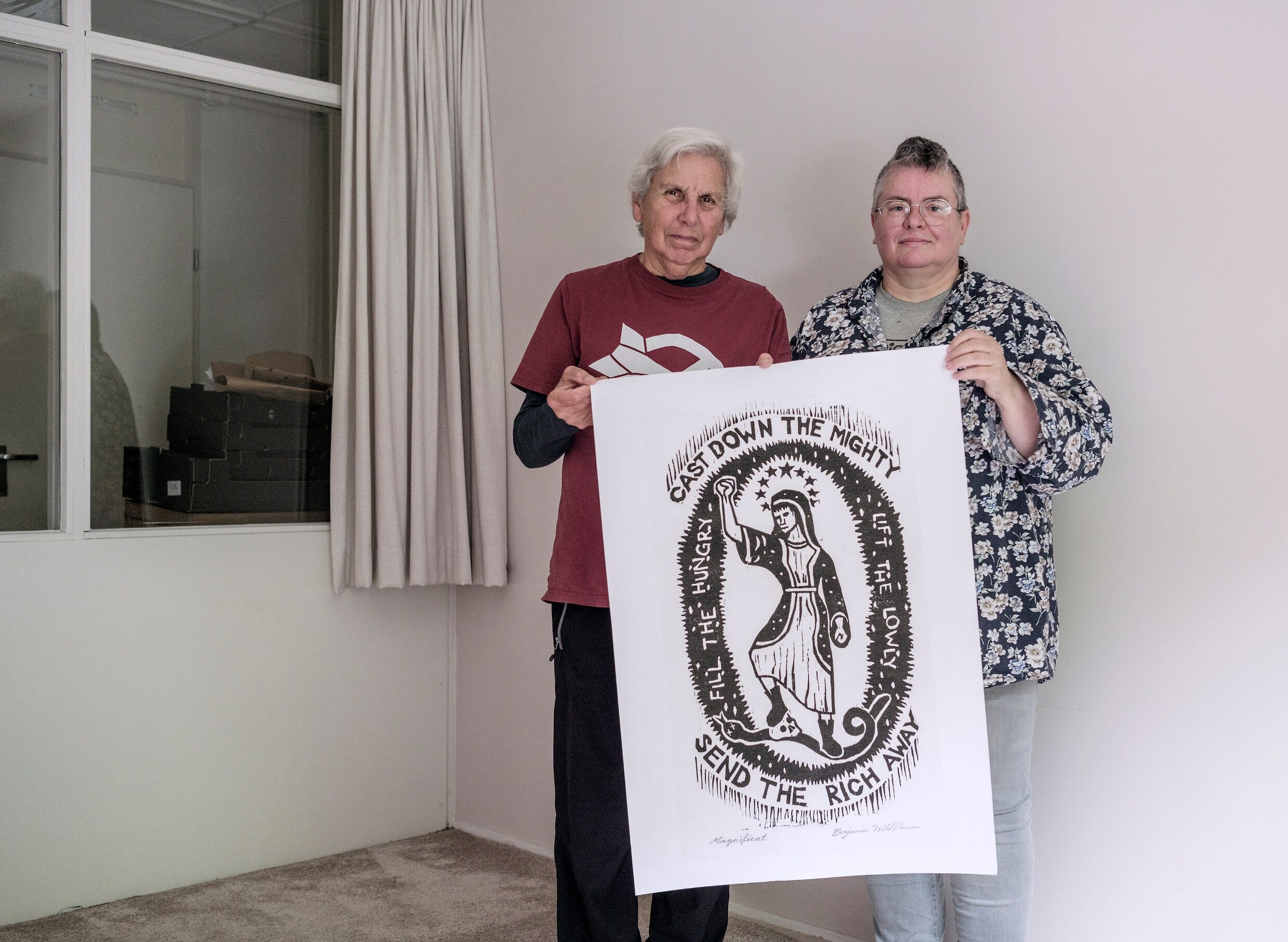
The August edition of The Catholic Agitator also features an interview with Susan Crane, a longtime peace activist and Catholic Worker from Redwood City, California, who has participated in four Plowshares actions (nonviolent civil disobedience aimed at “disarming” nuclear weapons or military hardware in the tradition of Isaiah). The interview covers her personal resistance journey, including how one of her periods of imprisonment led her into deeper spiritual waters:
I was held in solitary confinement for three to four days and I had no house to clean up, no kids to take care of, no books to read, nothing. And I thought, “Gee, I wonder what I should do?” Stuck in a room by myself, I thought, maybe I should pray.
Throughout my life, I had learned a whole lot about how to print, to do wiring, and even plumb a house, but my thinking on prayer was sort of stuck at a 5th grade level. So I did what I thought people did when they would pray: I thought about the people I cared about and I imagined sending them love. But when I got out, I was really curious and I started asking everyone, “What do you do when you are praying?”
I got really different answers from people. A lot of people did not really know what to say.
But when I talked to Fr. Steve Kelly, he said, “You know, us Jesuits, we have a series of exercises. Just like you learn how to do sit-ups and push-ups, we have spiritual exercises that can teach you what you do when you pray.”
And I found them a helpful tool on my spiritual journey. In fact, after that, I could not imagine how anyone could go for these exercises and be for war.
I find those experiences very good and they come back to me, they strengthen me. But it is more than that. It is the whole idea that we do these actions—you prepare for it, you do the action, you go to court, you do the prison sentence (or whatever consequence there is for it) —and it is kind of a prayer the whole time. And as I studied about the life of Jesus and the disciples, I saw the same: They were resisting all along the way. And it was all a prayer.
You can read the full interview in Friday’s edition of CWReads.
Brian Terrell offers a Catholic Worker response to the recent book by David F. Evans entitled, “Damned Whiteness: How White Christian Allies Failed the Black Freedom Movement” (University of North Carolina Press, 2025). While Evans’ book promises to offer “an unflinching history of white-led efforts at interracial organizing gone astray” including Dorothy Day and the Catholic Worker movement, Terrell disputes the portrayal of Dorothy Day, writing that Evans’ critique “is based on secondary sources and some preconceived assumptions” rather than contending with Day’s point of view as expressed in her own words.
In “Dorothy Day: We Are Urging Revolutionary Change” Terrell writes,
Evans takes note of the significance of Day’s choice of time and place to launch this newspaper on May 1, International Workers’ Day in Union Square, a hotbed of labor agitation, and believes that his conclusion is the obvious one. “If you were in my class,” Evans said in an April 23 address that he gave at Fordham University, “I’d ask you what’s significant about May 1, right?” Evans’ take on it: “By naming her paper The Catholic Worker and issuing it on May Day, she placed her movement in direct competition to the Communist Party. And as you see here from the very beginning, she made clear that the purpose of the paper is to combat communism and atheism.”
That the original purpose of The Catholic Worker was “to combat communism and atheism,” so clear to Evans today, was not evident to Day’s and Maurin’s contemporaries or to subsequent historians. A more common understanding has been that Day was not trying to convince or convert anyone to what she saw as the truths of the Catholic faith so much as to explain her perspectives. In that first issue, if she is to be believed, her purpose was to assure believers that they could pursue justice without abandoning faith, to assure Catholics, especially the Catholic immigrant laborers, that there was support for their struggles in church teachings. It was also to assure her former comrades on the Left of her continuing solidarity, to assure them that there were believers, some Catholics included, working beside them.
Read the full essay here.
Thanks for reading Roundtable! Like, restack, or share this post with a friend to help spread the word about the Catholic Worker
The June/July/August issue of The Catholic Worker has been hitting mailboxes this week along with the announcement that for the first time in decades, the paper will be changing its publishing frequency from seven issues per year to six: June/July/August, September/October, November/December, January/February, March/April, wrapping up with the May anniversary issue.
The move will save $28,000 in postage costs. “Never fear, we are holding open the possibility that some of those six issues will be twelve pages, so you won’t miss any of the articles we know you look forward to reading,” the editors write in a note to readers. “We welcome your thoughts on this change, so send us notes!” Notes, new subscriptions, and donations may be sent to 36 East First Street, New York, NY 10003.
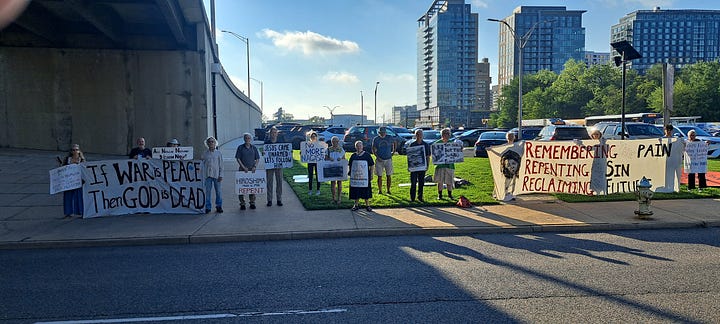
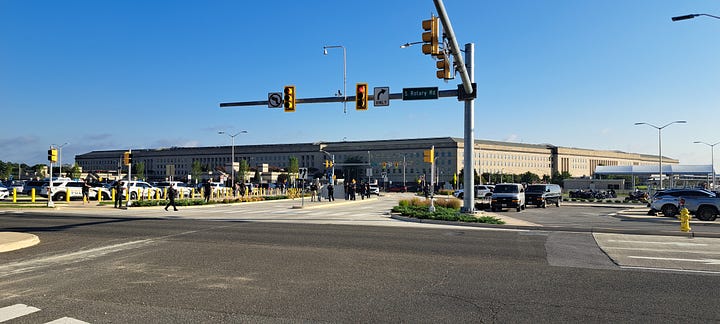
Art Laffin wrote in to highlight that at the August 6 Pentagon action in commemoration of the bombing of Hiroshima that two members of their witness were arrested during the action: Bill Frankel-Streit, co-founder of Little Flower Catholic Worker Farm in Trevilians, Virginia, and peace activist Delaney Wilder were arrested shortly after carrying a banner protesting nuclear weapons onto a Pentagon parking lot. Their court dates are October 15 and October 1, respectively.
Video from following August 8th White House Action:
Video by Pierre Kattar, a video journalist, filmmaker, and art director.
From the weekly update from the Hartford Catholic Worker, Christopher Doucot wrote about the joy of reconnecting with the first child they met back in 1993; PJ is now a “happy, healthy, successful, and delightful” 40 year old. But sadly, Ducot acknowledges that not every child they have met lives to see adulthood:
We were utterly unprepared for the reality that not all the kids we’ve loved over the years would live to 40. Last week Lil’ Richard was gunned down. Richard Williams was 20. He began coming to the Green House when he was 6 and continued to be a regular presence up until the cursed pandemic. Lil’ Richard had a cherubic chubby smile. He was joyful and mischievous. He also had an intellectual disability that left him open to manipulation. I don’t know if we would have been able to maintain a relationship if the pandemic hadn’t happened, but I’d like to believe we would have and he would be alive today because instead of being potentially manipulated into increasingly bad choices we would have nurtured him.
The whole of our society, including us, failed Richard. We have the financial resources in the U.S. to end poverty and provide the kind of support someone like Richard needs to flourish, but do we have the moral resources? I read somewhere that budgets are moral documents. They certainly are. If we want to know what matters to a person or a society we just need to assess how they budget their time and money. Did Richard matter? He did to us. Please pray for his friends and family, and please work to change how we spend our time and treasure in this land of plenty.
Sign up to receive Hartford Catholic Worker weekly updates here.
The June/July/August 2026 issue of The Catholic Worker leads with Efran Menny’s reflection on the a persistent racial divide within American Catholicism (”Catholicism & Black Identity,” reprinted from the Black Catholic Messenger). Inside, Jeff Dietrich (Los Angeles Catholic Worker) writes about being arrested while protesting ICE on Skid Row and pays tribute to a personal pantheon of nonviolent resisters, from Dorothy Day to Harriet Tubman (”All My Heroes of the Heart,” excerpted from his book “Rage Against the Dying”).
The issue also includes a tribute to Joseph “Little Joe” Terruso, a fixture of St. Joseph’s House whose decades-long routine of running the front door meant that he was often the first person visitors ran into, literally. “Joe didn’t romanticize [community life at St. Joseph],” Philip Basile writes. “He just lived it. He didn’t try to be the savior, he didn’t preach doctrine, he didn’t argue politics. But if you look at the heroic virtues—the kind of stuff the church looks at when evaluating a saint—Joe accidentally checks many of the boxes for a holy fool.”
Readers who want the full issue — including additional pieces on rural diaconal ministry, the legacy of César Chávez, and civil rights history in Mississippi — can subscribe by writing to The Catholic Worker, 36 East First Street, New York, NY 10003.
Little Platte Catholic Worker Farm shared summer newsletter updates with subscribers. They catered a fundraising dinner for Dubuque Rescue Mission with an assist from Maggie Miller, visiting from Mustard Seed Community Farm. They also sent two community members to DBQFest, to lead a puppet-making workshop. They have plenty of upcoming workshops this fall and fall—natural dye workshops, a work day, and an Advent wreath-making workshop. Read more here.
Ciaron O’Reilly announces the opening of a new Catholic Worker house in Brisebane, Austrailia on Sunday, October 4th with festivities beginning at noon local time. From Facebook:
A Celebratory Memorial Honoring Chris Maver - his life, work, art, humour & many acts of solidarity for the marginalised & those of us in jeopardy confronting the war making state!
Martha Hennessy will formally open a new Catholic Worker House of Hospitality & Nonviolent Anti-War Resistance -
Sharing a back fence with the 2nd largest Army Base in Australia! Gallipoli Barracks is now a permanent base for the Australian SAS+ who chopper over the house (in Blackhawks) to Amberley before taking off to kill anyone the Gringo Americans tell them to kill!
Learn more about this event on Facebook.
The Summer 2026 issue of At the Door, the newsletter of St. Francis Catholic Worker House in Chicago, reports that the community continues to make improvements and repairs on the house: new flooring and upgrades in the kitchen, the replacement of several windows, and repairing the basement shower, among other projects. The issue also features an essay by Quinn Smith meditating on why young adults are increasingly drawn to (or absent from) intentional communities like the Catholic Worker, weighing the “college path” centered on career and a desire for economic security against a more relational, communal life in which economic precarity is shared. And Dorothy Fromal writes on the centrality of shared meals to Catholic Worker hospitality:
“Meals at the Catholic Worker are usually simple and nourishing, sometimes creatively abundant, and most often sourced from rescued food. Could dinners be more organized? Yes. Could they be more efficient? Yes. Could they be better planned? Of course. However, there is magic that happens in the chaos: amazing conversations, mini-miracles, and life-changing opportunities for service.”
Elsewhere in the issue: a feature on Dostoevsky’s “The Brothers Karamazov” and its enduring influence on the Catholic Worker movement, reader letters remembering the late David Stein, and a save-the-date for the community’s Annual Benefit Brunch on Sunday, August 23.
Read the full issue online here.
Lydia’s House in Cincinnati, Ohio released their summer newsletter which includes House Notes, a reflection by co-founder Mary Ellen Mitchell entitled “The World Will Be Saved By Beauty,” and a sermon from co-founder Meredith Owensby, preached as the final project to complete her Masters in Divinity degree, entitled “The Call of Suffering With.” Owensby writes,
We are called to suffering. Suffering will transform. Going toward the suffering is the work God has given us to do, the work where Jesus told us we could encounter him.
So let us go forward, as Paul encourages in the end of this passage, to boast in God through our Lord Jesus Christ, through whom we have now received reconciliation. You and those you minister to will endure more than you thought possible. You will develop bumpy, scarred, transcendently beautiful characters. And you will know the sort of hope that does not disappoint, because it is shot through with the Holy Spirit. Amen.
Read the full newsletter here.
Molly Cruitt writes in US Catholic of drawing inspiration from Dorothy Day, as Cruitt seeks to apply a Catholic Worker style of hospitality to parish life:
Mutual hospitality at church is an opportunity to practice how we must live together in the world. Journeying together changes our social and spiritual lives in small but meaningful ways.
I don’t think I’m ever going to love meeting new people or be excited to engage in small talk. But with a little more confidence and motivation to be the welcoming presence that once was offered to me, I’m now approaching the after-Mass coffee hour a little braver and a little more ready to become that community for someone else.
Read the full article at US Catholic.
As the administration of St. John’s University in New York moves to derecognize faculty unions, Commonweal considers the importance of Dorothy Day’s intervention in the gravedigger’s strike of 1949. Arvin Alaigh writes,
For Day, moral and legal rights to organize are an extension of the innate human dignity imbued into every person. She was drawing on the rich tradition of Catholic social teaching (CST), which, since Pope Leo XIII’s 1891 encyclical “Rerum novarum”, had affirmed the relationship between dignity and workers’ ability to organize.
Read the full article at Commonweal
A recent episode of the Nonviolent Jesus podcast by John Dear featured Jack Cohen-Joppa, who with his wife, Felice, has put out The Nuclear Resister newspaper since 1980, chronicling well over 100,000 anti-nuclear actions. Cohen-Joppa says, “Our challenge is to continue to delegitimize and stigmatize the building of nuclear weapons. I am in touch with the people who believe that hope is a verb and take action. We believe that this is work worth doing.”
Listen to the full episode at BeatitudesCenter.org
In Letters From Leo, Christopher Hale highlights the connection between the Democratic Socialists of America founder Michael Harrington and the Catholic Church, including his time at the Catholic Worker writing that this “points to a history most of the DSA’s admirers and nearly all of its enemies have forgotten — it was birthed in the heart of the Catholic Church.”
Read more at Letters from Leo, though a subscription may be required for full access.
Martha Hennessy, granddaughter of Dorothy Day, spoke with The Good Newsroom (Archdiocese of New York) about the ongoing war in Iran, calling on parish priests to more vocally echo Pope Leo’s calls for peace. “Where’s this voice coming from the pulpit?” Hennessy asked. She pointed to New York Catholic Workers’ weekly vigils outside St. Patrick’s Cathedral and in Union Square, and cited Dorothy Day’s line that “war is a theft from the poor.”
Read the full article at The Good Newsroom.
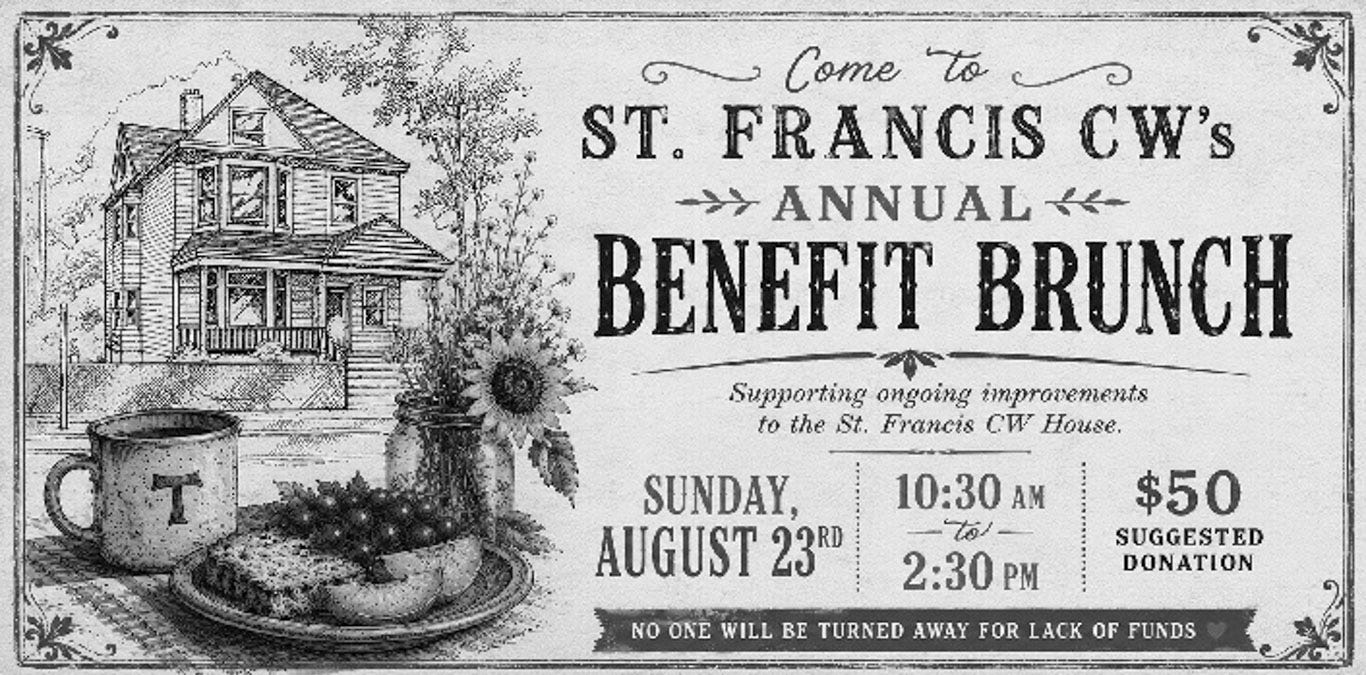
Chicago, Illinois—St. Francis Catholic Worker will hold its annual benefit brunch on Sunday, August 23rd from 10:30 a.m. to 2:30 p.m. Funds will be used to continue renovations on the house, which is located at 4652 N Kenmore Ave.
Des Moines, Iowa—The Des Moines Catholic Worker celebrates its 50th anniversary with an all-day cookout on Friday, August 28, from 3–6 p.m., featuring hamburgers, hot dogs, and all the trimmings.
For more info, contact Frank Cordaro at frank.cordaro@gmail.com or 515-490-2490, or Ray Blase at 515-778-6428.
Detroit, Michigan—The Detroit Catholic Worker marks 50 years of its Manna Community Meal soup kitchen on Saturday, August 29, 1–4 p.m. at St. Peter's Episcopal Church, honoring co-founders Fr. Tom Lumpkin and Marianne Arbogast. Program begins at 1:30 p.m., with reception to follow. Details from Lauren Calka at laurencalka@gmail.com.
New York, New York—The New York Catholic Worker has announced its Friday evening meeting lineup for September and October. All meetings are at Maryhouse, 55 East Third St. and begin at 7:30 p.m.
September 11 — Colleen Kelly: “9/11: Twenty-Five Years and Still Searching”
September 18 — Mary Kay Henry: “Lessons from a Lifetime of Organizing with SEIU”
September 25 — James Robinson: “Beyond Factory Farming” Book Talk
October 2 — Stephen Adubato: Monsignor Baroni, Ethnopolitics, and Direct Action in Newark, New Jersey
October 9 — Felton Davis: Rending of a Surprising 1998 Local Trial in NYC Municipal Court
October 16 — Rev. Liz Edman: “Dorothy Day & Elizabeth Burrow — A Story of Friendship & Courage”
October 23 — “An Evening of Remembering Patrick Jordan”
October 30 — Vern Walker: AI Through the Lens of Pope Leo XIV’s Magnifica Humanitas
Milwaukee, Wisconsin—The St. Bakhita House Catholic Worker in Milwaukee is dedicating its St. Bakhita Peace & Healing Garden at 4 p.m. on Saturday, August 29.
“We envision a world where incarceration is no longer a person's final sentence, but the beginning of a hope-filled future rooted in abundant life and generous service. That is why our mission is to transform lives both behind and beyond the prison walls,” writes executive director Anne Haines. Write to Anne for more information at anne@bakhitahouse.org.
San Antonio, Texas— From noon on September 6 to noon on September 13th, 2026, the San Antonio Catholic Worker will participate in the second annual Global Week of Prayer. The schedule is below:
Sunday September 6th:
10 AM Mass/Ecumenical Service
11 AM Brunch
12 noon - first hour of private prayer begins in small private Prayer Room.Ongoing one-hour increments of prayer will occur throughout the day and night, all week long… at least one person is needed for each hour.
Sunday, September 13th:
11 AM Ecumenical Prayer Service to engage the entire community in prayer for the last hour and to celebrate the week with lunch afterwards.
More information available here.
Sugar Creek, Iowa—The Midwest Catholic Worker Gathering at Sugar Creek, Iowa, will take place the weekend of September 10-13, 2026. Mark your calendar and stay tuned for more information! You do not have to be living in an existing Catholic Worker community to attend.

Platteville, Wisconsin—Little Platte Catholic Worker Farm will host its annual fundraising concert entitled, “Big Show at Little Platte” on Saturday, October 3, 2026. From the organizers:
The show will be held in our “studio barn” with a large garage door open to the outdoors, featuring both indoor and outdoor seating options. If needed, there will be a wood-burning stove inside, and a large bonfire outdoors. Please dress appropriately! Please bring lawn chairs or other seating if you are able.
Find more information or purchase tickets at the Eventbrite page.
by Dorothy Day from the February 1940 issue of The Catholic Worker
For the sake of new readers, for the sake of men on our breadlines, for the sake of the employed and unemployed, the organized and unorganized workers, and also for the sake of ourselves, we must reiterate again and again what are our aims and purposes.
Together with the Works of Mercy, feeding, clothing and sheltering our brothers, we must indoctrinate. We must “give reason for the faith that is in us.” Otherwise we are scattered members of the Body of Christ, we are not “all members one of another.” Otherwise our religion is an opiate, for ourselves alone, for our comfort or for our individual safety or indifferent custom.
We cannot live alone. We cannot go to Heaven alone. Otherwise, as Peguy said, God will say to us, “Where are the others?” (This is in one sense only as, of course, we believe that we must be what we would have the other fellow be. We must look to ourselves, our own lives first.)
If we do not keep indoctrinating, we lose the vision. And if we lose the vision, we become merely philanthropists, doling out palliatives.
The vision is this. We are working for “a new heaven and a new earth, wherein justice dwelleth.” We are trying to say with action, “Thy will be done on earth as it is in heaven.” We are working for a Christian social order.
Read the full aims and purposes here.
Thanks for reading Roundtable! Like, restack or share this post with a friend to spread the word about the Catholic Worker movement
Comments
Nothing yet. Say the first thing.
Sign in to join the conversation.