
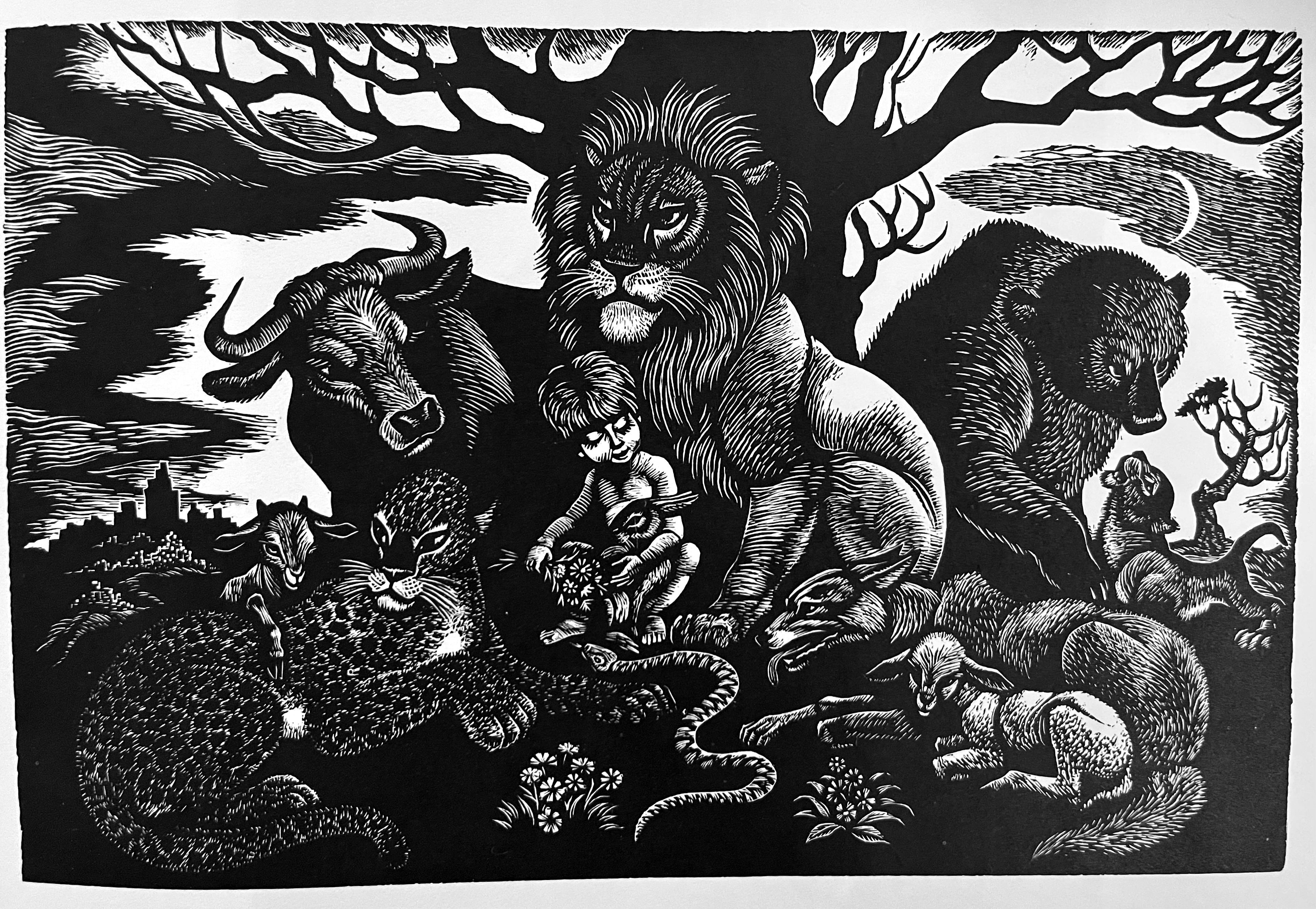
In two previous essays we’ve been seeing that Jesus offered the world a contrast society—the Church—which was meant to be a real alternative to the violence that forms the basis of the world’s attempts to secure order in the name of peace. As such the Church was not just a spiritual or religious fellowship, but a real community—a movement, a kingdom—whose nonviolent way of life together summoned all who would join to a new way of being human. Last time we saw that Jesus’ death for sedition on a Roman cross was the supreme example of this new way, pointing beyond the violence the world always thinks necessary, to God’s primordial peace that always beckons us.
But we can go deeper still. For it’s not just that Jesus’ death was an integral part of the kingdom way of life. Three days later, the tomb is empty. Death and resurrection are the defining logic of the kingdom. And thus it is that the whole paschal drama – cross and empty tomb – becomes the shorthand for the Sermon on the Mount life.
We saw that on the cross Jesus is just being his own best student, and so the Sermon on the Mount is just the extension of the self-offering of the cross into the details of our lives. But with cross always comes resurrection. So the ethic of the kingdom is also the extension of resurrection into the details of our lives. And this is the way that the kingdom goes forward into the world: bit by bit, as we weave the cross into the fabric of daily life, so we bring resurrection into that same fabric, though we may not see it, or always be aware exactly where new life is popping up.
Put differently, as it happened with Jesus, so it happens with us. Jesus’ bodily resurrection is the supreme foretaste of the kingdom. It’s God’s future age breaking into our history, precisely as God’s faithful response to Jesus living the life of that future age already in the present, even unto death. The same thing happens when we bring the cross into our lives by living the Sermon on the Mount. We put the life of the future into practice now – often suffering for it – and God responds by sowing resurrection life into those same details.
This is the basic logic of the Church’s way in the world. And if it sounds strange—it might be strange!—it’s good to remember that it’s no stranger than Christ’s resurrection itself, which was itself a “strange” resurrection “a little at a time.” In the Old Testament, Israel had hoped for a resurrection, some day, of all the righteous. But, on Easter, a little bit of that corporate resurrection broke into the present in the resurrection of this one man. Likewise, strange as it may be, little bits of resurrection break into our world as we put Good Friday to practice by living the Sermon on the Mount.
St. Paul, for instance, witnesses to exactly this pattern. He says that we are “always carrying in the body the death of Jesus, so that the life of Jesus may also be manifested in our bodies” (2 Cor 4:10). He means not just that someday there is going to be a resurrection, but that resurrection is happening right now, in this life, as he clarifies in the very next verse: “while we live we are always being given up to death for Jesus’ sake, so that the life of Jesus may be manifested in our mortal flesh (2 Cor 4:11).
How do we understand this witness of Jesus and his apostles? It’s here that we can take our final step into the depth of the mystery of the peaceable kingdom. For, I would suggest, all this is animated by our Trinitarian confession. God has made his world peaceful, and created a people to live the peace of the Sermon on the Mount, because of the peace that he is. And this peace eternally takes the pattern of cross and resurrection. For the very being of the Eternal Trinity just is the Son’s eternal “emptying” of himself in loving obedience to the Father, and the Father’s eternal response of simultaneously “re-filling,” as it were, that emptying beyond capacity with his inexhaustible divine life, which is nothing other than himself (see Phil 2:6-11). And thus we confess that Jesus is “consubstantial” with the Father.
The history of Good Friday and Easter are just this eternal gift-exchange of the Father and the Son played out among us. Put differently, “This is my body which is given up for you,” is but one expression of Jesus’ eternal nature—another instance of his eternal gift of himself to the Father—and the resurrection is likewise just the continued simultaneous refilling of that ongoing eternal gift by the Father.
So, to return to the reasons for Jesus’ crucifixion, perhaps we can now see why such a society would be deeply threatening. For by its way of life it calls into question the violence the world thinks is necessary, and therefore even sacred, to its own way of life. Jesus is showing up even the “respectable living” of the status quo keepers as being complicit in the violence they purportedly keep at bay.
And this is how a nonviolent revolutionary ends up on a cross. To most people, consistent nonviolence threatens to unleash upon us the forces of chaos. Far from being innocuous, then, Jesus’ way of life makes him positively dangerous. To most people’s way of thinking, if everyone acted like that, civilization would collapse. And so, to the extent that others might actually follow him, Jesus can only be a public enemy.
So on the one hand Jesus’ movement shows up the status quo keepers as no less violent than the armed zealots. But it also undercut the zealots’ own hope by showing that any new order on their terms would not be fundamentally new after all. It would just be another configuration of rule by force. And all this, of course, was at bottom an indictment: the practical revelation, by way of an actually existing society – the Church – that the world’s “peace” was a sham all the way down. In this, once again, we are simply repeating the view of St. Augustine.
Finally, because Christian nonviolence taps into the grain of the universe and strives to live in accord with God’s peace that is always already awaiting us, its tactics, some of which we saw above from the Sermon on the Mount, far from being hopelessly idealistic, are in fact the only ones that are realistic. Because Christian nonviolence is the human participation in God’s harmonious order, we refuse the way of violence not because its weapons are too strong, but because they are too weak. They are out of keeping with the way the world really is, and so they will never accomplish what they always seem to promise.
The really powerful weapons are precisely those Jesus specifies: turning the other cheek, loving enemies, prayer, suffering love, holy poverty, hospitality to the poor, martyrdom, alms, forgiveness, the works of mercy, community life, and the Mass itself. Pursuing peace with these weapons does not mean that we will not be killed for our faith. Nonviolence is not a coward’s way of avoiding reality. Rather, like our Lord, it makes us more likely to draw the world’s fury. And this just underlines that at bottom we never build the kingdom by our own efforts, but only by the resurrection of the dead.
I said in the first essay that all I wanted to do was present some of the rationale for the peace witness of someone like Dorothy Day. As such, none of the above should be taken to foreclose further discussion of if, and when, by whom, and what kind of, violence may ever “justly” be used in our world. I have merely intended to lay out, very briefly, some of the most basic history and theology that all Christians share. This is only the beginning of the conversation.
Yet I have obviously been intent to show just how heavily slanted towards peace our tradition is at this foundational level (there are other places where it is less obviously so). So it seems good to end with a brief nod to the early Church’s reception of this apostolic witness. In particular, it is instructive that the Fathers of the first two centuries tended to interpret Old Testament passages that refer to the final peace of the messianic age as being about them – the Church – now – already in this age. In other words, that the early Church was a counter-culture of peace was one way these early Christians knew that the long-promised kingdom of God had in fact arrived.
Isaiah (2:2-4), for instance, had said:
It shall come to pass in the latter days
that the mountain of the house of the Lord
shall be established as the highest of the mountains,
and shall be raised above the hills...
and they shall beat their swords into plowshares,
and their spears into pruning hooks;
nation shall not lift up sword against nation,
neither shall they learn war any more.
The early Fathers read this, not as a prediction about what would happen someday, but in God’s new society called Church.
Saint Irenaeus (d. 202 A.D.), for instance, writes that, contrary to their previous war making before they were Christians, converts to the Church from every nation now
formed their swords and spears into ploughshares, and changed them into pruning-hooks for reaping the grain, that is, into instruments used for peaceful purposes, so that they are now unaccustomed to fighting, but when smitten, turn the other cheek (Mt 5:39).
Likewise Origen of Alexandria (d. 254), the great theologian, writes, commenting on the same passage, that in the Church we have learned “to convert into pruning-hooks the spears formerly employed in war. For we no longer take up sword against nation, nor do we learn war any more, having become children of peace for the sake of Jesus.”
The Church Father Tertullian (d. 220) too, first quotes the Isaiah passage and then asks:
Who else are understood by this but we, who, fully taught by the new law, observe these practices?...For the way of the old law was to seek vengeance by the sword, and to pluck out eye for eye (Mt 5:38), and to inflict retaliatory revenge for injury. But the new law teaches us to have mercy, and to convert to peace the violence of swords and spears, and to remodel the execution of war upon the rivals and foes of the law into the peaceable action of ploughing and tilling the land.
And, perhaps most striking of all, St. Justin Martyr (d.165) responds to a Jew’s contention that Jesus could not have been the Messiah because the peace which Scripture promises, precisely in passages like Isaiah 2, has not come to the world. Justin insists that peace has come, that there is a new society, and that the Church is it: “we who were filled with war, and mutual slaughter, and every wickedness, have each through the whole earth changed our warlike weapons — our swords into ploughshares, and our spears into implements of tillage.” The Church’s nonviolence, for St. Justin, is proof that the messianic kingdom is here.
On the one hand, these texts are impressive simply because they witness how seriously the early Church took the Sermon on the Mount. Christians were forbidden, they say, from participating in war.
But that is not all. Even while making the point about war, all of these Church fathers have their eye on the wider reality from which their refusal of war arises. With the coming of Christ a new people has been created, who fulfill Isaiah’s prophecy by beating their swords into ploughs. But this can only mean that not only a new society, but a new time has appeared, precisely in this new society. Because they are the fulfillment of Isaiah’s vision, the Church is the community of the future breaking into the present. The peaceable kingdom is here.

Colin Miller is a member of the Maurin House Catholic Worker (Columbia Heights, Minnesota) and the Director of the Center for Catholic Social Thought at the Church of the Assumption in St. Paul, where he is also the Director of Pastoral Care & Outreach. Miller has written a book, We Are Only Saved Together: Living the Revolutionary Vision of Dorothy Day and the Catholic Worker Movement, published by Ave Maria Press.
Read Part I of this essay here. Read Part II of this essay here.
Comments
Nothing yet. Say the first thing.
Sign in to join the conversation.